How Should Christians Handle Objections?

It’s no secret that when a Christian says, “This is what I believe,” or “This is what the Bible says,” or even something as simple as, “I believe in God,” that there will be people who disagree. Sometimes their disagreement may even become an outright attack.

How are Christians to respond?

Here are five ways I’ve found to be effective and Christ-honoring—

1. Don’t argue. Arguments tend to create an “I don’t want to lose” feeling in the other person, which makes them unable to truly hear what you’re saying. Solomon wrote, “Do not answer a fool according to his folly, or you will be like him yourself” (Proverbs 26:4).

2. Ask questions. Jesus was a master at this. Look through the Gospels and you will see Jesus asking questions to clarify others’ positions. Questions stimulate further conversation, while statements tend to shut down the conversation. Questions develop a relationship, while definitive statements make you seem superior to the other person.

3. Don’t argue. Yes, this is good enough to repeat! Paul’s advice to Timothy was, “Do not waste time arguing over godless ideas and old wives’ tales” (1 Timothy 4:7).

4. Pray for mercy. Remember that if you are really speaking truths from the Bible, the person arguing against those truths is arguing with God, not with you.

5. Pray for light. Paul said that the “god of this age” has blinded people (see 2 Corinthians 4:2-4), so we should pray that the Holy Spirit would grant them light to see the truth.

“Oh, the unmitigated curse of controversy! Oh, the detestable passions that corrections and contradictions kindle up to fury in the proud heart of man! Eschew controversy, my brethren, as you would eschew the entrance to hell itself. Let them have it their way; let them talk; let them write; let them correct to you; let them traduce you; let them judge and condemn you; let them slay you. Rather let the truth of God suffer itself, than that love suffer. You have not enough of the divine nature in you to be a controversialist.” —Dr. Alexander Whyte

Let’s be passionate for people, not passionate to win an argument!

I go into more detail in this video…

Saturday In The Psalms—Creation Recognizes Its Creator

The sea saw it and fled; Jordan turned back, the mountains skipped like rams … rocks turned into a pool of water… (Psalm 114:3, 4, 8).

What would cause a sea to shrink?

Or a river to stop flowing? Or mountains and hills to quake in fear?

What could turn flint rocks into puddles?

God’s presence!

Creation recognizes its Creator!

Do we?

Waters and mountains and rocks cannot think or feel or appreciate majesty and beauty—but they can and do recognize their majestic Creator and bow in His presence.

How much more so we who can think and feel and appreciatehow much more so should we bow before our Majesty, the Creator of all!

Jesus may have had this Psalm 114 in mind when He said that rocks would cry out in praise if we humans did not [Luke 19:37-40]. I, for one, am not going to let rocks or waters praise on my behalf!

Thursdays With Oswald—Passion For Souls

Oswald ChambersThis is a weekly series with things I’m reading and pondering from Oswald Chambers. You can read the original seed thought here, or type “Thursdays With Oswald” in the search box to read more entries.

Passion For Souls

     You hear people say that Paul showed his wonderful breath of mind, his culture and generosity, his gentleness and patience, by becoming all things to all men [1 Corinthians 9:22]. He did nothing of the sort; he said, “I am become all things to all men” for one purpose only—“that I may by all means save some.” He did not say, “I became all things to all men that I might show what a wonderful being I am.” There is no thought of himself in the whole matter.

     The phrase “a passion for souls” is a dangerous one; a passion for souls may be either a diseased lust or a Divine life. Let me give you a specimen of it as a diseased lust—“Woe to you, teachers of the law and Pharisees, you hypocrites! You travel over land and sea to win a single convert, and when he becomes one, you make him twice as much a son of hell as you are” (Matthew 23:15). … 

     But have we got clearly in our minds what the passion for souls as a Divine life is? Read James 5:19-20: “My brothers, if one of you should wander from the truth and someone should bring him back, remember this: Whoever turns a sinner from the error of his way will save him from death and cover over a multitude of sins.” … 

     God grant we may understand that the passion for souls is not a placid, scientifically worked-out thing, it compresses all the energy of heart and brain and body in one consuming drive, day and night from the beginning of life to the end—a consuming, fiery, living passion. … 

     God grant we may understand that the mainspring of our passion for souls must be a personal, passionate devotion to the Lord Jesus Christ. 

From Workmen Of God

The root of our passion really does make a difference in our Christian activity. Is my passion to make converts so that people can say, “Look what a good guy he is”? Or is my passion to save a soul from death so that people can say, “Look what a great God He is”?

Fellow Christian, I pray our passion is always the latter.

Leave Every Place Better

Peter spent 3+ years with Jesus, and when he was asked to sum up Christ’s ministry he simply said, “He went around doing good and healing all who were under the power of the devil” (Acts 10:38).

What if His followers lived that way?

What if we made it our goal to leave every place better than we found it?

What if it was said of Christians, “I can tell they’ve been here because they did good while they were here”?

Check out this 3-minute clip…

My challenge to you:

Leave every place better than you found it

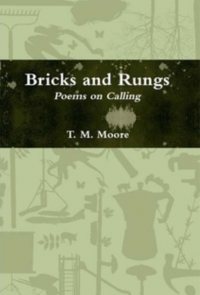
Bricks And Rungs (book review)

T.M. Moore is a first-rate theologian, so everything he writes is well-grounded in Scripture. However, when most people think of “theology,” they think of a lifeless treatise that is boring to read, or perhaps difficult to grasp. But T.M. totally shakes things up in Bricks And Rungs with rock-solid theology presented in beautiful poetic verse.

Bricks And Rungs is all about finding our purpose or calling in life. T.M. says—

“Most people have a sense of being here for some reason. They must become something, achieve something, or come to know something which they consider to be unique to them. Something is out there for them, beckoning them, drawing and wooing them beyond themselves to realize more of something, however that is envisioned or whatever it may be.

“Calling is experienced as a summons from without, a beckoning which resonates with something within, something deeply personal, leading us to aspire to more than what we know or are or have at present. …

“Everyone has a sense of calling. Christians know this to be a summons from God, a command which their lives are intended to fulfill by knowing God and serving Him. The Christian knows that each human being is called to know God and, knowing Him, to serve Him gladly and fruitfully. Calling thus involves our need to be blessed and to be a blessing to others.”

Some of these poems are autobiographical to T.M. Moore, some are reflections on Scripture, and some are musings about how each of us discovers our own calling. But all of these poems will open a window in your soul to hear God’s voice speaking to you about your own unique calling.

Take some time to linger over these insightful words.

What’s The Best That Could Happen?

I’ve had a good friend recommend a musical artist to me and I haven’t enjoyed the music.

I’ve had a good friend take me to a restaurant I haven’t liked.

I’ve had a good friend tell me how wonderful a certain movie was, and I thought it was a dud.

And I’m sure some of my good friends could say the same thing about my recommendations.

But you know what? All of these folks are still my friends.

I’ve never had one person say to me, “Your restaurant suggestion was awful. I’m unfriending you on Facebook and blocking your number from my phone. I never want to see or hear from you again!”

Yet sometimes I think church-going Christians feel like this might happen if they invite a friend to come to their church.

Seriously?!

Let’s consider the odds—

  • How likely is it that if you invite a friend to church and they say “no” that they are also going to say, “Get out of my life forever”?
  • If they do accept your invitation, but find that your church wasn’t a good fit for them, how likely is it that they’re going to say, “We can never hang out again”?

I think you would agree with me that both of these responses are highly unlikely!

But consider the other side—what if you invite them to your church and they say “yes”? What if after attending your church they like it? And what if by attending your church they enter into a personal relationship with Jesus?

If that happens, you’ve changed the course of their eternal destiny! 

Instead of focusing on the worst-case scenarios (which seem highly unlikely), we should be focusing on the best-case scenario!

If you’re still uneasy about inviting someone to your church, or even trying to have a conversation with them about your personal faith, here is a simple phrase to consider: Come and see.

Invite them to come and see your lifestyle that seeks to glorify Jesus (see Matthew 5:16). Let them see that you live your life like Jesus: doing good (Acts 10:38).

Invite them to come and see the Creator behind the creation (see Psalm 66:5). Whenever there is a discussion about the weather, or nature, or a medical science breakthrough, ask them, “Have you ever thought that if there is such a beautiful design there must also be an intelligent Designer?”

Christian, you have the best news ever! Don’t keep it to yourself. Invite those around you to come and see what a personal relationship with Jesus Christ is all about. Who knows? You may be a part of changing someone’s eternal destiny.

Saturday In The Psalms—Blessings For The Obedient

Praise the Lord! Blessed is the man who fears the Lord, who delights greatly in His commandments (Psalm 112:1).

For the one who loves God and wants to obey Him, check out these blessings—

  • blessed, powerful descendants
  • blessing the current generation
  • taking care of his household
  • keeping his righteousness intact
  • giving him light in dark times
  • multiplying his graciousness, compassion, and righteousness
  • blessing him to be a blessing to others
  • giving him discretion
  • a solid, unshakable foundation
  • a legacy to pass on to his children
  • no fear of evil
  • steadfastness
  • more than enough to share with others in need
  • exalted on earth and in heaven

Bring it on!

Thursdays With Oswald—Dealing With Spiritually Stupid People

Oswald ChambersThis is a weekly series with things I’m reading and pondering from Oswald Chambers. You can read the original seed thought here, or type “Thursdays With Oswald” in the search box to read more entries.

Dealing With Spiritually Stupid People

     I would like you to notice what the word “stupid” means. It does not mean ignorant, but anything formed or done without reason or judgment. Ignorance is being without knowledge “and the times of this ignorance God winked at [‘overlooked’]” (Acts 17:30). Do distinguish between ignorance and stupidity! … 

     [Passages to consider—1 Samuel 26:21 [I have acted like a fool]; Titus 3:3 [at one time we too were foolish, disobedient, deceived and enslaved]; 2 Timothy 3:6-7 [silly and weak-natured and spiritually dwarfed women, loaded down with the burden of their sins and easily swayed and led away by various evil desires and seductive impulses]; and Hebrews 5:12 [you actually need someone to teach you over again the very first principles of God’s Word]]

     What are we to do when we come across stupid souls? Ignorant souls we can deal with, they need knowledge; the stupid soul does not need knowledge; the stupid soul needs to have the Word of God until it is worried by it. … 

     Never water down the Word of God to the understanding of your people. … “The words that I speak unto you, they are spirit, and they are life.” The Word of God is “a lamp” and “a light,” but when people get off on the “stupid” lines, it is all instincts, impressions, vague ideas—“ever learning, and never able to come to the knowledge of the truth.”

From Workmen Of God

I know the word “stupid” seems like an inflammatory word, but don’t get distracted from Chambers’ pertinent point on account of this word. The Bible makes it clear that we will come across people who are stupid in regard to the things of God. Our course of action is not argument or persuasion, but—as Chambers says—“the Word of God, the Word of God, the Word of God, first second and last; no sympathy, no help, only the Word of God.”

Come And See

Survey after survey, and personal interview after personal interview all report the same indisputable truth—the #1 reason unchurched people don’t come to church is no one has invited them!

Wow! Christians have the life-changing truth of what a personal relationship with Jesus Christ can do, and they are for the most part keeping it to themselves.

The Easter season is upon us, so we have a golden opportunity to reverse this stat. There is something about Easter and Christmas where even those that don’t normally attend a church service feel like this season might be a good time to do so.

I want to present a very simple way to invite people to hear about our Risen Savior, and it’s just three simple words:

Come and See

No pressure. No promises. No gimmicks. Just this: “Come and see for yourself what a relationship with Jesus is all about.”

Over the next two Sundays we’ll be looking at some obstacles we church people may have to overcome, and some excuses many unchurched people use. But all of this will help us to simply and clearly say to our friends, “Come and see!”

Please join me in person or watch on Facebook Live.

Appropriately Proactive

Saul realized that his troops were rapidly slipping away… (1 Samuel 13:8).

The men of Israel saw what a tight spot they were in; and because they were hard pressed by the enemy, they tried to hide in caves, thickets, rocks, holes, and cisterns. Some of them crossed the Jordan River and escaped into the land of Gad and Gilead. 

Meanwhile, Saul stayed at Gilgal, and his men were trembling with fear. Saul waited there seven days for Samuel, as Samuel had instructed him earlier, but Samuel still didn’t come. Saul realized that his troops were rapidly slipping away. So he demanded, “Bring me the burnt offering and the peace offerings!” And Saul sacrificed the burnt offering himself.

Saul stayed … Saul waited … and as a result, Saul sinned.

Saul ended up being inappropriately reactive, and thus committing a sin. His reaction to his men slipping away, hiding, and defecting was to act in a way that was inappropriate for anyone but the priest.

It’s been said that action has killed its thousands, and reaction has killed its tens of thousands. But if only Saul would have proactively sought God, or proactively formed a battle strategy, or proactively spoke an encouraging word to his men, or proactively moved out with his troops—anything(!) but just sit still—perhaps his legacy as king wouldn’t have been so short lived.

When leaders aren’t appropriately proactive, they risk becoming inappropriately reactive.

A mark of a godly leader is one who is appropriately proactive.

This is part 20 in my series on godly leadership. You can check out all of my posts on this topic by clicking here.