This is a weekly series with things I’m reading and pondering from Charles Spurgeon. You can read the original seed thought here, or type “Thursdays With Spurgeon” in the search box to read more entries.
Light In A Dark Cave
Now I must have an illustration. I must compare truth to some cave or grotto that you have heard of, with wondrous stalactites hanging from the roof and others starting from the floor—a cavern, glittering with spar and abounding in marvels. Before entering the cave you inquire for a guide, who comes with his lighted flambeau. He conducts you down a considerable depth and you find yourself in the midst of the cave. He leads you through different chambers. Here he points to a little stream rushing from amid the rocks and indicates its rise and progress. There he points to some peculiar rock and tells you its name. Then he takes you into a large natural hall, tells you how many persons once feasted in it, and so on. Truth is a grand series of caverns. It is our glory to have so great and wise a Conductor. Imagine that we are coming to the darkness of it. He is a light shining in the midst of us to guide us. And by the light He shows us wondrous things. In three ways the Holy Spirit teaches us—by suggestion, direction, and illumination.
First, He guides us into all truth by suggestion. There are thoughts that dwell in our minds that were not born there but that were exotics brought from heaven and put there by the Spirit. It is not a fancy that angels whisper into our ears and that devils do the same. Both good and evil spirits hold converse with men. …
Sometimes He leads us by direction. … The Spirit gives a direction and tendency to our thoughts. Not suggesting a new one but leading a particular thought, when it starts, to take such and such a direction. …
Perhaps the best way in which the Holy Spirit leads us into all truth is by illumination. … Beloved, you may read to all eternity and never learn anything by it, unless the Holy Spirit illuminates it. And then the words shine forth like stars. … Blind men may read the Bible with their fingers, but blind souls cannot. We want a light to read the Bible by; there is no reading it in the dark. Thus the Holy Spirit leads us into all truth by suggesting ideas, by directing our thoughts, and by illuminating the Scriptures when we read them.
From The Holy Spirit: The Great Teacher
A good prayer every time you open your Bible is this: “Open my eyes to see wonderful things in Your Word” (Psalm 119:18).
Sometimes the naming of things gives us an inaccurate picture of the thing being named. For instance, many people think the “old” in Old Testament means outdated or perhaps updated by the “new” in the New Testament. When in fact, both Testaments are needed to give us the full picture of God’s love and glory.
A similar thing happens with the headings “major prophets” and “minor prophets.” It makes it sound like the major prophets have something major to say to us, while we could take or leave the minor messages of the minor prophets.
In reality, they were given these headings simply because of the volume of writing—the five major prophets consist of 182 chapters, whereas the 12 minor prophets only have 67 chapters. The volume of their writing may be minor, but their content carries major messages of meteoric power!
Two of Israel’s king Jehoahaz and his son Jehoash perpetually hung on to an attitude that limited what God wanted to do for Israel. That attitude can be summed up in a single word: but.
Jehoahaz “sought the Lord’s favor” during a time Israel was under the oppression of their enemies, and “the Lord listen to him”! God raised up a deliverer who brought them freedom. Israel, under Jehoahaz’s leadership, could have used this newly won freedom to live closer to God and remain in a place of renewed worship. “But” they used their freedom as a license to sin and God reduced Jehoahaz’s army to a mere skeleton of what it had been (2 Kings 13:4-7).
Jehoash went to visit Elisha. It doesn’t appear he went with a prayer request but merely to pay his respects to this dying prophet. God in His graciousness gave Jehoash something he didn’t even ask for: a promise of victory over Aram! Jehoash was invited to boldly ask for God’s help “but” he thought God had a limited supply and he asked for just a small portion. As a result, his victory over Aram was small—much smaller than God wanted for Israel (13:14-19).
Once again, enemies surround Israel and we read a statement pregnant with possibility: “But the Lord was gracious to them and had compassion and showed concern for them because of His covenant” (13:22-23). Despite their sin, God still wanted to bless them!
Jesus fulfilled God’s covenant. If God did not spare His own Son, how can I ever continue to remain skeptical that He wants to bless me?! He is glorified when I am abundantly blessed in Him. What do I do with God’s gracious concern? Will I squander it and live hemmed in by oppressors? Or will I embrace everything God has for me in Jesus and live in a way that He delights to bless?
My attitude will determine the blessing I receive.
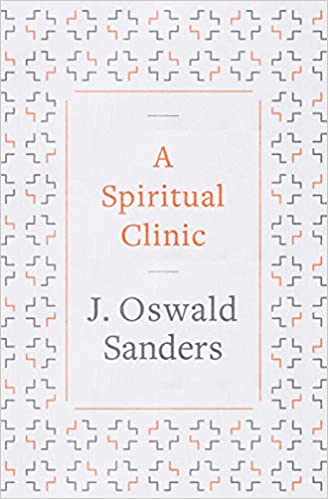
Some of the most formative leadership books I read early in my leadership journey were written by J. Oswald Sanders. Books like Spiritual Maturity and Spiritual Leadership. It’s my desire to be a lifelong learner, and in that pursuit, I need an external, objective source to help keep me on track. Sanders’ book A Spiritual Clinic is just the check-up I needed!
In the physical world, we may get a check-up from our primary care physician, a counseling session with a mental health professional, or perhaps a regular check-up with a spiritual advisor like a pastor or mentor. All of these are healthy if they are all grounded in the principles in God’s Word.
Sanders brings us to his spiritual clinic for a well-rounded check-up of our spiritual leadership. He says, “[This book’s] thesis is that the complex strains and problems which the Christian worker encounters in the contemporary world find their answer, not in tranquilizers or stimulants, but in a correct understanding and application of scriptural principles, and effectiveness in Christian work is the natural outcome of conformity to spiritual laws enunciated in the Scriptures.”
So “doctor” Sanders holds up the mirror of God’s Word to our activities to see how we are performing in light of God’s standards. He addresses topics like stress, learning, suffering, depression, spiritual ups-and-downs, and our conscience. He zeros-in on leadership topics like ambition, authority, discipleship, use of time, and understanding God’s calling.
Each chapter is short but packed with so many principles that it should take you quite a while to evaluate and implement. This is time well spent!
My dear friends Josh and Judy are moving. They feel like God has been calling them to Nebraska, and I affirm that God is directing them into this new chapter for their lives. I will miss them dearly, but I know God has indeed called them.
During times like this many people will often ask, “How do I know that God is directing me?”
In the Bible we see God speaking to people in several ways:
The Holy Spirit is a Person. He is described as having a mind, a will, and emotions. Although He doesn’t have a physical body, He is still a Person. Just like any person you could get to know, you can get to know the Holy Spirit more and more personally, becoming increasingly more acquainted with His voice.
All of us are unique individuals. God has never, ever duplicated a person. Your combination of genes, talents, personality, and personal experiences make you a one-of-a-kind in all of human history. That means that God speaks uniquely to each of us.
Even though the exact manner God will speak to us will be unique, there are some clear principles that we can know from the Bible.
1. Humbly listen for God’s voice.
Solomon wrote, “Trust in the Lord with all your heart and lean not on your own understanding; in all your ways acknowledge Him, and He will make your paths straight” (Proverbs 3:5-6). Let me unpack three key phrases:
lean not on your own understanding really means humbly exchanging an “I know best” posture for a “God, You know best” posture.
acknowledge Him is the Hebrew word yada. This word means knowledge that comes from personal experience. This is where you act on something you think the Holy Spirit is saying to you and then evaluate it. It’s how you get to know the Person of the Holy Spirit better and better.
He will make straight your paths might be better stated, “He will make your paths agreeable to His will.” In other words, you begin to feel in-sync with the Holy Spirit. The opposite of this would be grieving the Holy Spirit, where you feel out-of-step with God.
2. Consult with godly friends.
In Acts 16, the apostle Paul and his companions are attempting to go into new territories to share the good news about Jesus but Luke records twice that the Holy Spirit wouldn’t allow them. Perhaps they felt out-of-sync with the Spirit when they attempted to make their plans. Ultimately, God did open a door for them to move forward and Luke writes, “Concluding that God had called us.” Notice that word “us.” Paul shared his heart with his godly friends and they affirmed God’s voice, much as I affirmed the call on Josh and Judy’s lives in their move.
3. Don’t be overly concerned about making a mistake.
In Romans 8, Paul reminds us that God is working all things together for your good and for His glory. “All things” means even your mistakes—like not noticing that the Spirit was prompting you to move, or perhaps temporarily heading down a wrong path. The Holy Spirit can help you look back and see how these experiences have prepared you for your present moment. Even those missteps can be used for God’s glory. But most importantly, those missteps have never diminished God’s love for you!
Your journey will be unique from everyone else’s journey, but these three principles are applicable to everyone who wants to walk in the paths God has set for them.
Here’s the seed thought for this episode of Think On This…
Do to others what you would like them to do to you. (Matthew 7:12)
Think on this: Do I apply the Golden Rule negatively (just trying to avoid offending)? Or do I apply it positively (creatively trying to find ways to help others)?
It seems like these two things go together: leadership and grumbling. Sadly, it is usually an ugly, downward spiral: people grumble against those in leadership, the leaders feel the need to defend themselves and typically respond angrily, which causes even more grumbling against those in leadership. And down goes the spiral!
It doesn’t have to be this way. And it should neverbe this way among Christians!
Grumbling can be deadly for grumblers, but it doesn’t have to be for godly leaders.
(What does it mean to be a “godly leader”? I have an ongoing series of posts with the consistent theme “A mark of a godly leader is…” catalogued here.)



 The mind—ah!, what a precious gift!









 Craig T. Owens
Think On This…
September 11, 2020 — Craig T. OwensMy t-shirt from To Write Love On Her Arms that says, “You make today better.”
Think on this: Am I being intentional about making other people’s today better? Am I expressing my gratitude to those who are making my today better?
Share this: