This is a book I wish I didn’t have to write, but far too many pastors are leaving their ministries too early because of the attacks they have had to endure. When Sheep Bite is help for hurting shepherds.
One pastor has called this book “a must-read for every pastor and ministry leader,” and another pastor said, “This is more than a good book. This is the difference between finishing your race and dropping out.”
Listen to the podcast of this post by clicking on the player below, and you can also subscribe on Apple, Spotify, or Audible.
Have you every thought of Jesus as a gentleman?
Consider this question He asked of a Samaritan woman, “Will you give Me a drink?” (John 4:7).
As a Man, Jesus could have demanded to be served, but instead He asked her if she was willing to serve Him. He gave her dignity.
Jesus was tired and thirsty (v. 6), so He gave her an opportunity to be a blessing to Him. When Samaritans were so often overlooked or avoided or even derided by Jews, Jesus gave her a chance to help someone truly in need.
Jesus offered her living water. She was used to an angry look or a striking hand, not an offer of a blessing. He said, “I would like to bless you with living water, if you will just ask Me for it” (v. 10).
Once again, Jesus affirmed her dignity by giving her the option to take His blessing—it was right there for the asking. He didn’t force anything upon her, but allowed her to choose.
Jesus didn’t talk down to her. He didn’t demean her as a woman, a Samaritan, or a divorcée. He didn’t scold her for her religious beliefs. He treated her with love as a person of value and great worth.
Jesus is love.
Jesus is gentle.
Jesus wants to show us His favor.
And Jesus wants us to show His favor to others.
Are you treating others in this gentle, Christ-honoring way?
It’s an important question for you to ask and honestly listen to the answer from the Holy Spirit. Let’s be the kind of gentlemen and gentlewomen that represent Jesus well.
Listen to the podcast of this post by clicking on the player below, and you can also subscribe on Apple, Spotify, or Audible.
I want to make sure there are no misunderstandings on this, so please stay with me! I realize that the title of my newest book—When Sheep Bite—may bring a picture to your mind that I never intended.
Check out this episode of The Podcast.
Here are some helpful resources from this episode:
If you would like to watch the full interview I did on the Converge Coaching podcast, check that out here.
Listen to the podcast of this post by clicking on the player below, and you can also subscribe on Apple, Spotify, or Audible.
Mother’s Day messages seem to set a lofty expectation for women. When a pastor flips to Proverbs 31 and begins to read the description of the noble wife, I’m afraid many women—both moms and not-yet-moms—wonder how they could measure up to this list! The proverb itself really starts out with a question, “Who could find such a woman?!” (Proverbs 31:10).
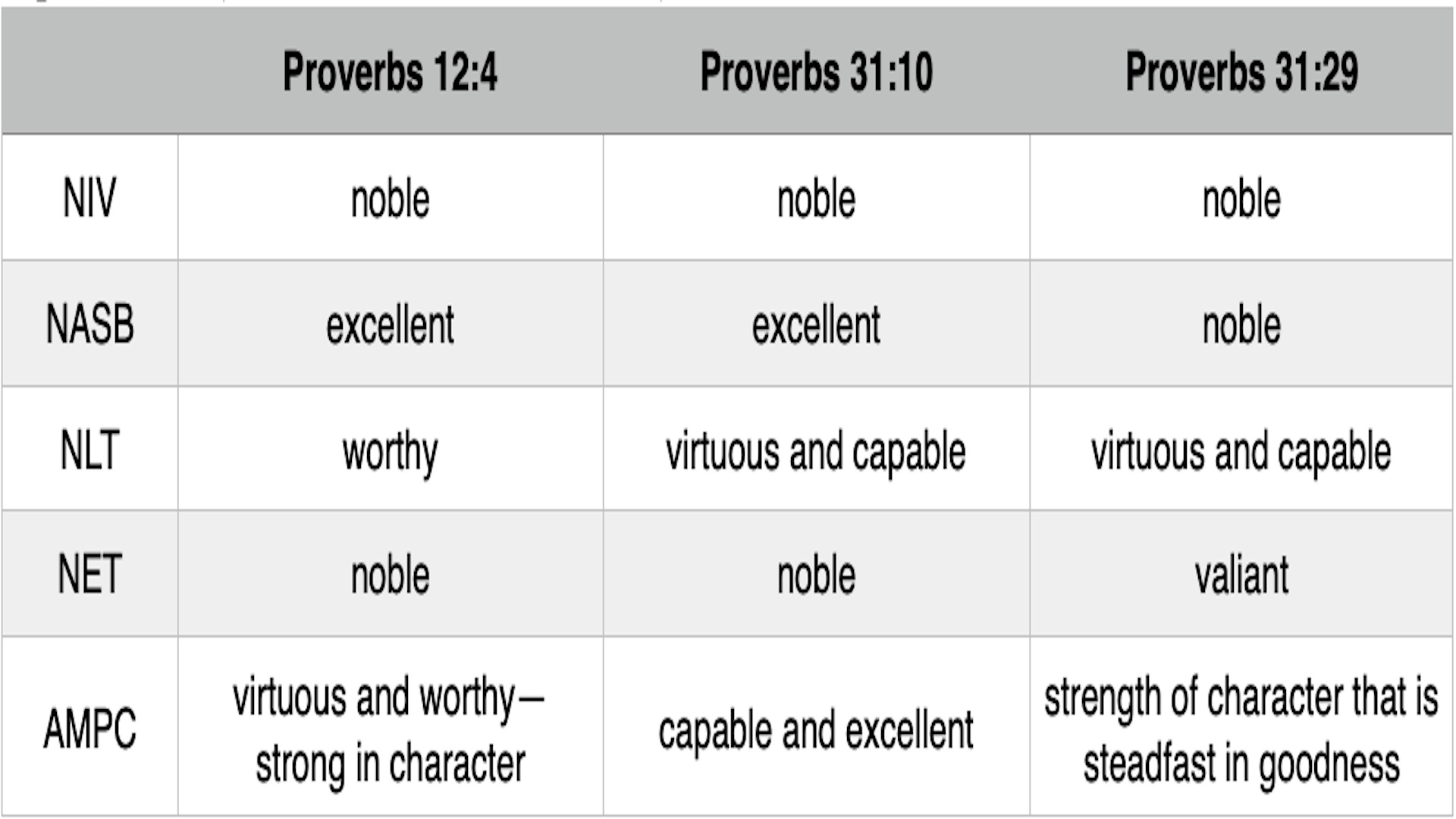
The Hebrew word for noble is used five times in Proverbs. Three of those are for this kind of superwoman (Proverbs 12:4, 31:10, 31:29).
This same word is also used twice for men in Proverbs—A good man leaves an inheritance to his children’s children (13:22); do not spend your strength on women, your vigor on those who ruin kings (31:3).
A woman’s nobility and virtue either unleashes strength OR her vices deplete strength and bring ruin. In the language of Proverbs 31:3, she is either a king-maker or a king-breaker.
This picture of empowerment is seen in the very first couple (Genesis 2:18-24). In the King James Version language, the word for helper is help meet. This means that Eve is the key that unlocks Adam’s potential. The godly woman makes possible what the godly man cannot do on his own.
As a kid, I always suspected my Mom had superpowers. I remember digging through the hair on the back of her head to find “the eyes” she said she had in the back of her head! She could kiss my boo-boo and instantly I was better, and she could help me understand the things that perplexed me the most.
As I got older, I realized that my Mom actually did have superpowers:
She faithfully loved her God—Proverbs 31:30
She diligently served her husband—31:11-12, 23
She consistently cared for her children—31:27-28
Ladies, that is the superpower that you have—you complete us, you elevate us, you unlock our potential! This brings both elevation for your family and honor for yourself(see Proverbs 31:29-31, and notice the phrase “city gate” in vv. 23 & 31 which symbolizes a leadership position).
Women who ignore their God-given superpower of nobility unleash the vicious cycle of king-breakers.
Women who use their God-given superpower of nobility unlock a virtuous cycle of king-makers.
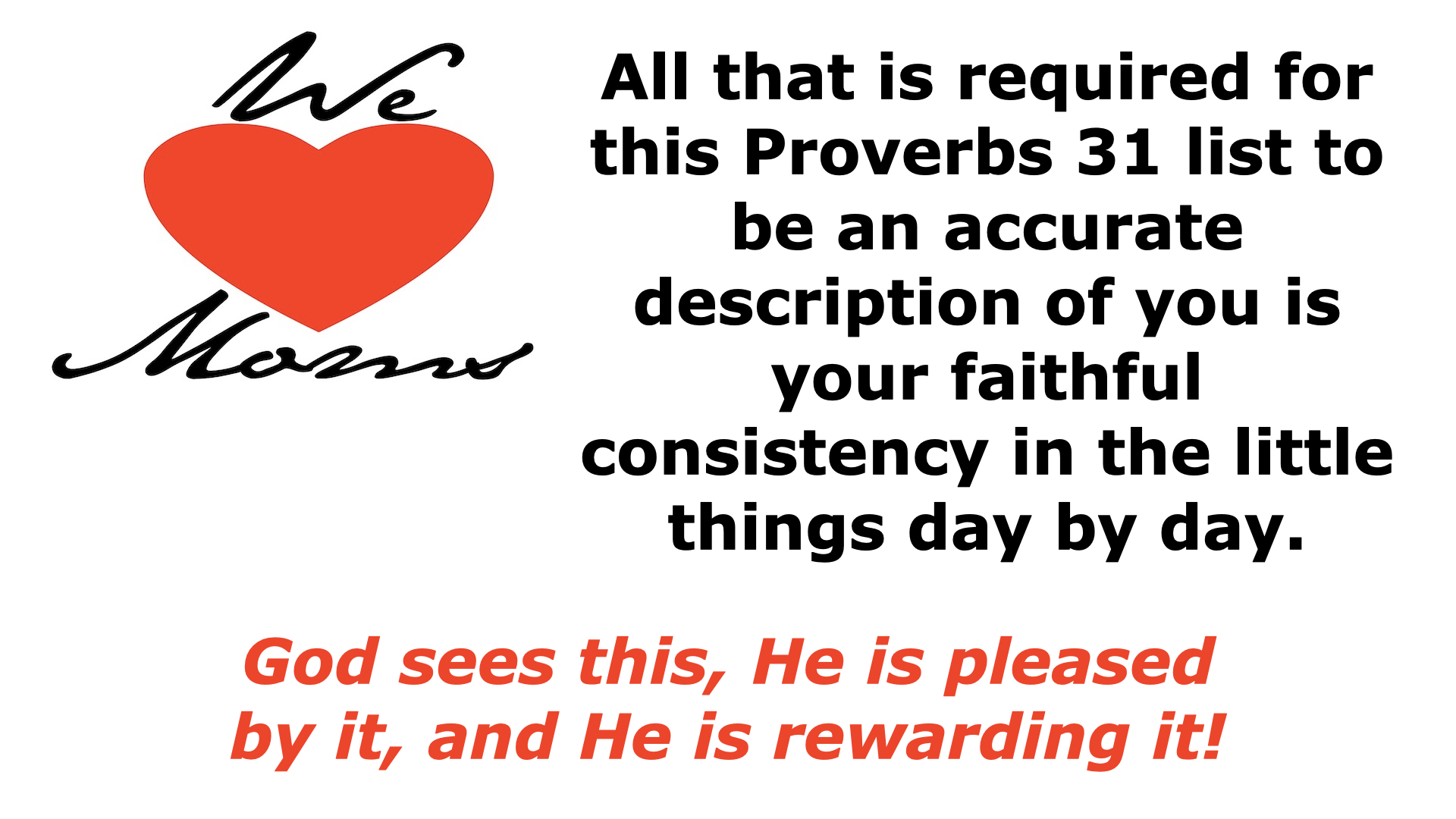
Ladies, be encouraged today that all that is required for this Proverbs 31 list to be an accurate description of you is faithfully loving your God and faithfully serving your family in the consistent, little things day after day after day. God sees this, He is pleased by it, and He is rewarding it!
Guys, you have a part to play in this too. What you do with the potential that your mother and your wife have unlocked for you also plays a vital role in your family and in your community. I talked about this on Father’s Day, which you can check out here.
Christians do a disservice to the Gospel when we’re known more for what we’re against than what we’re for.Check out this full message here. I have lots of new content every week, which you can check out on my YouTube channel.
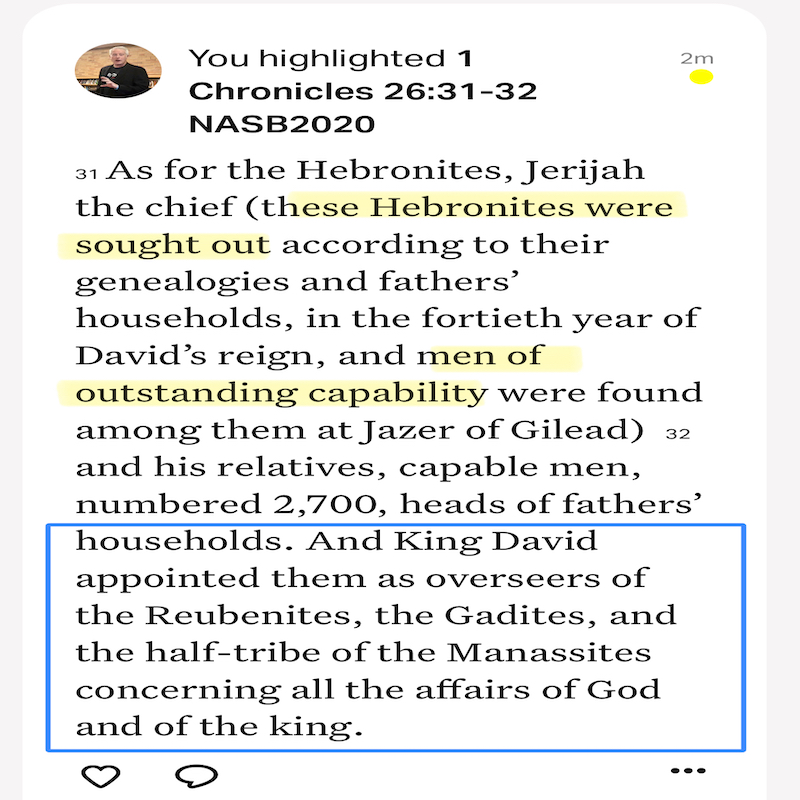
The Hebronites faithfully served God and King David without any fanfare or recognition. God shined His light on these “men of outstanding capability” so that they were finally recognized publicly. Note that they didn’t try to promote themselves. They faithfully served and God promoted these humble men in His timing.
I always appreciate the straightforward leadership insights that Ken Blanchard shares. He wrote, “Leadership is not something you do to people, but something you do with people.” And in this post he discusses some strategies when one of your direct reports is struggling.
“If I find 10,000 ways something won’t work, I haven’t failed.” —Thomas Edison
“We are a Christian people, according to one another the equal right of religious freedom, and acknowledging with reverence the duty of obedience to the will of God.” —1931 Supreme Court ruling
The Holy Spirit reminds us of God’s Word. But in order for Him to remind us, we have to study it first! Check out this full message.
“Your real, new self…will not come as long as you are looking for it. It will come when you are looking for God.” —C.S. Lewis, in Mere Christianity
“Just because they say it’s impossible doesn’t mean you can’t do it.” —Roger Bannister, who broke the “impossible” barrier of running less than a 4-minute mile on May 6, 1954
Listen to the audio-only version of this podcast by clicking on the player below, or scroll down to watch the video.
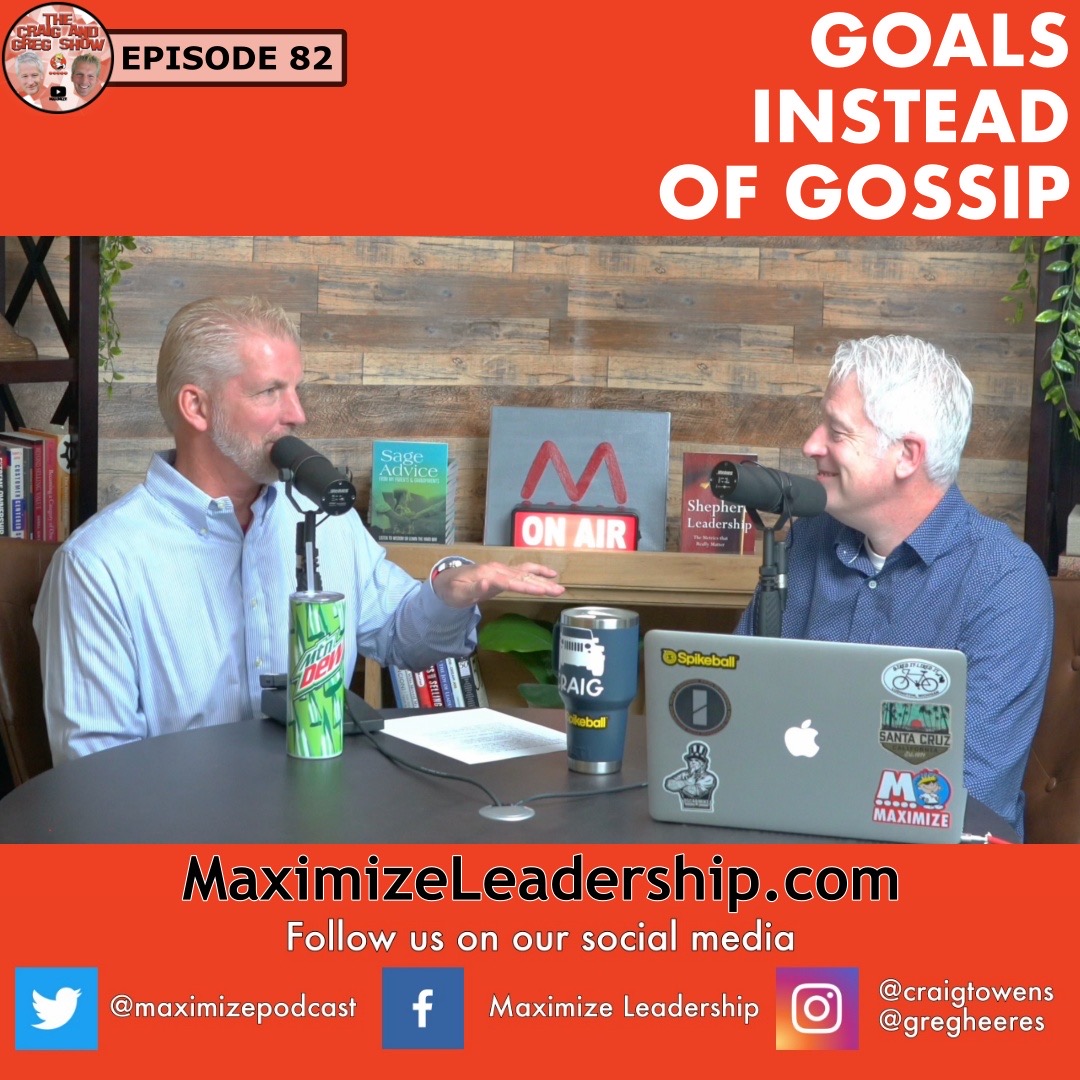
When you are in a leadership role it is unavoidable that you will occasionally have to talk about people. Perhaps it’s gathering more information or discussing an incident with a fellow leader. However, we have to be very careful that these discussions don’t cross the line into gossip. Gossip is toxic for your organization, and left unchecked can lead to disastrous results. Check out this episode where Greg and I discuss how to make your conversations about goals instead of gossip.
[0:31] Leaders have to have lots of conversations on different levels—how do they do this without gossiping about their teammates?
[1:32] Leaders need to have a goal for each of their conversations.
[3:39] What holds leaders back from having the productive (but difficult) conversations?
[6:02] Leaders need to be careful of the diabolic nature of gossip.
[8:58] We need to try to make all of our conversations constructive for us, our teammates, and the entire organization.
[11:01] Productive, healthy conversations must become a part of your organization’s culture.
[13:09] Do your teammates totally trust that you, as their leader, have their best in mind?
[16:51] Leaders need to prioritize transparency at all levels of the organization.
[18:36] Leaders can empower their teammates to make healthy changes.
Check out this episode and subscribe on YouTube so you can watch all of the upcoming episodes. You can also listen to our podcast on Spotify and Apple.
Answer me when I call, God of my righteousness! You have relieved me in my distress; be gracious to me and hear my prayer. … But know that the Lord has set apart the godly person for Himself; the Lord hears when I call to Him. (Psalm 4:1, 3)
I can’t come into God’s presence in my own strength. But when I am clothed in the righteousness of Jesus, the distress of my sin is relieved and I am joyfully welcomed into the awesome presence of my Heavenly Father! He longs to hear my voice, and He loves to be gracious to me!
Listen to the podcast of this post by clicking on the player below, and you can also subscribe on Apple, Spotify, or Audible.
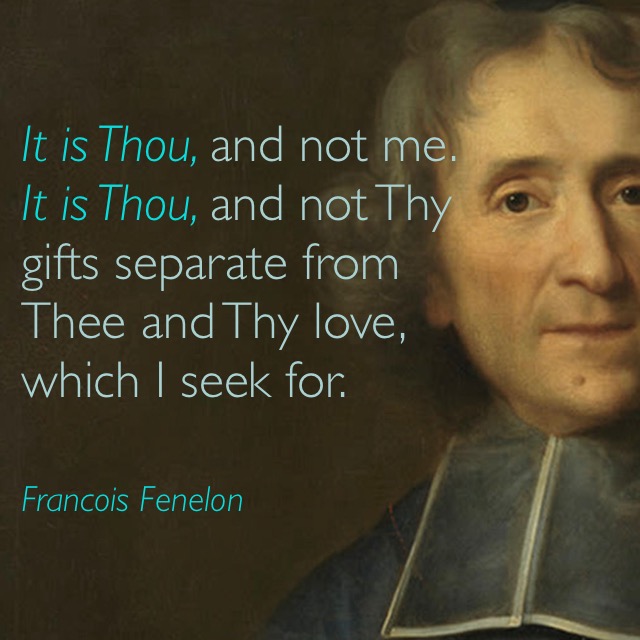
My cousin shared this quote from Francois Fenelon with me a couple of weeks ago, and it has continued to work on my heart—
I do not want to please men except so far as it is necessary in order to please Thee.
If Thou wishest to use me for Thy work for them, I give myself to it, and, without thinking about myself I shall simply spread to them all the gifts which Thou hast poured upon me. I shall not go forward groping, always falling back upon myself.
However dangerous and disintegrating the duty may be, I shall behave simply before Thee with a right intention, knowing the goodness of the Father before Whom I walk. He wants no subtlety in His own.
If, on the contrary, Thou dost not wish to use me for others, I shall by no means offer myself. I shall not anticipate anything.
I shall perform in peace the other things to which Thou dost limit me. Because, according to the grace of yielding which Thou dost give me, I neither desire nor refuse anything. I am ready for anything, and consent to be useless in everything.
Sought, refused, known, ignored, praised, contradicted, what does it matter? It is Thou, and not me. It is Thou, and not Thy gifts separate from Thee and Thy love, which I seek for. All good conditions are immaterial to me. (Francois Fenelon)
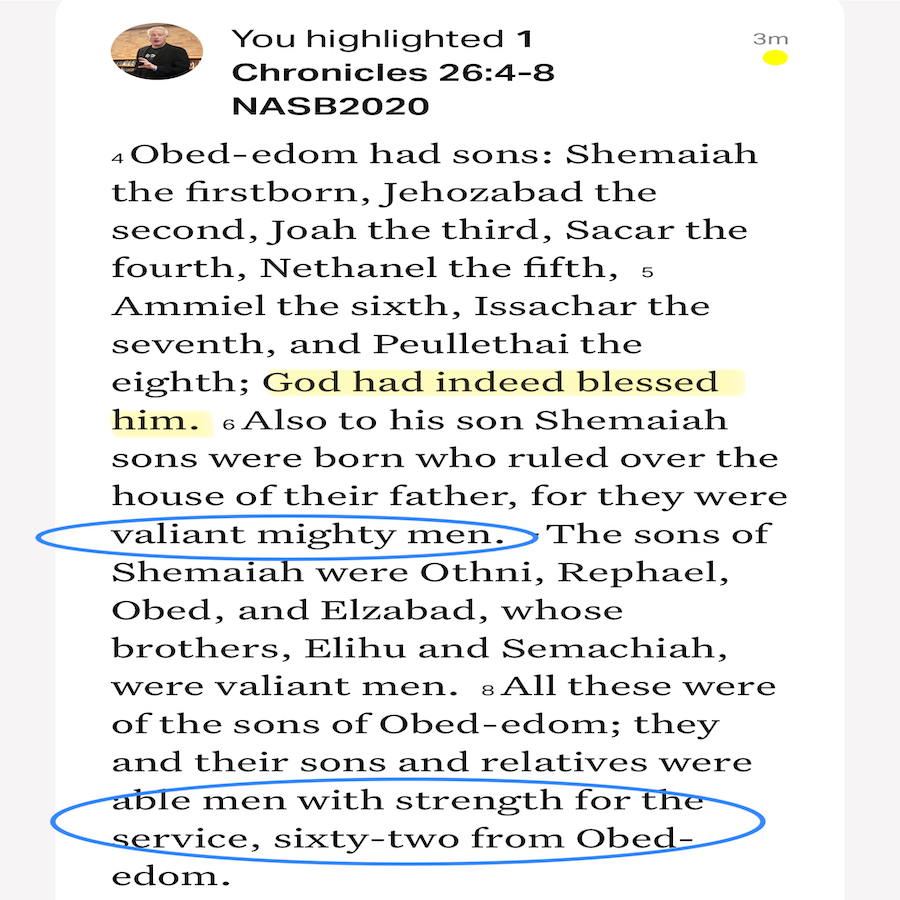
Every historical mention of Obed-Edom shows him serving God: as the guardian of the ark of the covenant of the Lord, as a gatekeeper, and as a worship leader. Here in this genealogy we learn that he faithfully served his family in a God-honoring way as well.
“God had indeed blessed him” so that his future generations were also known as valiant men of service before the Lord.
Obed-Edom demonstrates something I unpack in my book Shepherd Leadership. I wrote—
Humility is often misunderstood as allowing others to advance, and in so doing, I am completely overlooked. Others get the accolades and I get nothing. As a result, humility has gotten a bad reputation. People begin to think of a humble person as someone who never speaks up for himself, someone who can be taken advantage of, someone who becomes a doormat for everyone else. But the picture of a humble person in the Bible couldn’t be more different!
We all have to bow to someone or something. The humble shepherd leader has chosen to bow to God and to follow God’s righteous standards. One name for God is Jehovah Tsidkenu, which means God is righteous (see Psalm 119:137). The Hebrew letter tsadhe is a part of God’s righteous title, and it’s how we are called to live. Tsadhe means the humble, faithful servant. …
When you zoom in on the Hebrew letter tsadhe, you will see that the faithful, humble, kneeling servant is depicted with a crown. Far from being pushed down, left behind, or left unrewarded, the humble person is the one God delights to exalt!



 This is a book I wish I didn’t have to write, but far too many pastors are leaving their ministries too early because of the attacks they have had to endure. When Sheep Bite is help for hurting shepherds.
 Here is a recent video about When Sheep Bite. You can also check out the whole playlist of videos related to this helpful book.







 Craig T. Owens