No one likes to be mistreated—especially when the one that hurts us is one we would have thought of as an ally or even a friend.
These slights become even more painful when they take place inside the Christian community. When sheep bite sheep, our natural response is to lash out to try to even the scales of justice. But the Bible consistently and clearly calls Christians to pursue a supernatural response.
Join me for a highly practical series of messages on how you can respond in a Christ-honoring way when you are bitten by another sheep in God’s pasture.
(By the way, if you are a church leader dealing with biting sheep, my book When Sheep Bite is a great resource for you.)
Listen to the podcast of this post by clicking on the player below, and you can also subscribe on Apple, Spotify, or Audible.
Every business owner needs to be prepared for an eventual transition. Whether it be retirement, moving on to a new opportunity, or an M&A offer, nobody can run their business forever. In today’s episode Greg and I sit down to discuss Greg’s new book The Business Baton.
[0:35] “Keep your eye on the ball” is important for more than just sports, and far too often business owners forget this advice during the transition process.
[2:48] In chapter seven of The Business Baton, Greg discusses how to manage the pace of a transition.
[4:04] A Navigator can help you keep your focus on running your company during a transition.
[5:34] Greg talks about a few common reasons business owners take their eye off the ball.
[12:50] What does an owner disengaging do to the morale of the company?
[16:53] I share an interesting statistic from The Business Baton.
[19:26] An owners ongoing productivity is essential for maintaining the value of the organization.
[23:49] The Business Baton contains real case studies from organizations that Greg has worked with in the past, so you will likely see examples that line up with your industry.
[25:04] Greg and I share a section from The Business Baton about productivity.
Check out this episode and subscribe on YouTube so you can watch all of the upcoming episodes. You can also listen to our podcast on Spotify and Apple.
Listen to the podcast of this post by clicking on the player below, and you can also subscribe on Apple, Spotify, or Audible.
There is a cliche people love to quote: “Give a man a fish and you feed him for a day. Teach a man to fish and you feed him for a lifetime.”
Is this how Christians should live?
It sounds like the experienced fisherman may be annoyed at having to catch a fish every day just to give it to someone else. If you want to put a noble spin on the cliche, you could say that the wise and patient fisherman invested his time to teach someone else to provide for themselves, never needing to return to their teacher.
This certainly wouldn’t be the example of Jesus.
As He was teaching the large crowd of people, whom He thought of as sheep without a shepherd, they became hungry. Jesus directed His disciples to feed them. He didn’t tell them to teach the crowd to provide for themselves.
As Jesus miraculously fed thousands of people, notice that He kept on giving until they were all satisfied—
And taking the five loaves and two fish, He looked up to heaven and, praising God, gave thanks and broke the loaves and kept on giving them to the disciples to set before the people; and He also divided the two fish among them all. And they all ate and were satisfied.(Mark 6:41-42 AMPC)
The example in the Old Testament was to look to God for a supply of manna every single day. In the New Testament, Jesus taught us to pray for our daily supply of bread every single day (Exodus 16:14-17; Matthew 6:11; John 6:35).
Jesus never wants us to become self-sufficient. Instead, He wants us to remain steadfastly connected to Himself—as surely as a branch is connected to the vine.
Far from teaching us to provide for ourselves, Jesus says, “If you remain in Me and I in you, you will bear much fruit; apart from Me you can do nothing” (John 15:5).
Jesus is never wearied by our continually coming to Him; rather, He is delighted when we do! He wants to be our supply each and every day for all of eternity!
Listen to the podcast of this post by clicking on the player below, and you can also subscribe on Apple, Spotify, or Audible.
As both a consultant and in one-on-one conversations with colleagues, I have lost count of how many times I’ve heard leaders tell me how incompetent their teammates are. When I have gently asked how they could help their teammates improve, the response is usually something like, “I think they are giving me all they have right now.”
There is an age-old leadership principle that goes something like this—
A poor leader doesn’t believe his people can achieve more than they already are, so he stops training them and stops expecting great things from them. His people soon discover the level of performance their leader will settle for, and then gravitate to that level.
The leader then assumes that’s all that his people are capable of achieving, so he accepts it as fact and quits challenging his people to get better.
So both reinforce what the other believes, and the vicious downward cycle continues.
How sad!
But I have found that exemplary leaders believe the best is still to come. They challenge their teammates to strive for greatness. They take time to train, resource, and encourage them to strive for the next level. They don’t beat them up or give up on them when they stumble, but they treat stumbles as learning opportunities. They always believe their teammates can achieve more.
If you were on a team with a leader like that, wouldn’t you want to live up to those expectations? Of course you would! So instead of the vicious downward cycle I just outlined, an environment like this creates a virtuous cycle that keeps pulling people upward.
The apostle Paul talked in virtuous terms about his teammates. He wrote publicly about Timothy (I have no one else like him—Philippians 2:20), Epaphroditus (my brother, co-worker and fellow soldier—Philippians 2:25), Mark (he is helpful to me in my ministry—2 Timothy 4:11), and Luke (the beloved physician and faithful comrade—Colossians 4:14), to name just a few.
Even when he had to speak a challenging, correcting word to the saints in Corinth, he still believed the best for them—
I am not sorry that I sent that severe letter to you, though I was sorry at first, for I know it was painful to you for a little while. Now I am glad I sent it, not because it hurt you, but because the pain caused you to repent and change your ways. … I am very happy now because I have complete confidence in you. (2 Corinthians 7:8-9, 16 NLT)
I love that phrase: I have complete confidence in you!
A mark of a godly leader is his supreme confidence in his people to grow and improve.
If you feel like your teammates just aren’t measuring up, can I suggest that you take a look in the mirror? It may be that your expectations of them are too low, that your attitude toward them has been squelched, and that your words and actions are perpetuating a downward cycle.
By changing your attitude toward your teammates, you can put the brakes on that downward pull, and begin a brand new virtuous cycle that pulls your entire team—and your whole organization—up to heights where they have never gone before!
This is part 82 in my series on godly leadership. You can check out all of my posts in this series by clicking here.
Listen to the podcast of this post by clicking on the player below, and you can also subscribe on Apple, Spotify, or Audible.
We tend to be pretty self-centered creatures, filtering everything through our lens. This becomes especially true when we are going though a difficult time.
When I walked through a dark valley, I battled both physical and spiritual forces. People attacked me, but so did my own thoughts. “Why me?” and “I didn’t do anything to deserve this!” led to prayers like, “God, why didn’t You protect me from this? Why won’t you get me out of this?”
Do you hear a common theme? I didn’t while I was in the midst of the battle, but perhaps you hear it—“Why me? I didn’t do anything to deserve this! God, why didn’t You protect me from this? Why won’t You get me out of this?”
In his book Winning With People, John Maxwell shared ‘The Big Picture Principle’: “The entire population of the world, with one minor exception, is composed of others.”
On the other side of my dark valley I learned something about my time in the dark valley—I had grown:
I could help others diagnose depression
I could empathize with others
I could share helpful strategies to those who were struggling
I could intercede for them in prayer
My definition for intercede is to pray for people in a meaningful way because they are too beat up to pray for themselves.
In order to pray for them, I have to know what and how to pray. I can’t know what and how to pray unless I have firsthand experience. So perhaps my dark valley wasn’t for me, but for someone else (see Romans 8:28; 2 Corinthians 1:3-11).
I have talked and blogged so many times about the phrases “one another” and “each other” throughout Scripture. That means that Christian faith is best seen when we are with each other, supporting one another.
Jesus taught us to pray, “Our Father” (Matthew 6:9). The “our” signifies we are praying…
…with Jesus—John 14:13-14
…with other saints—Matthew 18:18-20
Even more than praying with us, Jesus intercedes for us (Hebrews 4:15-16). And Jesus gives us the Holy Spirit (John 14:26) who also intercedes for us and with us (Romans 8:26-27).
We join with our High Priest, helped by our Advocate, as we pray to our Heavenly Father on behalf of our brothers and sisters.
Listen to the interceding and expectation of a joyful answer that David writes in Psalm 20, and also notice how the saints are together—
May the LORD answer you when you are in distress; may the name of the God of Jacob protect you.May He send you help from the sanctuary and grant you support from Zion.May He remember all your sacrifices and accept your burnt offerings.May He give you the desire of your heart and make all your plans succeed.May we shout for joy over your victory and lift up our banners in the name of our God. May the LORD grant all your requests.Now this I know: The LORD gives victory to His anointed. He answers him from His heavenly sanctuary with the victorious power of His right hand.Some trust in chariots and some in horses, but we trust in the name of the LORD our God.They are brought to their knees and fall, but we rise up and stand firm.LORD, give victory to the king! Answer us when we call!
My cousin Dick Brogden wrote, “Jesus never intended us to suffer alone. We may not physically be able to cross oceans or deserts and sit in lonely cells with colleagues—but we are intended to traverse that distance spiritually and to bear the burdens of our brothers in prayer. Followers of Jesus under duress are empowered to bear unimaginable suffering when they know that they do not agonize alone.”
In your prayer time, I encourage you to ask the Spirit to show you lessons you have learned in your dark valleys, and then begin to intercede for your fellow brothers and sisters with the help you have already received.
“You have to expect things of yourself before you can do them.” —Michael Jordan
“The sun, with all those planets revolving around it and dependent on it, can still ripen a bunch of grapes as if it had nothing else in the universe to do.” —Galileo Galilei
“Physical care is vital to vigilance. HALT is the acronym often used by therapists to remind people of when they can be most vulnerable it stands for: hungry, angry, lonely, tired. Simply going to bed on a regular schedule to get a good night’s rest can help one’s brain be more focused on positive habits and more alert to fight temptations. Not only eating but also eating well can improve mood and feelings of well-being. Regular exercise keeps the mind more focused, the body feeling great, and improve sleep.” —Sam Black, in The Porn Circuit
“Leadership can be a lonely business filled with great amounts of soul-draining human interactions but little soul-filling intimacy. Without some safe-harbor relationships where we can lay down all of the armor and weapons needed to face the world and relax in confidence and unguarded communion, we become vulnerable to two debilitating frames of mind and spirit—the victim and the martyr. Allowed to blossom into resentment or a self-justification for seeking EGO-soothing instant gratification, these twin demons have been the downfall of many a leader in every walk of life.” —Kenneth Blanchard and Phil Hodges, in Lead Like Jesus
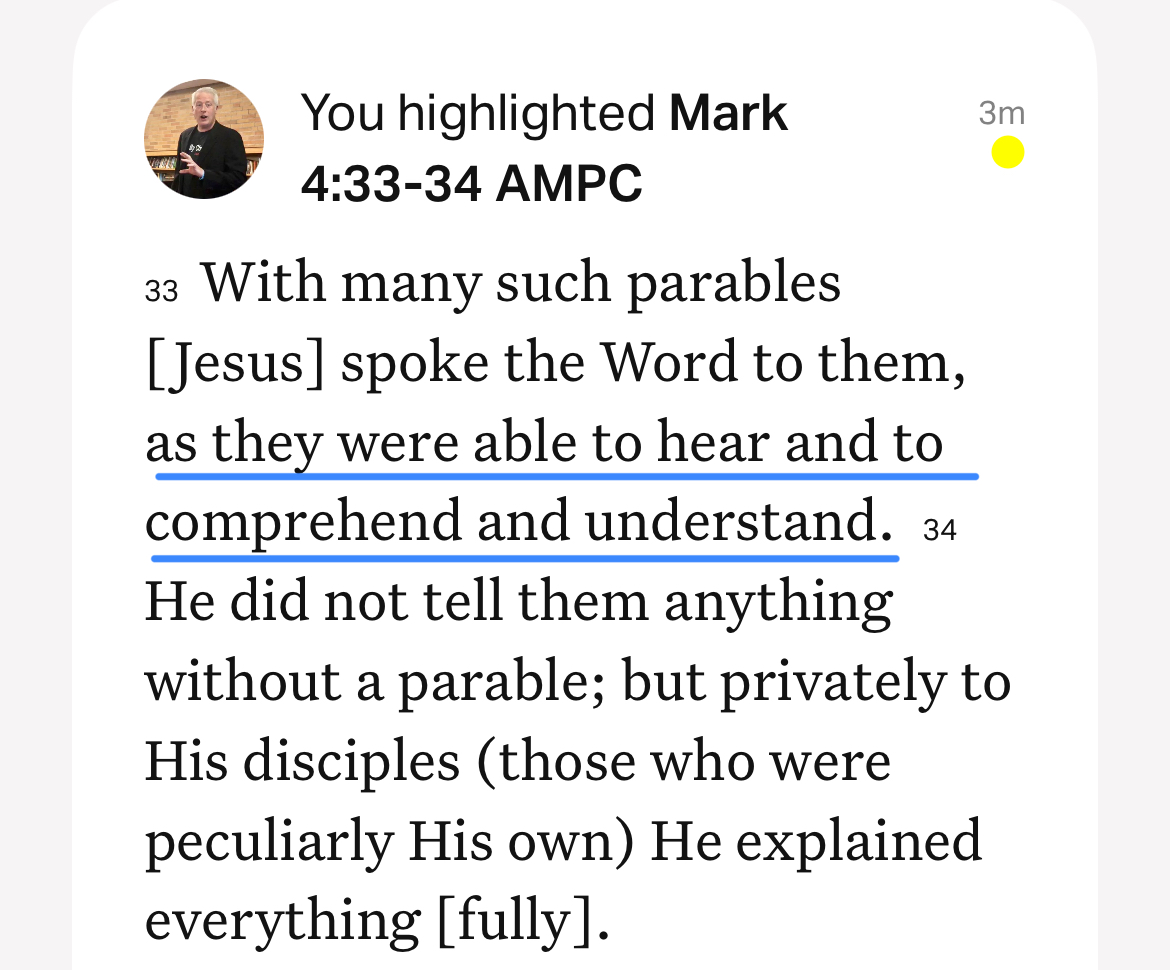
With many such parables Jesus spoke the Word to them, as they were able to hear and to comprehend and understand. He did not tell them anything without a parable; but privately to His disciples (those who were peculiarly His own) He explained everything fully. (Mark 4:33-34 AMPC)
We will “comprehend and understand” more when we are ready to handle it. There is a joy in the learning process—an excitement that comes as new depths of meaning are revealed to us. Be faithful and obedient with what has been revealed to you. Continue to abide in the presence of the Lord, meditating on His Word until He explains more to you.
Jesus wants us to understand His words.
There is a joy that comes through the prayerful pondering of and the searching through what He has said. Even if we don’t fully grasp all of the truth initially, what we do perceive is precious. And what we don’t fully understand, we keep searching. As G.K. Chesterton noted, “The riddles of God are more satisfying than the solutions of man.”
Then Jesus said—
“Things are hidden temporarily only as a means to revelation. For there is nothing hidden except to be revealed, nor is anything temporarily kept secret except in order that it may be made known. If any man has ears to hear, let him be listening and let him perceive and comprehend.” And He said to them, “Be careful what you are hearing. The measure of thought and study you give to the truth you hear will be the measure of virtue and knowledge that comes back to you—and more besides will be given to you who hear.” (Mark 4:22-24 AMPC)
Listen to the podcast of this post by clicking on the player below, and you can also subscribe on Apple, Spotify, or Audible.
My podcast partner Greg Heeres asked me if I had found one thing that really worked in developing or deepening relationships. My answer is short and to the point.
Listen to the podcast of this post by clicking on the player below, and you can also subscribe on Apple, Spotify, or Audible.
“No one will even notice.”
“It really doesn’t matter what I do.”
“There’s not much that I’m good at.”
Sadly, these statements are far too common for a lot of people. Even sadder is how frequently Christians say them. Of all people, Christians should be assured that God has created them on purpose and for a purpose. To fulfill that purpose, God has given each of us the right talents in the right proportions.
Jesus illustrated it with a story in Matthew 25, but I want to especially highlight what the master said to his stewards when they were giving an account for what had been entrusted to their care.
His master said to [the steward entrusted with five talents], “Well done, you upright (honorable, admirable) and faithful servant! You have been faithful and trustworthy over a little; I will put you in charge of much. Enter into and share the joy (the delight, the blessedness) which your master enjoys.” … His master said to [the steward entrusted with two talents], “Well done, you upright (honorable, admirable) and faithful servant! You have been faithful and trustworthy over a little; I will put you in charge of much. Enter into and share the joy (the delight, the blessedness) which your master enjoys.” … [The steward entrusted with one talent said], “So I was afraid, and I went and hid your talent in the ground. Here you have what is your own.” (Matthew 25:21, 23, 25 AMPC)
The two wise stewards were both told they had been faithful in a little, even though one started out with more than the other.
The lazy steward didn’t consider what he had been given to be worth the bother.
But all three of them were given only what they could handle—
To one he gave five talents [probably about $5,000], to another two, to another one—to each in proportion to his own personal ability. Then he departed and left the country. (Matthew 25:15 AMPC)
In other words, God gives us our talents or gifts on purpose. He knows exactly what gift to give us and in what proportion to be an effective steward for Him. Don’t ever discount what God has given you, and don’t ever envy what He has given to another servant. What you consider “a little” is still enough to accomplish the purpose God has for your life.
Do your very best with what you have, and then know that you will hear your Master say, “Well done. Come share My eternal joy!”
Listen to the podcast of this post by clicking on the player below, and you can also subscribe on Apple, Spotify, or Audible.
If you’re a shepherd leader, what do you do when the sheep under your care go, “Grrrr!”?
To make sure that you haven’t done anything that caused the murmuring, you should humbly pray, “Search me, O God” (Psalm 139:23-24). And then, if you see you have done something wrong, repent and make things right. You may want to check out my blog post A Leader’s Sincere Apology.
After this, Moses has given us in Exodus 16:8-9 two actions to take with murmuring sheep:
If it wasn’t anything that you did, you need to remind yourself that the people are murmuring against God.
If it wasn’t anything that you did, you need to remind the sheep that they are murmuring against God.



 No one likes to be mistreated—especially when the one that hurts us is one we would have thought of as an ally or even a friend.





 Craig T. Owens