


I love this…
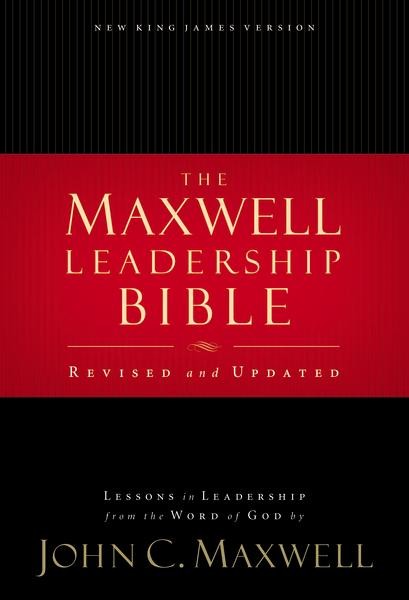 Hands-down the best book for any aspiring, developing, or seasoned leader is the Bible! John Maxwell is a mentor of leaders that I have come to greatly appreciate over the years of my leadership development. So having John Maxwell’s commentary accompany my daily Bible reading time has been a huge blessing! You can find this complete leadership development package in The Maxwell Leadership Bible.
The Bible is filled with leadership principles given by God Himself. John Maxwell is helping me compile various principles throughout the entirety of the Bible into cohesive units of study.
The Bible also presents us with various people who followed or violated God’s leadership principles. We are able to see the struggles that come to those who either ignore God’s directives or don’t consistently follow through on them. And we’re able to see the legacy of success that follows those who make it a priority to consistently walk in God’s precepts. Once again, Maxwell is brilliant at identifying these leadership lessons.
Normally I post reviews after I have read an entire book, but given the fact that my Bible reading time is in-depth and time-consuming, I wanted to post a review now to encourage Christian leaders to take advantage of this wonderful resource. If you want to use the Bible to grow your leadership capacities, the commentaries and insights provided by John Maxwell will be a huge blessing to you.
P.S. I am reading The Maxwell Leadership Bible on the Kindle version. I find it very convenient to tap on the footnotes, character studies, and leadership lessons that John Maxwell has prepared, and then quickly tap back to the biblical passage right where I left off.
 “Sometimes people ask me ‘Is Jesus the only way?’ and of course the question alludes to a journey. It occurs to me that when attempting to be helpful in giving directions, some facts are more relevant than others. In this case, perhaps none more so than one: the question of destination. When asking ‘Is Jesus the only way?’ it begs at least one further question, which is ‘To what?’ or ‘To where?’
“In our society, it is not uncommon to hear the statement ‘All religions lead to God.’ Although it’s not a logical statement, I find the second part of it—the ‘lead to God’ bit—very interesting. There seems to be an awareness, however subconscious, however little thought through, that only God Himself is the appropriate destination. Where does this thought come from? …
“Don’t all religions lead to God? No, they don’t even claim to.
“I have found it helpful at times to ask, ‘What is the destination you are aiming for? What is the destination you hope would be true?’ It seems to me that in the search for truth and meaning, many of us are not primarily or only looking for logical answers, but for a response to the existential longing for true life.
“Jesus says that He has come so that we might have life and life in all its fullness—life abundantly. The Message translation puts it as ‘real and eternal life, more and better life than [you] ever dreamed of’ (John 10:10). But what I find so intriguing about this is that Jesus tells us not just that He will give us life, not just that He will change and transform our lives, not just that He will show us the way to life, but that He Himself is the life (John 14:6). In other words, He is the destination. There is one faith that does claim to lead to God: Jesus stands unique across the ages. He is not simply the means through which we might get to some other destination. He is not a means to an end. Relationship with Jesus is the end.” —Tanya Walker, in A New Kind Of Apologist
 Christians are citizens of Heaven who are merely passing through Earth, so this isn’t a Christian’s final home. Because of this, it’s not unusual for Earthlings to mistreat, insult, and even persecute these “aliens and strangers.”
How are Christians supposed to respond to this?
First off, let’s make sure the persecution is for the right reason. Jesus said, “Blessed are you when people insult you, persecute you and falsely say all kinds of evil against you because of Me” (Matthew 5:11).
Jesus also told us that this persecution has a blessing in it: we would be able to share our faith in Jesus Christ at the highest levels on Earth: “On account of Me you will stand before governors and kings as witnesses to them” (Mark 13:9).
In 1 Peter 3:8, the apostle tells us how to live with everyone, Christian and Earthling alike:
This list may be easy to live out when people are friendly to you, but what about when unfriendly Earthlings are downright mean to you? In the very next verse Peter gives us two Don’ts and one Do:
In Psalm 35 David is dealing with people who are fighting against him. They are saying mean things and trying to do even meaner things. This prayer shows both God’s part and our part…
God’s part—defend me against the evildoers … remind me of Your salvation … pursue those who are falsely pursuing me … stay close to me.
My part—listen to God’s voice of assurance … live quietly … don’t give others cause to mistreat me … pray for those who persecute me … continually turn my thoughts and praise to God.
Peter wraps up this thought with these words—Who is going to harm you if you are eager to do good? But even it you should suffer for what is right, you are blessed (1 Peter 3:13-14).
Don’t give in to mistreatment and lash out in anger. Trust God to handle things. Keep on living a good life that is focused on bringing God all the glory due His name!
If you’ve missed any messages in this series, you may find the complete list by clicking here.
Give unto the Lord the glory due His name…. (Psalm 29)
 How in the world can I do that?! How can a mere mortal possibly give the All-Glorious, All-Powerful God glory that is equal to His majesty?
Verses 3-9 try to capture God’s power—
How do I give this God the glory due His name? How can my voice of praise even be heard above the voice of His majestic voice?
How? By simply worshiping the Lord in the beauty of holiness.
That means I come into His presence in the holiness of Christ—I remain clothed in His righteousness—then I can stand in God’s presence and join my voice with the voices of the mighty ones (v.1), with all His people (v. 11).
And He hears me.
And the glory due His name that comes from my lips causes all the creatures in His temple to exclaim, “Glory!” (v. 9)
I can give God all the glory due His majestic name by simply realizing that I am only in His presence because He wants me there, and has made the way possible for me to be there through His Son Jesus.
 In our recent Q Series, I was asked a great question: If God has told me that something is a sin for me, does that mean that it is a sin for everyone?
Using a personal example from my life, and using two biblical examples (in Samson and John the Baptizer) I shine some light on this question …
You might also be interested to check out some other Q&As regarding the Bible, end-times prophecy, parables, and prayer.
 “Evangelical Christians commonly offered Christ to mankind as a nostrum to cure their ills, a way out of their troubles, a quick and easy means to the achievement of personal ends. They use the right words, but their emphasis is awry. The message is so presented as to leave the hearer with the impression that he is being asked to give up much to gain more. And that is not good, however well intentioned it may be.
“What we do is precisely what a good salesman does when he presents the excellence of his product as compared with that of his closest competitor. The customer chooses the better of the two, as who would not? But the weakness of the whole salesmanship technique is apparent: the idea of selfish gain is presented in the whole transaction. …
“In those early Galilean days Christ’s followers heard His call, forsook the old life, attached themselves to Him, began to obey His teachings and joined themselves to His band of disciples. This total commitment was their confirmation of faith. Nothing less will do. And it is not different today. He calls us to leave the old life and to begin the new. There must never be any vacuum, never any place of neutrality where the world cannot identify us.” —A.W. Tozer, Man—The Dwelling Place Of God
 This is a weekly series with things I’m reading and pondering from Oswald Chambers. You can read the original seed thought here, or type “Thursdays With Oswald” in the search box to read more entries.
Ready For God—No Matter What
The greatest need of the missionary is to be ready to face Jesus Christ at any and every turn…. The great battle all along is not so much against sin, as against being so absorbed in work that we are not ready to face Jesus Christ. … This attitude of being ready to face Him means more and more disentanglement from so-called religious work, and more and more intense spiritual reality in so-called secular work. The whole meaning of the Christian life from Our Lord’s standpoint is to be ready for Him. …
Jesus appears in the most illogical connections, where we least expect Him…. When we are rightly related to God, life is full of spontaneous joyful uncertainty and expectancy—we do not know what God is going to do next; and He packs our life with surprises all the time. …
Readiness implies a right relationship to God and a knowledge of where we are at present. We are so busy telling God where we should like to go. Most of us are waiting for some great opportunity, something that is sensational, then we cry—“Here am I; send me.” … But readiness for God and for His work means that we are ready to do the tiniest thing or the great big thing, it makes no difference. …
Remember there is no such thing as prominent service and obscure service; it is all the same with God.
From So Send I You (emphasis mine)
I fear that many Christians have the idea that “missionary work” or “ministry work” is a separate calling from their “real work.” But according to both the biblical examples and these thoughts from Oswald Chambers, ALL work can be spiritual / missionary / ministry work if we are simply ready for God to use us.
What about you? Are you ready to be surprised by God? Are you ready to be His ministry whenever and wherever He wants to use you?
 Scholars, tradesmen, politicians, theologians, pastors, and martyrs—all have spoken or written about the greatness of God over the past two millennia. In How Great Is Our God we are treated to a sampling of these writings. Check out my full book review by clicking here, and then enjoy this first set of quotes.
“Oh, that everyone would strive to put down, in themselves, mastery and honor, so that the Lord of heaven and earth might be exalted!” —George Fox
“Those who are poor in spirit are men and women who have realized that things mean nothing, and that God means everything. …
“Poverty is not a good thing. Jesus would never have called blessed a state where people live in slums and do not have enough to eat, and where health deteriorates because conditions are all against it. It is the aim of the Christian gospel to remove that kind of poverty. The poverty which is blessed is the poverty of spirit, when people realize their own utter lack of resources to meet life, and find their help and strength in God. …
“So, the first beatitude means: O the bliss of those who have realized their own utter helplessness, and who have put their whole trust in God, for thus alone can they render to God that perfect obedience which will make them citizens of the kingdom of heaven!” —William Barclay
“Christ pronounces those to be happy who, chastened and subdued by afflictions, submit themselves wholly to God, and, with inward humility, turn to Him for protection.” —John Calvin
“Christ does not merely affirm that mourners are not unhappy. He shows that their very mourning contributes to a happy life, by preparing them to receive eternal joy, and by furnishing them with motives to seek true comfort in God alone.” —John Calvin
“Teach me to seek Thee, and reveal Thyself to me, when I seek Thee, for I cannot seek Thee, except Thou teach me, nor find Thee, except Thou reveal Thyself.” —Anslem
“I realize that I shouldn’t be surprised at God’s doing things that I can’t explain. I shouldn’t doubt His existence just because I find that I sometimes can’t understand why or how He has made something. I know that my nature is weak and limited and that God’s is limitless, incomprehensible, and infinite. From this, I can infer that He can do innumerable things for reasons that are unknown to me.” —René Descartes
“Truly the love of God and of this world may never be together in one soul, but whichever love is stronger puts out the other.” —Richard Rolle
“Two periods stand out in Christ’s life: His entrance into public ministry at His Baptism, and the culmination of it at His Passion. At both He had a fierce encounter with the devil. This should give you an idea of how the master tempter works. The more public your place, and the more eminent your service for God, the greater the probability that satan is at that very moment hatching some deadly scheme against you. If even the cadet corps need to be armed against satan’s bullets of temptation, how much more the commanders and officers, who stand in the front line of battle!” —William Gurnall
“Men should avoid taking their own vengeance, but avenge injury of God, with the intention to change. … Thus Moses, mildest man of all, killed many thousand of his people, for they worshipped a calf as they should worship God. And thus in our works of mercy lies much discretion….” —John Wycliffe
“God alone remits sin through Jesus Christ, His Son, and alone our Lord.
“Anyone who assigns this to creatures detracts from the honor of God and gives it to him who is not God; this is real idolatry.
“Therefore the confession that is made to a priest or neighbor shall not be declared to be a remittance of sin, but only seeking for advice.
“Works of penance coming from the council of human beings do not cancel sin; they are imposed as a menace to others.
“Christ has borne all our pains and labor. Therefore whoever assigns to works of penance what belongs to Christ errs and slanders God.” —Zwingli
“There is nothing better than to count up the worth of Christ; to take Him up and weigh Him again and again: and after this to have none other to court your love, and to woo your soul’s delight, but Christ.” —Samuel Rutherford
Lots and lots of additional quotes are coming from this book. Some of them will be posted here, and several will be shared on my Tumblr and Twitter accounts.
I gave charge of Jerusalem to my brother Hanani, and Hananiah the leader of the citadel… (Nehemiah 7:2).
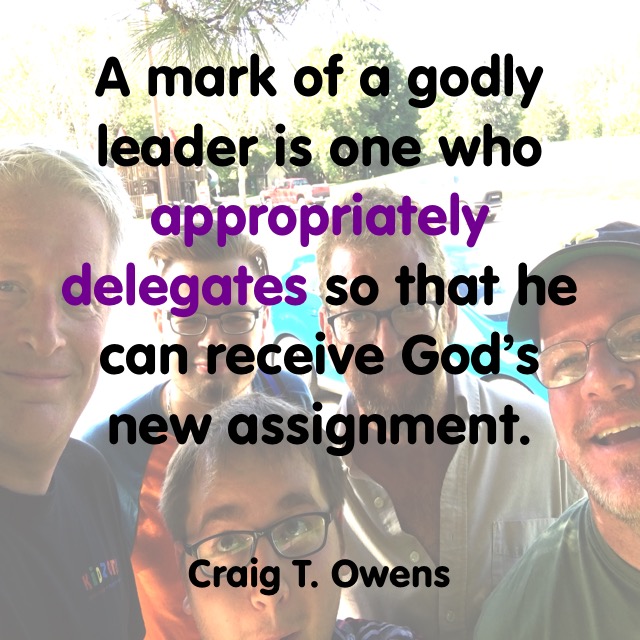 Good leaders delegate.
The project of rebuilding the walls around Jerusalem and hanging the doors had been completed, so it was time for Nehemiah to move to the next assignment God had for him.
To keep the momentum going which he had started, Nehemiah picked two trusted men:
These are good men that can carry on for Nehemiah. Nehemiah started the project, brought it to completion, and now new leaders are needed to keep the momentum going.
Notice that it is after completing the project and then delegating to new leaders that Nehemiah writes, “Then my God put it into my heart” to take on a new project (v. 5).
This is Part 9 in my series on godly leadership. To read my other posts, please click here.


 Craig T. Owens