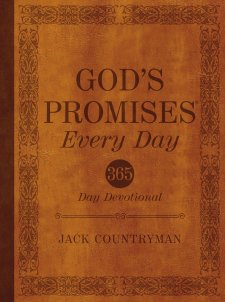
Psychologists tell us that babies are only born with two innate fears, yet many people’s lives are constricted because of numerous fears that they have allowed to creep in. A great way to begin defeating those fears is by learning what God has to say about them, and a great place to begin that journey is with Jack Countryman’s book God’s Promises Every Day.
It’s not very effective to simply tell ourselves, “Don’t be afraid of that.” Instead, we need something with more authority—like God Himself. The Bible is jam-packed with promises that God has given us; promises that will counteract our limiting fears.
Jack Countryman has put together a marvelous resource to bolster your fight against crippling fears every single day. Each day’s reading begins with a short portion of Scripture, followed by just a couple of short paragraphs unpacking the truth in that Scripture, and then concluding with a one-sentence-long prayer based on that biblical truth.
Short, but very powerful and effective! The Bible itself says that faith is built by hearing and applying God’s Word, and that’s exactly what God’s Promises Every Day makes so accessible to us.
It’s interesting to note that Jesus refuted every one of satan’s attack by quoting a portion of Scripture. Reading this book every day will similarly arm you to attack the temptations and fears that the enemy wants to throw at you as well.
C.S. Lewis said, “If satan’s arsenal of weapons were restricted to a single one, it would be discouragement.” How true! In relation to our prayer time, satan tries to discourage with lies like—
“God has bigger things on His mind than your puny request!”
“God helps those who help themselves; what have you done for yourself?”
“You created this situation and now you think God is going to bail you out?!?”
“Haven’t you prayed about this long enough already?”
“Your prayers don’t really make a difference.”
All of these lies are designed to discourage you, but always remember this—they are all lies! David said to God, “You keep track of all my sorrows. You have collected all my tears in Your bottle. You have recorded each one in Your book. My enemies will retreat when I call to You for help. This I know: God is on my side!” (Psalm 56:8-9)
A great example of a man who prayed long and hard—and fought off the things that might discourage him to give up—was Daniel.
Daniel began to do two things in the physical realm that results in two unseen spiritual victories taking place.
First, Daniel prayed. Daniel not only prayed boldly, but he also prayed long. Although Daniel prayed for 21 days, when an angel arrived with God’s answer, the angel said, “From the moment you decided to humble yourself to receive understanding, your request was heard in heaven. I have come in answer to your prayer.”
Second, Daniel fasted. The word fast literally means “to cover the mouth.” In Daniel’s case, we know that for 21 days he abstained from meat and wine. But he also abstained from “choice food” (NIV). What are those? I think these might be our “comfort foods.” Foods we go to to help relieve stress. Foods that become substitute sources of help, instead of humbling ourselves to go to God and ask for wisdom.
As Daniel was praying and fasting, it appeared that nothing was happening. But there were actually two victories won out of human sight.
First, a spiritual battle was won. The angel sent to Daniel was locked in combat with a demon for 21 days before he broke free to come to Daniel. We are still involved in that kind of spiritual warfare today (see Ephesians 6:12-18).
Second, Daniel was being refined and strengthened. When the angel arrived, he called Daniel “highly esteemed.” Don’t miss this—this greeting is the same Hebrew word used for what Daniel fasted (“choice food”). In other words, the temporary thing Daniel fasted turned into something of invaluable strength.
What if Daniel had stopped praying after 2 days? 10 days? 20 days?
Daniel—and you and I—may not see with our natural eyes the victories that are being won, but make no mistake about it: Our fasting and praying IS doing something amazing.
Your prayers are being heard. Spiritual battles are being won. You are being refined. God IS going to accomplish something great. God IS being glorified. Don’t stop praying and fasting until God comes through!
Do not be discouraged as you wait on God. There is winning even in the waiting!
Just as John was obedient to his calling, I need to be obedient to God’s calling as well.
John spoke God’s word clearly. He lived it out. He didn’t water down nor compromises his message. He didn’t let “ministry success” lead to pride. His whole life pointed everyone to Jesus.
This I must do too!
A mark of a godly leader is one who is humbly confident that God has a call on his life.
This is part 33 in my series on godly leadership. You can check out all of my posts in this series by clicking here.
This is a weekly series with things I’m reading and pondering from Oswald Chambers. You can read the original seed thought here, or type “Thursdays With Oswald” in the search box to read more entries.
Don’t Judge Others
This statement of our Lord’s [Matthew 7:2] is not a haphazard guess, it is an eternal law which works from God’s throne right down (see Psalm 18:25-26). … Life serves back in the coin you pay; you are paid back not necessarily are the same person, but the law holds —“for in the same way you judge others, you will be judged, and with the measure you use, it will be measured to you.” …
In Romans 2, this principle is applied still more definitely—I am guilty myself of what I criticize in another. Every wrong I see in you, God locates in me; every time I judge you, I condemn myself. “You, therefore, have no excuse, you who pass judgment on someone else, for at whatever point you judge the other, you are condemning yourself, because you who pass judgment do the same things” [v. 1]. …
We have judged our fellow-men as sinners; if God had judged us like that we would be in hell. God judges us through the marvelous Atonement of Jesus Christ.
Jesus warns us against judging people by a different standard that even God Himself uses! Can you imagine that we think we actually know better than God does who should be punished and who should be spared?!
The trouble is, we cannot see inside the other person’s heart so we judge by mere outward appearances. We ended up judging the other person by their actions, but we judge ourselves by our intentions. How utterly unfair!
We are in a far better place to simply let the Holy Spirit help us deal with the beams in our own eyes (Matthew 7:3-5), and let the Holy Spirit deal with others too. There is no good in my being involved in any judgments at all!
“What is the place of prayer in your life? What prominence does it have in our lives? It is a question that I address to all. It is as necessary that it should reach the man who is well versed in the Scripture, and who has a knowledge of its doctrine and its theology, as that it should reach anyone else. What part does prayer play in our lives and how essential is it to us? Do we realize that without it we faint? Our ultimate position as Christians is tested by the character of our prayer life.
“It is more important than knowledge and understanding. Do not imagine that I am detracting from the importance of knowledge. I spend most of my life trying to show the importance of having a knowledge of truth and an understanding of it. That is vitally important. There is only one thing that is more important, and that is prayer. The ultimate test of my understanding of the Scriptural teaching is the amount of time I spend in prayer. As theology is ultimately the knowledge of God, the more theology I know, the more it should drive me to seek to know God. Not to know about Him, but to know Him. The whole object of salvation is to bring me to a knowledge of God. I may talk learnedly about regeneration, but what is eternal life? It is that they might know Thee, the only true God in Jesus Christ whom God has sent.
“If all my knowledge does not lead me to prayer there is something wrong somewhere. It is meant to do that. The value of the knowledge is that it gives me such an understanding of the value of prayer, that I devote time to prayer and delight in prayer. If it does not produce these results in my life, there is something wrong and spurious about it, or else I am handling it in a wrong manner.” —Dr. Martyn Lloyd-Jones (emphasis added)
Listen to the podcast of this post by clicking on the player below, and you can also subscribe on Apple, Spotify, or Audible.
I love the balancing thought of being humbly confident in God’s presence (or if you like: being confidently humble).
Humble to know I have nothing in myself that gives me access to God’s presence and love and power, but confident to know that God through Christ’s work on the Cross desires to have me with Him.
C.S. Lewis wisely noted: “Humility is not thinking less of yourself, it’s thinking of yourself less.” Fear comes in when I’m thinking about me—how unworthy I am, how I messed up, how I wish I would have….
Fear leaves when I set my thoughts on Christ—how absolutely worthy He is, how He has accomplished everything for me, how He is working all things together for good.
There is no fear in love—dread does not exist—but full-grown, complete, perfect love turns fear out of doors and expels every trace of terror! For fear brings with it the thought of punishment, and so he who is afraid has not reached the full maturity of love—is not yet grown into love’s complete perfection. (1 John 4:18)
It is humbly confident (and confidently humble) to keep my mind off me and take all my thoughts to His perfect love. That’s when fear must go!
“The mark of God’s people is not incapacitating fear, but rather contrite courageous confidence in God. … The good news of the Bible is not that we are not worms, but that God helps worms who trust Him.” —John Piper, commenting on Isaiah 41:14
We have been looking at some bold pray-ers in the Bible, but today’s example takes it to a whole new level by praying an “impossible” prayer! Here are 4 valuable lessons we can learn from the prayer of Joshua.
When this story opens, the city of Gibeon is calling on the Israelites to help them. Five Amorite kings have all ganged up on Gibeon because of the treaty they made with Israel, and they intended to crush them into oblivion!
Joshua—without any debate, consultation, or hesitation—mobilizes his forces. Notice that there are no half-measures or hedging his bets. Joshua marches out with the entire army, including all of his elite warriors to rescue Gibeon.
Joshua’s troops marched all night to cover the 21-miles to get to Gibeon by daybreak. Modern-day military experts say that an army can cover about 20-25 miles before they are at the point of total exhaustion, so Joshua took his men right up to this point. But this all-night march surprised the five attacking armies, so much so that the Bible says God threw those enemies into a panic and God even fought for them, raining hailstones down on the Amorites that killed more men than the Israelites did in their attack!
After an all-night march and an all-day battle, the Amorites are on the run. This is when Joshua prays his “impossible” prayer. He asks God to let the earth stop rotating so that the sun and moon in the sky will give the Israelites enough light to complete their victory!!
AND GOD DOES IT!!
How could Joshua pray such an “impossible” prayer like this?
He had already seen God do the “impossible” like drying up the Jordan River and knocking down the supposedly impenetrable walls of Jericho.
God already told Joshua, “I have given them into your hand. Not one of them will be able to withstand you.” Joshua didn’t put an asterisk on God’s word—if God said every enemy would be defeated, that’s what Joshua was claiming.
Joshua was already moving forward in faith. He wasn’t sitting around waiting for God to do something. He was letting his marching be his praying.
By publicly praying this “impossible” thing, Joshua was ensuring that God would receive all the glory. The Bible says that Joshua prayed “with all Israel listening.”
The sun stopped in its tracks in mid-sky; just sat there all day. There’s never been a day like that before or since—God took orders from a human voice! Truly, God fought for Israel (v. 14, The Message).
What about you? Does it feel like your problems are ganging up on you like a bunch of bullies? You, too, can pray an “impossible” prayer like Joshua did—
Get God’s Word—what promise will you stand on? Don’t put any asterisks in there!
Know God’s peace—God told Joshua, “Do not be afraid of them.”
Watch God confuse your enemies—when the Israelites showed up God “threw them into confusion,” which literally means He discombobulated them so they couldn’t coordinate their counter-attack on Israel.
Publicly pray an “impossible” prayer while you fight! Tell others what your “impossible” prayer is so that God gets all the glory.
Join me this Sunday as we learn from another bold pray-er from the pages of Scripture.
This is a weekly series with things I’m reading and pondering from Oswald Chambers. You can read the original seed thought here, or type “Thursdays With Oswald” in the search box to read more entries.
The Holy Spirit’s Spring-Cleaning
A man’s character cannot be summed up by what he does in spots, but only by what he is in the main trend of his existence. … In Matthew 7 our Lord is dealing with the need to make character. First up: The uncritical temper.
Criticism is part of the ordinary faculty of the man, he has a sense of humor—a sense of proportion, he sees where things are wrong and pulls the other fellow to bits; but Jesus says, “As a disciple, cultivate the uncritical temper.” In the spiritual domain, criticism is love turned sour. In a wholesome spiritual life there is no room for criticism. …
No human being dare criticize another human being, because immediately he does he puts himself in a superior position to the one he criticizes. … That is never the work of the Holy Ghost. The Holy Ghost alone is in the true position of a critic; He is able to show what is wrong without wounding and hurting. … If we let these searchlights go straight down to the root of our spiritual life we will see you why Jesus says, “Don’t judge”; we won’t have time to. Our whole life is to be lived so in the power of God that He can pour through us rivers of living water to others. …
Jesus says of criticism, “Apply it to yourself, never to anyone else.” … It is impossible to develop the characteristics of a saint and maintain a critical attitude. The first thing the Holy Spirit does is to give us a spring-cleaning….
The dictionary defines criticism as the act or art of analyzing and evaluating or judging the quality of something. Jesus is looking for disciples whose character-in-action brings glory to our heavenly Father.
One area in which we all need to have the loving, penetrating searching of the Holy Spirit is in the area of our criticism We can criticize—but only ourselves; never others. We can criticize ourselves—but only in the loving eyes of the Holy Spirit who knows best how to give us a proper spring-cleaning.



 Psychologists tell us that babies are only born with two innate fears, yet many people’s lives are constricted because of numerous fears that they have allowed to creep in. A great way to begin defeating those fears is by learning what God has to say about them, and a great place to begin that journey is with Jack Countryman’s book God’s Promises Every Day.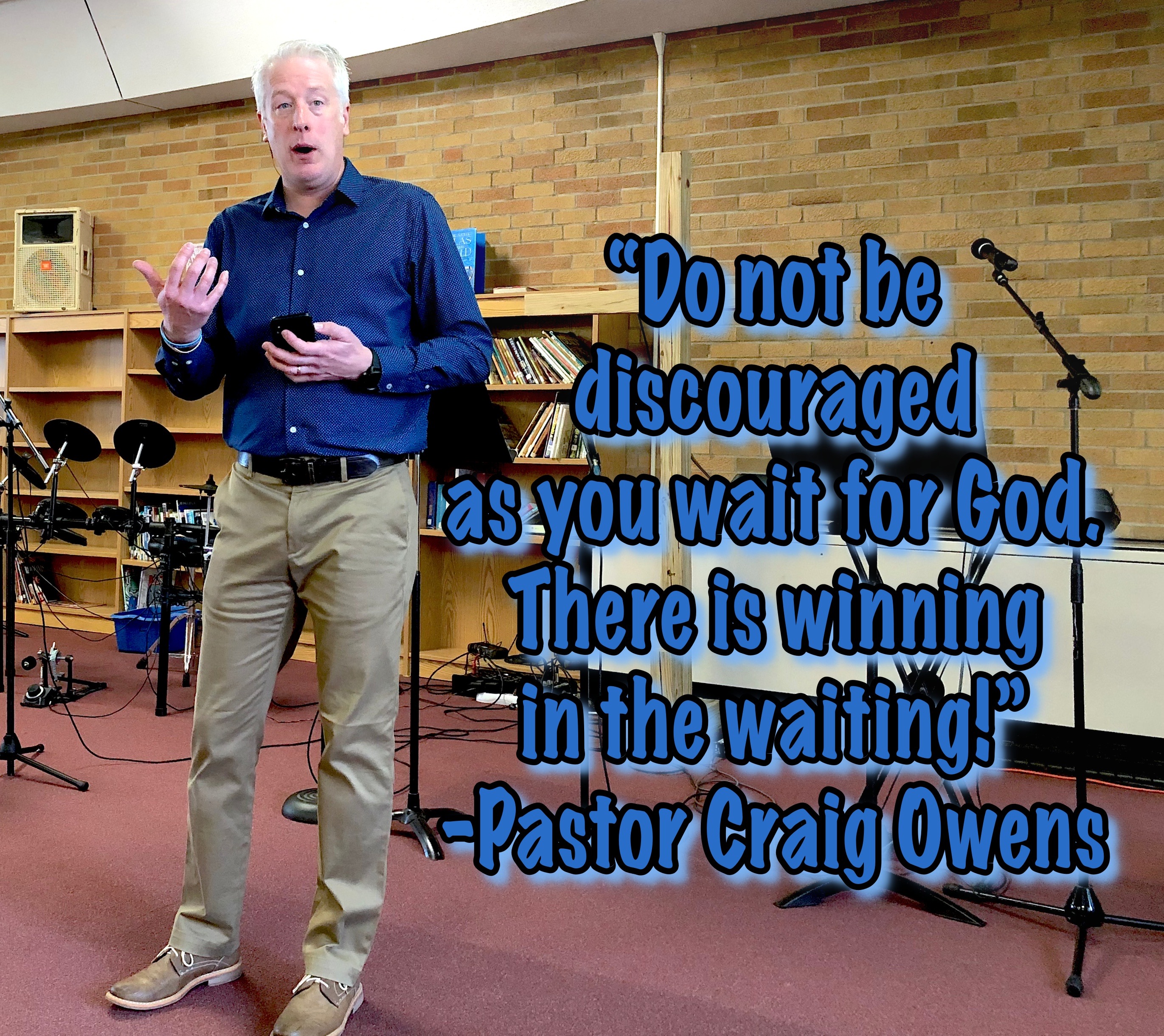






 Craig T. Owens