9 More Quotes From “Marching Off The Map”

Dr. Tim Elmore has given parents, teachers, coaches, and anyone else who works with students some excellent insights in his book Marching Off The Map. Here are a few more quotes from Dr. Elmore.

“The Latin root word for ‘educate’ is ‘ducere’ which means to ‘push out.’ … We should not put students in a passive mode as we teach. We must be inspirers of learning. We must help pull ambition out of them, not push information into them.”

“According to Dr. Michael Leahy, ‘Today’s typical high school student endures the same anxiety levels as a psychiatric patient did in the early 1950s.’ In any given year, about one in five will experience an anxiety attack. Why? Their world is overwhelming, cluttered with information coming at them at the rate of a thousand messages a day.”

“Thousands of Baby Boomers retire each day in America. They will leave leadership positions needing to be filled. Even if everyone in Generation X were a brilliant leader, there would not be enough of them to fill the vacancies left by the Boomers. The young adults among the Millennial Generation will be needed for leadership, ready or not.”

“Although our young adults are rich in potential—we don’t really expect them to perform responsible acts until a full decade later that we expected a century ago. I believe it’s detrimental both for our kids and our society. In many states, we give them the rights to adulthood at 18 or 21, like smoking, drinking or voting. We don’t, however, expect the responsibilities that accompanied those rights. It’s unhealthy. The rights and responsibilities should always go together.”

“Remember that children (in general) cannot comprehend an addictive behavior. Adults must lead them into healthy moderation, where they both understand and enjoy technology, but utilize it as a ‘servant.’ 

“Remember that children will choose ice cream over lima beans—and screens over the healthy alternatives for play. While there are some exceptions, adults must be the ones to lead them in their emotional development, and introduce behaviors and habits that produce maturity.

“Remember that children are drawn to entertainment, whether or not they learn something from it. … Adults must leverage what they’re magnetically drawn to and make it beneficial.”

“Wise leaders utilize vision that can see both backward and forward. They look back and learn from the past. They glean from past mistakes in order to avoid repeating them. Additionally, they seek what was helpful and timeless so they can carry those elements forward. They swing backward so they can swing forward well.”

“A culture that offers the young information and autonomy without requiring equal parts accountability and responsibility produces ‘unready’ adults.”

“Students are incentivized if they know why a topic is relevant before they learn. Students bond with an experience more than a lecture. Students comprehend information when it’s connected to a narrative. Students remember data when an image is utilized in their learning.”

“Effective teachers don’t say as much as possible. They actually say as little as needed—allowing students to get on with their learning.”

You can also check out my review of Marching Off The Map by clicking here. The first set of quotes (and an infographic) I shared from the book are here, and a set of quotes that Dr. Elmore shared in his book are here.

A Leader Must Be Consistent

There was a man…whose name was Job (Job 1:1).

Job is described by the author of this book like this: “that man was blameless and upright, and one who feared God and shunned evil. … This man was the greatest of all the people of the East” (vv. 1, 3).

God Himself described Job like this: “There is none like him on the earth, a blameless and upright man, one who fears God and shuns evil” (1:8). Even after Job’s calamities, God repeats this description and adds, “and still he holds fast to his integrity” (2:3).

satan acknowledged that Job feared God (1:9). But that slanderer accused Job of being a mercenary—that is, he said Job only feared and obeyed God because of what he got out of the bargain (1:10). But the liar missed something: Job’s obedience came before God’s blessing, and Job’s worship came after Job lost all his earthly possessions.

“In all this Job did not sin nor charge God with wrong” (1:22), and “in all this Job did not sin with his lips” (2:10).

A mark of a godly leader is one who acts consistently in good times and bad times.

It’s a good question for godly leaders to ask: why do I obey God? why do I trust Him? why do I fear Him? is it so that I can get something out of it? is it because I’ve already received something? is it so that I can avoid punishment?

Or do I obey, trust, and fear God because He is worthy of all that—and more!—regardless of anything else? Godly leaders consistently ask both sets of questions and answer an assured “Yes” to the last question.

This is Part 14 in my series on godly leadership. You can check out all of my posts on this topic by clicking here.

50 Core American Documents (book review)

“Those who do not learn from history are doomed to repeat it,”  said George Santayana. And if American citizens do not learn our country’s great history of freedom, we might not only repeat painful lessons but lose those hard-won freedoms as well. A great place to start learning is with 50 Core American Documents, compiled by Christopher Burkett.

Many times when we study history, we read a synthesized version of it from an author writing several years (or even decades) after an important American era has passed. There isn’t anything wrong with this, provided that the historian is accurate in his or her portrayal of the events and the people involved in the events. But in this compilation, the “middleman” has been cut out, as you will read the words spoken or written by the history makers themselves. There is no “spin” or interpretation of what was said, but just the words right from the originator.

These documents will take you back to before there was a United States of America, and then through some of the most pivotal and paradigm-shifting times in our history. Truly this compilation of documents should be required reading for anyone serious about understanding and safeguarding the freedoms we enjoy in this great land.

I highly recommend this book to you!

Honk! Honk! Honk!

First of all, I encourage you to watch the first few minutes of the video below for an amazing story about honking horns. Trust me on this one—it’s a memorable story that will go along way toward helping you defeat anxiety when it rears its ugly head in your life.

What kills joy and happiness and gratitude? Anxiety is the killer.

What makes people so full of joy-killing anxiety? In a word: fear. Fear of missing out … Fear of falling short … Fear of not measuring up … Fear of bad things that might happen.

If anxiety kills joy, what kills anxiety? Anxiety—the joy-killer—is itself killed when joy is expressed.

Being grateful for what you have kills the anxiety of what you don’t have.

Being thankful for what you have kills the fear of what you may be missing.

Being grateful for what you have kills the anxiety of the bad stuff that may never even happen.

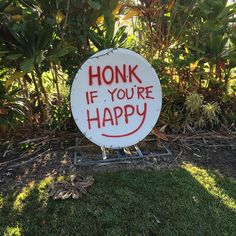
If joy kills anxiety, how can we develop more of it? Most people would say, “If you’re happy, give thanks” or “If you’re happy, honk.” But really it’s the other way around: “If you want to be happy, honk!”

Don’t fret or worry. Instead of worrying, pray. Let petitions and praises shape your worries into prayers, letting God know your concerns. Before you know it, a sense of God’s wholeness, everything coming together for good, will come and settle you down. It’s wonderful what happens when Christ displaces worry at the center of your life. (Philippians 4:6-7)

Honking your thanks is not only good for you, but it’s good for everyone around you who hears your “honk! honk!” of gratitude. David experienced this in Psalm 34:1-3. Even when he was at a low point, when he started praising God other anxious people began to experience joy as well.

Can I challenge you to join me in doing two things for at least the rest of this month:

  1. Keep a gratitude journal in a notebook, on your computer, or in your phone or tablet. Regularly write down those things for which you are grateful.
  2. Don’t keep your gratitude to yourself, but share it with the world. Use hashtag #honk to let people know you are using joy to kill anxiety in your heart.

Honk! Honk! Honk! It’s good for you; it’s good for others; and it brings glory to God.

Saturday In The Psalms—Don’t Be A Fool

The fool has said in his heart, “There is no God” (Psalm 53).

You can choose this paradigm if you like. But if you do, here’s what you can expect—

Corruption … you will reap from others the corruption you sow

No one seems trustworthy … you will live your life untrusting and not being trusted

Limited understanding … “without God we’re just a lucky convergence of matter and energy, and after death there’s a vast nothing,” says the fool. But anyone who’s ever fallen in love knows there is something more than just matter and energy.

Everyone seeks his own self-interest … no one does good just to do good (we’re back to the untrusting lifestyle again!)

Fear and terror of the unknown … these lurk constantly in the back of your mind

Missing out on eternal blessings … what if you’re wrong? what if there really is a God who wants to be in relationship with you? If that’s true, you are squandering your life. You are living for the moment, and about to miss out on an eternity of pleasure in God’s presence.

A fool sticks his fingers in his ears, closes his eyes, and refuses to even consider an alternative—“There. Is. No. God!”

Don’t be a fool!

Will you at least be willing to consider the possibility that this Universe was created on purpose? Will you at least be willing to consider that the Creator made you to have a relationship with Him?

The fool tries to make all of life fit into his tiny box. The wise person knows there’s so much more.

Don’t be a fool!

Praying Against Spiritual Strongholds

“This week we pray that God will demolish the Antichrist’s strongholds

“We are surrounded by systems and strongholds that oppose Christ the Lord and King. There are social, political, economic, and legal structures and schemes that try to disparage God.

“We are not for or against a particular political system. We are Bible-believers, Christ-worshippers; and we come from all walks of life and backgrounds. We seek the glory of God and His alone. We align ourselves with His Word.

“We should not harbor enmity or hatred toward anyone. Even if they oppose us, deride our faith, doubt our God, and insult our Savior and King, they are not our enemies. The real enemy is satan who manipulates them. Our war is against satan and his strongholds.

“Such people are poor humans who need love and compassion from us, and mercy and forgiveness from God. We do not depend on human methods or material weapons, because this is spiritual warfare against satanic powers. Rather, our method is prayer, and that is all.

“Our prayer—O Lord our God, may You be praised for ever and ever! Why do the nations rage? Why do the peoples plot in vain? The kings of the earth set themselves, and the rulers take counsel together, against You and against Your Anointed One (Psalm 2:1-2).

“Help us arm ourselves with the weapons You gave us in Your Word: the belt of truth, the breastplate of righteousness, the readiness of the gospel of peace, the shield of faith, the helmet of salvation, and the sword of the Spirit (Ephesians 6:14-17).

He who sits in the heavens laughs; the Lord derides them … at the name of Jesus every knee will bow, in heaven and on earth and under the earth, and every tongue confess that Jesus Christ is Lord, to the glory of God the Father (Psalm 2:4; Philippians 2:10-11). I pray in the mighty name of Jesus. Amen.” —a prayer from Praying For Muslims

Thursdays With Oswald—Is Jesus My Master?

Oswald ChambersThis is a weekly series with things I’m reading and pondering from Oswald Chambers. You can read the original seed thought here, or type “Thursdays With Oswald” in the search box to read more entries.

Is Jesus My Master?

     To have a master and to be mastered are not the same thing, but diametrically opposed. If I have the idea that I am being mastered, it is a sure proof that I have no master. If I feel I am in subjection to someone, then I may be sure that that someone is not the one I love. To have a master means to have one who is closer than a friend, one whom I know knows me better than I know myself, one who has fathomed the remotest abyss of my heart and satisfied it, one who brings me the secure sense that he has met and solved every perplexity of my mind—that, and nothing less, is to have a master. … 

     Our Lord never takes measures to make us obey Him. Our obedience is the outcome of a oneness of spirit with Him through His Redemption. That is why, whenever Our Lord talked about discipleship, He prefaced it with an “IF”—“you do not need to unless you like”; but—“If any man will be My disciple, let him deny himself.” 

From So Send I You

After reading Oswald Chambers’ definition of a loving master, would you say Jesus is your Master?

After reading what Chambers says about obedience being an expression of love, would you say you obey your master out of love or out of duty?

How you answer these questions makes all the difference in how you live as a disciple of Jesus.

Antidote For Anxiety

Anxiety is a joy-crushing, life-sapping, happiness-draining burden. Anxiety is also something that plagues more people around us than we care to admit.

But there is hope in our anxiety, because there is an antidote for our anxiety.

The Bible outlines a simple strategy that helps us not only recover from the downward pull of anxiety but also shows us how to quickly fight off anxiety the next time it rears its ugly face in our hearts.

Join me at Calvary Assembly of God every Sunday in November as we share the antidote for anxiety that will set you free and restore your happiness.

8 Quotes From “Live Dead Journey”

Live Dead Journey are notes from missionaries on the front lines. You can check out my book review by clicking here. One of the things that stood out to me was the focus of these “tour guides” on their time abiding with Jesus. Here are some quotes that share their heart on this.

“Abiding time is extravagant daily time with Jesus.” –Dick Brogden

“Jesus spent close to 90 percent of His life in a village of twelve families, and even His three years of ministry were characterized by time alone with the Father. Moses spent forty years in Midian and had multiple trips to the mountain with God. Paul spent thirteen years in preparation, some of it in the Arabian Desert, and prayed constantly. Adam, Joseph, David, Elijah, Daniel, Mary, John, and others all gave God extravagant time. When we examine the lives of any heroes of the faith, we can see that they lingered daily with Jesus.” –Dick Brogden

“Jesus has become my safe place. When stability is not present in life here, I can lean on Him. When friends are not constant, Jesus is. He knows what I need and provides everything. Jesus is enough for me.” –Joy Hawthorne

“I’ve learned that not spending time with Jesus today is one step in not spending time with Him tomorrow.” –Miriam Davis

“One thing I have discovered is that I can’t survive throughout the day on just one block of time with Jesus. So at some other point in my day, I spend time basking in His presence. … Abiding is a lifestyle.” –Eva Bridges

“To help draw out the lessons from a passage, I now look for the following. Is there:

  • A command for me to obey?
  • A promise for me to claim?
  • A sin for me to avoid or repent of?
  • An example for me to follow (good) or avoid (bad)?
  • A truth to believe?
  • A prayer to pray?” –Jeff Griffin

“I’ve realized that what I desire I become–Jesus is my desire, and I want to be like Him.” –Cathy Stone

“How extravagant are you toward Jesus with your time? Do you lavish time on Jesus? Do you give Jesus the most energetic and focused times of your day? Or do you tend to give Jesus the crumbs of your schedule?” –Dick Brogden