The Best Way To De-Stress

Listen to the podcast of this post by clicking on the player below, and you can also subscribe on AppleSpotify, or Audible. 

Of all the things that rob a Christian of peace and robust mental health, stress has to be near the top of the list. There are so many stressors in our lives that to not find a way to actively de-stress is to choose to remain stressed. This is sort of like fertilizing the weeds, as we learned in our second mental health strategy. 

A certain amount of stress is good for us—doctors call this eustress. Our bodies have been designed by God with a hormone called cortisol that helps us respond to stressful situations, and He also designed that the unused cortisol be flushed from our bodies as we sleep and exercise. However, when we become stressed, many times sleep and exercise are squeezed out of our lives. 

Men’s Health magazine reported, “You personally may dictate when you’ll die. After studying 1633 men for 30 years, Purdue scientists found that worrying takes 16 years off your life. Negative thinking triggers the release of cortisol, a stress hormone that can be dangerous when elevated for long periods of time.” 

The eustress can degrade into distress if we’re not attentive to this downward slide. The excess cortisol that is allowed to remain in our bodies leads to unhealthy responses—like sleeplessness, starvation or binge eating, and little to no exercise. These unhealthy factors are further exacerbated by our diminished coping skills that come from the damage done to the hippocampus in our brain. Lingering cortisol kills the neurons in this memory center of our brains, which makes it harder for us to recall past lessons that could help us resolve stress. 

Sadly, distress can become its own downward cycle as the unhealthy responses and diminished coping skills negatively impact our lives, creating even more stressors. 

Stress makes us:

  1. Self-focused 
  2. Short-sighted 
  3. Stingy with our time, possessions, and even God’s promises 

But there is a word of hope for us. William James noted, “The greatest weapon against stress is our ability to choose one thought over another.” 

I want to give you one thought—one word, one action—to combat stress: Bless. 

Blessing others takes the focus off myself. Blessing God puts the focus on Him. 

In the Gospels, we see people who had suffered the ravages of stress, encounter Jesus, find freedom, and then begin to bless others as a preventative to returning to their stress-filled lives. We can see a few examples in healed women, a man delivered from demons, and a woman who had lived a less-than-virtuous life (Luke 8:1-3, 26-39; 7:36-50). 

Frequently, the Old Testament psalmists shared how blessing God and others brought them out of their stressful situations. A great example comes from David when he chose to bless God in a stressful place, and ended up being a blessing to other afflicted people around him (Psalm 34:1-6). 

When you feel stress mounting, you need to get active. Feelings follow actions. We usually won’t feel ourselves into action, but we can act ourselves into feelings. 
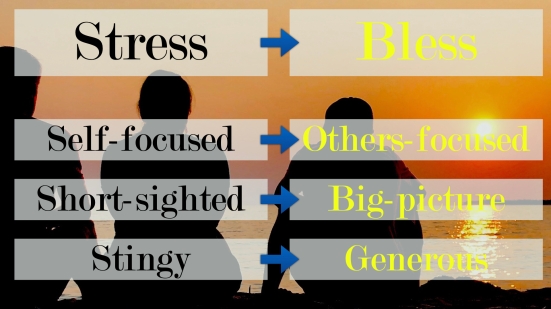
The best way to de-stress is to bless! 
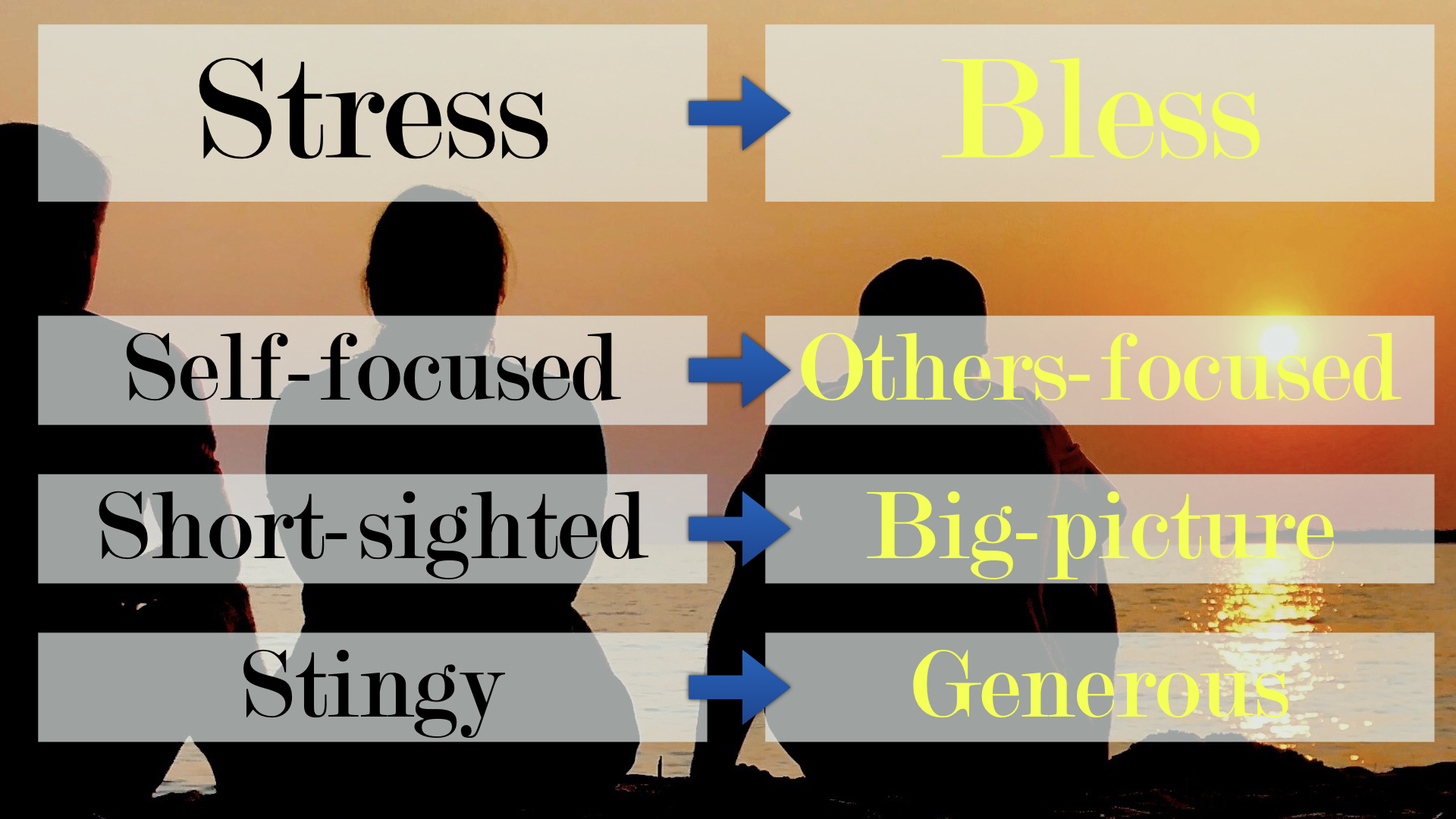
As we bless, look at the shifts that take place: 

  1. Instead of remaining self-focused we become others-focused 
  2. Instead of being short-sighted we get a big-picture orientation 
  3. Instead of being stingy with our possessions and God’s promises we become generous

Remember that in the distress cycle I mentioned earlier the brain cells in the hippocampus were being damaged? The excess cortisol literally kills those neurons. The good news is that the hippocampus is one of the few places in the brain that experiences neurogenesis after cortisol is flushed. When you replace stressing with blessing, and the cortisol is regularly flushed from your body, brain cells are regenerated in your hippocampus. In essence, you are developing both a new brain and a new mind. 

The apostle Paul wrote, “Put off, concerning your former conduct, the old man which grows corrupt according to the deceitful lusts, and be renewed in the spirit of your mind, and that you put on the new man which was created according to God, in true righteousness and holiness” (Ephesians 4:22-24 NKJV). 

Don’t let stress steal life from your years and years from your life. De-stress by blessing God and blessing those around you. 

If you’ve missed any of the previous eight mental health strategies that I have shared in this series, you can find them all by clicking here. 

►► Would you please prayerfully consider supporting this ministry? My Patreon supporters get behind-the-scenes access to exclusive materials, like this exclusive video in which I take my supporters behind the scenes of my thought process in designing my confrontation flowchart. ◀︎◀︎


Links & Quotes

Healthy leaders look in the mirror first before they confront a teammate on something that needs to change. Check out the full conversation Greg and I had on The Craig and Greg Show about defeating the two-headed leadership killer of ignorance and arroganceI have lots of new content every week, which you can check out on my YouTube channel.

“I am often, I believe, praying for others when I should be doing things for them. It’s so much easier to pray for a bore than to go and see him.” —C.S. Lewis, Letters to Malcolm: Chiefly on Prayer

“The greatest weapon against stress is our ability to choose one thought over another.” —William James

The most empowered and empowering person is the one who remains in Jesus.

“Whereas three or more incidents of intense stress within a year (say, serious financial trouble, being fired, or a divorce) triple the death rate in socially isolated middle-aged men, they have no impact whatsoever on the death rate of men who cultivate many close relationships.” —Daniel Goleman, Richard Boyatzis & Annie McKee, Primal Leadership

T.M. Moore has an outstanding series of posts on how Christians should interact with the governments in the lands in which they live. I highly recommend this series to you. T.M. wrote, “We have seen that justice is a jewel of many facets. In its obligatory facet, justice requires that we love our neighbors simply because they are made in the image of God. We must regard them, and do with them, as we wish to be regarded and done with ourselves. In its preventive facet, justice demands that we use forethought in all our actions to make sure, as far as possible, that our neighbor or his property is not injured by what we do. Distributive justice encourages us to share generously with our neighbors and others in need. Restorative justice comes into play when the balance of neighbor love has become disturbed and the one guilty of disturbing it is required to set things right again. Each of these forms of justice, grounded in the Law of God, is very much a part of life in our society today. It is simply mindless or prejudicial to insist that we should have no input from Scripture or the Law of God, either in the public square or in the making of public policy. Our nation was founded on Biblical principles of justice, and to deny this is to rewrite history past and to put in jeopardy history to come.”

The Greek word translated as “consider” in Hebrews 3:1 means to observe closely, to consider attentively, to fix your eyes or mind upon it. In its context, this verb is usually directing us to the end result of being in awe, kindling a renewed faith, and being rejuvenated with a new resolve to move forward. This is what happens especially when we consider Jesus❣️

13 Quotes From Others In “Developing The Leader Within You 2.0”

John Maxwell does an excellent job of including insightful words from other authors—past and present—in his books. Developing The Leader Within You 2.0 is no exception. Here are a few of the quotes he shared. 

“There have been meetings of only a moment which have left impressions for life, for eternity. No one of us can understand that mysterious thing we call influence… Yet out of everyone of us continually virtual goes, either to heal, to bless, to leave marks of beauty; or to wound, to hurt, to poison, to stain other lives.” — J.R. Miller 

“The art of being wise is knowing what to overlook.” — William James 

“A man of character will make himself worthy of any position he is given.” —Mahatma Gandhi 

“Nothing is easier than saying words. Nothing is harder than living them, day after day.” —Arthur Gordon 

“We set young leaders up for a fall if we encourage them to envision what they can do before they consider the kind of person they should be.” —Ruth Haley Barton 

“What we achieve inwardly will change outward reality.” — Plutarch 

“Success leads to the greatest failure, which is pride. Failure leads to the greatest success, which is humility and learning.” — David Brooks 

“Our world has replaced the word soul with the word self, and they are not the same thing. The more we focus on our selves, the more we neglect our souls.” — John Ortberg 

“The most effective leaders approach problems through a lens of opportunity.” —Glenn Llopis 

“Face reality, and let your first loss become your last loss.” —Larry Maxwell 

“If we learn to appreciate more of what we already have, we’ll find ourselves having even more to appreciate.” —Michael Angier 

“No one is useless in this world who lightens the burden of it for someone else.” —Benjamin Franklin 

“Everybody can be great, because everybody can serve.” —Martin Luther King Jr 

You can check out my full book review of Developing The Leader Within You 2.0 by clicking here. And you can also read some John Maxwell quotes from this book here. 

12 Quotes From “JumpStart Your Growth”

JumpStart Your GrowthJumpStart Your Growth is a companion book to The 15 Invaluable Laws Of Growth by John Maxwell. Check out my review of both of these books by clicking here. These are some of the quotes I appreciated from JumpStart.

“The time comes when you need to stop waiting for the man you want to become and start being the man you want to be.” —Bruce Springsteen

“Growing involves admitting you don’t have the answers, and it requires that you get over any fear you may have of making mistakes or looking foolish. And I found that I had to get started if I wanted to find the best way. That is the price of admission if you want to improve.” —John Maxwell

“If you want to get from where you are to where you want to be, you have to start by becoming aware of the choices that lead you away from your desired destination.” —Darren Hardy

“No factor is more important in people’s psychological development and motivation than the value judgments they make about themselves. Every aspect of their lives is impacted by the way they see themselves.” —Nathaniel Branden

“You need to learn to become your own encourager. Every time you do a good job, don’t just let it pass; give yourself a compliment. Every time you choose discipline over indulgence, don’t tell yourself that you should have anyway; recognize how much you are helping yourself. Every time you make a mistake, don’t bring up everything that’s wrong with yourself; tell yourself that you’re paying the price for growth and that you will learn to do better next time. Every positive thing you can say to yourself will help.” —John Maxwell 

“Act as if what you do makes a difference. It does.” —William James

“If there is an area in your life that seems overwhelming to you—health, work, family, or something else—try chipping away at it a little bit every day instead of trying to tackle it all at once. … Discipline is a morale builder. Boost yours by taking small steps that will take you in a positive direction.” —John Maxwell 

“At the end of each day, you should play back the tapes of your performance. The results should either applaud you or prod you.” —Jim Rohn

“There are two primary choices in life: to accept conditions as they exist, or to accept the responsibility for changing them.” —Denis Waitley 

“Rarely does a haphazard approach to anything succeed, and if it does, it’s not repeatable.” —John Maxwell

“Train yourself to fight for positive changes. Remember that your choices will lead to either the pain of self-discipline or the pain of regret.” —John Maxwell

“You can’t improve and avoid change at the same time.” —John Maxwell

Links & Quotes

link quote

Some good reading from today…

“Therefore it is the duty of a brave man not to shut his eyes when anything threatens, but to put it before him and to search it out as it were in the mirror of his mind, and to meet the future with foreseeing thought, for fear he might afterwards have to say: This has come to me because I thought it could not come about. If misfortunes are not looked for beforehand, they quickly get a hold of us.” —Ambrose

Sad: The Presbyterian Church (USA) votes to NOT denounce infanticide. Seriously?!?

Turn off the tube: “The study involved more than 13,200 adults in Spain who were all college graduates, and were around 37 years old at the study’s start. Participants were followed for about eight years, over which there were 97 deaths. Those who watched three or more hours of TV a day were twice as likely to die over the study period, compared with those whose watched TV for one hour or less daily, the study found. And, oddly, even compared to other activities that are sedentary—like driving a car or using a computer—watching TV still appears to be deadlier.”

A good overview of ISIS in Iraq.

A challenging thought from Dr. Tim Elmore for anyone who works with students: Addictions: One Reason Not To Take The Easy Road.

“Act as if what you do makes a difference. It does.” —William James 

“Small deeds done are better than great deeds planned.” —Peter Marshall


Keep Going

Keep GoingI don’t mean to say that I have already achieved these things or that I have already reached perfection. But I press on to possess that perfection for which Christ Jesus first possessed me. No, dear brothers and sisters, I have not achieved it, but I focus on this one thing: Forgetting the past and looking forward to what lies ahead, I press on to reach the end of the race and receive the heavenly prize for which God, through Christ Jesus, is calling us. (Philippians 3:12-14)

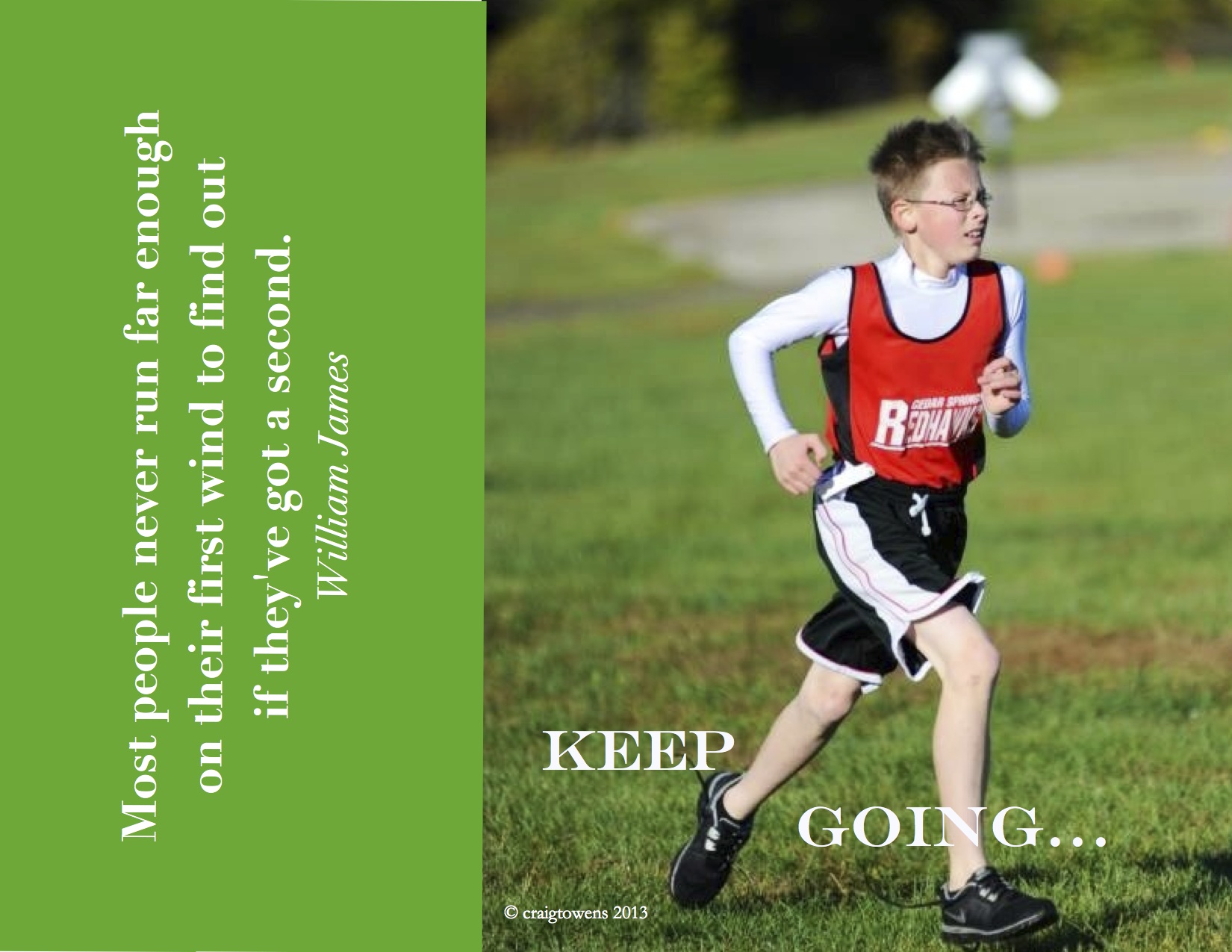
“Most people never run far enough on their first wind to find out if they’ve got a second.” —William James

When things go wrong, as they sometimes will,
When the road you’re trudging seems all uphill,
When the funds are low but the debts are high,
And you want to smile but you have to sigh,
When care is pressing you down a bit…
Rest if you must, but don’t you quit!

Life is queer with its twists and turns,
As every one of us sometimes learns,
And many failures turn about
When we might have won had we stuck it out.
Don’t give up though the pace seems slow…
You may succeed with another blow.

Often the struggler has given up
When he might have captured the victor’s cup;
And he learned too late when the night came down,
How close he was to the golden crown.

Success is failure turned inside out…
And you can never tell how close you are
It may be near when it seems so far.
So stick to the fight when you’re hardest hit
It’s when things seem worst that you must not quit. —Edgar A. Guest

Winner Or Whiner?

This morning on John Maxwell’s “Minute With Maxwell” he said: “Winners know they have to do the right thing and then they’ll feel good. Whiners want to feel good before they do the right thing.

I have learned this is true in my life. If I wait until I feel like do something, I’ll make all kinds of excuses to avoid doing it. But if I do what I know I’m supposed to do I’ll feel good that I did it.

Good feelings follow good actions.

Winners do right to feel good.

Whiners wait to feel right before they do anything.

Behavioral psychologist William James wrote: “Action seems to follow feeling, but really action and feeling go together; and by regulating the action, which is under the more direct control of the will, we can indirectly regulate the feeling, which is not. Thus the sovereign voluntary path to cheerfulness, if our cheerfulness be lost, is to sit up cheerfully and to act and speak as if cheerfulness were already there.” (emphasis mine)

So let me ask you: Are you going to be a winner or a whiner today?