Peter spent 3+ years with Jesus, and when he was asked to sum up Christ’s ministry he simply said, “He went around doing good and healing all who were under the power of the devil” (Acts 10:38).
I’ve had a good friend recommend a musical artist to me and I haven’t enjoyed the music.
I’ve had a good friend take me to a restaurant I haven’t liked.
I’ve had a good friend tell me how wonderful a certain movie was, and I thought it was a dud.
And I’m sure some of my good friends could say the same thing about my recommendations.
But you know what? All of these folks are still my friends.
I’ve never had one person say to me, “Your restaurant suggestion was awful. I’m unfriending you on Facebook and blocking your number from my phone. I never want to see or hear from you again!”
Yet sometimes I think church-going Christians feel like this might happen if they invite a friend to come to their church.
Seriously?!
Let’s consider the odds—
How likely is it that if you invite a friend to church and they say “no” that they are also going to say, “Get out of my life forever”?
If they do accept your invitation, but find that your church wasn’t a good fit for them, how likely is it that they’re going to say, “We can never hang out again”?
I think you would agree with me that both of these responses are highly unlikely!
But consider the other side—what if you invite them to your church and they say “yes”? What if after attending your church they like it? And what if by attending your church they enter into a personal relationship with Jesus?
If that happens, you’ve changed the course of their eternal destiny!
Instead of focusing on the worst-case scenarios (which seem highly unlikely), we should be focusing on the best-case scenario!
If you’re still uneasy about inviting someone to your church, or even trying to have a conversation with them about your personal faith, here is a simple phrase to consider: Come and see.
Invite them to come and see your lifestyle that seeks to glorify Jesus (see Matthew 5:16). Let them see that you live your life like Jesus: doing good (Acts 10:38).
Invite them to come and see the Creator behind the creation (see Psalm 66:5). Whenever there is a discussion about the weather, or nature, or a medical science breakthrough, ask them, “Have you ever thought that if there is such a beautiful design there must also be an intelligent Designer?”
Christian, you have the best news ever! Don’t keep it to yourself. Invite those around you to come and see what a personal relationship with Jesus Christ is all about. Who knows? You may be a part of changing someone’s eternal destiny.
Ty Cobb was baseball’s first superstar and its first inductee into the Major League Baseball Hall of Fame. Yet when most people think of him, they think of a racist jerk. Was he? Charles Leerhsen unpacks Ty Cobb’s life in an outstanding biography entitled Ty Cobb: A Terrible Beauty.
Leerhsen himself initially believed all the negative reports about Cobb. He wrote:
“When I started researching this book I believed, like a lot of people, that Ty Cobb was a maniac, meaning a racist and a mean, spikes-sharpening son of a bitch. This was not a professional opinion based on knowledge; it was an assumption based on stories I’d been hearing all my life. People said it in bars; Ken Burns said it in his baseball documentary, so it must be true—that sort of thing. That I’d come to this conclusion without investigating the matter myself made the myth more, not less, powerful for me. … The experience [of researching and writing this book] taught me a lesson about how assumptions can shape our thinking, and hence our lives. Just because you’ve heard something a thousand times doesn’t mean it’s true.”
As Leerhsen began meticulously going through the real-time daily accounts of Cobb’s life, when he began reviewing original source material, all his preconceived ideas about Ty Cobb began to melt away. Leerhsen discovered that an opportunistic journalist named Al Stump almost wholly made up the derogatory claims about Cobb from unnamed sources. And as the cliche goes, the bad stuff is easier to believe than the good stuff, so the lies about Cobb stuck.
Ty Cobb was a phenomenal baseball star. He set 90 Major League records in his career, and he still holds the records for:
Combined runs scored and runs batted in (4065)
Highest career batting average (.366)
Most batting titles (11)
Most steals of home (54)
Stealing second, third, and home in succession (5) … once he did that on consecutive pitches!
The youngest player to compile 4000 hits and score 2000 runs
Not only does Leerhsen rebut all of the lies about Cobb, but he uncovers the life of a man who almost singlehandedly made Major League Baseball the national pastime that it became.
There’s also a great lesson to be learned here—never judge someone by what “they” say, but get the facts for yourself!
All baseball fans—and especially Detroit Tigers fans like me—will thoroughly enjoy this book.
The prophet Nathan confronted David after David had committed adultery with another man’s wife, gotten her pregnant, and then had her husband killed to try to cover up their affair. David assumed he had gotten away with it, but God sent Nathan to tell David that He knew all about it.
His prayer is instructive for us when we sin too. David’s appeal to God for forgiveness is based solely on God’s ability and willingness to forgive, not on any merits David brings.
In this prayer, David presents a tally sheet. On his side of the ledger, he lists my transgressions, my iniquity, my sin, my bloodguilt. He sums it up with, “Against You, You only, have I sinned and done what is evil in Your sight.”
David also tallies up God’s side of the ledger: You are right, You are just, You are righteous.
We might be tricked into thinking that a Perfect Being like this wants nothing to do with a sinful creature like you and me. But this is completely wrong! David appeals to God’s unfailing love, and Your great compassion. He lists God’s desire to cleanse, wash, blot out sins, restore, and release from blood-guiltiness.
David said, “I have sinned against the Lord.” And immediately Nathan responded, “The Lord has taken away your sin.”
Sin is all on me! Restoration is all on God!
With this in mind, we learn that the mark of a maturing Christian is not one who never sins, but one who…
…feels a broken heart because of their sin (see Psalm 51:10)
…confesses my sin
…confidently asks for His forgiveness
…helps others who have sinned (v. 13)
…continues to abide in Jesus (vv. 10-12)
God is quick to forgive. Are we equally as quick to ask for His forgiveness?
You can study more of the lessons from the prayers of David:
David hasn’t done anything wrong. He’s never tried to lead a rebellion against King Saul. In fact, he’s never even talked poorly about Saul. And yet Saul is out to kill David!
David tries to get as far away as he can, choosing to live in the desert so that he might get some relief from Saul. Still Saul comes after him with a force of 3000 men! Every time David moves, Saul’s men are hot on his trail. David described his situation like this—
My mortal enemies surround me. Their hearts are cold and calloused toward me, and they speak terrible things about me. They track me down and surround me. They are like hungry lions, crouching, waiting to pounce on me!
If you were in David’s sandals, how confident would you be that God could get you out of the situation? Remarkably, David’s confidence was as high as it could be!
David not only was confident that God would hear him, but that He would listen to him. More than that, David knew God would pay attention to him. And then David boldly said, “I call on You, O God, for you WILL answer me.”
How could David pray such a confident prayer? The answer is in this principle…
There is a direct correlation between intimacy and confidence.
David made two very intimate claims about his relationship with God:
You will keep me as the apple of Your eye
You hide me in the shadow of Your wings
The apple of the eye is the pupil. Our eyes are amazingly designed to not only take in information but to protect themselves. If something is getting too close to our eye, the eyelids blink in protection faster than we can consciously tell them to. So David was claiming that God would protect him by reflex!
The shadow of Your wings was a reference to the top of the Ark of the Covenant; a place called the mercy seat. Here is where the priest sprinkled the blood of a sacrificial lamb to atone for the people’s sin and to appeal to God’s mercy. The mercy seat was over-shadowed by two angels’ wings.
David was saying that God kept him in this intimate place—covered by God’s mercy and protection!
Jesus also told us about intimate confidence when He said, “If you remain in Me, and My words remain in you, ask whatever you wish, and it will be given you” (John 15:7).
Intimacy: remain IN Jesus, and let His words remain IN you
Confidence: ask whatever you wish, and it will be given you
Are your prayers this confident? If not, don’t work on raising your confidence, but work on increasing your intimacy. Check your intimacy level with questions like:
Am I abiding in Jesus?
Are His words abiding in me?
Do I have any unconfessed sin?
Is my prayer a “Your kingdom come, Your will be done” prayer?
Focus on intimacy, and then watch your confidence soar!
If you are interested in learning more about the prayers of David, I have also discussed his prayer for help, his prayer of crying out loud, and his prayer of praise.
“The idea which here shuts out the Second Coming from our minds, the idea of the world slowly ripening to perfection, is a myth, not a generalization from experience. And it is a myth which distracts us from our real duties and our real interest. It is our attempt to guess the plot of a drama in which we are the characters. But how can the characters in a play guess the plot? We are not the playwright, we are not the producer, we are not even the audience. We are on the stage. …
“The doctrine of the Second Coming teaches us that we do not and cannot know when the world drama will end. The curtain may be rung down at any moment: say, before you have finished reading this paragraph. This seems to some people intolerably frustrating. So many things would be interrupted. Perhaps you were going to get married next month, perhaps you were going to get a raise next week: you may be on the verge of a great scientific discovery; you may be maturing great social and political reforms. Surely no good and wise God would be so very unreasonable as to cut all this short? Not now, of all moments!
“But we think thus because we keep on assuming that we know the play. We do not know the play. We do not even know whether we are in Act I or Act V. We do not know who are the major and who the minor characters. The Author knows.” —C.S. Lewis, in The World’s Last Night
This is a great portrayal of a conversation between J.R.R. Tolkien and C.S. Lewis on the value of myths…
David shows us a picture of a man who made prayer the cornerstone of all he did. He’s quick to cry, “Help!” when he’s in trouble, and he doesn’t hold back when he’s crying out to God.
But he also shows us that prayer isn’t just for times of trouble. Prayer should be an ongoing conversation with God so that we can get to know His heart. God knows what’s going to happen (Isaiah 46:10), and He wants us to ask Him to make things clear to us (Jeremiah 33:3).
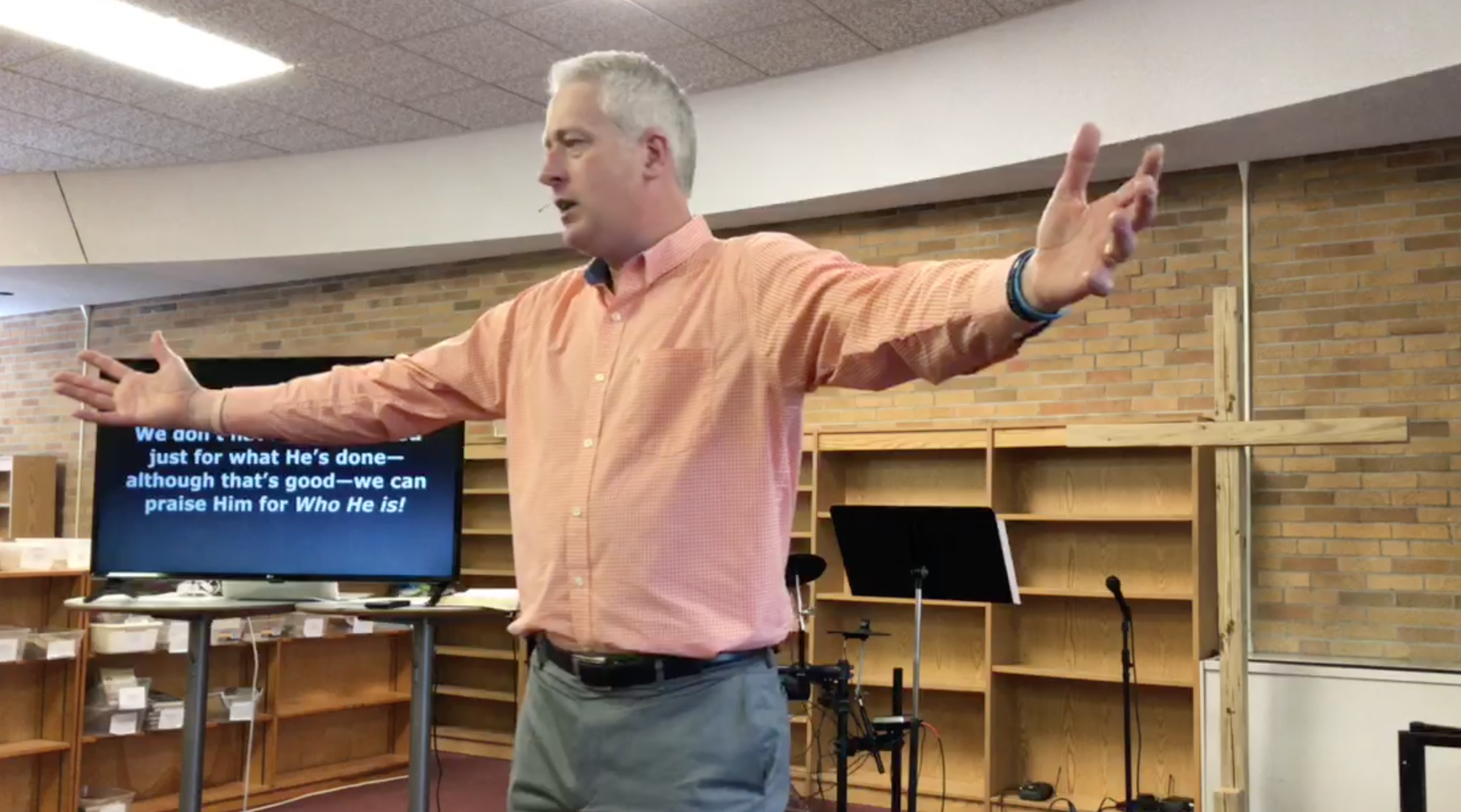
In Psalm 145, David challenges us to lift up our praise to God, as well as our prayers. This psalm of praise teaches us that we don’t have to only praise God for what He’s done—although that’s a great thing to do—but we can also praise God simply for Who He is!
In this psalm, David says God is…
…worthy of praise (v. 3a)
…great beyond comprehension (v. 3b)
…majestic (v. 5)
…awesome (v. 6)
…abundantly good (v. 7)
…gracious, compassionate, slow to anger, rich in love (v. 8)
…good to all (v. 9)
…mighty (v. 11)
…everlasting (v. 13)
…strong (v. 14)
…righteous and loving (v. 17)
…near to us (v. 18)
…fulfilling (v. 19)
…watchful (v. 20)
Let’s not be known just for our petitions, but for our praise.
Let’s not be known just for our “Help!” but for our “Hallelujah!”
Mark Batterson’s newest book—Whisper—is all about learning to hear what God is speaking to you. Check out my review of Whisper by clicking here.
“Is God’s voice the loudest voice in your life? That’s the question. If the answer is no, that’s the problem.”
“If you aren’t willing to listen to everything God has to say, eventually you won’t hear anything He has to say.”
“When someone speaks in a whisper, you have to get very close to hear. … And that’s what God wants.”
“God is great not just because nothing is too big; God is great because nothing is too small. God doesn’t just know you by name; He has a unique name for you. And He speaks a language that is unique to you.”
“We worry way too much about what people think, which is evidence that we don’t worry enough about what God thinks. It’s the fear of people that keeps us from hearing and heeding the voice of God. We let the expectations of others override the desires God has put in our hearts.”
“Every thought that fires across our eighty-six billion neurons is a tribute to the God who knit us together in our mothers’ wombs. But when we have a thought that is better than our best thoughts on our best day, it might be from God. That doesn’t make it equal with Scripture, but it’s a step above a ‘good idea.’ Is it easy differentiating between good ideas and God ideas? No, it’s not. And again, even what we perceive to be God ideas must be screened by Scripture. But when God gives us ideas that we don’t believe originated with us, we must be careful to give credit where credit is due. And it’s our job to take those thoughts captive and make them obedient to Christ.”
“If your life is off-key, maybe it’s because you’ve been deafened by the negative self-talk that doesn’t let God get a word in edgewise. Maybe you’ve listened to the voice of shame so long that you can’t believe anything else about yourself. Or maybe it’s the enemy’s voice of condemnation that speaks lies about who you really are.”
There’s a time when David was fainting and had no one to help him—my spirit was overwhelmed and fainted, throwing all its weight on me. I look for someone to come and help me, but no one gives me a passing thought! No one will help me; no one cares a bit what happens to me (Psalm 142:3-4).
Here’s the backdrop to this prayer. King Saul has tried to kill David twice, not including the time Saul sent assassins to David’s house to kill him there. Even Jonathan, Saul’s son, was embarrassed and grieved at his father’s shameful treatment of David.
David runs away from Saul so quickly that he doesn’t take any food or even a weapon. He literally only has the clothes on his back and the sandals on his feet. He’s able to get some day-old bread from Ahimelech the priest, and he also takes Goliath’s sword from the temple.
David is clearly not thinking clearly. He is wearing Goliath’s sword on his side. Remember that David killed Goliath. Goliath is from Gath. And where does David run? To Gath!! He has to pretend he’s gone insane in order to escape from Gath, and he flees to the cave of Adullam.
It’s here that he prays an intense prayer. How intense? David literally shouts this prayer. He uses phrases like:
I cry aloud to the Lord
I lift up a thundering voice to God to plead for mercy
I let my complaint gush out in front of God, not holding anything back
He cries to God, “You are all I really want in life” and “You’re my last chance, my only hope for life”
After he did all that, he still says, “God, listen to my even louder cry!
Just how desperate is your situation? Just how heavy is your burden? Have you come to the realization that God is your ONLY help? Then, like David, cry out louder and louder to Him until He answers you!
A blind man got the attention of Jesus by yelling at the top of his lungs, “Jesus, Son of David, have mercy on me!!” Jesus said that this man’s faith healed him. What was the demonstration of his faith? It was the persistent calling out to the only One who could help him.
Earlier in this chapter, Jesus says this: So what makes you think God won’t step in and work justice for His chosen people, who continue to cry out for help? Won’t He stick up for them? I assure you, He will. He will not drag His feet. But how much of that kind of persistent faith will the Son of Man find on the earth when He returns? (Luke 18:7-8).
Once again Jesus links a continual cry for help to the definition of persistent faith.
So I’ll ask again: just how desperate are you for God to answer you? If you will cry out loud to Him, God will see your persistent faith and will step in and work for you.



 Peter spent 3+ years with Jesus, and when he was asked to sum up Christ’s ministry he simply said, “He went around doing good and healing all who were under the power of the devil” (Acts 10:38).










 Craig T. Owens