Supernatural Interference

The foundational claim of Christianity is Jesus died AND rose to life again. The Apostle Paul says that if the resurrection didn’t happen, anyone who claims to be a Christian is in a world of hurt (1 Corinthians 15:3-4, 14, 17-20).  

“But resurrected from the dead?! Really? I believe in facts. I believe in the laws of science.” Me too! But I also believe that the supernatural is not the opposite of belief in the natural. Just like Paul said, “Why should any of you consider it incredible that God raises the dead?” (Acts 26:8). 

Noted astronomer Allan Rex Sandage said, “It is my science that drove me to the conclusion that the world is much more complicated than can be explained by science. It was only through the supernatural that I can understand the mystery of existence.”

And C.S. Lewis added, “How can anything be seen to be an exception till the rules are known? … Nothing can seem extraordinary until you have discovered what is ordinary. Belief in miracles, far from depending on an ignorance of the laws of nature, is only possible in so far as those laws are known.”  

Let me give you a simple example. Suppose I divide $5 evenly between two of my buddies. The laws of mathematics dictate that both of them will have $2.50. But what if one of my friends, through some sleight of hand, steals some of my other friend’s money? The fact that one of them now has more than half doesn’t change that mathematical law that $5 divided evenly is two sets of $2.50. 

The mathematician as a mathematician doesn’t know how likely one friend is to steal some of the other friend’s money. For that answer, he has to ask someone else. The changing of the outcome does not negate the laws. In fact, the more certain we are of the laws of mathematics the more clearly we know that something outside of them “interfered.” 

Concerning Jesus, there are three undeniable facts—

  1. Jesus died (John 19:28-34, 38-42; Mark 15:44-45; Matthew 27:62-66) 
  2. Death is irreversible
  3. Jesus is alive (1 Corinthians 15:3-8)

It appears the laws of biology have been interfered with, that a supernatural miracle has occurred. The supernatural fact that Jesus was resurrected does not change the biological fact that death is irreversible. We just didn’t expect the outside influence. Just like we didn’t expect one friend to steal money from another friend.

What does this mean for you and me? It means that you can trust God’s word. All of it! Jesus told us that He would die by crucifixion and that He would be resurrected three days later (John 10:18; Matthew 20:19). 

If that word came true, we can also trust this word: We can have our sins forgiven and receive God’s gift of eternal life—just as Christ was raised from the dead through the glory of the Father, we too may live a new life (Romans 6:4). 

The law of sin says: All of us have sinned and fallen short of God’s standard. The unbreakable law of sin is that the penalty for unforgiven sin is eternal death. That law cannot be broken, unless there is a Supernatural interference—a miracle!

Jesus interfered. He took our sins upon Himself. He supernaturally switched places with us and let the death penalty fall on Himself. And if we believe in that, we can have our sins forgiven and receive what we didn’t expect—eternal life with God! 

What a God we have! And how fortunate we are to have Him, this Father of our Master Jesus! Because Jesus was raised from the dead, we’ve been given a brand-new life and have everything to live for, including a future in heaven—an inheritance that is kept in heaven for you, pure and undefiled, beyond the reach of change and decay (1 Peter 1:3-4 MSG & NLT)
Sovereign Love

Listen to the podcast of this post by clicking on the player below, and you can also subscribe on AppleSpotify, or Audible.

Jesus is on His passionate journey toward the Cross. Every step on this journey is a step of love. 

After Jesus finished His last supper with His disciples, they all went to one of their favorite places to pray—the Garden of Gethsemane. It was a place they all knew well. Including Judas, who had been looking for an opportunity to turn Jesus over to the religious authorities when He was out of the public eye. 

Jesus knew this time was coming (Matthew 10:33-34; John 13:1, 3; 18:4), and His knowing prompted His serving. So we can say that His foot-washing service was as much a reminder to Himself as it was to His followers. 

After they entered the garden to pray, events began to unfold at a fast pace, ultimately culminating in Jesus being crucified. 

But let us never forget that through all of this horrific, inhumane mistreatment and torture, Jesus remains the King of kings, the Son of God. In fact, very God Himself.

The Jewish religious leaders knew this too (John 8:54-59; 10:31-33). And without “knowing it” the soldiers that came to arrest Jesus knew it as well.

Just look at the absolute authority of the King of kings. Grown men—religious leaders and hardened soldiers—fall to their knees at just three words: “I am He.” 

Christ’s kingdom has overruling authority. It collects no taxes, it has no standing army, it requires no checks-and-balances because its Sovereign IS Truth and Love. This unequaled, unrivaled power was contained in Jesus—“You would have no authority over Me unless it was given you from above.” 

Which makes His submission to Pilate and others even more amazing! One word from Him could have crushed legions and toppled governments—yet for love’s sake, He submitted. Let that sink in—Sovereignty submitted.

What appeared to be the cruelty of man was the sovereignty of God. 

No one can take My life from me. I sacrifice it voluntarily. For I have the authority to lay it down when I want to and also to take it up again. For this is what My Father has commanded. (John 10:18) 

“Christ’s death was not the death of a martyr, who sinks at last overwhelmed by enemies, but the death of a triumphant conqueror, who knows that even in dying He wins for Himself and His people a kingdom and a crown of glory.” —J.C. Ryle 

Christ has bought us out from under the doom of that impossible system by taking the curse for our wrongdoing upon Himself. For it is written in the Scripture, “Anyone who is hanged on a tree is cursed” (as Jesus was hung upon a wooden Cross). (Galatians 3:13 TLB) 

Sovereign love submitted to the cruelty of man SO THAT you and I could be saved from the inescapable doom that will inevitably crash down on us. Jesus loved us so much that He allowed the Cross to happen to Him. 

The question now remains—what are you doing with this sovereign love? 

Do you know Jesus as your Savior? Have you received this gift He willingly, lovingly purchased for you on the Cross? 

If you have, let me ask you another question: Christian, are you living in a way that leads others to this sovereign love too (John 13:34-35)?

Anytime you see the Cross, remember what sovereign love did there for you. 

►► Would you please prayerfully consider supporting this ministry? My Patreon supporters get behind-the-scenes access to exclusive materials. ◀︎◀︎

Love Securely

Jesus is journeying toward the Cross. On Thursday, it’s His last opportunity to impart His most important thoughts to His disciples. He is about to be arrested, and everything is about to go sideways for the disciples—“this isn’t the way this is supposed to happen!”—and Jesus needs to prepare them with the truth they will need to sustain them through this. 

“I have eagerly desired to eat this Passover with you before I suffer,” Jesus says (Luke 22:15).  

So Peter and John are sent to make arrangements for the Passover meal, but one of the arrangements that they overlooked was the host duties—washing the feet of each guest, anointing them with perfume, and giving them a welcoming kiss. 

As they are eating dinner, Jesus makes four important statements:

  1. “One of you will betray Me”
  2. “All of you will abandon Me”
  3. “I will rise again and restore you”
  4. “I have prayed for you”

These statements get the disciples arguing about who’s going to betray Jesus—“It’s not me, is it?!”—and over how faithful they are—“I would never abandon Him!” Ultimately they begin to argue over who is the greatest disciple among them. 

Jesus not only explains to them how the servant is greater than the master in God’s sight (Luke 22:24-27), but He then becomes the living example of that when He washes their feet (John 13:1-5, 12-17). 

Here’s an important principle—Only secure people can lovingly serve others. 

Insecure people don’t like to serve others because they feel they are being misused, or taken advantage of, or that others will look down on them. 

Jesus “knew” (John 13:1, 3) how much power His Father had given Him, making Him secure enough to serve. Security really means, “I am loved by God, and I know who I am in Him.”

Jesus served out of love: the profound love that He knew His Father had for Him. He gave His disciples the same mandate: Serve others out of love for Me and show the world that you are My disciples (see John 13:34-35).

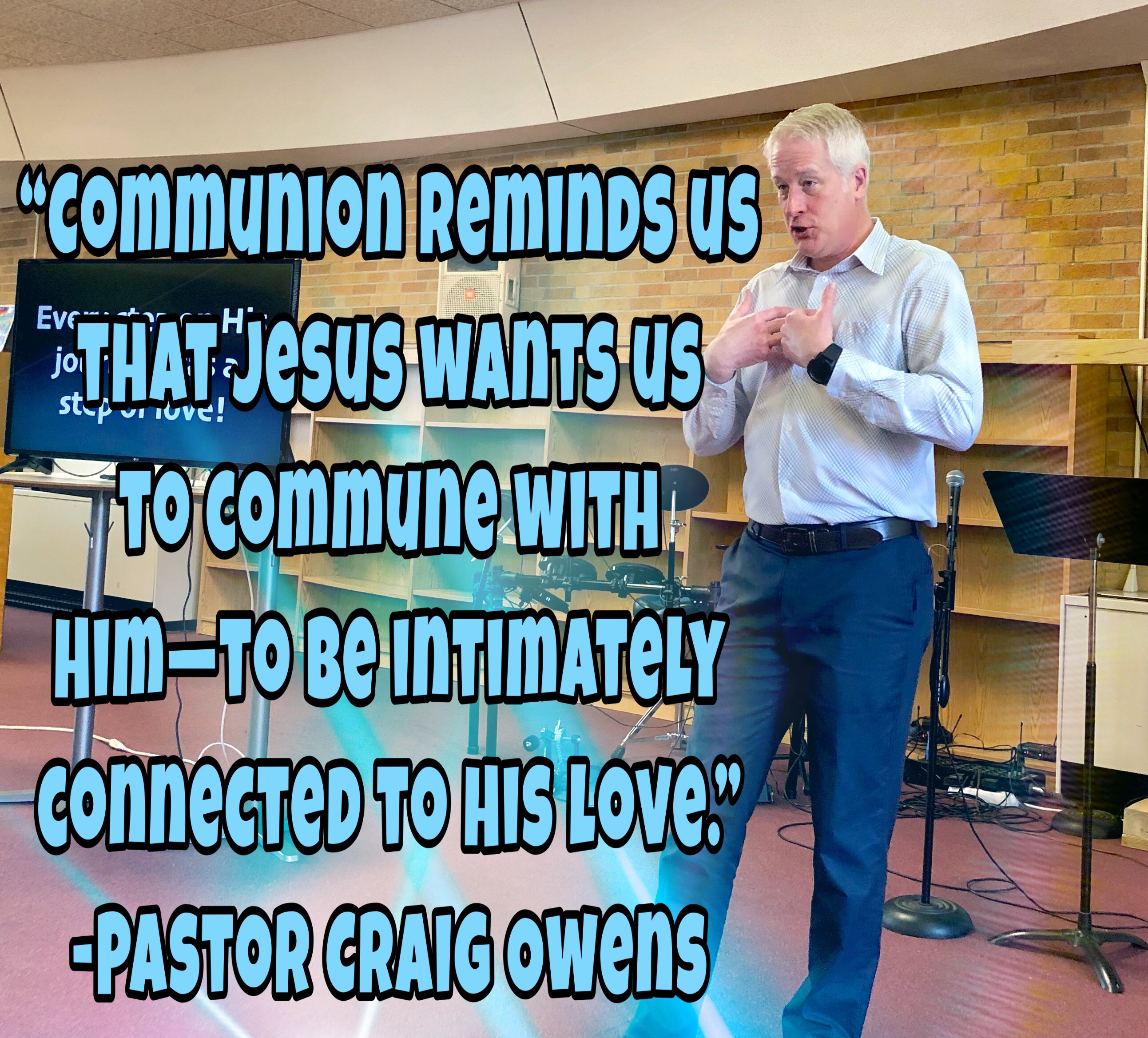
When Jesus ate this last supper with His disciples, He instituted a remembrance celebration that we now call Communion. The root word is “commune” which the dictionary defines as a “conversation with profound intensity and intimacy.” 

This is the type of intimate relationship Jesus had with His Father, and this is the type of relationship He calls us to with Him. The broken bread of Communion reminds us that Jesus can make whole any broken area that would keep us from communing with Him. The cup of Communion reminds us that Jesus can instantly and fully forgive any sin that would keep us from communing with Him. 

Jesus set the example—we are to commune with our Heavenly Father through the way He made by His broken body and His shed blood. It’s out of this communion that we are empowered by His love, and then feel secure enough to serve others in love too. 

What Are You Doing With God’s Story?

…You could have no power at all against Me unless it had been given you from above… (John 19:11)

As Daniel says, “The Most High is sovereign over all the kingdoms of the earth, and He gives them to whom He pleases.” 

God is sovereign. All of History is His story!

Pilate tried to change the story—twice he said, “I find no fault in Him” (vv. 4, 6). But still his caving in to the chief priests fulfilled His story.

The soldiers were looking for personal gain (v. 24), and yet their greed unwittingly fulfilled His story.

Jesus knew what was happening, and purposely let people treat Him a certain way to fulfill His story (vv. 28-30, 36-37). 

God is still telling His story today.

The question is—am I willfully fighting against it (like Pilate), or ignorantly fulfilling it (like the soldiers), or obediently submitting to it (like Jesus)?

Sabbathing

On the Wednesday of Christ’s Passion Week, all of the Gospel writers are in perfect agreement. Between all four of them, they write not one word about what happened on that day. That silence actually speaks volumes to us!  

Jesus is almost surely in Bethany (since that has become is nightly retreat this week), and He is taking a Sabbath rest. “Wait,” you might be saying, “sabbathing on Wednesday?! I thought that was supposed to be Saturday or Sunday?” 

The Sabbath is not a day; it’s an attitude of the heart. 

Jesus followed the example His Father set right at the beginning. 

The Israelites are to observe the Sabbath, celebrating it for the generations to come as a lasting covenant. It will be a sign between Me and the Israelites forever, for in six days the Lord made the heavens and the earth, and on the seventh day He rested and was refreshed. (Exodus 31:16-17)

Notice that God rested and was refreshed. The word rested means to stop working and celebrate. It’s a time to reflect on the work completed and celebrate what has been done. Then the Bible says God was refreshed, which literally means “God refreshed Himself.” He took a deep, satisfying, rejuvenating breath! 

Resting and being refreshed—or sabbathing—is not a luxury; it’s a necessity! 

Jesus understood this principle of sabbathing. Remember that He had only a limited time to accomplish all that the Father had for Him: “We must work the works of Him Who sent Me and be busy with His business while it is daylight; night is coming on, when no man can work” (John 9:4 AMP). If anyone was a Man on a mission, it was Jesus, and yet rest was vital to Him…

  • …from the very beginning of His life, Jesus practiced healthy habits
  • …He started each day in prayer 
  • …He rested and refreshed after expending Himself in ministry, and encouraged His disciples to do so as well (see Luke 2:52; Mark 1:35; 6:30-32, 45-46) 

Now—just before the intense, horrific, inhumane experience He is about to go through—Jesus is sabbathing. He is resting and refreshing His body, soul, and spirit. 

So what keeps us from sabbathing? 

  1. Guilt—“I feel guilty taking time off.” Remember that if Jesus did it, we should too. 
  2. Misplaced priority—“If I don’t do it, it won’t get done.” But remember Who is in charge. The psalmist reminds us, “The Lord is king!” (Psalm 99:1). 
  3. Fear—“If I ‘tune out’ what might I be missing?” Remember: Your Father is watching over you every single moment (see Psalm 121).  

If you want to experience more productivity in your life, don’t try to go 24/7—take a sabbath break. Stop working and celebrate what God has done, then take a deep breath of worship in God’s presence. Jesus demonstrated that sabbathing was vital for ministry success. 

Jesus Prepares Us For The Path

In His final week of ministry leading up to the Cross, Jesus got the most out of every minute He had. 

After a busy Monday where He cleared the temple, Jesus went back to Bethany, where He spent the night, only to return to the same temple courts Tuesday morning to teach His disciples. 

Tuesday is a preparation day. This is His last day in public before His trial and crucifixion and He has many final words to impart to His followers. Much of His teaching comes in response to the increasing onslaught from the religious leadership, who are desperately trying to find a way to silence Him once and for all.

It’s important to note that Jesus doesn’t prepare the path for us, but He prepares us for the path. 

Jesus prepares us for… 

1. OPPOSITION

Not only did Jesus face opposition, but He told His followers that we would too (see Matthew 5:11; 10:17-22). Indeed as Jesus sat in the temple courts teaching on this Tuesday, group after group of religious leaders attacked Him (Matthew 21:23; 22:15, 23, 34-35). There are many lessons we can learn, but here are a few important takeaways: 

    • Answer entrapping questions with a question of your own. 
    • You don’t have to answer everything people ask you.  
    • Either-or questions probably need a both-and answer. 
    • The better we know the Scriptures, the better we can know those both-and answers.
    • Consider the source of the questioner. 
    • We shouldn’t have an unhealthy obsession with nonessential things. 
    • Love fulfills the law. 
    • When we teach in love, some people will finally get it.

2. DAILY LIVING

Between all of the entrapping questions, Jesus taught some valuable lessons. 

    • The power of faith-filled prayer
    • Obedience to God is valuable whenever it happens and in whomever it occurs 
    • We are only stewards of God’s resources 
    • The ugliness of hypocrisy

3. END TIMES EVENTS

Jesus doesn’t want us to be surprised, so He tells us upfront what is coming. Some of what He teaches here would have partial fulfillment in about 30 years when the Romans besieged Jerusalem, but the ultimate fulfillment is still to come—Matthew 24-25; Mark 13; Luke 21. 

Christ’s passionate journey was out of love for us. Which means everything He taught us was for our benefit. To honor Him, we need to know the Scriptures and God’s power (Matthew 22:29). 

So we study the Word of God to get to know the God of the Word. Keeping our eyes on Jesus will keep us prepared for the path ahead of us, no matter how rough it is. 

What Christians Often Miss About Zeal

On what we now refer to as Palm Sunday, Jesus arrived in Jerusalem with the crowd shouting, “Hosanna” because they thought Jesus was going to set things right. In this, they were disappointed. Jesus knew that His time for reigning in Jerusalem hadn’t come yet, and Christ’s passionate journey meant He would not cut any corners!

Before Jesus left Jerusalem that Sunday evening, Mark noted that “He looked around at everything.” He didn’t respond right away to what He saw. This is very important to note because we shouldn’t think that His response on Monday was something spontaneous. No, it was planned out in specific detail.  

On Monday morning, Jesus prepared to make the 2-mile trip from Bethany to Jerusalem. The Gospels note quite frequently the amount of time Jesus spent in prayer, including beginning His day in conversation with His Father (see Mark 1:35). On this morning, He must have talked with His Father about everything He had seen in Jerusalem the day before. 

 En route to Jerusalem, Jesus encounters a fig tree that gives every appearance of life and vitality. It looks like it’s ready to serve people, but upon closer inspection, Jesus discovers that there is no fruit on it. He curses the tree for its deceptive outward appearance. This is definite foreshadowing for what’s about to happen! 

Jesus enters the temple and begins to drive out merchants, and moneychangers, and dove sellers. He roars at them, “God says this is to be a place of prayer for all nations, but you have turned it into a den of robbers!” (see Matthew 21:12-17; Mark 11:15-19; and Luke 19:45-48). 

The phrases house of prayer and den of robbers are direct quotations from Isaiah and Jeremiah, respectively (Isaiah 56:3-7; Jeremiah 7:1-11), but what do they mean? 

The temple had specific courts available—

  1. The Court of the Gentiles was open to all people, foreigners included.
  2. The Women’s Court was open to all Jews and, their “uncontaminated” wives.
  3. The Court of Israel was limited to male Jews who were clean and purified.
  4. The fourth court was the Holy Place limited to priests robed in their priestly vestments. 

This buying and selling was undoubtedly happening in the Court of the Gentiles. As the Passover was approaching, people from all over the world were here—some purchasing animals to use as sacrifices, and some exchanging their foreign money for Israelite money for the temple tax. 

There was a lot of hustle and bustle, but very little worship. This is what angered Jesus. The activity in the temple was like the fig tree He cursed—it looked like it was fruitful, but that was merely outward deception. 

Were the merchants exploiting people? Perhaps. But they were certainly occupying the only space where non-Jews could worship. They were certainly becoming a distraction to any true worship activities. They were clearly becoming the main attraction. 

There are two important lessons in this outburst that Jesus gives to all His disciples:

  1. As our Christlikeness increases, our intolerance of religious showmanship should increase. 
  2. As our Christlikeness increases, our intolerance of unrighteousness should increase—both a greater hate for sin and a greater love for sinners! 

“Let the zeal of the house of the Lord ever eat you up. For example: do you see a brother running [toward sin]? Stop him, warn him, be grieved for him, if the zeal of God’s house has now eaten you up. Do you see others running and wanting to drink themselves drunk? Stop whom you can, hold whom you can, frighten whom you can; win in gentleness whom you can: do not in any way sit still and do nothing.” —Augustine 

Christ’s passionate journey was out of love for us. Which means He hates anything that keeps us from His Father. 

If you know God’s love, be zealous about those things that keep others from coming in to know God’s love for themselves. Not angry at people, but angry at practices and “religious shows” that hinder people from knowing God’s love like you know God’s love. 

Sunday In Jerusalem

The Sunday before Christ’s crucifixion is typically called “The Triumphal Entry.” But was it really? One thing’s for sure—Jesus didn’t come to Jerusalem the way the people expected! 

To fully get the picture of what’s happening we need to turn back the calendar several hundred years. Ever since Jerusalem fell to invading armies, the Jews hung on to the promise that God would restore their king and their kingdom. They were awaiting a descendant from the line of King David who would drive out their overlords and restore Jerusalem to its rightful place. 

They clung to a promise in Psalm 118 that included these words—“Lord, save us! Lord, grant us success! Blessed is He who comes in the name of the Lord. From the house of the Lord we bless you. The Lord is God, and He has made His light shine on us. With boughs in hand, join in the festal procession up to the horns of the altar” (vv. 25-27). 

But Jesus was prophesied to come as the Prince of Peace, gentle and unassuming, the Servant of all people (Isaiah 9:6; 42:1-3). Jesus simply didn’t do things the way the crowds expected! He was born in a manger in Bethlehem (not as a king in Jerusalem), and hailing from Nazareth caused people to mock, “Nazareth? Can anything good come from Nazareth?!” 

So on that Sunday as Jesus approached Jerusalem, it wasn’t as a conquering King but as a humble servant. As He came near, He wept a sobbing lament over Jerusalem (Matthew 23:37). 

The crowd took palm branches (as Psalm 118 suggested) and shouted, “Hosanna!” That word means “Save us,” but what they really meant was, “Save us NOW!” Jesus came riding a mule—a lowly work animal, not a war horse—to remove any fear people may have, and to show them His servant’s heart. 

Even His disciples didn’t get this. But the Pharisees sure did: They wanted Jesus to rebuke the crowd for their insolence and blasphemy! Many of the worshippers were eyewitnesses to the resurrection of Lazarus, so Jesus said to the Pharisees, “They have to give praise to God for this!” 

Jesus made His way to the temple but there were no sacrifices, no anointing, no coronation. Mark tells us Jesus simply “looked around at everything and then left.” 

Have you ever noticed that Jesus never rushes? He’s never early. He’s never late. He’s never confused. He’s never trying to catch up. 

This is because Jesus was in complete sync with His Father. Jesus said that everything He did was directed by His Father, and every word He spoke was given to Him by His Father. 

We, too, should be able to move in that same unrushed pace. Because of what Jesus did for us on Calvary, we may have the same “oneness” with our Father as Jesus did (John 14:20). 

Worry creeps into our lives when—like those cheering crowds in Jerusalem—we try to make our agenda happen on our timetable with our own resources. But when we look to Jesus, we see such a perfect peace as He relied on His Father. 

Christ’s passionate journey was out of love for us, so that we could know peace with God as we journey through life with Jesus. 

Join me this Sunday as we take a closer look at the Monday of Christ’s Passion Week. 

Stop Letting Fear Limit Your Life

Listen to the podcast of this post by clicking on the player below, and you can also subscribe on AppleSpotify, or Audible.

It’s inescapably true: We let fears limit us when we listen to them. 

John Piper wrote, “I call you today to stop defining and limiting your future in terms of your past and start defining it in terms of your God.”

When we have a spirit of fear instead of the confidence that comes from a right relationship with God through Jesus, the smallest of things sends us ducking for cover! “As for those of you who may be left, I will also bring weakness into their hearts in the lands of their enemies. And the sound of a driven leaf will chase them, and even when no one is pursuing they will flee as though from the sword, and they will fall.” (Leviticus 26:36 NASB) 

God says, “Fear not—there is nothing to fear—for I am with you; do not look around you in terror and be dismayed, for I am your God. I will strengthen and harden you to difficulties, yes, I will help you; yes, I will hold you up and retain you with My victorious right hand of rightness and justice.” (Isaiah 41:10 AMPC)

“When God calls you to be free from fear (to overcome this natural emotion and have peace), He does not leave the command hanging in the air. He puts pillars under it. Five of them in Isaiah 41:10. That’s the nature of all biblical commands. They come with divine support.

  1. Fear not . . . God is with you.
  2. Fear not . . . God is your God.
  3. Fear not . . . God will strengthen you.
  4. Fear not . . . God will help you.
  5. Fear not . . . God will uphold you.” —John Piper

When we grasp that God is with us, that God is helping us, that God is bigger than the things we wrongly fear, there is nothing we cannot do! 

As Jonathan said to his young armor-bearer, “Come, and let us go over to the garrison of these uncircumcised; it may be that the Lord will work for us. For there is nothing to prevent the Lord from saving by many or by few.” (1 Samuel 14:6 AMPC)

O Sovereign Lord! You made the heavens and earth by Your strong hand and powerful arm. Nothing is too hard for You! (Jeremiah 32:17 NLT)

“Because you’re not yet taking God seriously,” said Jesus. “The simple truth is that if you had a mere kernel of faith, a poppy seed, say, you would tell this mountain, ‘Move!’ and it would move. There is nothing you wouldn’t be able to tackle.” (Matthew 17:20 MSG)

►► Would you please prayerfully consider supporting this ministry? ◀︎◀︎

What’s Your Knee-Jerk Response To Trouble?

The patellar reflex is a helpful diagnostic tool for a doctor to check the health of your central nervous system. It’s commonly called the knee-jerk response. But beyond the medical world, it’s also come to mean “an immediate unthinking emotional reaction to certain stimuli.” This has implications for the health of our prayer life too. 

When Jesus talked about praying He never said, “If you pray,” but always “When you pray.” He assumed it would be a vital part of a Christian’s life. He also used a verb tense which would add an “ing” to the verb, so He was really saying, “When you are maintaining an ongoing dialogue with your Father.” 

So when something unexpected happens to us, Jesus wants us to say, “Why, my Father already knows about this!” This is the knee-jerk reaction Jesus wants to see. 

We see this on full display when Peter and John are told by the Jewish religious authorities not to talk about Jesus publicly anymore. When these men reported this threat to the rest of the church, notice their knee-jerk response: “When they heard this, they raised their voices together in prayer to God.” 

There are two interesting things I notice in their prayer. The first thing is how they used the Lord’s Prayer (Matthew 6:9-13) as the template of their prayer. 

  • Our Father in HeavenSovereign Lord.
  • Hallowed be Your nameYou made the heaven and the earth and the sea, and everything in them.
  • Your kingdom come, Your will be done on earth as it is in heavenYour power and will decided beforehand what would happen. 
  • Forgive us our debts, as we also have forgiven our debtors“Consider their threats” was like saying, “Forgive us for inappropriate thoughts and forgive them for speaking ignorantly against Your name.”
  • Give us today our daily breadEnable Your servants to speak Your word with great boldness today. 
  • Lead us not into temptation, but deliver us from the evil one. For Yours is the kingdom, and the power and the glory foreverStretch out Your hand to heal and perform miraculous signs and wonders. May Your name be glorified!

The second thing I see in their prayer is that they stood on a biblical promise. They quoted the words of David from Psalm 2—words that had been penned nearly 1000 years earlier—and applied them to their present situation. 

What’s your knee jerk response to troubles? It’s an easy question to ask, and an easy answer to change.

When something comes at you from out of the blue, learn to say, “Why, my Father already knows about this!” Then find a biblical promise you can claim and turn that promise into a prayer modeled on Christ’s prayer. Pray that again and again until God provides the answer. 

Let’s make prayer our first response and not our last resort!