Thursdays With Oswald—Think As Christians

Listen to the podcast of this post by clicking on the player below, and you can also subscribe on AppleSpotify, or Audible. 

This is a weekly series with things I’m reading and pondering from Oswald Chambers. You can read the original seed thought here, or type “Thursdays With Oswald” in the search box to read more entries.

Think As Christians

     The [Holy] Spirit is the first power we practically experience but the last power we come to understand. The working of the Spirit is much easier to experience than to try and understand, the reason being that we form our ideas out of things we have seen and handled and touched; but when we come to think about the Godhead and the Spirit, language is strained to its limit, and all we can do is to use pictures to try and convey our ideas. 

     Yet in spite of the difficulty, it is very necessary that we should think as Christians as well as live as Christians. It is not sufficient to experience the reality of the Spirit of God within us and His wonderful work; we have to bring our brains in line with our experience so that we can think and understand along Christian lines. It is because so few do think along Christian lines that it is easy for wrong teaching and wrong thinking to come in, especially in connection with the Spirit. 

From Biblical Psychology

Christians should be first-rate thinkers. Why? Because the Holy Spirit in a Christian is the Mediator between our brains and our Creator.

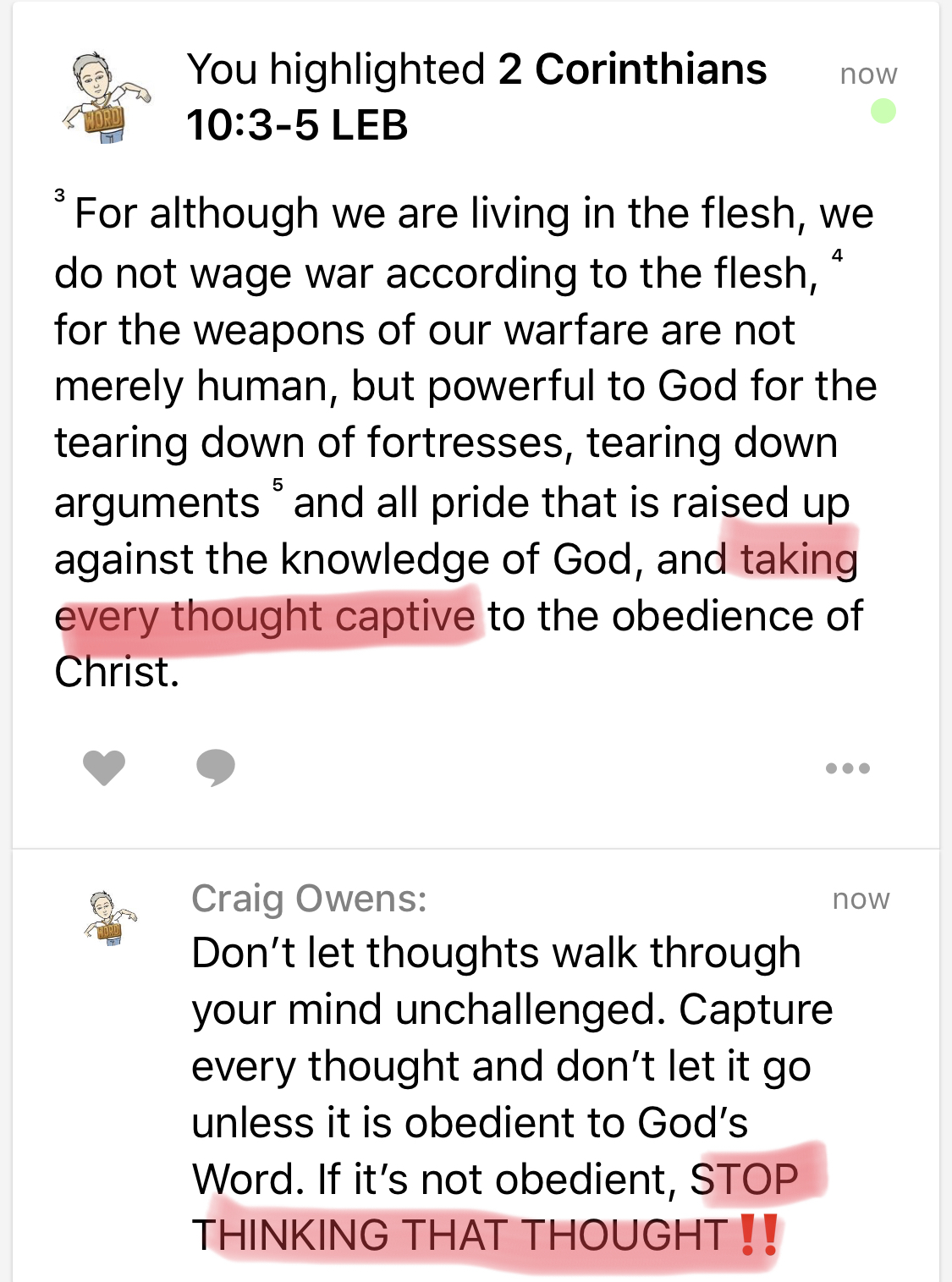
We can have the mind of Christ, if we will but exercise our thoughts. As Paul said, we need to take our thoughts captive so that they line up with the reality of God (2 Corinthians 10:5). We cannot simply make a “theology” out of our experiences, but we need to use the thinking power of the Holy Spirit to help us find out what God is revealing to us about Himself through our experiences.

God created us with a mind, a will, and emotions. Let’s make sure we’re not emphasizing one to the diminishment—or exclusion—of the others!

►► Would you please prayerfully consider supporting this ministry? My Patreon supporters get behind-the-scenes access to exclusive materials. ◀︎◀︎

Strengths Formula

God wants you to be yourself, but not as you can make you. But to be the “you” He created you to be. Part of what He implanted in you was certain gifts, talents, and abilities. To the extent that you allow the Holy Spirit to (1) reveal these gifts to you, and (2) turn these gifts into strengths, you will find more joy in being “you” as your “you” builds up the Body of Christ.

Just before listing some of the innumerable spiritual gifts God reveals in humanity, the apostle Paul says this:

For by the grace given me I say to every one of you: Do not think of yourself more highly than you ought, but rather think of yourself with sober judgment, in accordance with the measure of faith God has given you. (Romans 12:3)

Does that sound contradictory at all: Do not think…but rather think?

The root word is the same in each usage (phroneo in the Greek), but the prefix is what sets them apart from each other.

  • The first has the prefix hyper-. That means it’s overly analyzed, overly concerned = self-focused. 
  • The second time the prefix is soph- (meaning “wise”). This is sound thinking, big-picture thinking = others-focused.

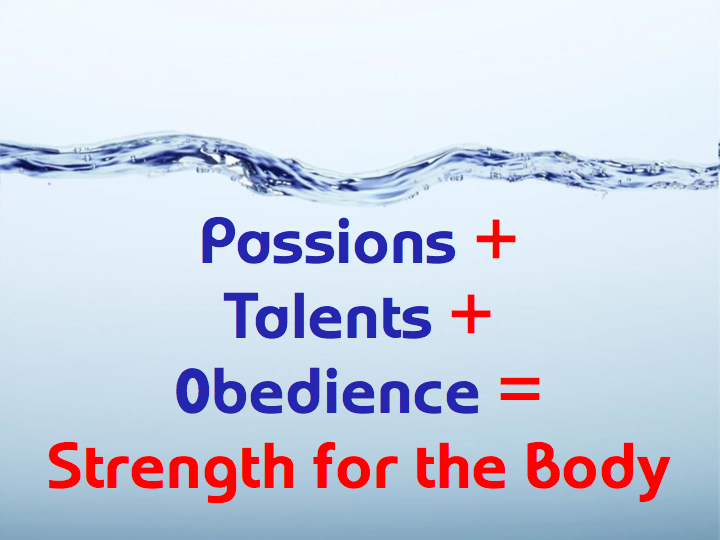
The Holy Spirit gives you sophroneo thinking to reveal your God-implanted gifts and talents to benefit others—to benefit the whole Body of Christ. He helps us turn our talents into strengths by using a formula like this:

Passions + Talents + Your Obedience = Strength for the Body

Pay attention to your passionate responses to situations, as they will reveal to you some of your gifts.

Listen to areas where others say you are talented. This will help you know how God has wired you.

Then you must be obedient to the prompting of the Holy Spirit in how to use your talents. If you let them sit on the shelf, they will never become strengths. Strengths develop when you passionately and obediently use your God-given talents for God’s glory.

The Holy Spirit wants to help you in all of these areas. Will you let Him?

If you’ve missed any of the messages in the Immersed series, you can find them all here.

If I Only Would Have Thought That Through…

These words are usually said after we have messed up something. We look back and say, “What was I thinking?!”

The truth is: you were thinking, it was just wrong thinking.

The Apostle Paul writes this:

Clothe yourselves with the Lord Jesus Christ, and do not think about how to gratify the desires of the sinful nature. (Romans 13:14)

The King James Version, instead of do not think, says, “make no provision for the flesh.” In other words, the idea here is forethought.

We have a filter at the base of our brains called the reticular activating system (or R.A.S.). This is what lets in the important things, and keeps out the unimportant things. But here is the vital issue—

YOU CAN PROGRAM YOUR R.A.S.!

You tell your RAS what’s important and what’s unimportant. Paul says that if we use our forethought to consciously decide to clothe ourselves with Christ, we are programming our RAS to spot the things that glorify Him and ignore the things that gratify our fleshly desires.

A phrase that I use often (hat tip to Dr. Richard Dobbins) is: I need to think about what I’m thinking about.

By doing this, I’m able to see how I’ve programmed my RAS. It’s either programmed to look for God-honoring things or flesh-gratifying things.

Try it for yourself. Make the conscious decision to read the Bible every day. Then in your prayer time, ask the Holy Spirit to help you think about God-honoring things. If you will do this, you will notice that you are noticing more things that please God, and that you are ignoring more things that please your sinful nature.

Thursdays With Oswald—The New Thinking Of Pentecost

This is a weekly series with things I’m reading and pondering from Oswald Chambers. You can read the original seed thought here, or type “Thursdays With Oswald” in the search box to read more entries.

The New Thinking Of Pentecost

     Everywhere the charge is made against Christian people, not only the generality of Christians, but really spiritual people, that they think in a very slovenly manner. Very few of us in this present dispensation live up to the privilege of thinking spiritually as we ought. This present dispensation is the dispensation of the Holy Spirit. The majority of us do not think according to the tremendous meaning of that; we think ante-Pentecostal thoughts, the Holy Spirit is not a living factor in our thinking; we have only a vague impression that He is here. Many Christian workers would question the statement that we should ask for the Holy Spirit (Luke 11:13). The note struck in the New Testament is not ‘Believe in the Holy Spirit,’ but ‘Receive the Holy Spirit.’ That does not mean the Holy Spirit is not here; it means He is here in all His power, for one purpose, that men who believe in Him might receive Him. So the first thing we have to face is the reception of the Holy Spirit in a practical conscious manner. …

     So as Christians we have to ask ourselves, does our faith stand ‘in demonstration of the Spirit and of power’? Have we linked ourselves up with the power of the Holy Spirit, and are we letting Him have His way in our thinking?

From Biblical Ethics

There are two dangerous extremes: (1) We can become so intellectual, that we never ask for the Holy Spirit’s help, or (2) We can become so “spiritual” that we ignore the development of our intellect.

I believe the proper balance is a both-and approach.

  • In the Old Testament, David asked for the Holy Spirit to search his heart and thoughts (Psalm 139:23-24).
  • Jesus said that the Holy Spirit would guide us into all truth (John 16:13), and that He would help us to recall the things we have heard from Christ (John 14:26).
  • The apostle Paul talked about the Holy Spirit searching our mind and revealing God’s mind to us (1 Corinthians 2:10-16).

(check out all of the above Scriptures by clicking here.)

All of these speak of a partnership. We have to do our part AND we have to listen to the Holy Spirit’s voice. And from personal experience, I’ve found that I think much more clearly and thoroughly when I listen to the Holy Spirit!

Let Yourself Go!

Pastors, this is good counsel for all of us…

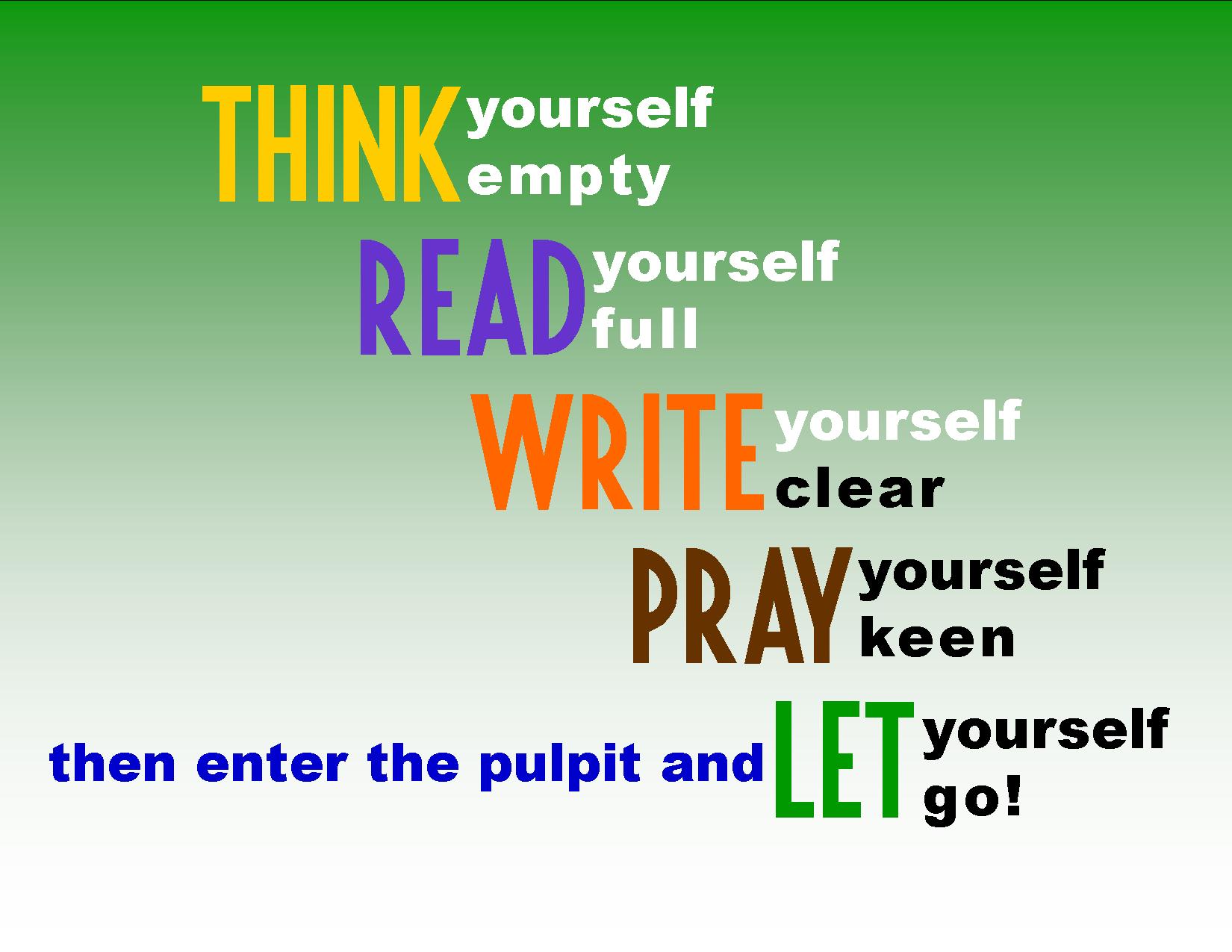
“Think yourself empty, read yourself full, write yourself clear, pray yourself keen—then enter the pulpit and let yourself go!” W.H. Griffith Thomas

New Habits

Do you have any habits? I’ll bet you have more of them that you realize! In fact, most of our day is made up of habitual things: same wakeup time, same morning routine, same route to work of school, same lunch choices, same way of thinking, same way of coping with stress, and so on.

For many families, a new school year begins today. Even if you don’t have school-aged children, the Tuesday following Labor Day is sort of the (un)official start of the fall season. And it’s a good time to take a look at your habits.

“Take your mind out every now and then and dance on it. It is getting all caked up.” —Mark Twain

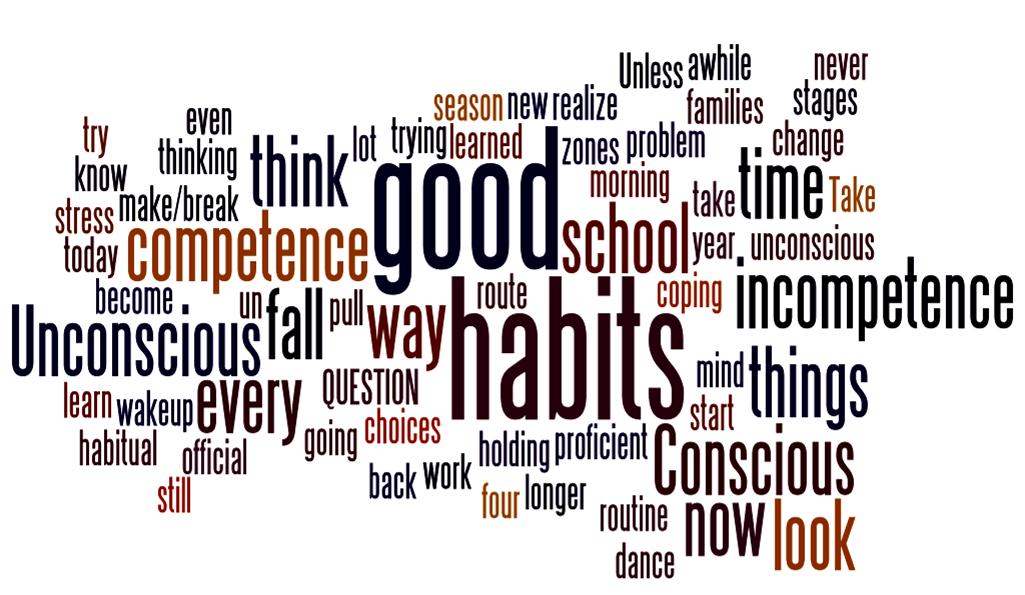
Good advice! We usually learn things through four stages:

  • Unconscious incompetence: we’re no good at something, but we don’t even realize it.
  • Conscious incompetence: we realize something must change, but we’re still no good at it.
  • Conscious competence: we’ve learned something, and now we’re good at, but we have to think about it a lot.
  • Unconscious competence: we’ve become proficient at something, and we don’t have to think about it any longer.

The problem is with both of our unconscious zones. Unless we pull out our habits and look at them every once in awhile, we may never know what’s holding us back.

QUESTION: What new habits are you going to try to make/break this fall?

Hmmm

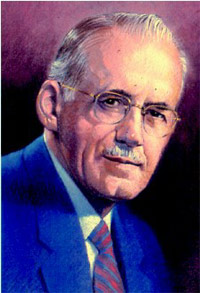
Feats of thinking may create reputation, but habits of thinking create character. —A.W. Tozer

If this is true, then I’ve got some questions to ask myself:

  • How do I think?
  • How am I processing the world around me?
  • Do I see the hand of God in daily events?
  • Can I find His truth at work?
  • Am I learning from what I experience each day?
  • Do I think positively or negatively?
  • Do difficulties cause faith or fear?
  • Am I thinking long enough?
  • Do my thoughts produce a Christ-like attitude?
  • Do I take time to think about my thoughts?

Two more thinking quotes for today:

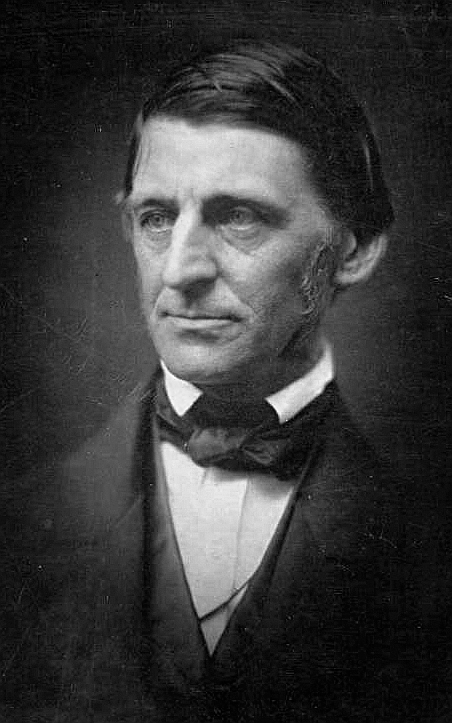
Life consists of what a man is thinking about all day. —Ralph Waldo Emerson

Summing it all up, friends, I’d say you’ll do best by filling your minds and meditating on things true, noble, reputable, authentic, compelling, gracious—the best, not the worst; the beautiful, not the ugly; things to praise, not things to curse.Philippians 4:8

Am I Learning?

Listen to the podcast of this post by clicking on the player below, and you can also subscribe on AppleSpotify, or Audible. 

In the Old Testament, there’s a phrase that repeats at the end of the historical record of almost every king of Israel and Judah:

As for all the other events of his reign, and all he did, are they not written down in the annals of the kings of Israel [or] Judah?

This phrase is repeated again and again (almost 40 times!). To me, the question mark at the end of this key phrase is really more like this: These stories are all here for your benefit—are you reading them? are you learning from them?

“Those who do not learn from history are doomed to repeat it.” —George Santayana

But maybe we think, “Those things don’t pertain to me.” Or even, “C’mon, that’s as plain as the nose on your face! I don’t need to study that because everyone knows you shouldn’t act that way!” How about this…

These things happened to them as examples and were written down as warnings for us, on whom the fulfillment of the ages has come. So, if you think you are standing firm [if you think you know it all], be careful that you don’t fall! (1 Corinthians 10:11-12, my paraphrase)

In light of that, here are some questions that would serve us well:

  • Am I reading these examples?
  • Am I learning from them?
  • Am I reviewing my own personal history?
  • Am I learning from that?
  • Am I writing down my experiences (both failures and successes) so that others can learn from me?

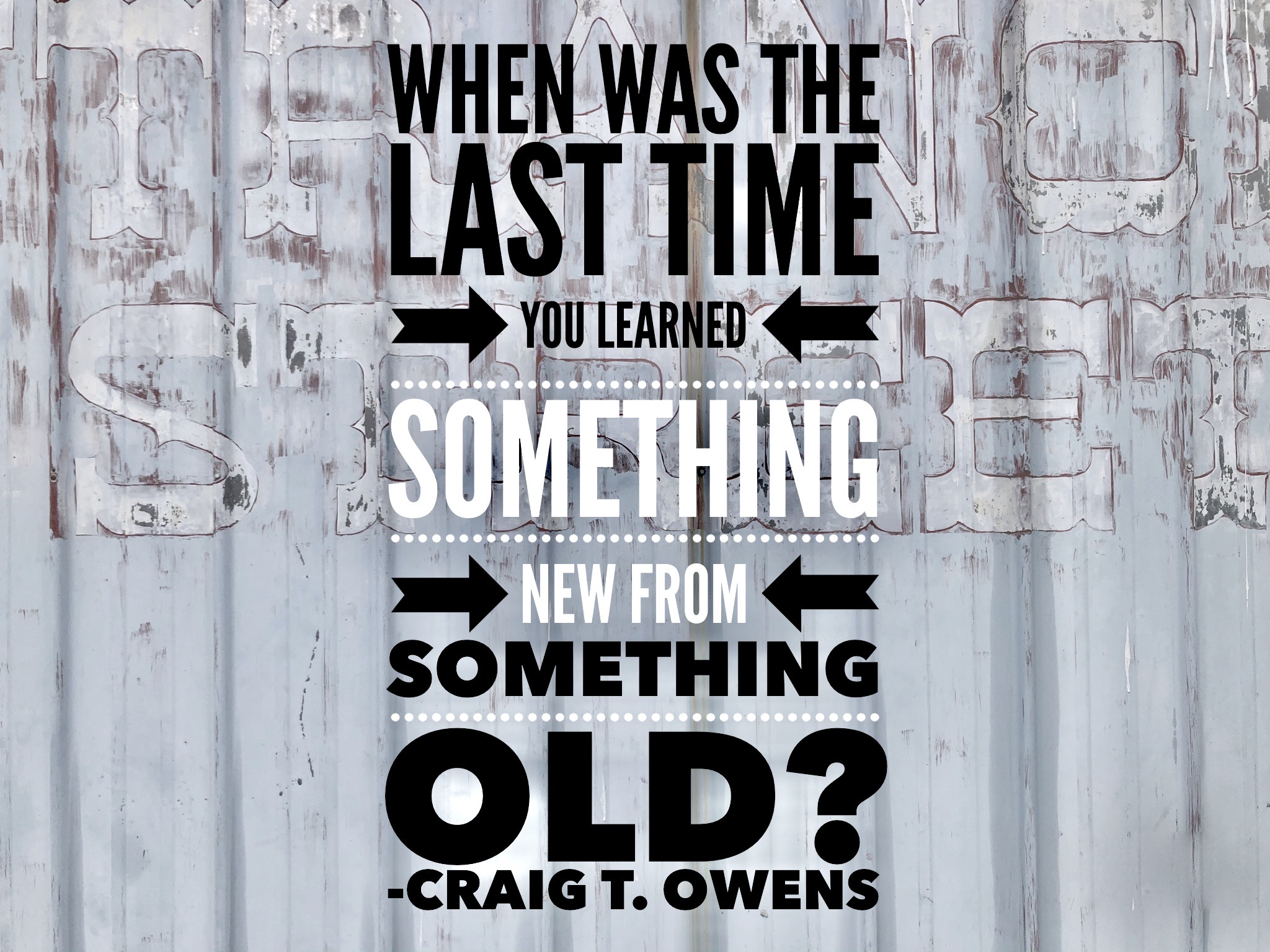
And maybe the most important introspective question of all: When was the last time I learned something new from something old?

►► Would you please prayerfully consider supporting this ministry? My Patreon supporters get behind-the-scenes access to exclusive materials. ◀︎◀︎
Thought Patrol

Have you ever found yourself in circumstances that weren’t exactly what you had planned or hoped for? You know, things are just not going your way? What do you do then? How do you handle this? I suggest the first place to start is by thinking about your thinking.

I know that may sound a little unusual, but I have often times had to stop to think about what I’m thinking about. To ask myself, “Why am I thinking that?”

I believe this is what the Bible is really saying when it tells us to take every thought captive. If we don’t, our negative thoughts can lead us to unplanned places and can keep us trapped there. But if we will take time to think about what we’re thinking about, we can discover the key to freedom from that undesirable place.

A few quotes to get us started:

“No man has ever succeeded who kept his mind on negative things… and no man ever rises above his thoughts of himself.” —C.M. Ward

“You are today where your thoughts have brought you. You will be tomorrow where your thoughts take you.” —James Allen, As A Man Thinketh

“They themselves are makers of themselves by virtue of the thoughts which they choose and encourage; that mind is the master-weaver, both of the inner garment of character and the outer garment of circumstance, and that, as they may have hitherto woven in ignorance and pain they may now weave in enlightenment and happiness.” —James Allen, As A Man Thinketh

“Only when you assume full accountability for your thoughts, feelings, actions, and results can you direct your own destiny; otherwise, someone or something else will.” —Roger Conners, Tom Smith & Craig Hickman, The Oz Principle

“Summing it all up, friends, I’d say you’ll do best by filling your minds and meditating on things true, noble, reputable, authentic, compelling, gracious—the best, not the worst; the beautiful, not the ugly; things to praise, not things to curse. Put into practice what you learned from me, what you heard and saw and realized. Do that, and God, who makes everything work together, will work you into his most excellent harmonies.” —Philippians 4:8, The Bible

Let’s all work on patrolling our thoughts today.

Jesus Tweets

Listen to the podcast of this post by clicking on the player below, and you can also subscribe on AppleSpotify, or Audible. 

I began using 𝕏 (formerly known as Twitter) in 2009. There is something challenging about conveying what I’m doing or thinking or encouraging others in 280 characters or less. I also love the bite-sized flow of comments from others that keep me informed and entertained.

As with anything I commit myself to, it always has to pass the “Would Jesus Do This” test. So, would Jesus use 𝕏? Would we be reading @JesusChrist tweets if He were on earth today?

I think so!

Just a quick survey of the Gospels will show you how many of His profound statements were in the 𝕏-ready 280-characters-or-less format…

In refuting the temptations of satan, all three Old Testament passages Jesus quoted are 𝕏-length.

  • Man does not live on bread alone, but on every word that comes from the mouth of God.
  • Do not put the Lord your God to the test.
  • Worship the Lord your God, and serve Him only.

In His famous Sermon on the Mount, all of the “blessed are” beatitudes are tweetable.

  • Blessed are the poor in spirit, for theirs is the kingdom of heaven.
  • Blessed are those who mourn, for they will be comforted.
  • Blessed are the meek, for they will inherit the earth.
  • Blessed are those who hunger and thirst for righteousness, for they will be filled.
  • Blessed are the merciful, for they will be shown mercy.
  • Blessed are the pure in heart, for they will see God.
  • Blessed are the peacemakers, for they will be called sons of God.
  • Blessed are those who are persecuted because of righteousness, for theirs is the kingdom of heaven.
  • Blessed are you when people insult you, persecute you and falsely say all kinds of evil against you because of Me.

Each sentence of Jesus’ model prayer fits in the 𝕏 dialogue box.

  • Our Father in heaven, hallowed be Your name, Your kingdom come, Your will be done on earth as it is in heaven.
  • Give us today our daily bread.
  • Forgive us our debts, as we also have forgiven our debtors.
  • And lead us not into temptation, but deliver us from the evil one.

All of Christ’s powerful “I AM” declarations in the Gospel of John are less than 140 characters.

  • I am the bread of life. He who comes to Me will never go hungry, and he who believes in Me will never be thirsty.
  • I am the light of the world. Whoever follows Me will never walk in darkness, but will have the light of life.
  • I am the gate; whoever enters through Me will be saved.
  • I am the good shepherd; I know My sheep and My sheep know Me.
  • I am the resurrection and the life. He who believes in Me will live, even though he dies.
  • I am the way and the truth and the life. No one comes to the Father except through Me.
  • I am the true vine, and My Father is the gardener.
  • I am the vine; you are the branches.

Even the most well-known verse of all fits into the 𝕏 dialogue box:

For God so loved the world that He gave His one and only Son, that whoever believes in Him shall not perish but have eternal life.

The words of Jesus are just as timely and relevant today as they were the day He first spoke them, so let’s use our social media platforms to rebroadcast (or retweet) these life-changing truths.

►► Would you please prayerfully consider supporting this ministry? My Patreon supporters get behind-the-scenes access to exclusive materials. ◀︎◀︎