Don’t Let Your Gratitude Get Hijacked

Listen to the podcast of this post by clicking on the player below, and you can also subscribe on Apple, Spotify, or Audible. 
Last week I mentioned that I was a bit surprised that scientists had done so much research on the benefits of gratitude because science tends to have an over-reliance on the tangible world. But it’s hard to ignore that there are so many intangibles (like gratitude) which make a tangible difference in people’s lives. 

We get ourselves into trouble if we focus exclusively on the tangible or intangible. We also get ourselves into trouble if we don’t use all of the resources God has given us. 

The Bible tells us that we have been created in the image of God, and that one of the things that separates us from the other creatures in the world is our soul (Genesis 2:7). Our soul is compromised of our mind, our will, and our emotions. 

(Check out all of the Scriptures I mention in this post by clicking here.) 

We cannot allow any one of these to lay dormant or even considered less valuable than the others, nor we can allow any one of these to bully the others. 

  • If my emotions dominate (especially emotions like fear or anger) I can give into fight-or-flight—Psalm 106:7 
  • If my mind dominates, I can become dark and confused—Romans 1:21 NLT 
  • If my willpower dominates, I tend to be very selfish—Isaiah 14:13-14 

When my emotions flare up, when my mind is dark, or when I feel selfish, I need to remember to engage the other two parts of my God-breathed soul. This is where gratitude comes into play. 

I love reading the Psalms when I’m battling the negative emotions that seem to rush in during trying times. The psalmists were so honest about what they were feeling. Check out a couple of examples in Psalm 7:17 and 9:1-2 where we see David engaging his mind and his will to make the choice to be grateful to God despite his circumstances. 

In the New Testament, we see a similar response from Paul and Silas when they are falsely imprisoned in Philippi (see Acts 16:22-26). Despite their cruel circumstances, they chose to life thankful worship to God. Luke write that the other inmates were listening, and so was the jailer and his family, who ended up accepting Jesus as their Savior. 

I’ve got three important words for you when dark times threaten to hijack your gratefulness:

TALK TO YOURSELF

We see another psalmist doing this in Psalm 42:1-6. He asks his soul why it is so downcast, and then he says, “I chose to remember God in all His goodness and I chose to praise Him!” These words are repeated again in Psalm 42:11 and 43:5, which tells me that giving thanks to God is not a one-and-done thing, but something that needs to be continually repeated. 

You can get some conversation starters for your self-talk in two simple ways:

  1. Write down your gratitude 
  2. Talk about your gratitude 

Keep a gratitude journal: Write something down at the end of each and every day. Write it down. Re-read it regularly. Tell others about it. And then be ready for others to ask you about Jesus—just like the Philippian jailer—when they notice how thankful you are! 

Use your mind to talk back to your fears and worries, and then engage your willpower. Don’t let your gratitude get hijacked by the circumstances around you, but allow your thankfulness to help you reframe your circumstances into God’s plan. 

Check out the other messages in our Be Thankful series by clicking here. 

►► Would you please prayerfully consider supporting this ministry? My Patreon supporters get behind-the-scenes access to exclusive materials. ◀︎◀︎
Be Thankful

It’s so easy to spot the negative things. It’s so easy to gripe about the bad stuff with others. It’s so easy to complain about what’s wrong with the world. 

But the Bible repeatedly calls the saints of God to rise above this downward pull of negativity. In fact, for those who have a relationship with their Heavenly Father, who call Jesus their Savior, and who call the Holy Spirit their Counselor, there is really only one way to live: Grateful! 

This Thanksgiving season, let’s renew our commitment to live with such gratitude that we begin to reverse the trends toward the negative that seem to envelope our culture. I hope you can join me at Calvary Assembly of God beginning this Sunday for our series Be Thankful. 

If you have missed any of the messages in this series, check them out here:

The Great Attitude Of Gratitude

There’s something about gratitude that distinguishes people. Think about it: would you rather hang around with grumblers or grateful people? 

The gratitude of Paul and Silas certainly made them stand out from the crowd when they were in Philippi. Wrongly accused, beaten, and thrown in prison, but instead of bellyaching, they were praising God. Later on, when Paul wrote his letter to the Christians in Philippi, the theme of gratefulness permeates his letter. 

The distinguishing mark is actually in the title: The GReat ATTITUDE spells out GRATITUDE! 

Join us this Sunday as we rejoin a series of messages perfectly timed for this season of Thanksgiving where we’ll be learning how great the attitude of gratitude truly is! We would love to have you join us in person, but you can also check out the messages at 10:30 each Sunday morning on Facebook and YouTube. 

You can check out the messages we shared in this series last year by clicking here.

If you’ve missed any of the messages this year, you will be able to check them out here:

Thanksgiving 365

Listen to the podcast of this post by clicking on the player below, and you can also subscribe on Apple, Spotify, or Audible.

Happy Thanksgiving Eve! I am so thankful for you and the many ways you encourage and inspire me. 

I’ve got a challenge for you: How can you make the Thanksgiving spirit a 365-days-per-year thing instead of just one Thursday in November? 

Your gratitude expressed to others could be the lifeline that they need! 

►► Would you please prayerfully consider supporting this ministry? My Patreon supporters get behind-the-scenes access to exclusive materials. ◀︎◀︎

Magnifying God

Listen to the podcast of this post by clicking on the player below, and you can also subscribe on Apple, Spotify, or Audible.

No one likes to be around a complainer! 

Complainers, ironically, find things wrong everywhere else but with themselves. Complainers know how everyone else should raise their kids, run their businesses, operate their government, lead their sports teams to victory, but they seldom apply their so-called wisdom to their own lives. Complainers find the one thing that’s wrong in an otherwise perfect situation.   

Complaining is easy because it comes so naturally. What do I mean by that? Take a look at the magazine covers at your grocery store—do they have good news or complaints? Take a look at the lead news stories—are they celebrations or complaints? Those magazines want to sell copies. Those news stations want viewers. Those websites want clicks. They wouldn’t promote the complaints if they didn’t get them the attention (and the advertising revenue) they desire! 

Let me see a show of hands on this: How many of you want to be around complainers? 

I noticed no one raised their hand, so I need to ask a follow-up question: Why do you complain? If you don’t like to be around a complainer, why do you do what others obviously don’t like either? 

I think we complain because we think our situation is unique—no one has experienced anything quite like what we’re going through. We often make a list to “prove” to everyone that we have earned the right to complain. This is what Job did. Check out his list in Job 7:1-11, and then notice his conclusion where he says, “Therefore I will not keep silent; I will speak out in the anguish of my spirit, I will complain in the bitterness of my soul.” 

But we need to be careful because the Bible makes it clear that complainers make God angry (see Numbers 11:1; 1 Corinthians 10:10-11). Why? I think there are two reasons. 

First, I think God gets angry about complaints because of how quickly they spread to everyone around them—like cancer cells they destroy the whole body. 

Second, complainers take everyone’s eyes off God and point their attention to the lousy situation about which they are complaining. 

On the other hand, grateful people stand out because they can find the one thing worthwhile in an otherwise lousy situation. Being a grateful person takes discipline to overcome the downward pull of everyone else’s complaints. 

Paul wrote a letter to the church at Philippi that is bursting with thankfulness! We only have to get three verses in when he says, “I thank my God every time I remember you” (Philippians 1:3). 

Paul stood out because of his great attitude of gratitude. Consider what happened the very first time he visited the city of Philippi. He and Silas were wrongly accused, beaten, and locked in prison. Paul didn’t start a petition, he didn’t give the jailer a bad review on Yelp, he didn’t organize a rally, he didn’t call the Roman governor. Instead, Paul and Silas were praying and singing hymns to God while the other prisoners listened in (Acts 16:16-25). 

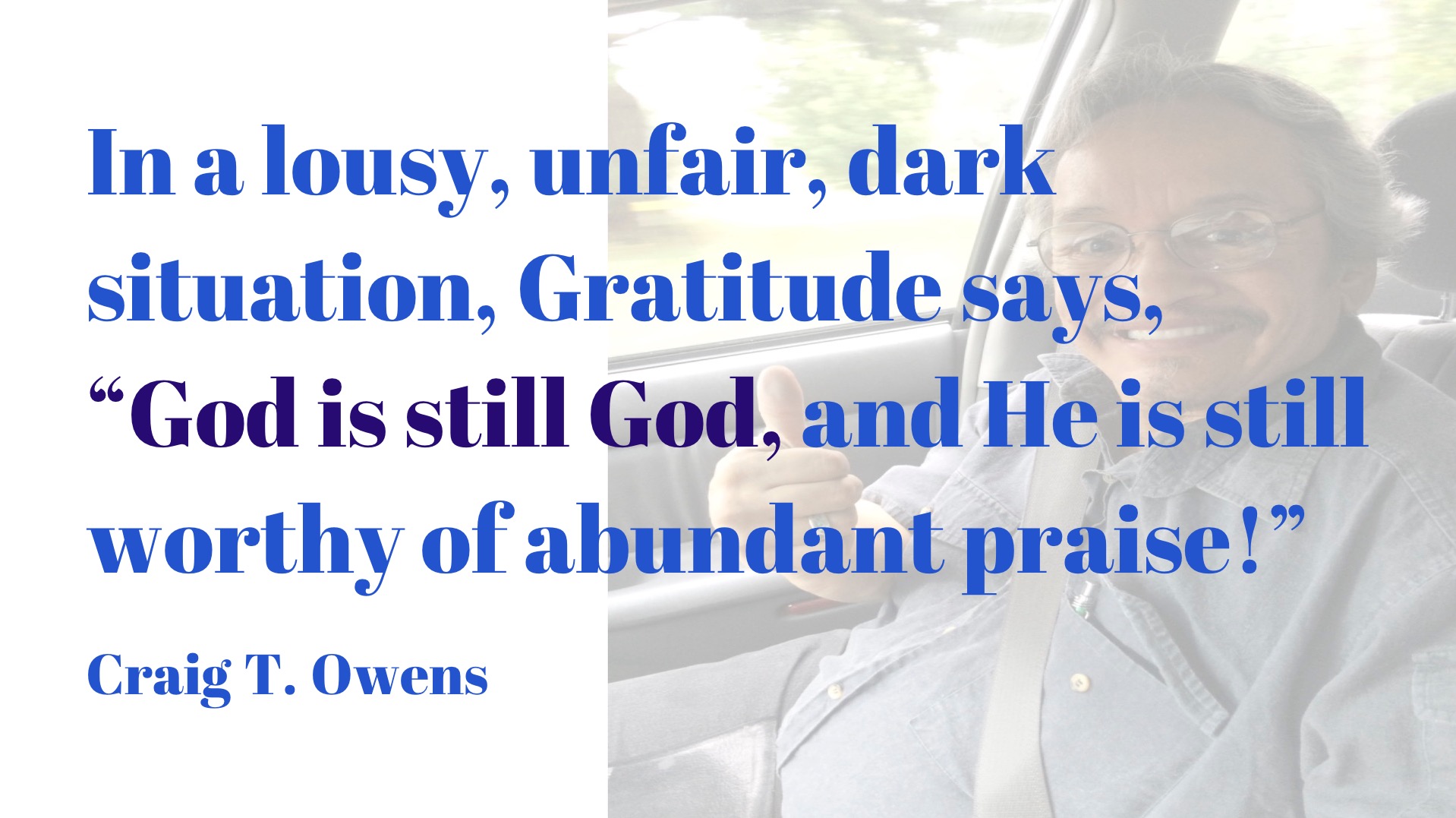
In a lousy, unfair, dark situation, Gratitude says, “God is still God, and He is still worthy of abundant praise!” 

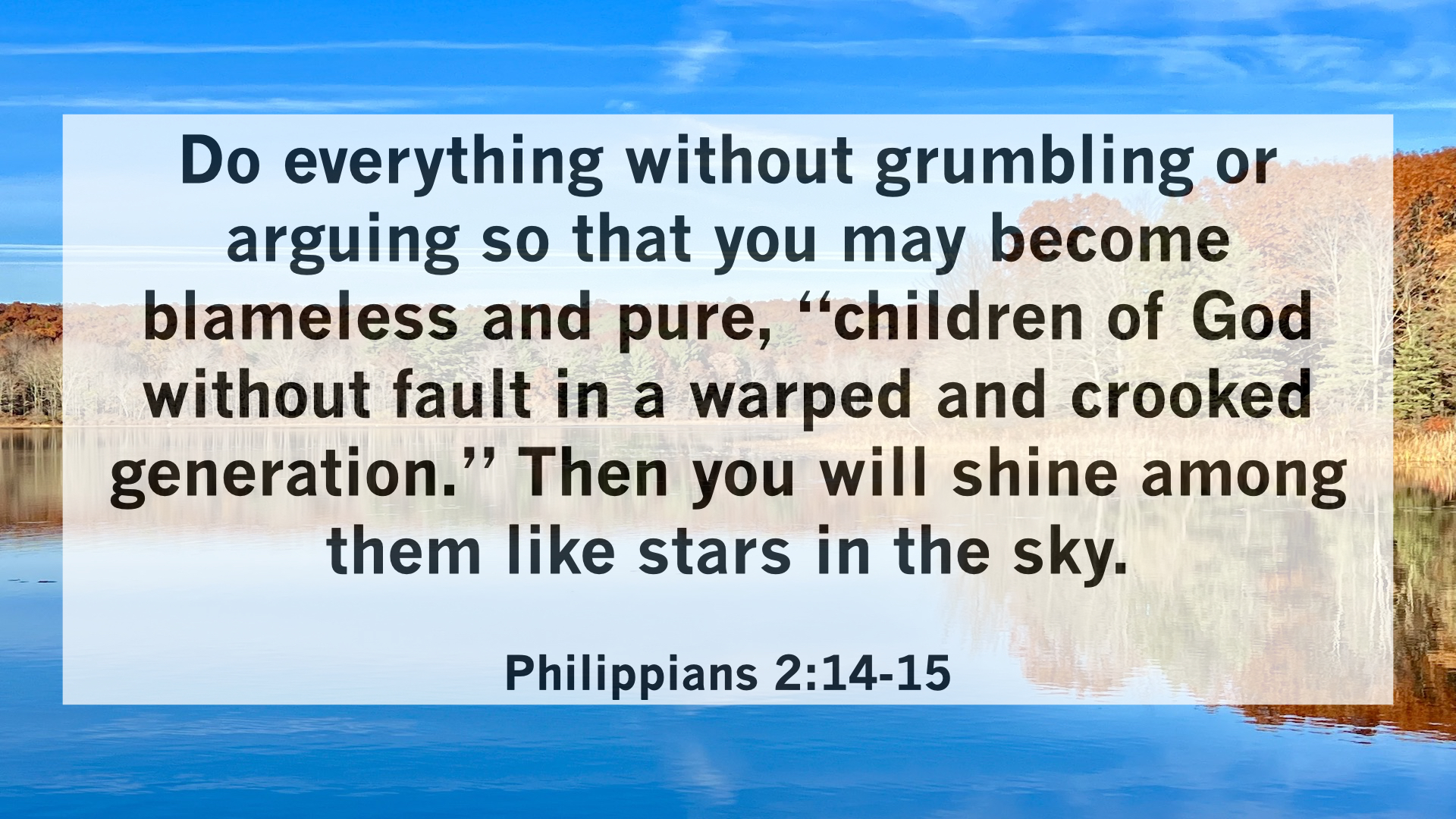
So in the middle of his letter to the Philippians, Paul instructs these Christians to: Do all things without murmurings and disputings (Philippians 2:14 KJV). Murmurings are the vocalizing of the faults we have found. Disputings, though, are internal. In the Greek, this word almost always refers to complaining and grumbling thoughts, and many times it’s translated as “evil thoughts.” 

When the complaining comes out of our mouths, that is just the ugly weed. The root of that complaint is in our hearts. We don’t need a vocabulary change, we need a heart change. 

When we praise God, we magnify Him. That doesn’t make God bigger because He is infinite. But it does put a “telescope” on Him. Telescopes bypass everything that is close by and focus on something majestic. Our praise—like Paul and Silas’ song from prison—invites others to look through our telescope to see the God we are magnifying. 

Gratitude can start with one person, and then it can spread. Gratitude can counteract the cancerous complaints. Will you be that one grateful person at this Thanksgiving season and beyond? Will you be the one that says, “No matter what, God is still God, and He is still worthy of abundant praise”? Will you be that one that sings praise at the exact moment everyone else expects complaints? If you do, your gratitude will entice others to want to worship this all-good God too! 

Follow along with all of the messages in our series called The Great Attitude Of Gratitude by clicking here. 

►► Would you please prayerfully consider supporting this ministry? My Patreon supporters get behind-the-scenes access to exclusive materials. ◀︎◀︎

The Great Attitude Of Gratitude

There’s something about gratitude that distinguishes people. Think about it: would you rather hang around with grumblers or grateful people? 

The gratitude of Paul and Silas certainly made them stand out from the crowd when they were in Philippi. Wrongly accused, beaten, and thrown in prison, but instead of bellyaching, they were praising God. Later on, when Paul wrote his letter to the Christians in Philippi, the theme of gratefulness permeates his letter. 

The distinguishing mark is actually in the title: The GReat ATTITUDE spells out GRATITUDE! 

Join us this Sunday as we launch a series of messages perfectly timed for this season of Thanksgiving where we’ll be learning how great the attitude of gratitude truly is! We would love to have you join us in person, but you can also check out the messages at 10:30 each Sunday morning on Facebook and YouTube. 

If you’ve missed any of the messages in this series, check them out here:

Poetry Saturday—Thanksgiving

We walk on story fields of white
And do not see the daisies, 
For blessings common in our sight 
We rarely offer praises. 
We sigh for some supreme delight 
To crown our lives with splendor, 
And quite ignore our daily store 
Of pleasures sweet and tender.

Our cares are bold and push their way 
Upon our thought and feeling; 
They hang about us all the day, 
Our time from pleasure stealing. 
So unobtrusive many a joy 
We pass by and forget it, 
But worry strives to own our lives, 
And conquers if we let it.

There’s not a day in all the year 
But holds some hidden pleasure, 
And, looking back, joys oft appear 
To brim the past’s wide measure. 
But blessings are like friends, I hold, 
Who love and labor near us. 
We ought to raise our notes of praise 
While living hearts can hear us.

Full many a blessing wears the guise 
Of worry or of trouble; 
Far-seeing is the soul, and wise, 
Who knows the mask is double. 
But he who has the faith and strength 
To thank his God for sorrow 
Has found a joy without alloy 
To gladden every morrow.

We ought to make the moments notes
Of happy, glad thanksgiving; 
The hours and days a silent phrase 
Of music we are living. 
And so the theme should swell and grow 
As weeks and months pass o’er us, 
And rise sublime at this good time, 
A grand thanksgiving chorus. —Ella Wheeler Wilcox

8 Thankful Quotes

“…May we also unite in most humbly offering our prayers and supplications to the great Lord and Ruler of Nations and beseech Him—To pardon our national and other transgressions, To enable us all, whether in public or private stations, to perform our several and relative duties properly and punctually, To render our national government a blessing to all the people, by constantly being a government of wise, just, and constitutional laws, discreetly and faithfully executed and obeyed, To protect and guide all nations and to bless them with good government, peace, and concord, To promote the knowledge and practice of true religion and virtue, and the increase of science, And generally to grant unto all mankind such a degree of temporal prosperity as He alone knows to be best.” —George Washington’s Thanksgiving Proclamation in 1789 

“Let your soul lose itself in wonder, for wonder is in this way a very practical emotion. Holy wonder will lead you to grateful worship and heartfelt thanksgiving. It will cause within you godly watchfulness; you will be afraid to sin against such a love as this.” —C.H. Spurgeon 

“As flowers carry dewdrops trembling on the edge of the petals, and ready to fall at the first waft of wind or brush of bird, so the heart should carry its beaded works of thanksgiving, and, at the first breath of heavenly flavor, let down the shower perfumed with the heart’s gratitude.” —Henry Ward Beecher 

“Thanksgiving will draw our hearts toward God and keep us in fellowship with Him; it will take our attention from ourselves and give the Spirit room in our hearts.” —Andrew Murray 

“If we pray without ceasing, we shall not want matter for thanksgiving in everything. We shall see cause to give thanks for sparing and preventing, for common and uncommon, past and present, temporal and spiritual mercies. Not only for prosperous and pleasing, but also for afflicting providences, for chastisements and corrections; for God designs all for our good, though we at present see not how they tend to it.” —Matthew Henry 

“Blessed is that home which has in it an altar of sacrifice and of prayer, where daily thanksgivings ascend to heaven and where morning and night praying is done.” —E.M. Bounds 

“Not to lose myself and reader in this digression, the sum is, the unspeakable blessings which the priesthood of Christ hath obtained for us are a strong obligation for the duty of praise and thanksgiving; of which that in some measure we may discharge ourselves, He hath furnished us with sacrifices of that kind to be offered unto God.” —John Owen

“Gratitude is from the same root word as ‘grace,’ which signifies the free and boundless mercy of God. Thanksgiving is from the same root word as ‘think,’ so that to think is to thank.” —Willis P. King 

Linger In Gratitude

I just finished a series of messages at Calvary Assembly of God called Fading Gratitude. It was intended to give some practical thoughts that would stimulate our continual gratitude—not just thankfulness on a day called Thanksgiving.

Sarah Young does a masterful job speaking the words of Scripture as though it were Jesus speaking first-person to us. This word is so appropriate on the heels of this series and on the eve of our Thanksgiving celebration.

“I want you to linger in gratitude. This is a most delightful place—where the joy of My presence shines warmly upon you. 

“You often and pray fervently for something until you receive the answer you desire. When I grant your request, you respond joyfully and thankfully. But your tendency is to move on rather quickly to the next matter. I want you to remain for a while in an attitude of grateful joy. Instead of experiencing only a short-lived burst of gratitude, let this pleasure flow freely into the future by training yourself to recall what I have done. One way is to tell others about it. This blesses both them and you, and it pleases Me. Another way is to write down the prayer-answer someplace where you will see it again and again.

“Keep bringing your gratitude to Me. This thankfulness will bless you doubly—with happy memories of answered prayer and with the delight of sharing enjoy it with Me.” —Jesus (in Sarah Young’s Jesus Always, emphasis mine)

Fading Gratitude

Looking back at the history of God’s people in the Bible, there is a distinct up-and-down cycle. The Israelites would be worshiping God and enjoying His blessings, and then we see them turning their back on God and needing Him to rescue them from oppressors. After God rescues them the people praise Him, only to slip right back into the same downward slide again. 

I believe their slipping away from God can be directly linked to their forgetfulness. 

If any of us allows our gratitude for all of God’s blessings to fade, we will experience the same slipping away. 

However, there is good news! If there is a peril in our forgetfulness, there is also a power in our thankfulness! 

If you missed any of the messages in this series, please check them out here: