Listen to the podcast of this post by clicking on the player below, and you can also subscribe on Apple, Spotify, or Audible.
Godly leaders should be secure enough to think of themselves as servants and stewards—nothing more, nothing less. And people in the church should look on their leaders as servants and stewards—nothing more, nothing less.
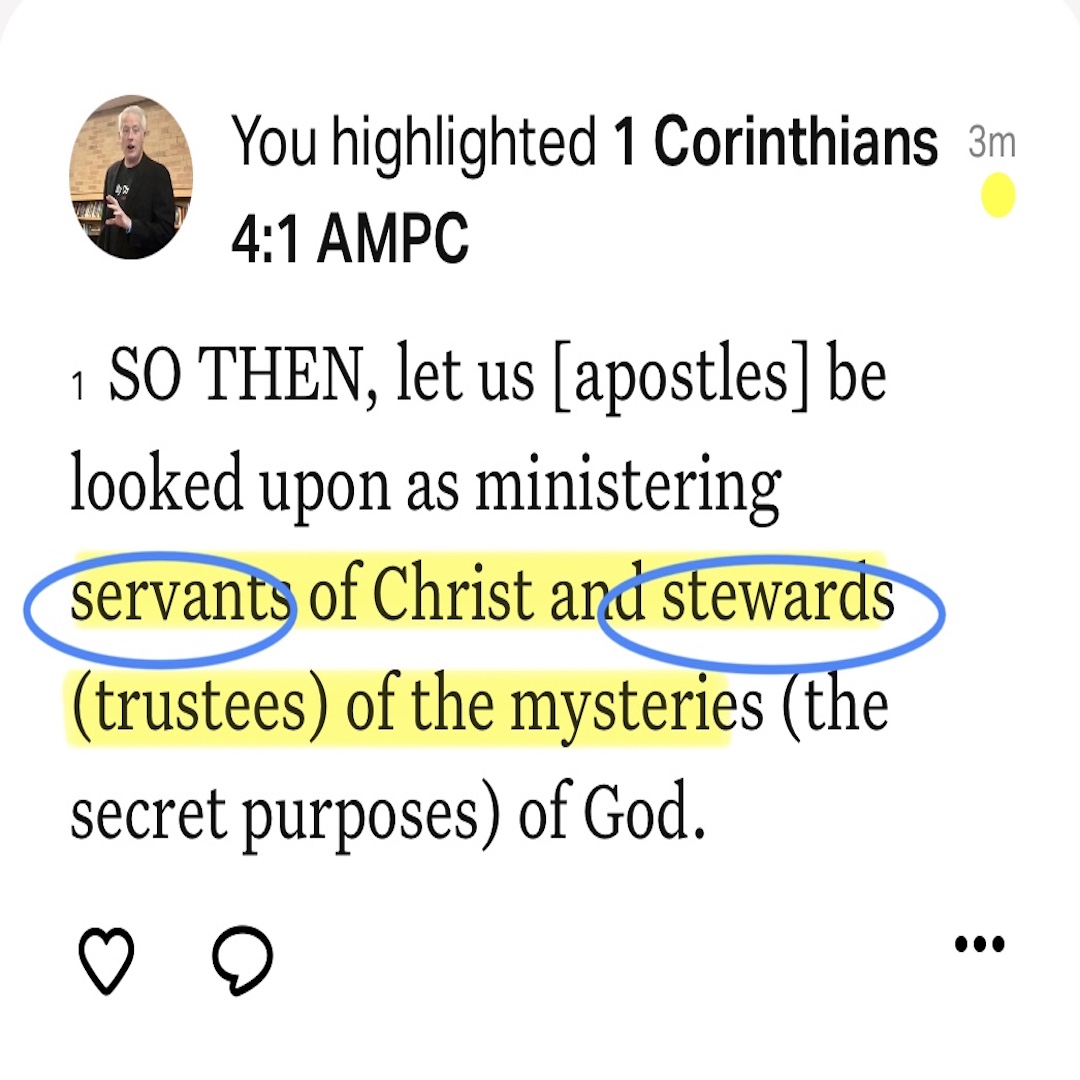
So then, let us apostles be looked upon as ministering servants of Christ and stewards (trustees) of the mysteries (the secret purposes) of God. (1 Corinthians 4:1 AMPC)
Q: How do I know if I am a servant?
A: People treat me like one.
Q: How do I know I have a servant’s attitude?
A: I don’t mind being treated like a servant.
Paul lived this out—Now, brothers and sisters, I have applied these things to myself and Apollos for your benefit, so that you may learn from us the meaning of the saying, “Do not go beyond what is written.” Then you will not be puffed up in being a follower of one of us over against the other(1 Corinthians 4:6).
I closed the chapter ‘Secure to Serve’ in my book Shepherd Leadership like this—
God wants to use you as a leader. He has called you to great things. Just remember that He does the calling and the equipping so that you can serve and shepherd others. It may be a prominent, noticeable position, or it may be an obscure position unseen by very many. It may be a position God keeps you in until the day He calls you home, or it may be a temporary position. A humbly confident leader doesn’t fight to climb a ladder nor strive to keep a position on a higher rung of the ladder. The shepherd leader is confident to serve where God places him, and humble enough to be moved, or even removed, as God sees best. But most of all, a secure shepherd leader knows that God’s desire for His leader in any position is a heart to serve others.
Listen to the podcast of this post by clicking on the player below, and you can also subscribe on Apple, Spotify, or Audible.
“No one will even notice.”
“It really doesn’t matter what I do.”
“There’s not much that I’m good at.”
Sadly, these statements are far too common for a lot of people. Even sadder is how frequently Christians say them. Of all people, Christians should be assured that God has created them on purpose and for a purpose. To fulfill that purpose, God has given each of us the right talents in the right proportions.
Jesus illustrated it with a story in Matthew 25, but I want to especially highlight what the master said to his stewards when they were giving an account for what had been entrusted to their care.
His master said to [the steward entrusted with five talents], “Well done, you upright (honorable, admirable) and faithful servant! You have been faithful and trustworthy over a little; I will put you in charge of much. Enter into and share the joy (the delight, the blessedness) which your master enjoys.” … His master said to [the steward entrusted with two talents], “Well done, you upright (honorable, admirable) and faithful servant! You have been faithful and trustworthy over a little; I will put you in charge of much. Enter into and share the joy (the delight, the blessedness) which your master enjoys.” … [The steward entrusted with one talent said], “So I was afraid, and I went and hid your talent in the ground. Here you have what is your own.” (Matthew 25:21, 23, 25 AMPC)
The two wise stewards were both told they had been faithful in a little, even though one started out with more than the other.
The lazy steward didn’t consider what he had been given to be worth the bother.
But all three of them were given only what they could handle—
To one he gave five talents [probably about $5,000], to another two, to another one—to each in proportion to his own personal ability. Then he departed and left the country. (Matthew 25:15 AMPC)
In other words, God gives us our talents or gifts on purpose. He knows exactly what gift to give us and in what proportion to be an effective steward for Him. Don’t ever discount what God has given you, and don’t ever envy what He has given to another servant. What you consider “a little” is still enough to accomplish the purpose God has for your life.
Do your very best with what you have, and then know that you will hear your Master say, “Well done. Come share My eternal joy!”
Listen to the podcast of this post by clicking on the player below, and you can also subscribe on Apple, Spotify, or Audible.
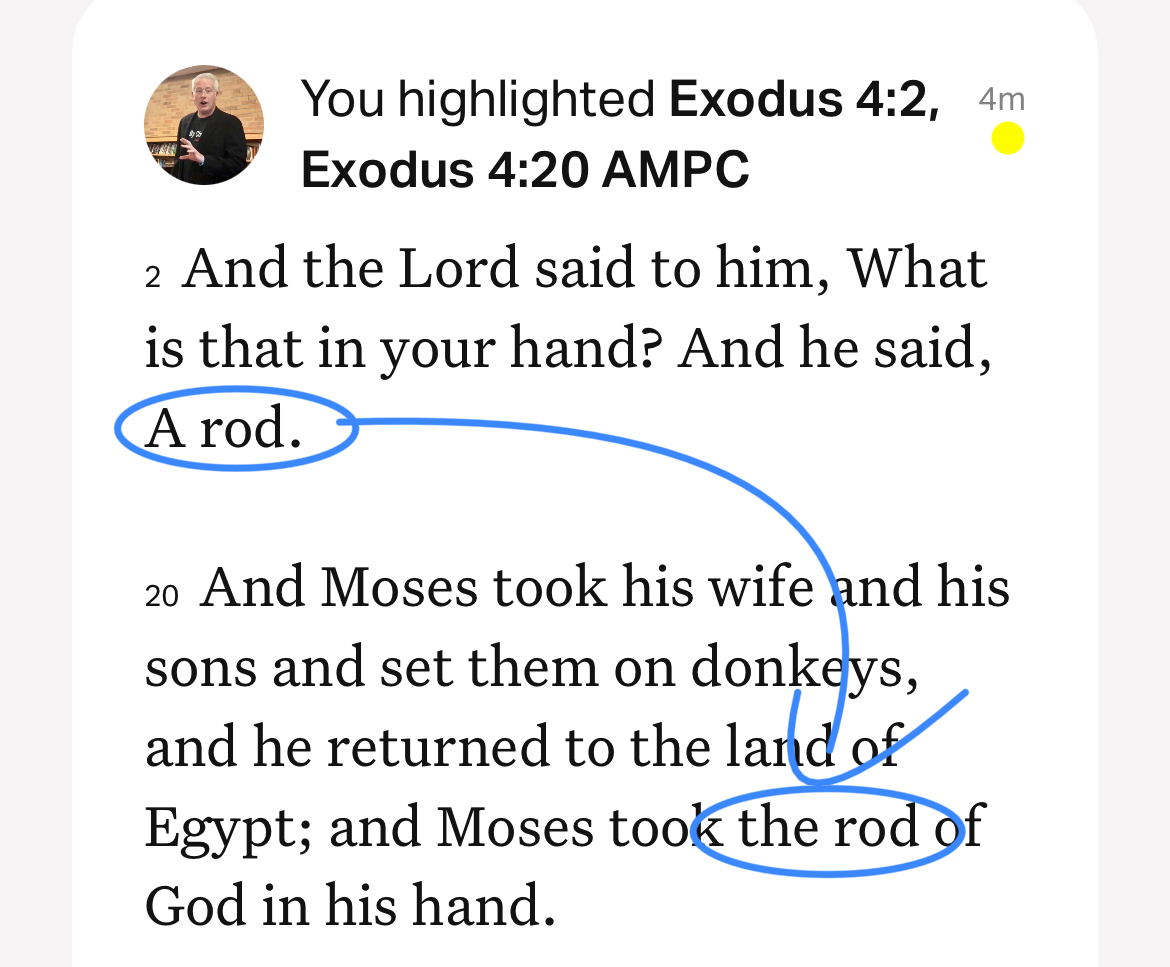
And the Lord said to [Moses], “What is that in your hand?” And he said, “A rod.” … And Moses took his wife and his sons and set them on donkeys, and he returned to the land of Egypt; and Moses took the rod of God in his hand. (Exodus 4:2, 20 AMPC)
What Moses originally called merely “a rod” he later called “the rod of God.” He recognized that what he thought was his was in actuality what God had given him to use.
When we recognize that what’s in our hands isn’t our creation, but a God-given talent, it marks a defining moment in both our maturity and our humility. Or to borrow a phrase I elaborate on in my book Shepherd Leadership, this helps us view our God-given talents or positions with confident humility (or, if you like, humble confidence).
With this shift in Moses’ understanding and language in mind, this is how we should treat every strength God has given us:
• I will have to give an account to God for how I invested or squandered what He entrusted to me
When we realize that we are not self-made men or women, but that any talents, abilities, or opportunities we have are God-appointed, we show a marked maturity in our understanding of our stewardship of God’s gifts. As our maturity grows, our confidence and our humility will grow proportionately. And as we become more confidently humbled in the way we steward God’s gifts, our leadership cannot help but exhibit more of God’s blessing on it.
All of this growth starts with just the simple recognition that what’s in my hands is there only because God placed it there.
Listen to the podcast of this post by clicking on the player below, and you can also subscribe on Apple, Spotify, or Audible.
We have been learning about how God gifts us so that He can use us to build His kingdom. Discovering these gifts and then living in this gift zone is going to require us to stretch out of our comfort zone. So far, we’ve looked at two factors:
As you look back, the things that thrill you and kill you have probably remained consistent through your life. You may recall moments where implementing your gifts went very well and times when it didn’t go so well. The former makes us ready to try again and maybe expand a little further, but the latter tempts us to shrink back into our comfort zone. The key is to find out how we can be more consistent in using our gifts productively.
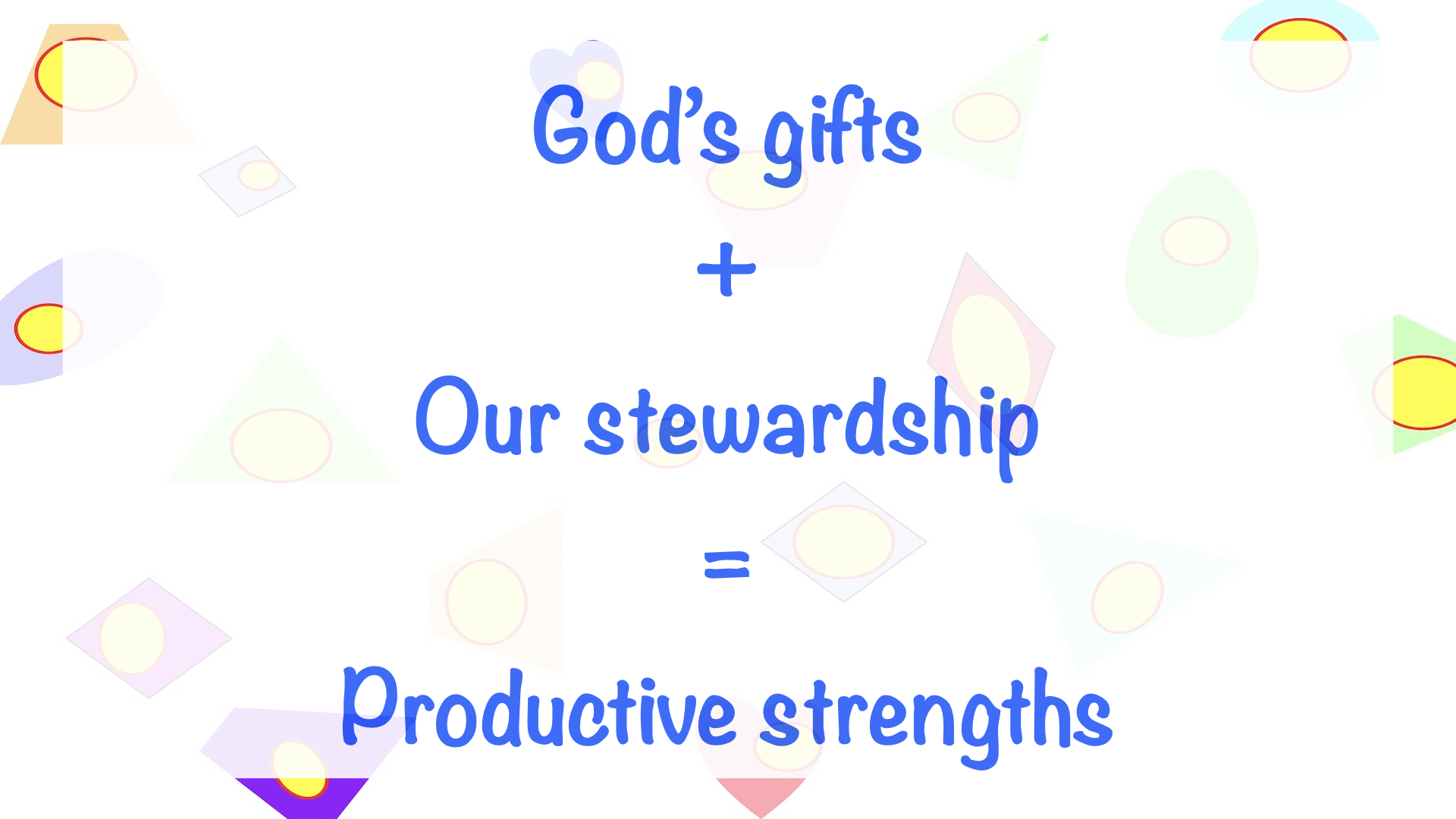
It looks like this: God’s gifts + Our stewardship = Productive strengths.
God gives the gifts as only He knows best (Psalm 139:16; Romans 12:6; 1 Corinthians 12:11) and then we steward these gifts into productive strengths.
The dictionary defines it as the responsible overseeing and protection of something considered worth caring for and preserving.
The Bible always portrays a steward as the one in charge of the precious things in a household—in our case, the Church.
Jesus makes the role of a steward very clear in his parable found in Matthew 25:14-27. Notice three important things:
The master gave gifts to everyone of his servants, but he gave “each according to his ability” (vv. 14-15).
The wise servants stewarded the master’s gift by that way they “put his money to work” (vv. 16-18)
The master demanded accountability of all of his servants. Two servants acknowledged “you entrusted me” with these gifts (vv. 19-23), while one said, “I was afraid” (vv. 24-27).
God created each of us on purpose and for a purpose. He gave us the gifts we need to accomplish that purpose. We will only find our fulfillment in life in stewarding those God-given gifts and opportunities in ways that glorify Him. Not only fulfillment here, but then eternal satisfaction when we hear our Savior say, “Well done, good and faithful servant! Enter into your Master’s happiness!”
The only servants that heard the “well done” from their master were those who realized it was “your money…entrusted” to me. I like how Eugene Peterson brings this out in his paraphrase:
Make a careful exploration of who you are and the work you have been given, and then sink yourself into that. Don’t be impressed with yourself. Don’t compare yourself with others. Each of you must take responsibility for doing the creative best you can with your own life. (Galatians 6:4-5 MSG)
So let’s add one more circle to the passion and pain circles, and that is the circle of proficiency. This is what fulfills us because we can do it so well; it feels so natural for us to be doing this. Proficiency is what really brings together the passion and the pain, and it helps us find the sweet spot.
Let me give you a couple of examples—one from the Old Testament and one from the New Testament.
Nehemiah was killed that Jerusalem was in shambles and the people were disgraced (Nehemiah 1:3-4)—that’s what killed him. Nehemiah didn’t go to wall-building school, but he effortlessly strategized, cast vision, organized, planned, procured, and adapted—that’s his proficiency. The wall was built in 52 days, Israel’s enemies were disgraced, and the people had a place to worship again (Nehemiah 6:15-16, 9:1-3)—that’s what thrilled him.
The apostles and the first deacons in the New Testament church saw that some of the widows were being overlooked in the food distribution (Acts 6:1)—this is what killed them. These new leaders didn’t go to food-distribution school, but they effectively strategized, cast vision, organized, planned, procured, and adapted (v. 3)—this is their proficiency. The widows were cared for, the Word of God spread, and more people became Christians (v. 7)—that’s what thrilled them.
God gives gifts—we feel that in what thrills us and what kills us. We steward those gifts into productive strengths—we stick with what we fulfilled in doing. Our productive strengths then glorify God as we strengthen and grow the Body of Christ.
Let me give you four things to consider about your area of proficiency:
What comes easily to me?
Where do I see both the steps and the completion before others do?
Where do I experience the greatest ROI of my time and efforts?
What do I do that thrills me because I ran to because it was killing me, and now it fulfills me to keep doing it?
With all three of these circles, please take some time to ponder what your sweet spot is. And if you’ve missed any of the messages in this series, you can find them all here.
Fellas, the godly superwomen in our lives have unlocked our leadership potential. What are you going to do with that? You have only two choices: steward it or squander it. We only honor these godly women when we steward that potential well. Watch the full Father’s Day sermon here.
I have lots of new content every week, which you can check out on my YouTube channel.
Dan Reiland addresses an important topic for busy leaders: busy work vs. real work. “Doing the easy stuff makes us feel good, doing the hard stuff helps other people live better. When we focus on our real work over busywork, we see intentional progress toward a focused vision or goal, rather than just checking things off a list.” Check out the four things Dan calls leaders to focus on.
“Because of what Jesus did for us through His life, death, and resurrection, we are no longer the worst things we have ever done. We are now the best thing God has ever done for us! That’s what God saved us from.That is our history. Now the question is, what has God saved us for? That is our destiny!“ —Jim Wiegand, in the Everything Begins With Purpose reading plan on YouVersion
A good reminder for pastors. “Call your own soul often to account; examine the temper, the frame, and the motions of your heart with all holy severity, so that the evidences of your faith in Jesus, and your repentance for sin, and your conversion to God, be many and fair, be strong and unquestionable; that you may walk on with courage and joyful hope toward heaven, and lead on the flock of Christ thither with holy assurance and joy.” —Isaac Watts
“The fellow who never makes a mistake takes his orders from one who does.” —Herbert Brocknow
“‘The fear the Lord.’ This refers to an awesome respect for God, which is a good thing. Without it, people are presumptuous before God. Those who do not fear God fail to respect His awesome power and righteousness, and they do not recognize the infinite distance between their sins and His holiness.“ —Quest Study Bible commentary on Psalm 128:1
“Our Lord did not ask us to give up the things of earth, but to exchange them for better things.” —Fulton J. Sheen
“Abortion advocates have long labeled humans in the earliest stages of development as ‘nothing but’ clumps of cells. This description is like calling Michelangelo’s David ‘a clump of marble.’ The only difference is that while art historians know every detail of this statuary masterpiece, scientists are still unlocking the secrets of the embryo.” John Stonestreet shares some astounding new research about the ways that the cells of a baby develop in a way that can only be attributed to an All-Wise Creator.
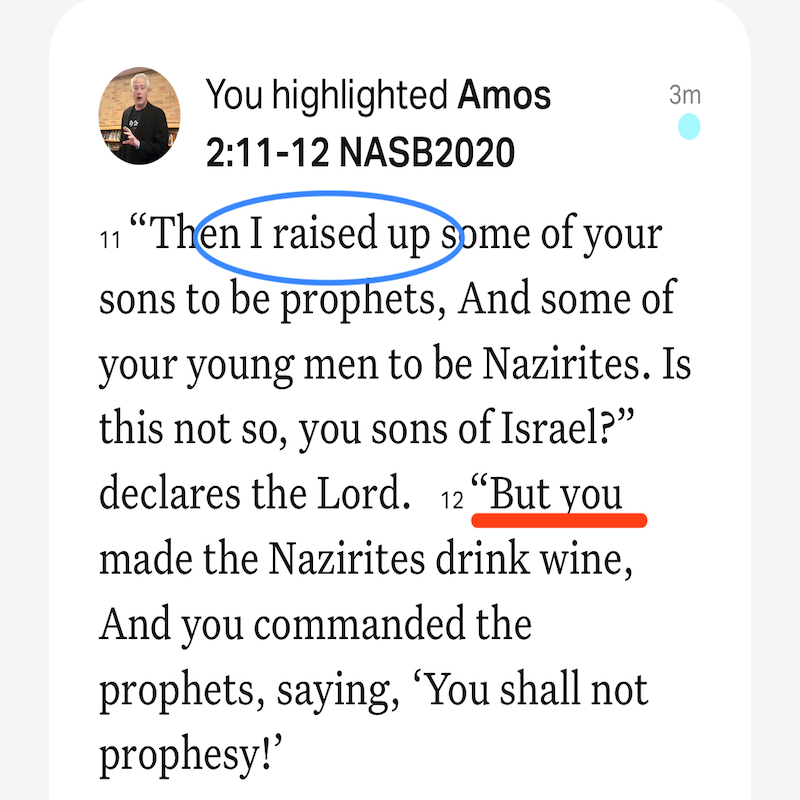
The unrighteous always seek to pull down those who hold to God’s righteous standard. How sad that they think it easier to pull the righteous down than to repent of their own evil. God sees this: He rewards the righteous who do not compromise and He punishes the unrepentant unrighteous who try to force the righteous to compromise.
Listen to the podcast of this post by clicking on the player below, and you can also subscribe on Apple, Spotify, or Audible.
On Mother’s Day, I mentioned that Proverbs 31 might be an intimidating description for Moms, but it doesn’t need to be that way. This chapter lists what is possible when a woman is fully committed to God, her husband, and her children.
Her faithfulness is her superpower which unleashes so many good things for those around her. Or as we said it: Her nobility helps her be a king maker.
I concluded by saying that men have an important role to play in order to honor the king-making power which the godly women in his life have unlocked. This is a man’s superpower! Together, God-fearing men and women can create a legacy of king makers. But separated or self-focused men and women can create a legacy of king breakers.
The Hebrew word for noble is used five times in Proverbs: three times for the godly superwoman (Proverbs 12:4, 31:10, 31:29), and twice for the godly superman (13:22, 31:3).
Remember that this word is also translated in different versions of the Bible as excellent, virtuous, and strong in character.
In Proverbs 31:3 the word vigor for men is attached to that same Hebrew word. In this context, the word can be defined as strength, efficiency, ability, or wealth.
On Mother’s Day, we said that Eve is the “help meet” (as the old King James Version says), which means that she is the key that unlocks Adam’s potential. The teaching throughout Proverbs says that men can squander this unlocked potential by…
…forgetting God’s laws—Proverbs 31:4-5
…not stewarding the unlocked leadership opportunities in our marriage, parenting, work, or community involvement (Proverbs 5:15-20; 2:1-5, 12-17; 22:29; 31:23).
In essence, we cancel the definition of vigor that we saw above, changing strength to weakness, efficiency to inefficiency, ability to inability, and wealth to poverty.
On Mother’s Day we looked at virtuous Ruth who used her godly superpower to unlock the potential for Boaz, the man who would become her husband. Let’s look at his example:
he was called a man of standing because his righteousness was well known in Bethlehem—Ruth 2:1
he was obedient to the smallest details of the law—Ruth 2:3; Leviticus 19:9-10
he honored his father by following his example—Matthew 1:5; Joshua 2:1-24, 6:23
he was an honored employer—Ruth 2:4
he was also (just like Ruth) called a man of noble character—Ruth 3:7-11, 14
A Dad’s superpower looks very similar to a Mom’s superpower. The godly woman unlocks the potential, and when the godly man carefully stewards that potential, he is also using his godly superpower (Luke 12:42-43, 48)!
Guys, when we use our God-given superpower, we honor Him and the godly women in our lives who have made this possible for us. We do this by…
…faithfully loving God with all our heart, soul, mind, and strength—Proverbs 31:4-5; Mark 12:28-31
…caring for our bride like Jesus cares for His bride—Ephesians 5:25
…honoring the legacy of our parents—Ephesians 6:2-3
…passing on a godly heritage to our children—Ruth 4:21-22
This is God’s design. And it is God’s delight when we live this way. So we must make the choice to either carry on the godly heritage that was handed down to us, or reverse the ungodly heritage that we may have inherited.
Godly men and women unlock and perpetuate their God-given superpower by giving their heart, soul, mind, and strength to God. And then God will continue to empower us as the spouses, parents, and leaders in our community that He desires for us to be!
Listen to the podcast of this post by clicking on the player below, and you can also subscribe on Apple, Spotify, or Audible.
I’ve noticed over the years that some people get quite nervous—even fearful—with the thought of God coming close to then. Some people have told me, “I can’t go to church—the roof will fall in on me!”
If I’m honest, I had a time in my life when I feared God’s approach. I didn’t want to pray, “God, use me however You want to” because I just knew He was going to send me somewhere I didn’t want to go, or ask me to give up something that was special to me.
But from the the birth of Jesus until His ascension, the consistent message is: Fear not! and Rejoice!
Matthew 21:4 says that Christ’s arrival on a donkey was “to fulfill” another one of the jots and tittles. And John adds, “Jesus found a young donkey and sat upon it, as it is written, ‘Do not be afraid, O Daughter of Zion; see, your King is coming, seated on a donkey’s colt’” (John 12:14-15).
Typically, conquerors came with a show of overwhelming force, not a show of humility. But Jesus came to Jerusalem with the same message repeated at His birth, “Fear not.”
This is elaborated on in the original prophecy found in Zechariah 9:9-14, where the opening word is, “Rejoice!” We rejoice because He is coming to take away the instruments of war that the occupying forces used to keep the citizens in bondage. He is coming to bring freedom He is coming to announce hope and restoration.
With all of these jot-and-tittle prophecies, we have been asking three questions.
(1) What did it mean then? Quite simply, on that first Palm Sunday it meant that this was not the time for judgment.
(2) What does it mean now? Since the final judgment has not taken place, it must mean it still is not a time of judgment, but a time of favor. God is still drawing people to Himself by His kindness (Romans 2:4).
Zechariah 9:14 makes it clear that there will be a day of judgment. And Peter says that God’s not being slow about this, but He is demonstrating His patience so that none will have to perish without Him (2 Peter 3:9-10).
(3) What does it mean for me? It means that I don’t have to fear the approach of God.
First, there is no fear when God calls me to stand before Him because my sins have been forgiven (Romans 8:1).
Second, there is no fear when God asks me to give something to Him because God has equipped me ahead of time to respond obediently. When Jesus sent His disciples ahead of Him to bring back the donkey that He would ride into Jerusalem, Jesus must have already informed the donkey’s owners that this would be coming. The disciples were simply to say, “The Master needs the donkey now.”
God has already prepared me to say, “Yes” to whatever He calls me to do (Psalm 139:16).
Finally, there is no fear when God asks me to give something to Him because I’m only giving back to Him what is already His. You and I are just stewards of what God has given us. When the disciples talked to the steward of the donkey, they assured him, “The Lord needs it and will send it back here shortly” (Mark 3:11). And the prophecy in Zechariah, God says, “Now I announce that I will restore twice as much to you” (Zechariah 9:12). Maybe not here on earth, but the rewards in Heaven will be incalculable for His faithful servants!
Those who know Jesus as their Master can live as fearless stewards.
We don’t fear the requests of our King, but we rejoice to allow Him access. We don’t fear the approach of our Judge, but we rejoice to stand before Him forgiven and rejoicing!
Listen to the audio-only version of this podcast by clicking on the player below, or scroll down to watch the video.
When we think about leadership, we often envision the people in organizationally designated leadership roles “leading down” to the people on their team. In this episode of The Craig And Greg Show, we flip the script, discussing how you can “lead up” to those above you and help your team achieve greater levels of success.
[0:30] This is part 1 of a new series of periodic episodes of how to lead at all levels of your organization.
[1:07] What is the real definition of a leader?
[1:55] You need different skills to lead up based on how receptive your leader is.
[3:31] Do you have the right tools to lead up, or do you need to fill your toolbox first?
[5:30] What happens when the leadership above you changes?
[6:35] There are two really important words when leading up: stewardship and accountability.
[7:59] “I told you so” doesn’t help you lead up, nor does withholding information from your up-leader.
[11:55] What are the best ways to talk to your up-leader?
[14:35] Everyone in the organization already knows when you have the good ideas, so you don’t have to announce it.
[15:05] How do you balance being proactive with being too aggressive?
[16:05] What lessons can you learn from working with your difficult up-leader?
[17:42] You shouldn’t try to “fix” your up-leader, but help your up-leader.
[19:34] I share how I kept my attitude in check with my difficult up-leader.
[22:00] Coaches can help you do what you’re already doing better than you’re currently doing it
Check out this episode and subscribe on YouTube so you can watch all of the upcoming episodes. You can also listen to our podcast on Spotify and Apple.
When I look up “prosper” in the dictionary, the first entry says, “to be successful or fortunate, especially in financial respects.” This isn’t even close to the Old Testament Hebrew word for prosper!
God makes prosper a dependence on Him. Mammon makes prosper a dependence on self.
The Hebrew word tsalach means:
to overcome obstacles (like crossing a river)
to be empowered by the Spirit of God to overcome an enemy (like Samson did)
to flourish like a plant growing to full harvest
to have favor with man so that good can be done for others (Nehemiah 1:11)
to be poured out; to be a conduit of God’s blessings to others
Prosperity God’s way is being blessed to bea blessing to others.
Prosperity is never for me, only from God through me.
Prosperity from God helps me overcome obstacles for others, defeat enemies for others, bring in a good harvest for others, have earthly favor that will benefit others, finish well for the sake of others.
I’ll say it again: True prosperity ISN’T for me, it’s only from God through me!
Hezekiah showed how God’s prosperity came through him to benefit others:
he did “what was good and right and faithful before the Lord”
he lived “in obedience to the law and the commands”
“he sought his God and worked wholeheartedly”
In light of this definition, I have no problem praying, “God, make me prosperous. As I seek You and work wholeheartedly, flow through me to bless others!”
This is a weekly series with things I’m reading and pondering from Charles Spurgeon. You can read the original seed thought here, or type “Thursdays With Spurgeon” in the search box to read more entries.
A Christian’s Waiting Activity
They were looking intently up into the sky as He [Jesus] was going, when suddenly two men dressed in white stood beside them. “Men of Galilee,” they said, “why do you stand here looking into the sky? This same Jesus, who has been taken from you into heaven, will come back in the same way you have seen Him go into heaven.”(Acts 1:10-11)
Despisers tell us nowadays, ‘Your cause is done for! Christianity is spun out! Your divine Christ is gone! We have not seen a trace of His miracle-working hands, nor of that voice that no man could rival.’ Here is our answer: We are not standing gazing up into heaven. We are not paralyzed because Jesus is away. He lives, the great Redeemer lives, and though it is our delight to lift up our eyes because we expect His coming, it is equally our delight to turn our heavenly gazing into an earthward watching and to go down into the city and there to tell that Jesus is risen, that men are to be saved by faith in Him, and that whoever believes in Him will have everlasting life! We are not defeated! Far from it—His ascension is not a retreat, but an advance! His tarrying is not for lack of power, but because of the abundance of His long-suffering. …
It is clear that He has not quit the fight nor deserted the field of battle. Our great Captain is still heading the conflict! He has ridden into another part of the field, but He will be back again, perhaps in the twinkling of an eye [Revelation 22:12; Matthew 25:21]. …
Brothers and sisters, do not let anybody spiritualize away all this from you! Jesus is coming as a matter of fact—therefore go down to your sphere of service as a matter of fact. Get to work and teach the ignorant, win the wayward, instruct the children, and everywhere proclaim the sweet name of Jesus! … Jesus is not coming in a sort of mythical, misty, hazy way. He is literally and actually coming—and He will literally and actually call upon you to give an account of your stewardship. Therefore now, today, literally not symbolically, personally and not by deputy, go out through that portion of the world that you can reach and preach the gospel to every creature according as you have opportunity, for this is what the men in white apparel meant—be ready to meet your coming Lord. …
If you would meet Him with joy, serve Him with earnestness!
From The Ascension And The Second Advent Practically Considered
Jesus was about His Father’s business the whole time He was on earth. As He ascended to heaven, He promised us His authority and the empowerment of the Holy Spirit so we too could be about our Father’s business.
In one of His parables about stewarding our Master’s gifts and resources until He returned, Jesus said, “Occupy until I return” (Luke 19:13). I love Spurgeon’s remind: “If you would meet Him with joy, serve Him with earnestness!”
Yes, we are waiting for Jesus to return, but our waiting is an active waiting. With one eye toward the heavens and one eye toward earth, we actively tell others about our soon returning King. Occupy! Stay active! Stay alert! Meet Him with joy!



 Godly leaders should be secure enough to think of themselves as servants and stewards—nothing more, nothing less. And people in the church should look on their leaders as servants and stewards—nothing more, nothing less.
 God wants to use you as a leader. He has called you to great things. Just remember that He does the calling and the equipping so that you can serve and shepherd others. It may be a prominent, noticeable position, or it may be an obscure position unseen by very many. It may be a position God keeps you in until the day He calls you home, or it may be a temporary position. A humbly confident leader doesn’t fight to climb a ladder nor strive to keep a position on a higher rung of the ladder. The shepherd leader is confident to serve where God places him, and humble enough to be moved, or even removed, as God sees best. But most of all, a secure shepherd leader knows that God’s desire for His leader in any position is a heart to serve others.










 Craig T. Owens