Listen to the podcast of this post by clicking on the player below, and you can also subscribe on Apple, Spotify, or Audible.
When the righteous thrive, the people rejoice… (Proverbs 29:2).
I have read hundreds of leadership books and biographies of history’s most influential leaders. But no book even comes close to the leadership principles I discover on an almost daily basis in my Bible. Without a doubt, my Bible is my go-to leadership Book!
A great place to start mining leadership principles is the book of Proverbs. Take time to study just one of the 31 chapters each day, and you will be astounded at the leadership insights you will have gleaned by the end of the month.
Take Proverbs 29 as an example. Reading through this chapter, I’m reminded that:
righteous leadership causes people to rejoice
a leader builds stability through consistent justice, but bribes or showing favoritism undermines a leader’s foundation
leaders who speak up for those without a voice of their own will continue to exert influence long after their tenure is over
wise leaders energize people when they share a compelling vision
justice comes through a righteous leader, but ultimate justice come from God
I even read an important warning for leaders who make it their goal to lead righteously: Bloodthirsty men hate a man of integrity and seek to kill the upright (v. 10).
But even on the heels of that warning I read this assurance to continue to lead righteously: Fear of man will prove to be a snare, but whoever trusts in the Lord is kept safe (v. 25).
A mark of a godly leader is one who is continually finding new leadership principles in the Bible.
Try it for yourself and see how applying God’s wisdom will increase your influence as a leader.
This is part 58 in my series on godly leadership. You can check out all of my posts in this series by clicking here.
Listen to the podcast of this post by clicking on the player below, and you can also subscribe on Apple, Spotify, or Audible.
I may have heard more confusion, bad preaching, and even heresy based on Psalm 82 than almost any other passage! Most of the confusion comes from just verses 1 and 6, but if we read the entire psalm, I think confusions are quickly cleared up.
The biggest point of confusion is the use of the word “gods.” The Hebrew language doesn’t have capital and lowercase letters like we do. So the word God (with or without a capital “G”) is the same Hebrew word—el (singular) or elohiym (plural)—which means mighty One or mighty ones. Humans can be mighty ones, but only Yahweh is the Mighty One.
Further adding to the confusion for some people is that Yahweh God is sometimes referred to in the plural in Hebrew: elohiym. This is understandable because we believe God is Three-in-One. Not three gods, but one God in three Persons.
Bible translators have to use context clues to determine whether the biblical authors are referring to Yahweh or a pretend deity. Thankfully, English Bible translators have helped us out:
when the Hebrew word is Yahweh, most Bibles print it LORD
when the Mighty One is implied in the text it’s God (with a capital “G”), and when it’s just a mighty person it’s typed god/gods (with lowercase a “g”).
the NIV translators really helped us in Psalm 82 by designating the false deities in quotation marks (“gods”), almost as if they’re saying “the so-called gods.”
When we were looking at the Selah in Psalm 81, I pointed out the importance of remembering that context is king. Clearly, from the context in Psalm 82, these are false gods (lowercase “g” and inside quotation marks).
Asaph only speaks in the first and last verses of this psalm, but notice his commentary that “God presides…He gives judgment.” As in, God gets the final and decisive word. In fact, God does the most speaking in this psalm (in verses 2-7). God indicts wicked people for…
defending the unjust
showing partiality to the wicked
knowing nothing, understandingnothing, walking around in darkness
and notes “you will die like mere men”
Now notice what the Selah pause connects. This is a pause for us to contrast two things: the righteous way and the wicked way. Or maybe we could say the contrast is between the way of the righteous Mighty One and His followers, and the way of wicked mighty ones.
The Selah really begs an important question, “How long will your pride keep you doing these wicked things?” Notice what God calls on people to do in opposition to what the wicked are doing:
the wicked defend the unjust vs. the righteous are to defend the weak and fatherless
the wicked show partiality to the wicked vs. the righteous maintain the rights of the poor and oppressed
the wicked are concerned only about themselves vs. the righteous rescue the weak and needy from the hand of the wicked
The Selah is intended to prompt us to ask ourselves: “Which are we? What am I doing or not doing?”
The word for rendering a judgment is used four times in Psalm 82:
God gives judgment on the activities of the “gods”
the wicked defend the unjust, meaning that they condone their unjust activities
the righteous defend the weak, meaning they speak up for those being oppressed by the “gods”
finally, Asaph declares in verse 8 that God renders the final and decisive judgement
Listen to the podcast of this post by clicking on the player below, and you can also subscribe on Apple, Spotify, or Audible.
I hate… (Psalm 119:163).
In my experience, many Christians struggle with the word “hate,” as though it shouldn’t have any part in their vocabulary. And yet here is that word right in the middle of Psalm 119, this longest chapter in the Bible which extols the value of the Bible in all 176 verses.
I remember watching “Sesame Street” when they would sing the song, “One of these things is not like the other.” Let’s play that same game from this Sin/Shin section of Psalm 119:
I stand in awe of Your Word
I rejoice in Your promise
I love Your law
I praise You, God, for Your righteous laws
I follow Your commands
I obey Your statues
I love Your statutes
I obey Your precepts
I hate falsehood
Doesn’t that last one seem out of place? In fact, it’s not just “hate,” but one translation says, “hate and abhor,” and another says, “hate and detest”!
But I want you to notice first of all that it is not a person that the psalmist hates, but falsehood, deception, fraud, lying. The root word in Hebrew is someone who is purposefully dealing falsely as a means of tricking or cheating.
This is what we could correctly say is righteous anger.
The psalmist’s love for the glory of God is great, which means he also reveres this Book of Truth—the Bible—that leads people to basking in God’s glory. To be apathetic about lies that are deliberately attempting to cheat people out of an intimate relationship with God is the exact opposite of love.
Hate is not the opposite of love;apathy is the opposite of love.
Hate of those things which keep people from God is the completion of the love for God and the respect for the Book that brings people to Him.
To love fully, I must also hate well. Not people, but actions that keep people away from experiencing and knowing God’s love. May all of us learn from the Holy Spirit how to awaken from any apathy we may have, and to correctly express our righteous anger.
The Bible uses two phrases that we don’t typically use today: “the horn of the wicked” and “the horn of the righteous.”
A horn in Hebrew literature is a symbol of strength. The wicked blow their own horn—trumpeting how they are self-made people. Obviously, this God-ignoring arrogance isn’t something God can bless!
What about “the horn of the righteous”? Is there a way to blow our horn so that God is glorified? In a word: Yes!
Check out this short 2-minute video to hear how I describe the right and wrong ways to honor your uniqueness by blowing a righteous, God-honoring horn…
Listen to the podcast of this post by clicking on the player below, and you can also subscribe on Apple or Spotify.
When I see words like truly (3 times), surely (2 times), and yes (1 time) occurring so frequently in a rather short psalm, it catches my attention. Combined with the call for a Selah pause another two times in this twelve-verse psalm, and this is clearly a chapter that we should read slowly and deliberately.
Because of these words truly and surely, I find five truisms that David makes clear to us, and I also find that they are linked together in a beautiful circular chain.
Truism #1—God keeps me secure. He alone is my source of security (vv. 1-2).
Truism #2—Evil people are envious of a righteous person’s secure position and will try to pull them down (vv. 3-4). When this happens I need to take a Selah pause to remember Who holds me secure.
Truism #3—These attacks by evil people do not put my security in jeopardy, but instead it gives me a been-there-done-that testimony to share with others (vv. 5-8). Again, I need to Selah to remember that my challenges are often for the benefit of others as much as they are for my strengthening.
Truism #4—Poor people are not excluded from God’s help, and rich people are not above God’s help (vv. 9-10). God sees every human being as infinitely valuable.
Truism #5—God is both All-Loving and All-Powerful. He gets the final word on both judgment and reward (vv. 11-12). This fifth truism should refuel my understanding of the first truism—that God holds me securely—which continues my confident journey through this chain of beautiful truisms all over again.
This is a weekly series with things I’m reading and pondering from Charles Spurgeon. You can read the original seed thought here, or type “Thursdays With Spurgeon” in the search box to read more entries.
Listen to the podcast of this post by clicking on the player below, and you can also subscribe on iTunes or Spotify.
An Important Distinction
Many had been the good works of Abram. It was a good work to leave his country and his father’s house at God’s bidding. It was a good work to separate from Lot in so noble a spirit. It was a good work to follow after the robber-kings with undaunted courage. It was a grand work to refuse to take the spoils of Sodom and to lift up his hand to God that he would not take a thread even to a shoelace. It was a holy work to give to Melchizedek tithes of all that he possessed and to worship the Most High God.
Yet none of these are mentioned in the text, nor is there a hint given of any other sacred duties as the ground or cause, or part cause, of his justification before God. No, it is said, ‘And he believed in the Lord, and He accounted it to him for righteousness’ (Genesis 15:6). …
If there is salvation for the dying thief and others like him, it cannot be of debt, but of grace, seeing they have no good works! If Abram, when full of good works, is not justified by them, but by his faith, how much more we, being full of imperfections, must come to the throne of the heavenly grace and ask that we may be justified by faith that is in Christ Jesus and saved by the free mercy of God! …
Always distinguish between the truth of God that living faith always produces works, and the lie that faith and works cooperate to justify the soul. We are made righteous only by an act of faith in the work of Jesus Christ. That faith, if true, always produces holiness of life. But our being righteous before God is not because of our holiness in life in any degree or respect, but simply because of our faith in the divine promise [Romans 4:22-25].
From Justification By Faith
“I’ve been made righteous in God’s sight SO THAT I can live a holy life” is vastly different from “I’m living a holy life SO THAT I can be made righteous in God’s sight.”
None of our good works—no matter how many we do—will ever wipe the slate clean of our sins. It’s an impossibility! That is why faith in the work of Jesus on the Cross is vital. It’s my faith in His substitutionary work that has canceled the record of my sins and made me holy before God, SO THAT now I am free to live out that holy life!
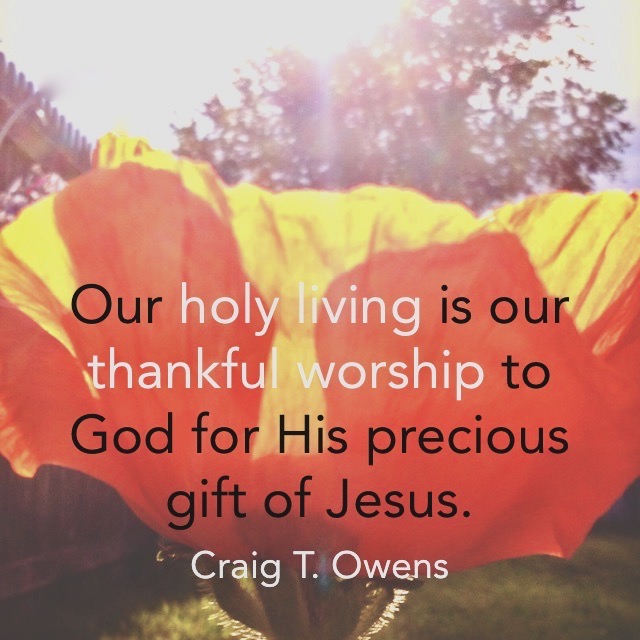
What freedom there is in allowing our living faith to overflow into our loving deeds! Our holy living is our thankful worship to God for His precious gift of Jesus.
Here’s the seed thought for this episode of Think On This…
In the fifteenth year of Amaziah son of Joash king of Judah, Jeroboam son of Jehoash king of Israel became king in Samaria, and he reigned forty-one years. He did evil in the eyes of the Lord and did not turn away from any of the sins of Jeroboam son of Nebat, which he had caused Israel to commit. He was the one who restored the boundaries of Israel from Lebo Hamath to the Dead Sea,in accordance with the word of the Lord, the God of Israel, spoken through His servant Jonah son of Amittai, the prophet from Gath Hepher. The Lord had seen how bitterly everyone in Israel, whether slave or free, was suffering; there was no one to help them. And since the Lord had not said He would blot out the name of Israel from under heaven, He saved them by the hand of Jeroboam son of Jehoash. (2 Kings 14:23-27)
Think on this: Just because God has used me to do something amazing doesn’t necessarily mean that I am free of sin.
Once I was asked to teach a class on business ethics but I said, “I can’t because there’s no such thing as ‘business ethics.’ There is only ethics: Either something is right or it’s not.”
I think the same concept holds true for “social justice.” There is no such thing: Either something is just or it’s not.
For those situations that are truly unjust, the Bible tells us how to handle them. But first, let’s get a sense of what the Bible actually means by the word “justice.”
Psalm 50 is a courtroom scene, with God Himself presiding as the Judge, summoning all of creation into His presence (see Psalm 50:1-6). Just before The Judge begins to speak, the psalmist Asaph calls on us to Selah—or pause to consider—after saying, “The heavens proclaim God’s righteousness.”
The New Living Translation has this verse saying, “The heavens proclaim His justice…” and the Amplified Bible uses both words: “The heavens declare His righteousness (rightness and justice)….” So which word is it: righteousness or justice?
The Hebrew word (tsedeq) means something that is ethically right. In other words, something for which God sets the objective standard for rightness and wrongness. There is another Hebrew word that is often very closely associated with tsedeq, and that is justice (mishpat): that is the penalty for violating tsedeq.
But here’s where things get really interesting. We usually associate the idea of justice with retribution (or payback), but God’s justice is usually portrayed as restoration.
In other words, God’s mercy is so strong and His desire for us to be restored into right standing with Him is so passionate, that His default is restorative mercy.
God’s response to our acts of unrighteousness wasn’t to rain down retributive justice on us, but to send His Son to earth to make restorative mercy available!
In his first public sermon, Jesus quoted the prophet Isaiah. The last words Jesus read about His mission on earth were “to proclaim the year of the Lord’s favor.” He left off the last phrase in Isaiah which said, “and the day of vengeance of our God.” Favor (restoration) now; judgment (retribution) later for those who would not accept the restoration Jesus made available.
Back in the Psalm 50 courtroom, God tells us the wrong way to address injustice: with angry, demeaning words (Psalm 50:19-20).
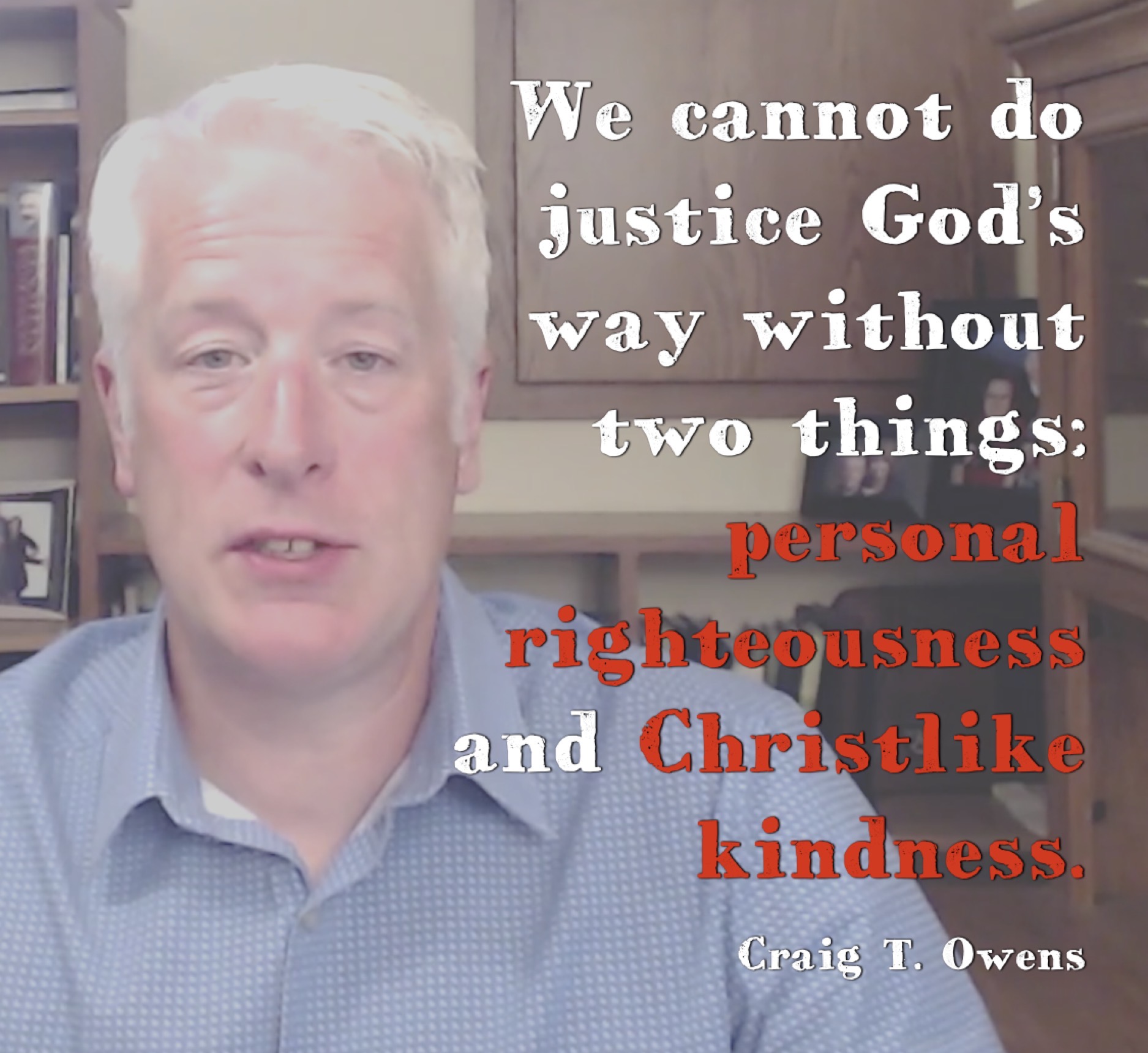
We CANNOT do justice God’s way without two things:
Personalrighteousness which comes from Jesus in us (Romans 5:1); otherwise, we’re just hypocrites pointing out the exact same injustice that’s in ourselves.
Kindness. “But let the one who boasts boast about this: that they have the understanding to know Me, that I am the Lord, who exercises kindness, justice and righteousness on earth, for in these I delight,” declares the Lord. (Jeremiah 9:24)
And what does the Lord require of you but to do justly, and to love kindness and mercy, and to humble yourself and walk humbly with your God? (Micah 6:8)
The darkness of injustice is the absence of light. Jesus says to us, “Youarethelight of the world” (Matthew 5:14).
The hate of injustice is the absence of love. Jesus says to us, “A new command I give you: Love one another. As I have loved you, so you must love one another. By this everyone will know that you are My disciples, if you love one another” (John 13:34-35).
Here are my takeaways—
Let God be The Judge.
Make sure I am in right standing with God through my relationship with Jesus Christ.
If I see injustice, address it with kindness, light, and love.



 Before the throne of God above





 Craig T. Owens