Too good to share just one, here are five from a collection of Shel Silverstein poems printed after his death in the book Everything On It.
This is a reprint of an article I wrote for this week’s Cedar Springs Post.
Now that it appears that—let’s cross our fingers—Spring has finally sprung, many people will be throwing open the windows, airing out the house, and cleaning up some things that have accumulated over the long, icy winter. Ah, yes, the annual rites of spring cleaning!
One place that lots of things accumulate is our schedule. Between sports schedules, church activities, music lessons, grocery store trips, making meals, parent-teacher conferences, birthday parties, and so many other things, our schedules are packed chockfull.
In our relationships love is typically spelled “t-i-m-e.” So if you don’t have enough t-i-m-e to express your love, perhaps some spring cleaning is needed.
A few things to remember:
(1) Time is finite. You cannot call a time-out, you cannot bank up some time for another day, you cannot slow down the clock. Once you commit to something, that time is gone forever.
(2) It’s okay to say “No.” A friend of mine recently shared this thought: Whenever you say “Yes” to anything, there is less of you and your time for something else. So make sure your “Yes” is worth the “less.” If the “less” is t-i-m-e with your loved ones, please say a guilt-free “No, thank you.”
(3) Make your “Yes” mean yes. If you do decide to commit to something, then honor your commitment. Jesus said, “Let what you say be simply ‘Yes’ or ‘No’” (Matthew 5:37). And wise King Solomon warned, “It is better not to make a vow than to make one and not fulfill it” (Ecclesiastes 5:5).
(4) Time is your servant, not the other way around. Make your time work for you; don’t be a slave to the clock. A good indication that you’re the slave and not the master is that feeling like you are always running late for everything. Cut out some non-essentials like TV time or countless Facebook hours so you can make t-i-m-e for what’s really important.
Happy Spring (time) Cleaning!
Some links to some interesting reading and quotes I found today.
An April Fools joke that’s not funny at all! The Joke’s On Us!
Great thoughts about church music from 97-year-old Bible professor Stanley Horton: What About Church Music?
I’m normally a University of Michigan fan, but this grotesque support of abortion is just over-the-top: University Goes Out Of Its Way To Support Abortion.
Love this from Ken Davis: This House Guest May Be Stealing Your Life.
“Unutterable mercy! There is no sinner out of hell so black but that God can wash him white. There is not out of the pit one so guilty that God is not able and willing to forgive him; for He declares the wondrous fact—‘I, even I, am He that blotteth out thy transgressions.’” —Charles Spurgeon
6 Things God Will Never Do To You (it will help if you sing Rick Astley while you read this!).
Tim Elmore shares Five Qualities Google Looks For In Hiring Employees.
“The Holy Spirit is the missing factor in our personality, and without Him we cannot be altogether as God wants us to be. An abiding gift makes an abiding change in the person to whom the gift is made.” —Thomas Selby
“Continually revise your relationship to God until the only certainty you have is not that you are faithful, but that He is.” —Oswald Chambers
You can spin it around, roll it down the stairs, throw it high in the air, and still it isn’t phased one bit. It doesn’t matter if you’re moving fast or slow, if you’re at high altitudes or in Death Valley, it still works. The needle of the compass always points north.
It can’t help it: it is naturally oriented to the north pole. Whether it’s pitch-black outside, or 40 degrees below zero; whether you feel like north is “north” or not, the needle will always point its way back to north.
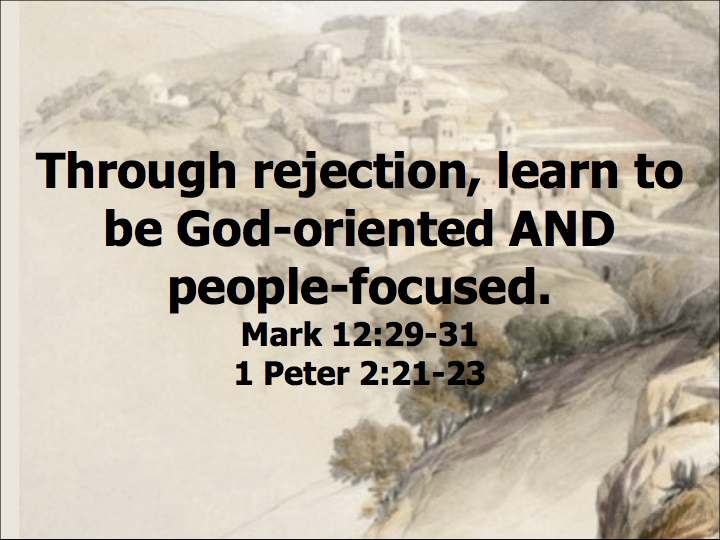
Jesus could be cheered by the crowds or jeered by them. People could shout “Hosanna!” or “Crucify Him!” The weather could be calm or stormy, His disciples could be courageous or scared to death, and still Jesus was oriented to His Father.
Every word Jesus said, every action He undertook, every lesson He taught, every prayer He prayed was God-oriented.
But not only that, even as much as people ridiculed Him, snubbed Him, rejected Him, or denied Him, Jesus was still people-focused. After being so cruelly treated, I think I may have turned from some people, or even turned on some people with some not-so-kind words. I may have even begun to withdraw from people. But despite the way people mistreated Him, Jesus remained lovingly people-focused (see 1 Peter 2:21-23).
Jesus us told us that if we stand for Him, we will be mistreated as well (see Luke 21:17 and John 15:20). But He also told us there was a reward for that mistreatment (see Matthew 5:11-12).
When asked what the greatest of all the commandments was, Jesus replied that it was to be God-focused and people-oriented—
Jesus replied, “The most important commandment is this: ‘Listen, O Israel! The Lord our God is the one and only Lord. And you must love the Lord your God with all your heart, all your soul, all your mind, and all your strength.’ The second is equally important: ‘Love your neighbor as yourself.’ No other commandment is greater than these.” (Mark 12:29-31)
So a good check-up question for us all: How am I doing at being God-oriented and people-focused, no matter what the circumstances are?
UPDATE: I explore the example of how Jesus responded to His critics in a couple of chapters of my book When Sheep Bite.
These are links to articles and quotes I found interesting today.
“Before the judgment seat of Christ my service will be judged not by how much I have done but by how much I could have done.” —A.W. Tozer
Medical science tells us what the nose knows.
Great advice on handling people who are mean: “But I mustn’t encourage you to go on thinking about her: that, after all, is almost the greatest evil nasty people can do us—to become an obsession, to haunt our minds. A brief prayer for them, and then away to other subjects, is the thing, if one can only stick to it.” —C.S. Lewis
“Some stumble because they do not see the stone in the way: divine grace enables us to perceive it and so to avoid it. … Oh, for grace to walk this day without a single stumble! It is not enough that we do not actually fall; our cry should be that we may not make the smallest slip with our feet but may at the last adore Him ‘Who is able to keep us from stumbling.’” —Charles Spurgeon
I like this: 4 Ways You Should Pray For Your Pastors.
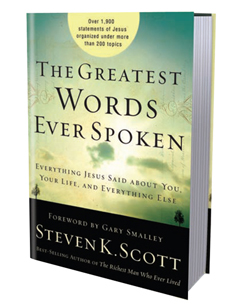
Obviously the best quotes from The Greatest Words Ever Spoken are from Jesus Himself. But Steven K. Scott, who complied the words of Christ into this unique format (you may read my book review by clicking here) had some good things to say too.
“No occurrence in history or physical science has been verified with a higher degree of statistical certainty than the fact that Jesus is exactly who He claimed to be—the Messiah, the Son of the living God.”
“We cannot worship the Father in spirit or in truth unless we see Him for who He really is and understand His relationship with the Son.”
“Agnostics hold the position that they simply do not know if God exists. Atheists, on the other hand, claim intellectual superiority over all others, saying they know there is no God.”
“If you want to know what God thinks and feels, how He acts and works, what grieves Him and what pleases Him, all you have to do is read the words and observe the behavior of Jesus Christ.”
“Several years ago a string of four letters took the Christian community by storm. It seemed like WWJD, which stands for ‘What would Jesus do?’ was everywhere—and why not? When a choice has to be made, is any other question more important to ask? The answer is ‘Yes, one question is more important. One question Christians should ask before choosing any course of action, making any spiritual decision, or adopting any value or belief.’ That question is ‘WDJS: what did Jesus say?’ This is the question Christians need to ask because in many situations we simply can’t know for sure what Jesus would do, so we are left to figure it out for ourselves. And figuring it out may require more wisdom, revelation, insight, and spiritual maturity than we possess at the time. … Jesus made more statements about how His followers should live and what they should believe than about any other group of topics.”
“By nature, we evaluate nearly every situation according to its immediate impact on our desires, and we make our choices accordingly. Consequently, we often sacrifice that which would bring infinite eternal benefit in exchange for temporary gratification.”
“Jesus shows us that blaming others for our failures is not only offensive to God; it is detrimental to our relationships. While we all want healthier relationships, most of us have a hard time breaking free from our natural inclinations. The words of Christ… can bring about extraordinary change in every relationship in your life, for the rest of your life. … We can have better relationships with anyone who crosses our path, but it doesn’t happen naturally. Jesus provides both the revelation and the power that frees us from our human nature.”
Finding God In Hidden Places by Joni Eareckson Tada is a delightful, heart-warming collection of stories in which Joni shares how she has seen God at work in some unexpected places. You can read my full book review by clicking here. Below are some of the quotes that especially stood out to me from this book.
“I take comfort in this: Although it seemed as though God were asleep when I was at the wheel, He wasn’t. He was there. I remind myself that no matter if it’s by the skin of the teeth or with miles to spare… God helps His people. If it’s not their appointed time to die, God will deliver them. God will keep us. He’ll help. He’ll intervene—perhaps just in the nick of time. Is that too close for comfort? Maybe. But our trust in Him was never meant to be comfortable—only close. And the nick of time is close enough.”
“Right now you may be in the middle of a long stretch of the same old routine. … You don’t hear any cheers or applause. The days run together—and so do the weeks. Your commitment to keep putting one foot in front of the other is starting to falter. Take a moment and look at the fruit. Perseverance. Determination. Fortitude. Patience. Your life is not a boring stretch of highway. It’s a straight line to heaven. And just look at the fields ripening along the way. Look at the tenacity and endurance. Look at the grains of righteousness. You’ll have quite a crop at harvest…so don’t give up!”
“If we’re going to stand up and make a difference for Christ while others lounge about, you can be sure we will encounter hardships, obstacles, nuisances, hassles, and inconveniences—much more than the average couch potato. And we shouldn’t be surprised. Such difficulty while serving Christ isn’t necessarily suffering—it’s status quo.”
“Labels, labels, labels. I’m glad Jesus referred to people as people. He never mentioned His friend being a coward; He simply called him Peter. He never referred to the woman who loved Him deeply as a prostitute; He just called her Mary Magdalene.”
“This is the daily stuff of my life. It always involves more than simply picking up hamburgers and cokes, or clothes from the dry cleaners. It involves a chance to make God real to people. A chance for them to serve, to feel good about themselves, to experience a new way of doing things. It’s a chance to break the mold and accomplish a task in a different manner—an opportunity to throw a hand grenade into the ordinary way of living and, in so doing, take people by surprise.”
“Problems are often God’s way of grabbing a lever in order to pry us out of our ruts. And when you rise up out of a rut, you end up enjoying the fresh air of possibilities, the new breeze of challenge and change. Your faith finds feet. Your witness begins to work.”
“Jesus didn’t pass me by. He didn’t overlook me. He answered my prayer—He said, ‘No.’ And I’m glad. A ‘no’ answer has purged sin from my life, strengthened my commitment to Christ, and forced me to depend on grace. It has bound me with other believers, produced discernment, disciplined my mind, and taught me to spend my time wisely. It has stretched my hope, increased my faith, and strengthened my character. Being in this wheelchair has meant knowing Christ better. Feeling His strength every day.”
“I wonder how many of us second-guess a prompting and ignore the Spirit’s leading. That night I learned that every urge to do good, every prompting to share the gospel, is a prompting from God. We need not second-guess. … This week you’ll hear God’s still, small voice whisper, ‘Say something to her… invite him… make that call… apologize.’ You’ll be tempted to brush it off—but don’t. Seize the moment! Today is the day of salvation! The prompting may never pass your way again. Neither might that person. Ever.”
“It’s just like God. He steps into our tightly controlled, private space, raises His hand, and says, ‘Pardon Me, everyone. I have something to reveal about this person.’ He presumes on our comfort zones, tears aside curtains, throws open locked doors, and pulls the fire alarm on stuffy, sacrosanct attitudes. He oversteps our nicely organized plans and strips the veneer off our smug ways. He boldly intrudes into our sin, brashly calling it what it is and challenging us to leave it behind. It’s called humiliation. It’s one of the painful ways we face our sin. If we remain unaware of our sin, we cannot truly know or understand ourselves. Humiliation lands a knockout blow to self-esteem, reminding us that without Christ we are nothing.”
My dear fellow pastor, please be on guard! Be careful to remain physically fit, spiritually full, emotionally strong, and mentally stimulated. Keep your relationships healthy and guard against the attacks of the enemy.
Heed these wise words of A.W. Tozer—
“Yet the ministry is one of the most perilous of professions. The devil hates the Spirit-filled minister with an intensity second only to that which he feels for Christ Himself. The source of this hatred is not difficult to discover. An effective, Christ-like minister is a constant embarrassment to the devil, a threat to his dominion, a rebuttal of his best arguments and a dogged reminder of his coming overthrow. No wonder he hates him. satan knows that the downfall of a prophet of God is a strategic victory for him, so he rests not day or night devising hidden snares and deadfalls for the ministry. Perhaps a better figure would be the poison dart that only paralyzes its victim, for I think that satan has little interest in killing the preacher outright. An ineffective, half-alive minister is a better advertisement for hell than a good man dead. So the preacher’s dangers are likely to be spiritual rather than physical, though sometimes the enemy works through bodily weaknesses to get to the preacher’s soul.”
What do you do to keep yourself healthy and on-guard?