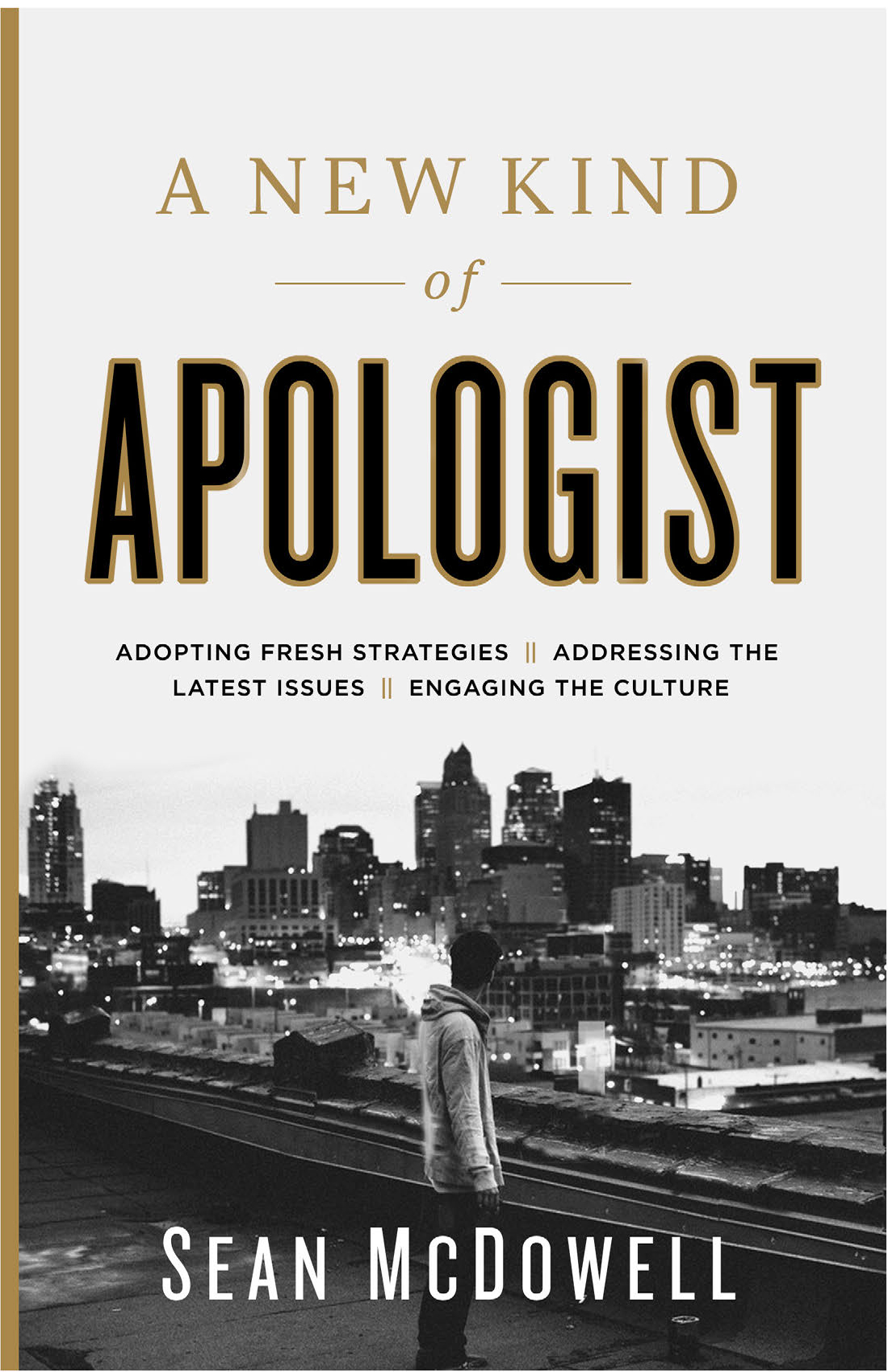
12 Quotes From “A New Kind Of Apologist”

A New Kind Of Apologist is edited by Sean McDowell and contains a collection of fabulous essays to prepare Christian apologists to be effective in this current generation. You can read my full book review by clicking here. These quotes mainly deal with the attitude that a Christian apologist should adopt.

“Truth must be wedded to grace, and what we say is important…but how we say it is equally critical.” —Sean McDowell 

“To listen to a person will require that we temporarily set aside our objections to what a person is saying and allow him or her to speak openly without fear of being challenged.” —Tim Muelhoff

“Our character and relationships with others have a greater capacity for attracting those around us to the Christian message than do our arguments or rhetoric.” —Ken Wytsma & Rick Gerhart 

“If our beliefs are not expressed in love and by example, we miss the greatest command of all, which is loving God and loving others.” —Dan Kimball

“The Barna Research Group found that twentysomethings who stay in church were twice as likely to have a close personal friendship with an adult inside the church. Those who had an adult mentor at church, aside from the pastor, were almost three times as likely to stay as those who did not.” —Jeff Myers

“Any fully-orbed presentation of the truth about ourselves and God’s plan for us cannot be a disembodied, purely intellectual truth; it must truthfully reflect our nature as created beings.

“Part of being incarnate means that it is good and right for us to have emotions and express them—as our Lord did, for example, by weeping at the tomb of Lazarus and getting angry with the money changers in the temple. The fact that little children wanted to come to Him suggests that He had a welcoming physicality and a warm personality that they instinctively trusted and found attractive. He wasn’t just a walking dictionary of Christian theology.” —Holly Ordway

“At its core, apologetics is the art and science of defending the faith. However, practically understood, the work of the apologist is simply to answer with integrity, clarity, and compassion the questions critics are asking about the gospel (1 Peter 3:15). The context of this passage implies a lifestyle on the part of the apologist that engenders and welcomes questions from their audience. The encouragement of Peter seems to be that we avoid the telemarketer approach of simply enduring questions solely for the sake of closing the deal. Rather, Peter calls us to anticipate and patiently answer the questions of our unbelieving friends, family members, and neighbors in an uncompromising and yet humble manner.” —Christopher Brooks

“We must be Christians first and apologists second, which means our intellectual lives must be primarily shaped by seeking to understand the faith we live within rather than debating, disputing, or even persuading those who do not believe it.” —Matthew Anderson 

“It is our responsibility to share the message of hope through Christ ‘with gentleness and respect’ and ‘with grace,’ as Peter and Paul taught. The gospel message is already offensive to some. We need not make it more offensive by presenting it in a manner that lacks gentleness, respect, and grace.” —Mike Licona

“Truth without grace is abusive and arrogant. Grace without truth is mushy sentimentalism. … As much as possible, always deal with the person in grace and the issue itself in truth.” —Glenn T. Stanton

“Paul doesn’t say that we ought to know how to answer each question [see Colossians 4:5-6]. He specifically teaches us to answer each person. … Paul tells us that we aren’t in the question-answering business. We are in the people-answering business. Today’s apologist must understand that questions don’t need answers; people need answers. … I am convinced that the key to apologetics today is to identify what non-Christians thirst for most and show how the Christian faith alone can slake that thirst.” —Abdu Murray

“The manner in which we communicate the gospel is not a minor add-on to the gospel itself [see 1 Peter 3:15-16]. Very often it is the nature of the communication that determines whether the gospel gets a hearing at all. …

“It remains true that it is not arrogant to make truth claims, it is not arrogant to pursue a knowledge of that truth, and to argue that we’ve found it. It is important that the content of our message is a genuine reflection of the gospel, and that the manner in which we communicate it doesn’t become a stumbling block.” —Tanya Walker

More quotes from A New Kind Of Apologist will be coming soon. You can also follow me on Tumblr and Twitter to read great quotes every single day.
A New Kind Of Apologist (book review)

For years, Josh McDowell has been ranked as a first-class Christian apologist: one who can persuasively defend the Christian faith. Sean McDowell grew up in this environment, being well mentored by his apologist father, and has become a world-renown apologist himself. So when Sean speaks of the need for a new kind of apologist, Christians should take notice.

A New Kind Of Apologist is a collection of essays edited by Sean McDowell. The book also contains short interviews which Sean has conducted with both those defending and opposing Christianity. This book covers everything from how apologists can be the most effective in a new generation of skeptics and seekers, as well as some thoughtful ways to address the issues at the forefront of the minds of this new generation.

The essays in this book are written by seasoned veterans of Christian apologetics, and some who are newer to the scene. But all of them write with a voice that is relevant to this current generation.

Not only will this book inform your brain, but it will challenge your heart as well. The overriding theme through all of these excellent essays is this—Christians must seek to love people more than win an intellectual argument. The new apologist knows his “stuff” but also knows how to develop genuine, caring relationships with those skeptics and seekers that need to hear the good news that Christianity offers.

I loved this book! It is clearly one that I am going to be referring to again and again and again as I seek to hone my apologetic and relationship-building skills.

I am a Harvest House reviewer.

10 Quotes From “The Broken Way”

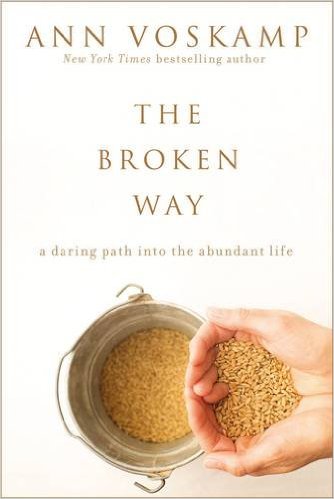
All of us will deal with brokenness at some point in our lives. Ann Voskamp’s The Broken Way is a brilliant light shining in the darkness of brokenness and pain. Check out my review of Ann’s book by clicking here.

“When the church isn’t for the suffering and broken, then the church isn’t for Christ. Because Jesus, with His pierced side, is always on the side of the broken. Jesus always moves into places moved with grief. Jesus always seeks out where the suffering is, and that’s where Jesus stays. The wound in His side proves that Jesus is always on the side of the suffering, the wounded, the busted, the broken.”

“The body of Christ doesn’t offer you some clichés, but something to cling to—right here in our own scarred hands. His body doesn’t offer some platitudes, but some place for your pain—right here in our offered time. His body doesn’t offer some excuses, but we’ll be an example—right here in our bending down and washing your wounds.”

“A Wounded Healer uses nails to buy freedom and crosses to resurrect hope and He never treats those who hurt on the inside as less than those who hurt on the outside.”

“Get busy, get distracted, and you can forget God. Forget God, and you lose your mind and your peace. Forget God, and all you remember is anxiety. Anxiety can give you God-Alzheimer’s. Forget the face of God, and you forget your own name is Beloved.”

“The art of giving is believing there is enough love in you, that you are loved enough by Him, to be made enough love to give.”

“You can be glued to a screen or glued to your schedule or glued to your stuff—and maybe that’s just a bit of lost living. You can be a slave to getting ahead, a slave to the clock, a slave to convenience, a slave to some ill-advised American dream—and maybe that’s a lot of lost living. Maybe even in a bit of brokenness, grace moves in you to get up and give to people you love and people that you’re learning to love, to go to the park and laugh with your kids or any kids, to give an elderly woman a hand and a listening ear and the gift of presence—that’s large living.”

“The world is brokenhearted and full of suffering, and if you listen to what life needs instead of what you need from it, you could fill the brokenness with your own brokenhearted love—and this will in turn fill you. … You are where you are for such a time as this—not to make an impression, but to make a difference.”

“When you are filled to the brim with the enoughness of Christ, the only way you can possibly have more is to pour yourself out.”

“The wondrous order of Christianity isn’t ‘go and sin no more and Jesus won’t condemn you.’ The order of Christ and Christianity is ‘neither do I condemn you—go and sin no more.’”

“The only way to live a truly remarkable life is not to get everyone to notice you, but to leave noticeable marks of God’s love everywhere you go.”

I will be sharing more quotes from The Broken Way soon. If you would like to be notified as soon as these quotes are posted, please subscribe to my blog. And to read other inspiring quotes I share every day, follow me on Twitter or Tumblr (or both!).

4 Quotes On The Destructive Nature Of Pornography

“Pornography is based on and fed by always needing to see something new. It works neurologically to create an obsessive demand for more of something you’ve never seen before. The promise of something new is what gets you excited and interested, which means, by definition, that you can never be fully satisfied. That’s the opposite of cherish. Pornography works off volume, not individuality; it works off the novel, not the known. Learning to cherish a solo picture of a unique mate shapes our hearts and minds to cherish a particular individual above all others.” —Gary Thomas, in Cherish

“Pornography, by its very nature, is an equal opportunity toxin. It damages the viewer, the performer, and the spouses and the children of the viewers and the performers. It is toxic mis-education about sex and relationships. It is more toxic the more you consume.” —Dr. Mary Anne Layden 

“We can’t fill up our eyes with our wives if our eyes have been previously filled with someone else. One of the many dangers of porn is that it neurologically trains us to find our wives less beautiful.” —Gary Thomas, in Cherish

“When it comes to porn, it turns an intimate relationship love-connection into a rehearsed performance that’s less about the emotional bonding that happens when people have sex. No emotional connection, no commitment, no kissing and cuddling, just performing and self-focusing. Porn fails to emphasize the most real parts in relationships. It doesn’t depict real people with real bodies with real (and beautiful) flaws. In fact, it tries to sell the complete opposite—a photoshop fantasy that reality should never have to compete with. So it only makes sense that those who are exposed to porn have their perceptions of sex twisted and warped. Soon, real people don’t measure up, and partners are considered less exciting when compared to an exaggerated production on a computer screen.” —Fight The New Drug

10 Quotes From “Cherish”

As I said in my book review of Gary Thomas’s Cherish, this is a must-read for married couples, those about to be married, and those who counsel married couples. Please check out my review, and then enjoy a few quotes from this book.

“Learning to truly cherish each other turns marriage from an obligation into a delight. It lifts marriage above a commitment to a precious priority.”

“In one sense, love is the nurturing aspect of marriage, while cherish is the ‘tasting’ aspect of marriage. Love meets the need; cherish tickles the tongue.”

“If you want to be fully satisfied in your marriage, if you want your wife to feel cherished, then mentally treat your wife like Eve. Let her be, in your mind, in that way, the only woman in the world. Say with King Solomon, ‘My dove, my perfect one, is the only one’ (Song of Songs 6:9 ESV).” 

“You’ve already made your choice. In your ideal world, you have no intention of ever starting over with someone else, so why not put your energy into and your focus on guarding that choice, building on the strengths of that choice, and making yourself ever more grateful that you made that choice?”

“At some point, if you want marital happiness, if you want to learn how to cherish a real man instead of longing for an imaginary composite, some ‘Frankenstein’ husband who somehow has it all, then you have to own your choice and even learn to cherish your choice. ‘My vineyard, my very own, is for myself’ (Song of Songs 8:12 NRSV).”

“The call to cherish isn’t to appreciate being pleasured by your spouse but to take pleasure in the pleasure of your spouse.”

“If we want to cherish our spouses, we must learn to take an active interest in what interests them.”

“Cherishing is expressed, or it’s not. Intimacy is built, or it is assaulted, even in the most mundane marital conversations.”

“The act of consistently noticing and honoring our spouses cultivates and maintains a certain kind of relationship, and it shapes our hearts. Noticing and honoring sustain the force and power of cherishing. When we stop noticing and stop honoring our spouses in the little things, the relationship starves.”

“Active cherishing—noticing and then expressing the excellence you see—is a way to shape our attitudes and to generate feelings of closeness and well-being. When we do what the Bible tells us to do, we will be doubly blessed—our spouses will be happier, increasing the joy in our marriages, and we’ll become happier psychologically as well. Cherishing our spouses literally makes us feel better. So cherishing means waging war on contempt and going on the offense with gratitude.”

I will be sharing more quotes from Cherish soon. If you’d like to be notified when these quotes are posted, simply enter your email address in the field in the right column and click “Sign me up!” You may also want to follow me on Twitter and Tumblr for other quality quotes I post every day.

9 Quotes From “Take Your Life Back”

take-your-life-backStephen Arterburn and David Stoop have given us a great resource if we are struggling to free ourselves from the wounds that are trapping us in a reactive life. I truly believe Take Your Life Back will start many people on a journey of healing. Check out my full book review by clicking here, and then check out a few quotes from this helpful book.

“When we’re constantly looking at what’s happening with other people and measuring our satisfaction based on how fairly we feel we’ve been treated, we are forever at the mercy of what is going on over there. We’ve wired ourselves to react to whatever scale of comparison we’ve established.”

“The real self, quite simply, is the self that God sees. He sees it all, with all its flaws. He does not approve of or endorse everything He sees, but He loves the person He sees. He does not see an idealized self, free of sin. He sees the real self—sinful, doubtful, and flawed—and yet He accepts the reality of it and loves us in spite of it all.”

“Our reactions to pain and our adaptations to it are unique to ourselves; we are not all the same. But we have several things in common: In one way or another, we have turned our back on reality, and we have allowed all, or portions, of our lives to be controlled by another person, a destructive pattern, or unrealistic expectations. We live on the edge of almost. We are almost breaking free, or we are almost free. We are almost fed up or almost ready to take our lives back.” 

“Denial keeps us from addressing the things we can change, causing us to think that our inability to change everything means we can’t change anything. … Because we either don’t or won’t see how far we are from living the life that God intends for us, we stay in our denial and wait for the magic cure that never materializes. But when we admit that we’re in denial, and when we are willing to break through it, we can begin to move into recovery.”

“When we talk about the elephant in the room, we have a way of describing it as a small rodent. Our internal application for minimizing language automatically converts words like pain into irritation; devastating into difficult; abusive into insensitive; and horrific into unpleasant. Our self-talk is unrealistic, so whenever we communicate with someone else, we present our overwhelming problems as manageable situations that we have completely under control. Because we don’t acknowledge the full scope and intensity of our struggles, we don’t act in realistic ways to free ourselves and take our lives back. We minimize in order to give ourselves permission to do little or nothing to change.”

“Toxic shame undermines our will and our power to stand up for ourselves. … Toxic shame carves out a new normal for those who partake of its poisonous fruit. Rather than seeing themselves as human beings who have made a few mistakes—maybe even some really big mistakes—people who are saturated with toxic shame see their failures as an objective expression of who they are. Before long, they don’t even try to avoid future mistakes. They don’t learn from their errors because they don’t think they can, or need to, learn anything. Repeated mistakes are simply a self-fulfilling prophecy that their shame as written for them. …

“Toxic shame…blinds us to wisdom and insight. It prevents us from cleaning up after ourselves. We start to live in the debris of past mistakes, and that leads us to more debris-producing decisions. We fill our lives with problem after problem because we don’t think we can do any better.”

“There is such a thing as good shame. A better term for it might be godly sorrow. …

“Godly sorrow is a warning sign that we are on the wrong path and need to make some adjustments. Any mistakes we make are not seen as the inevitable result of who we are but as stark reminders that—because of who we are, created in the image of God—we can do better. We are genuinely sorry that we fell short, hurt ourselves or other people, or simply created a lot of hassle that has kept us from living in the good things that God has for us. However, our defective behavior is rightly seen as separate from our identity. Making a mistake doesn’t mean that we are a mistake; it’s simply evidence that we are like every other human being—completely capable of many things, including mistakes. …

“Godly sorrow is a prompt from God, and from a well-developed conscience, that we need something more to achieve all that we want to accomplish. We respond to healthy shame with the desire to get better or do better….”

“Tough love says that I will choose to not give you what you want if it prevents you from attaining what you need.”

“Taking your life back is not just about deciding to defend yourself. It is about finding and removing roadblocks, sinkholes, and dead ends that have disconnected you from other people and stopped your journey from going forward together.”

Is Love Touchy-Feely?

mowt-loveOne of my greatest joys is investing in people, and then watching them develop their God-given gifts. One such man is my friend Scott Troost.

I began a series at the beginning of the month talking about things I have come to appreciate, and I asked a couple of my friends to join with me. Last week Josh Schram shared his appreciation with wise counsel, and this week Scott shared what he’s come to appreciate about love.

Is “puppy love” real love? Is love even supposed to have a feeling? If there are no feelings associated with love, how can you know that you are indeed loving? Scott shares his personal journey on what he’s come to appreciate about love, and I sincerely hope you will watch this video of his message…

The Truth About Wise Counsel

proverbs-12-1Pastor Josh Schram shared with us the lessons he’s appreciated about receiving wise counsel from those around him. One of Josh’s opening remarks really hit home with me, because it’s something I still struggle with at times: I have to get beyond thinking that those who are trying to speak into my life are somehow trying to meddle in my life!

A couple of other thoughts that really made me pause and reflect were—

“Ignorance may be bliss, but it won’t last.” How true! I may cover my eyes and ears to the truth, but my ignorance will ultimately lead to my downfall.

“People who will speak truth into my life care more about me than about my feelings.” As Proverbs says, “Wounds from a friend can be trusted, but an enemy multiplies kisses” (27:6).

Josh closed with these challenging questions:

  • Am I open to correction from wise counsel?
  • When I am corrected, do I feel like I must defend myself?
  • Are my ears open and am I really listening?

Check out this helpful message for yourself…

Rick Warren On What Mercy Means

rick-warren“Mercy means…

…being patient with people’s quirks (James 3:17)

…helping anyone around you who is hurting (Proverbs 3:27)

…giving people a second chance (Ephesians 4:31-32)

…doing good to those who hurt you (Luke 6:35-36)

…being kind to those who offend you (Jude 22-23)

…building bridges of love to the unpopular (premeditated mercy) (Matthew 9:13)

…valuing relationships over rules (Romans 13:10)” —Rick Warren

Mother Teresa On The Fallout From Legalized Abortion

mother-teresa“It was a sad infidelity to America’s highest ideals when this Court said that it did not matter, or could not be determined, when the inalienable right to life began for a child in its mother’s womb.

“America needs no words from me to see how your decision in Roe v. Wade has deformed a great nation. The so-called right to abortion has pitted mothers against their children and women against men. It has sown violence and discord at the heart of the most intimate human relationships. It has aggravated the derogation of the father’s role in an increasingly fatherless society. It has portrayed the greatest of gifts—a child—as a competitor, an intrusion, and an inconvenience. It has nominally accorded mothers unfettered domination over the independent lives of their physically dependent sons and daughters. And, in granting this unconscionable power, it has exposed many women to unjust and selfish demands from their husbands or other sexual partners.” —Mother Theresa, addressing the Supreme Court of the United States