


 “When Jesus was crucified, His followers were discouraged and depressed. They no longer had confidence that Jesus had been sent by God, because they believed anyone crucified was accursed by God. They also had been taught that God would not let His Messiah suffer death. So they disbursed. The Jesus movement was all but stopped in its tracks. Then, after a short period of time, we see them abandoning their occupations, regathering, and committing themselves to spread a very specific message—that Jesus Christ was the Messiah of God who died on the Cross, returned to life, and was seen alive by them. And they were willing to spend the rest of their lives proclaiming this, without any payoff from a human point of view. It’s not as though there were a mansion awaiting them on the Mediterranean. They faced a life of hardship. They often went without food, slept exposed to the elements, were ridiculed, beaten, imprisoned. And finally, most of them were executed in torturous ways. For what? For good intentions? No, because they were convinced beyond a shadow of a doubt that they had seen Jesus Christ alive from the dead. What you can’t explain is how this particular group of men came up with this particular belief without having had an experience of the resurrected Christ. There’s no other adequate explanation.” —J. P. Moreland, quoted in More Than A Carpenter
The Resurrection Of Jesus Makes All The Difference
February 14, 2017 — Craig T. OwensUnforgiveness
February 9, 2017 — Craig T. Owens From D.L. Moody’s book Prevailing Prayer—
“I believe this is keeping more people from having power with God than any other thing—they are not willing to cultivate the spirit of forgiveness. If we allow the root of bitterness to spring up in our hearts against some one, our prayer will not be answered.” …
“It may be that you are saying: ‘I do not know that I have anything against anyone.’ Has anyone anything against you? Is there someone who thinks you have done them wrong? Perhaps you have not; but it may be they think you have. I will tell you what I would do before I go to sleep tonight; I would go and see them, and have the question settled. You will find that you will be greatly blessed in the very act.” …
“It is human to err, but it is Christ-like to forgive and be forgiven.” …
“As Matthew Henry says: ‘We do not forgive our offending brother aright nor acceptably, if we do not forgive him from the heart, for it is that God looks at. No malice must be harbored there, nor ill will to any; no projects of revenge must be hatched there, nor desires of it, as there are in many who outwardly appear peaceful and reconciled. We must from the heart desire and seek the welfare of those who have offended us.’”
Check out more quotes from Prevailing Prayer by clicking here.
Check out my review of Prevailing Prayer by clicking here.
13 Quotes From “Prevailing Prayer”
February 8, 2017 — Craig T. Owens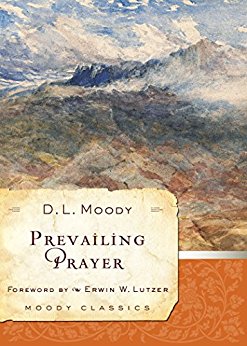 D.L. Moody challenges all Christians to stick with prayer a little longer. Far too many of us give up too soon, and miss out on the miracle God wants to do. Check out my review of Prevailing Prayer by clicking here.
“The two first and essential means of grace are the Word of God and Prayer. … If we read the Word and do not pray, we may become puffed up with knowledge, without the love that buildeth up. If we pray without reading the Word, we shall be ignorant of the mind and will of God, and become mystical and fanatical, and liable to be blown about by every wind of doctrine.”
“The reason we so often fail in moving our fellowmen is that we try to win them without first getting power with God. Jesus was in communion with His Father, and so He could be assured that His prayers were heard.”
“It is not by eloquent sermons that perishing souls are going to be reached; we need the power of God in order that the blessing may come down.”
“Our Master’s prayers were short when offered in public; when He was alone with God that was a different thing, and He could spend the whole night in communion with His Father. My experience is that those who pray most in their closets generally make short prayers in public.”
“In Proverbs 28:9 we read, ‘He that turneth away his ear from hearing the law, even his prayer shall be abomination.’ Think of that! It may shock some of us to think that our prayers are an abomination to God, yet if any are living in known sin, this is what God’s Word says about them.”
“There is a great deal more said in the Bible about praise than prayer; yet how few praise-meetings there are! David, in his Psalms, always mixes praise with prayer. Solomon prevailed much with God in prayer at the dedication of the temple; but it was the voice of praise which brought down the glory that filled the house. … However great our difficulties, or deep even our sorrows, there is room for thankfulness.”
“Even if nothing else called for thankfulness, it would always be an ample cause for it that Jesus Christ loved us, and gave Himself for us.”
“When the church, the pulpit, and the pew get united, and God’s people are all of one mind, Christianity is like a red-hot ball rolling over the earth, and all the hosts of death and hell cannot stand before it.”
“We are not told that Jesus ever taught His disciples how to preach, but He taught them how to pray. He wanted them to have power with God; then He knew they would have power with man.”
“It is not the most beautiful or the most eloquent language that brings down the answer; it is the cry that goes up from a burdened heart.”
“Some people think God does not like to be troubled with our constant coming and asking. The only way to trouble God is not to come at all. He encourages us to come to Him repeatedly, and press our claims.”
“The Lord delights in hearing His children make their requests known unto Him—telling their troubles all out to Him; and then we should wait for His time.”
“Let our prayer be that God may advance His work, not for our glory—not for our sake—but for the sake of His beloved Son whom He hath sent.”
Prevailing Prayer (book review)
February 7, 2017 — Craig T. OwensWhile I was growing up I heard an oft-repeated phrase around our church: “I prayed it through.” I think this would resonate with the heart of Dwight Moody, as he clearly articulates this concept in his book Prevailing Prayer.
Quite simply, Moody defines prevailing prayer as prayer that “involves the whole of our being. It affects our minds because we are occupied with God; it affects our wills because we desire to be yielded to God; and it affects our emotions because we are consumed with a love for God.” But many people—even seasoned Christians—wold probably confess that praying like this is challenging. Moody would agree with this, which is why he has given us such a practical book.
Moody not only lays out for us what will increase the likelihood that we will prevail in prayer, but he also diagnoses some of the roadblocks to this kind of consuming prayer. Each chapter links with the other chapters to build a convincing case that every Christian can learn how to prevail in prayer.
Moody uses stories from the Bible, stories from his own life and ministry, quotes from other Christian thinkers, as well as common-sensical ideas to create a desire to pray in this powerful, sustained way.
Whether you are a brand new Christian or a “seasoned saint,” Prevailing Prayer will energize your prayer life!
Don’t Miss God’s Greatest Blessings
February 6, 2017 — Craig T. Owens “One of the great mistakes of the people of Israel in the Old Testament was to seek and wallow in the temporal blessings of God so much that they missed the great blessing of God Himself. We are in danger of doing the same today. …
“Having failed to pursue the presence of the Lord, Israel ultimately came to despise His many blessings, attributing them instead to their own prowess or to the false idols and pagan deities of their unbelieving neighbors.
“Yet God promised that their highest pleasures and most lasting joys would be found in Him, and not in the conditions of their lives. Not in His blessings, but in Him. Israel completely missed the mark, and we today are in just the same place.
“As long as we continue to seek our happiness in the blessings God provides rather than in the God Who provides blessings, we will be in danger of falling short of the exceedingly great and precious promises of God. ‘Come to Me,’ Jesus insisted, ‘and I will give you rest’ (Matthew 11:28). We will never know complete contentedness in the presence of the Lord as long we count our blessings primarily in terms of conditions and things. …
“Until seeking Him, knowing Him, dwelling with Him, walking with Him, delighting in Him, and partaking of Him is the greatest blessing, richest pleasure, and surest joy we know, we will be in danger of falling into idolatry and failing at our Kingdom-and-glory calling from the Lord.” —T.M. Moore
Thursdays With Oswald—What To Do With Spiritual Barriers
February 2, 2017 — Craig T. Owens This is a weekly series with things I’m reading and pondering from Oswald Chambers. You can read the original seed thought here, or type “Thursdays With Oswald” in the search box to read more entries.
What To Do With Spiritual Barriers
The inevitable barriers are there in every one of our lives. … The thing to do is to recognize that the barriers are inscrutable, that they are not by chance but entirely by God’s permission, and they should be faced and not ignored. …
The peril of the inevitable barriers is that if I have not faced the facts sufficiently, I am apt to blame God for them. There is one fact more that I do not know, and that fact lies entirely with God, not with me. It is no use to spend my time saying, I wish I was not like this, I am just like it. The practical point in Christianity is—Can Jesus Christ and His religion be of any use to me as I am, not as I am not? Can He deal with me where I am, in the condition I am in?
From Shade Of His Hand
What a wretched man I am! Who will rescue me from this body that is subject to death? Thanks be to God, Who delivers me through Jesus Christ our Lord! (Romans 7:24-25)
To keep me from becoming conceited because of these surpassingly great revelations, there was giving me a thorn in my flesh, a messenger of satan, to torment me. Three times I pleaded with the Lord to take it away from me. But He said to me, “My grace is sufficient for you, for My power is made perfect in weakness.” Therefore I will boast all the more gladly about my weaknesses, so that Christ’s power may rest on me. That is why, for Christ’s sake, I delight in weaknesses, in insults, and hardships, persecutions, and difficulties. When I am weak, then I am strong. (2 Corinthians 12:7-10)
For I am convinced that neither death nor life, neither angels nor demons, neither the present nor the future, nor any powers, neither height nor depth, nor anything else in all creation, will be able to separate us from the love of God that is in Christ Jesus our Lord. (Romans 8:38-39)
“The Bible point of view seems to cover most of the facts” (Oswald Chambers).
Horatius Bonar On What Happens When You Pray
February 1, 2017 — Craig T. Owens “This incense was to be ‘offered with’ or ‘laid upon’ so as to cover or envelope the ‘prayers of all saints’—yes, all saints, from Able downwards; for this seems to be the gathering into one of all prayers from the beginning, that at length they may be answered (Luke 18:3, 7). Upon the golden altar in front of the throne the prayers of the saints of all ages have been laid; there they have accumulated; the unanswered ‘How longs?’ not forgotten.
“Not one petition, even the poorest or feeblest, has dropped from that altar, or been swept away, or lost in the process of time. All, all are there. In themselves the are poor, having no fragrance; but their intrinsic imperfection cannot change the nature of that altar on which they are laid. There they are preserved— each sigh, each tear, each cry, from child or aged man, from the chief of sinners, from the thief upon the cross, from the chamber of weakness and sorrow, from the crushed spirit and the broken heart—there they are: the groanings that cannot be uttered; the ‘God be merciful to me, a sinner;’ the ‘How long?’ of the tortured martyrs; the moan of the suffering saint upon his tossing sick-bed—there they are: the father’s prayer, ‘Lord, save my child;’ the child’s prayer, ‘Lord, save my father’— there they are: the pleadings for the church of God, for the overthrow of Antichrist, for the binding of satan, for the deliverance of earth, for the consummation of the eternal purpose! Not one cry lost; not one petition gone astray. All there!
“There is no such thing as unanswered prayer. Delay will only add to the fullness of the answer, and increase our joy when it comes. And it will come. He is faithful that promised. He cannot deny Himself.” —Horatius Bonar, in Light & Truth: Revelation (emphasis mine)
Streams In The Desert (book review)
January 31, 2017 — Craig T. Owens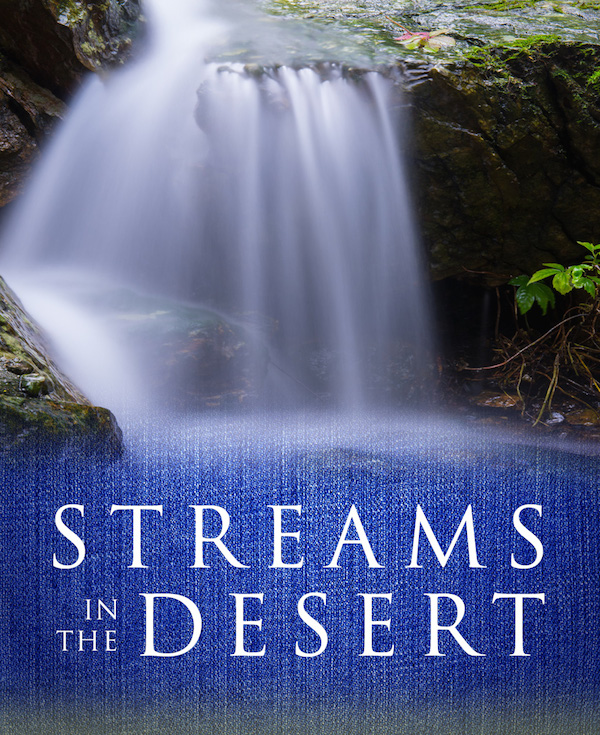 God said, “Behold, I am doing a new thing! Now it springs forth; do you not perceive and know it and will you not give heed to it? I will even make a way in the wilderness and rivers in the desert” (Isaiah 43:19). This verse perfectly sums up the dominant message in Lettie Cowman’s book Streams In The Desert.
Everyone has been there: things haven’t gone as we planned … we’re not sure how we could have ended up in such a dry, barren place … it seems like nothing is working out right … we begin to think that even God has lost sight of us. But it’s in this painful, desert place that God is ready to do something unheard of!
Lettie Cowman knew the pain of sickness and disappointment and thwarted dreams. Yet in the midst of her desert place, as she poured out her raw emotions, she began to see a river springing up in her wilderness. This book is a heaven-sent blessing to anyone in those dark, barren places.
Each day you will get a glimpse of God’s spring, as Lettie shares her personal discoveries, insights from Scripture, quotes from other desert wanderers, poems of reflection, and even prayers for help. Each day’s short reading is thirst-quenching and soul-satisfying.
If you are going through a desert place, get a copy of this book for yourself. If you have a friend who is struggling, buy a copy for them, and find times to get together to discuss each day’s reading. There’s a reason why this book has stood the test of time and has been an immense help to so many throughout the years.
Beware Of Loving Praise From People
January 30, 2017 — Craig T. Owens “Beware of loving praise from men more than praise from Me. One of the effects of the Fall is that people are overly concerned about what others think of them…. I don’t want you to be preoccupied with how other people view you. I have lovingly shielded you from being able to read the minds of others. What they think of you is really ‘none of your business.’ People’s thoughts are unreliable—distorted by their sinfulness, weaknesses, and insecurities. Even if they praise you to your face, some of their thoughts about you will be quite different. I am the only One who sees you as you truly are. … Instead of seeking praise from men, seek to see Me looking at you. My loving approval of you is shining from My face.” —Jesus (in Sarah Young’ s book Jesus Always)
Get Off Facebook, Dad!
January 28, 2017 — Craig T. OwensThis is reprinted from the Axis Culture Translator—
 Middle-aged Americans (35- to 49-year-olds) are now spending more time on social media (seven hours a week) than their children, with the fastest growing demographic on Facebook being Baby Boomers. I recently asked my daughter’s best friend what she was doing that evening and she responded, “nothing, just going home to watch my parents stare at their phones all night.” Ouch.
There’s nothing inherently good or bad about social media, it just is. Yet, how we use it matters. Is documenting your life online keeping you from actually living it? Maybe the greatest gift we can give our children is presence. Here are five practical ways to model healthy social media habits in your home so you can be fully present and engaged with your family.
1. Practice Faithful Presence: Root your life in the real. Anchoring yourself in the here and now reduces the impulsive need to broadcast your life, which can lead to envy, depression, and FOMO. Instead, embrace JOMO!
2. Resist the Urge to Share: Instead of posting that picture of you and your husband at the beach, keep that moment just between the two of you. Cherish it, and it will become an intimate memory binding you to one another, instead of cheapening the moment by sharing it with the world.
3. Unplug: Our devices tell us there is something more important going on “out there” than what’s going on right here, but that’s not true. Establish tech-free times during the day or tech-free places (dinner table) to encourage deliberate, face-to-face interaction with your family. Or, try giving up social media for Lent this year.
4. Slow Down: Your life’s pace matters. Our friends Matt and Julie Canlis encourage parents to live at “Godspeed”, which means living life intentionally, mindfully, and slowly. Practice it by reading a novel aloud together as a family at night, or play a board game instead of watching a movie. Start small, take 15-minutes every morning just to be with your kids before heading off to work and school. Build a liturgy to your day that encourages you to slow down and subvert the digital culture.
5. Pay Attention: The best way to capture moments isn’t to post them to SnapChat, it’s to simply pay attention. Cultivating an awareness of the world around us is a big part of being fully human. Henry David Thoreau said “Only that day dawns to which we are awake.” Ask yourself from time to time, “Am I paying attention to my life right now?” Otherwise, whole days, even our very life could pass by unnoticed.
Our kids need healthy boundaries around screen time and social media, what better way to provide those boundaries than by modeling them with our own actions and habits.
Parents, please sign up for the weekly email from Axis. You can do so by clicking here.
My most-viewed posts


 Craig T. Owens