Listen to the podcast of this post by clicking on the player below, and you can also subscribe on Apple, Spotify, or Audible.
Near the beginning of my interview on the Leading From Alignment podcast with Jim Wiegand and John Opalewski, I was asked to share a bit of my personal background.
I have been incredibly blessed to have grown up in a solid Christian home and in a fantastic Bible-believing church. And yet I still had to come to a point where I had to decide for myself whether I was going to put my faith in the claims of the Bible. Check this out…
Parents, God is faithful to His Word. If we as parents will teach the Scriptural truths to our children, the Holy Spirit will bring that back to their remembrance as our kids get older. We don’t have to fret about their spiritual standing, but we can stand on God’s promises.
This doesn’t remove responsibility from us. I love the story of a woman named Monica who prayed for years and years for the salvation of her son. Even when it appeared he was running as hard as he could away from God, Monica continued to pray. Eventually, her son did put his faith in Jesus and went on to have an immeasurable impact on world and church history. Monica’s son is Augustine of Hippo.
So Mom and Dad, make sure your kids hear God’s Word. Then make sure God hears your prayers for that Word to not return void. You don’t have to fret over your children when you remember that God loves them even more than you do!
Listen to the podcast of this post by clicking on the player below, and you can also subscribe on Apple, Spotify, or Audible.
Jesus told us twice, “Your Father knows what you need before you ask Him” (Matthew 6:8, 32). He knows the good we need.
When we were children, our parents tried to give us good-for-you food, but sometimes it wasn’t necessarily good. It might have given us nutrients, but perhaps it wasn’t as tasty as we would have liked. Let’s be honest: most junk food tastes really, really good—probably better than the good-for-you food. As a result, sometimes we eat just to eat. We eat because we have to. We choke down the vegetables just so we can get to the dessert.
As parents, we want our kids to have good-for-you food. God wants that too, but He wants more than that for us: He wants it to be savory as well. Jesus talked about how evil parents knew enough to give good things to their children, but then He reminded us how much more does God want to give us (Luke 11:11-13)!
It usually takes much longer to prepare food than it does to eat it. This is especially true for more savory gourmet meals. When we gulp down our food, we don’t really appreciate or savor the tastes, the subtle hints the chef has mixed in, and certainly not the time involved to prepare such a lovely feast.
When we gulp down our food without savoring it…
…we don’t honor the one who prepared the food
…we don’t savor the goodness so we don’t appreciate the goodness
…we move on to dessert (or junk food) before our body is ready for it
In Psalm 106 we read a history lesson of Israel’s ups-and-downs—the trouble they were in and the deliverance God prepared for them. The psalmist directly connects their lack of savoring God’s good things to their rebellion and their carnal, godless cravings. Instead of slowing down to be grateful for what God had given them, they just wanted to move on to the next dessert. That attitude may have been what was behind the spoiled girl named Veruca Salt in the movie “Willy Wonka and the Chocolate Factory” who sang the song “I Want It NOW!”
David gives us the antidote for this tasteless gulping of God’s good and good-for-us food: “Taste and see that the Lord is good…” (Psalm 34:8a). This deliberate tasting allows us to see how excellent the things of God are, better than anything else the world has to offer!
David concludes his counsel with these words, “Blessed is the man who takes refuge in Him. Fear the Lord, you His saints, for those who fear Him lack nothing” (Psalm 34:8b).
In the New Testament, the apostle Peter gives us a similar word: “Like newborn babies, you must crave pure spiritual milk so that you will grow into a full experience of salvation. Cry out for this nourishment, now that you have had a taste of the Lord’s kindness” (1 Peter 2:2-3 NLT).
It’s this savoring that will help us appreciate the sweet and the bitter. It’s this appreciation that brings glory to God and keeps us craving more of the ultimate good that only He has for us.
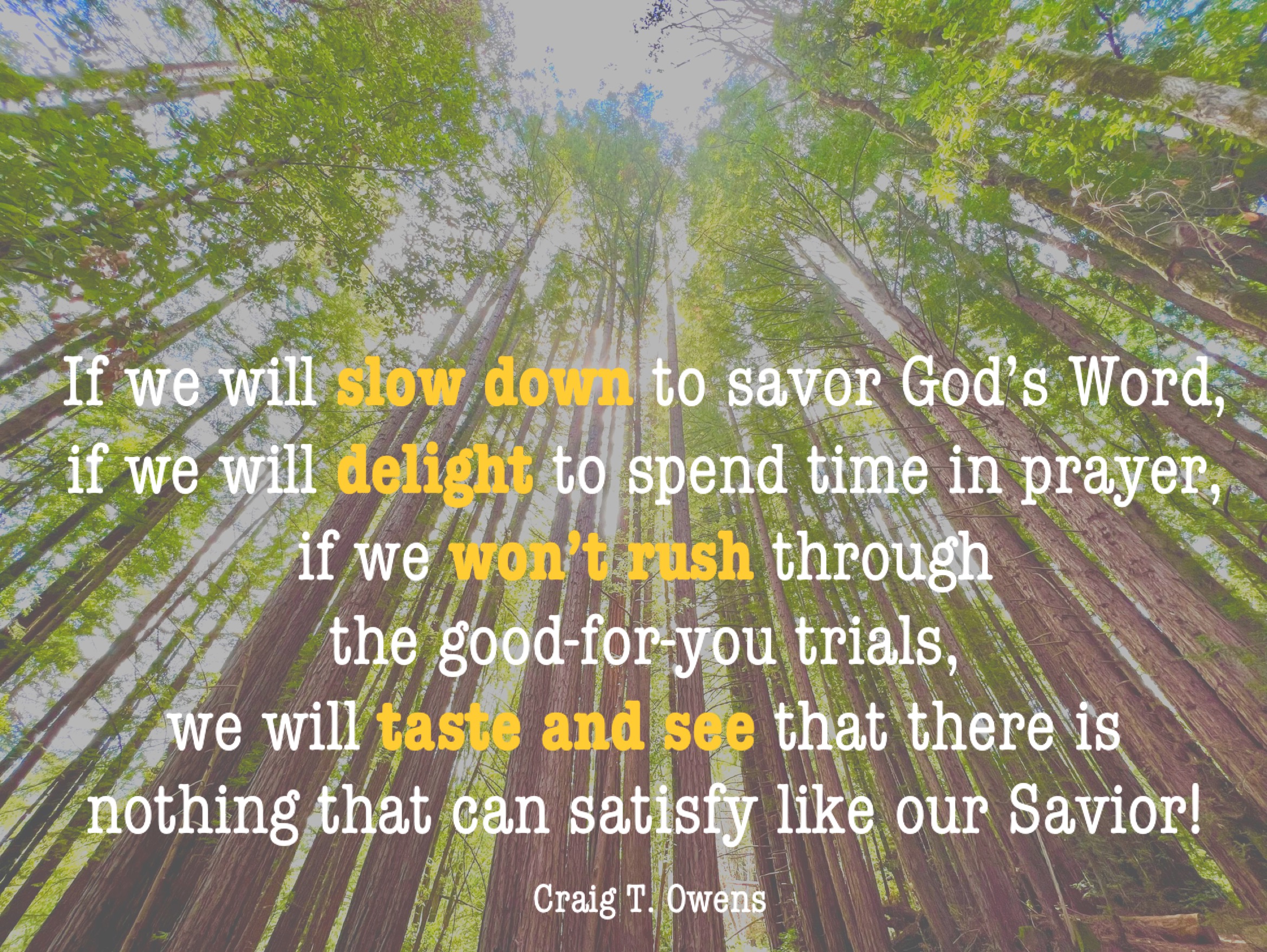
If we will slow down to savor God’s Word, if we will delight to spend time in prayer, if we won’t rush through the good-for-you trials, we will taste and see that there is nothing that can satisfy like our Savior!
This is a weekly series with things I’m reading and pondering from Charles Spurgeon. You can read the original seed thought here, or type “Thursdays With Spurgeon” in the search box to read more entries.
Listen to the podcast of this post by clicking on the player below, and you can also subscribe on Apple, Spotify, or Audible.
Cutting The Root Of The Weed Of Sin
I acknowledged my sin to You, and my iniquity I have not hidden. I said, “I will confess my transgressions to the Lord,” and You forgave the iniquity of my sin. Selah. (Psalm 32:5)
We must confess the guilt as well as the fact of sin. It is useless to conceal it, for it is well known to God; it is beneficial to us to own it, for a full confession softens and humbles the heart. I will confess my transgressions to the Lord. Not to my fellow human beings or to the high priest, but to Jehovah. …
When the soul determines to lay low and plead guilty, absolution is near at hand; hence we read, “And You forgave the iniquity of my sin.” Not only was the sin itself pardoned, but so was the iniquity of it; the virus of its guilt was put away at once, as soon as the acknowledgment was made. God’s pardons are deep and thorough: the knife of mercy cuts at the roots of the ill weed of sin.
But the devil loves to condemn us, to whisper the lie that we’ve sinned one too many times for God to forgive us again. This is truly a lie because a forgiven sin is a forgotten sin. So in essence when we ask God to forgive us for our most recent sin, He views it as our only sin!
In my book Shepherd Leadership, I challenged pastor-shepherds to make good use of confession:
When your reactions aren’t Christlike, admit it. Someone might want to push back, “But if I say I was wrong, then I may lose some leadership credibility.” I would agree that you will lose credibility if you believe you are a self-made leader and if you are climbing up a career ladder that you designed. But if you are truly living and leading as a servant that God has equipped and placed among this flock, admission of an un-Christlike action or reaction triggers something extraordinary: God’s help. Peter said it this way: “All of you, clothe yourselves with humility toward one another, because, ‘God opposes the proud but shows favor to the humble’” (1 Peter 5:5).
Did you catch that? God stands back from the proud person who will not admit his error nor ask for help, let alone ask for forgiveness. On the other hand, God lavishes His grace on the humble one who admits both his error and his need for help. Admission of an inappropriate action or reaction brings God’s help!
Friends, the mark of a maturing shepherd is not one who never misspeaks or never makes a mistake. No, the mark of a maturing shepherd is the one who is closing the gap between his mess up and his confession, and one who is experiencing fewer mess ups over time because the Holy Spirit is helping him get healthier and more mature. —an excerpt from chapter 12 of Shepherd Leadership
Don’t listen to the devil’s lies, but hear the loving voice of the Holy Spirit calling you to confess your sin and receive immediate absolution from it. As Spurgeon said, “God’s pardons are deep and thorough: the knife of mercy cuts at the roots of the ill weed of sin.”
If you would like to know more about Shepherd Leadership, please click here.
This is a weekly series with things I’m reading and pondering from Charles Spurgeon. You can read the original seed thought here, or type “Thursdays With Spurgeon” in the search box to read more entries.
Listen to the podcast of this post by clicking on the player below, and you can also subscribe on Apple, Spotify, or Audible.
Delightful Judgments
My soul is consumed with longing for Your laws at all times. (Psalm 119:20)
Search God’s Word and you will have before your eyes the ultimate judgment of unerring truth, the last decree from the supreme authority from which there is no appeal! The Bible contains the verdict of the Judge of all the earth, the judgments of God who cannot lie and cannot err.
Thus, God’s Word is rightly called His ‘judgments.’ It is a Book not to be judged by us, but to be our judge—not a word of it may be altered or questioned. But to it we may constantly refer as to a court of appeal whose sentence is decisive. …
Our judgments must be daily more and more conformed to the judgments of God that are laid down in Scripture. And there must be in our spirit a longing after holiness until we delight in the Law of the Lord and meditate therein both day and night. We will grow to the likeness of that which we feed upon, heavenly food will make us heavenly minded! The Word of God received into the heart changes us into its own nature and, by rejoicing in the decisions of the Lord, we learn to judge after His judgment and to delight ourselves in that which pleases Him.
From Holy Longings
The 119th Psalm is an amazing chapter—176 verses arranged as a love letter to both God’s Word and the God who gave us His Word. Every one of these verses extol the value and beauty of God’s commands, decrees, precepts, statues, law, and judgments.
As Spurgeon pointed out, “judgment” does not mean a sentence of guilt pronounced against us, but a standard for determining the rightness or lawlessness of something. God’s Word is the final judgment on sin and righteousness.
The psalmist who penned this beautiful prose more than likely had only the first five books of our Bible—Genesis, Exodus, Leviticus, Numbers, and Deuteronomy—and yet he finds such delight in these words because of the awesome God they reveal. Look at his delight…
I delight in Your decrees (v. 16)
Your statues are my delight (v. 24)
I delight in Your commands (v. 47)
I delight in Your law (v. 70)
Your commands give me delight (v. 143)
As Spurgeon said, the more we delight in God’s Word, the more we will meditate on it; the more we meditate on it, the more it will change our hearts to make lifestyle judgments that are pleasing to God.
No matter whether you’ve never really studied the Bible, or you are an “old pro” with a well-worn Bible close at hand, may we all continue to grow in our delight of God’s Word and our reverence of the God revealed to us in the Word.
If you would like some Bible studies to help get you started, check out:
This is a weekly series with things I’m reading and pondering from Charles Spurgeon. You can read the original seed thought here, or type “Thursdays With Spurgeon” in the search box to read more entries.
Listen to the podcast of this post by clicking on the player below, and you can also subscribe on Apple, Spotify, or Audible.
Aids Of Self-Judgment
My soul is consumed with longing for Your laws at all times. (Psalm 119:20)
Spiritual desires are the shadows of coming blessings. What God intends to give us, He first sets us longing for. Therefore, prayer is wonderfully effective because it is the embodiment of a longing that is inspired by God because He intends to bestow the blessing prayed for! What are your longings, then, my hearer? Do you long to be holy? The Lord will make you holy! Do you long to conquer sin? You will overcome it by faith in Jesus! Are you pining after fellowship with Christ? He will come and make His abode with you! Does your soul thirst, yes, even pant after God as the hart for the water brooks? Then you will be filled with all His fulness….
I say not that it is so with all human wishes, for ‘the sluggard desires and has nothing’ [Proverbs 13:4] and many a man has such evil cravings within his heart that it were contrary to the purity of God for Him to grant them. But where there are intense, heartbreaking earnings of a holy order, depend upon it, they are tokens of good things to come!
Where the grace of God reigns in the soul, it makes a man become a stranger among his fellows…. Worldly men care nothing for the judgments of God. No, they care nothing for God Himself! But when a man becomes born anew, a citizen of heaven, there grows up within his spirit a spiritual appetite of which he had felt nothing before—and he longs after God and His Holy Word. See to it, brothers and sisters, whether your souls cry out for God, for the living God, for again I say, by your longings you may test yourselves—by your heart’s desires you may forecast the future—and by your hungering and thirsting you may judge whether you are men of this world or citizens of the world to come. With such aids to self-judgment, no man ought to remain in doubt as to his spiritual condition and eternal prospects.
From Holy Longings
I am currently teaching a series of lessons called Craving. We are learning in these sermons that God created our souls to long intensely, to have cravings. But we go astray when what we crave are things that will merely last during this world.
John told us, “This world is fading away, along with everything that people crave. But anyone who does what pleases God will live forever” (1 John 2:17 NLT). So by its very definition, worldly things will never satisfy our cravings because the world is temporary. Only an eternal God can give us eternal satisfaction.
As Spurgeon teaches us here, examining our longings is the best aid of self-judgment and will help us determine our future. Craving God’s presence will bring God’s blessing and His eternal fulfillment of our cravings. Craving anything else will lead to frustration and eternal disappointment.
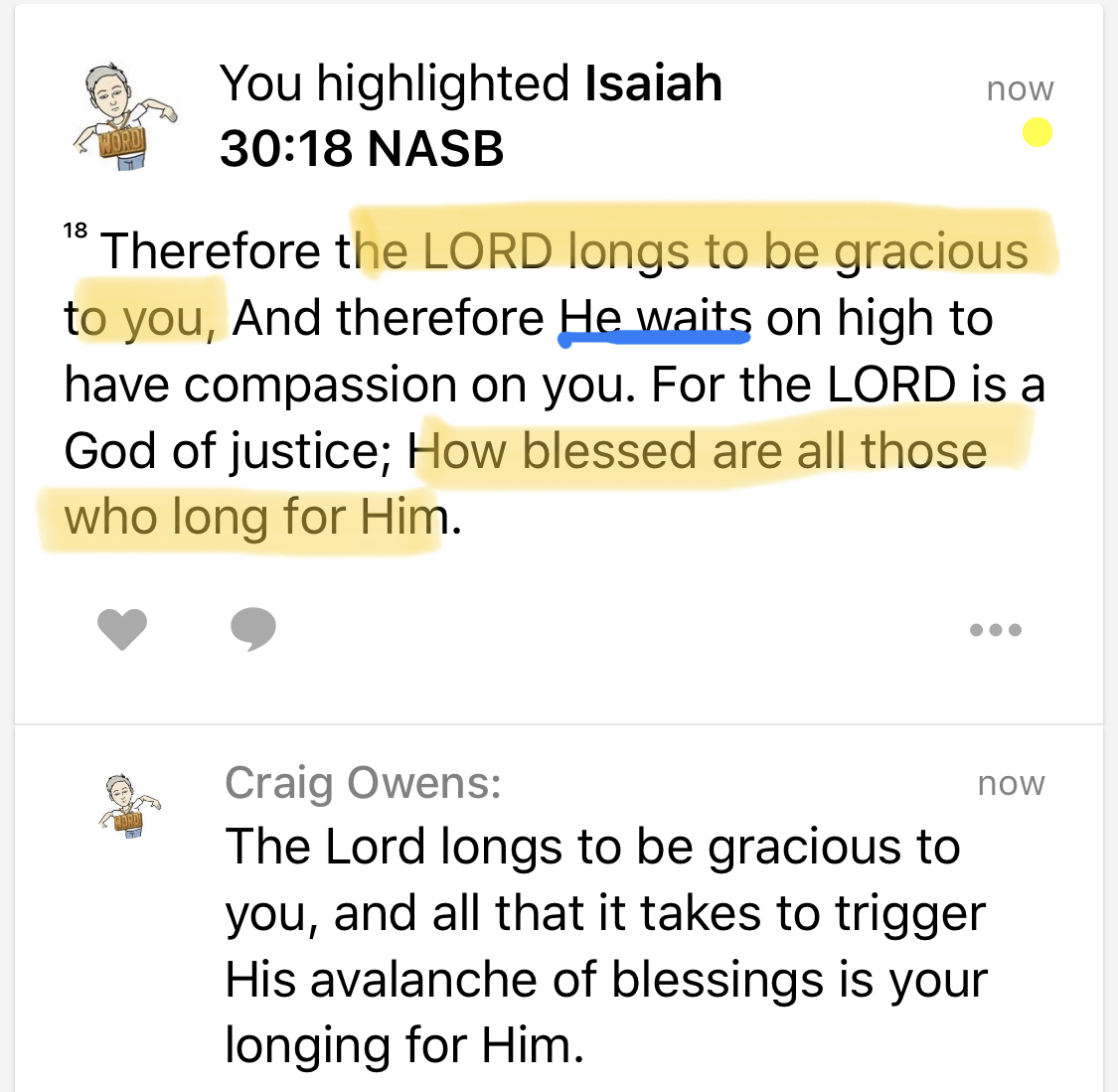
God longs to bless us (Isaiah 30:18) as long as we are craving Him!
This is a weekly series with things I’m reading and pondering from Charles Spurgeon. You can read the original seed thought here, or type “Thursdays With Spurgeon” in the search box to read more entries.
Listen to the podcast of this post by clicking on the player below, and you can also subscribe on Apple, Spotify, or Audible.
Guided For God’s Sake
In You, Lord, I have taken refuge; let me never be put to shame; deliver me in Your righteousness.Turn Your ear to me, come quickly to my rescue; be my rock of refuge, a strong fortress to save me. Since You are my rock and my fortress, for the sake of Your name lead and guide me. Keep me free from the trap that is set for me, for You are my refuge. Into Your hands I commit my spirit; deliver me, Lord, my faithful God. (Psalm 31:1-5)
To lead and to guide are two different things very like each other, but patient thought will detect different shades of meaning, especially as the last may mean ‘provide for me.’ The double word indicates an urgent need—we require double direction, for we are fools and the way is rough.
Lead me as a soldier, guide me as a traveler! Lead me as a babe, guide me as an adult; lead me when You are with me, but guide me even if You are absent; lead me by Your hand, guide me by Your Word. The argument used is one fetched from the armory of free grace: not for my sake, but ‘for the sake of Your name’ guide me.
When we let God lead us and guide us, we are never “put to shame.” It’s my own attempts at guiding myself that end up in shame and failure. This is why Jesus taught us to pray for God’s name to be glorified as His will is done. Part of that leading and guiding provides our daily bread and an escape from falling in the face of temptation.
Interestingly, Jesus prayed the same thing for Himself in the Garden of Gethsemane: “Not My will, but Yours be done.” And then Jesus could confidently use the same words from this Psalm as He hung on the Cross: “Father, into Your hands I commit My spirit.” We can pray with the same assurance when we are allowing the Holy Spirit to both lead and guide us every single day.
This is a weekly series with things I’m reading and pondering from Charles Spurgeon. You can read the original seed thought here, or type “Thursdays With Spurgeon” in the search box to read more entries.
Listen to the podcast of this post by clicking on the player below, and you can also subscribe on Apple, Spotify, or Audible.
Holy Longings
My soul is consumed with longing for Your laws at all times. (Psalm 119:20)
One of the best tests of a man’s character will be found in his deepest and heartiest longings. You cannot always judge a man by what he is doing at any one time, he may be under constraints that compel him to act contrary to his true self, or he may be under an impulse from which he will soon be free. He may, for a while, back off from that which is evil, yet he may be radically bad. … A man’s longings are more inward and more nearer to his real self than his outward acts—they are more natural in that they are entirely free and beyond compulsion or restraint.
As a man longs in his heart, so is he. I mean not every idle wish, as I now speak, but strong desires of the heart. These are the true life of a man’s nature. You will know whether you yourself are evil by answering this question: To what have you the greatest desire? … So then, dear hearers, your heart longings may furnish you with helps for self-examination, and I beg you to apply them, as things of the heart touch the root of the matter.
From Holy Longings
Jesus was constantly taking us back to the examination of our heart. He knew that “out of the heart come evil thoughts—murder, adultery, sexual immorality, theft, false testimony, slander” (Matthew 15:19). He further demonstrated this when He made anger in the heart the same as murder, and lust in the heart the same as adultery (Matthew 5:21-30).
We can try to change our behaviors all day long, but if we don’t address the heart longings that are prompting those behaviors, we are fighting a losing battle.
Sigmund Freud called them “Freudian slips” when we said or did something that seemed out of character. I think we should call them eye-opening insights—we just had an opportunity to glimpse what heart longing is at the root of that inappropriate word or action. Thankfully, the same Holy Spirit that reveals these carnal longings to us will also lead us to repentance and a heart change that brings about God-honoring heart longings.
Don’t try to excuse or cover up what may have slipped out, but use that as a merciful warning of heart longings that need the sanctification of the Holy Spirit. We are all a work-in-progress, which is why I like to remember the word sanctification by saying it “saint-ification.” Let’s yield to the Holy Spirit to bring out greater saintliness by saint-ifying our heart longings.
Listen to the podcast of this post by clicking on the player below, and you can also subscribe on Apple, Spotify, or Audible.
I had a great time on the Ailbe Podcast with Rusty Rabon.
The reason I wrote Shepherd Leadership is because my heart was aching for my fellow pastors who were feeling frustrated maybe even to the point of contemplating resigning their churches. The principles I teach in this book are ones that will get all of us back to a biblical standard of what God says is successful in our ministries.
Toward that end, I love praying for pastors. Every week I send a Sunday morning prayer to my fellow pastors in my hometown to encourage them to find satisfaction in serving the sheep the Chief Shepherd has placed under their care.
As we wrapped up our time together, Rusty referred to a prayer I shared in my chapter entitled ‘Stick-to-it-iveness.’ This prayer is adapted from Psalm 23 and is intended to be a source of strength for pastors.
Take a listen…
I hope this prayer is helpful and energizing to you. I also hope that you will pick up a copy of Shepherd Leadership to infuse some more encouragement into your ministry efforts.
If you would like to check out the other clips I have already shared from this podcast, please check them out here. Shepherd Leadership: The Metrics That Really Matter is available in print or ebook, and in audiobook through either Audible or Apple.
Question marks invite a conversation; whereas, periods or exclamation points tend to end the conversation. Clearly, God enjoys dialogue.
God sometimes asks questions to get Zechariah to evaluate his surroundings or the prevailing culture. Sometimes God asks Zechariah a question to get him to clarify what he is seeing or thinking.
But without a doubt, most of the questions are posed by Zechariah to either God or to the angelic messenger who sometimes serves as Zechariah’s guide. Not once does God nor the angel tell Zechariah to hold his tongue. Zechariah’s questions are never belittled nor treated as though they were a bother. Nor are his questions ignored.
Rather, every single question is answered.
God enjoyed talking with Adam and Eve in the garden of Eden, He walked and talked with Enoch, He listened to the questions asked by Job and the psalmists, and here He engages Zechariah in conversation too.
Prayer is never designed to be a monologue—with us just speaking to God—nor is Bible reading designed to be a monologue—with just God speaking to us. Both prayer and Bible reading are used by the Holy Spirit to keep a dialogue active and engaging. You and I should never be afraid to approach God with our questions, nor should we be afraid to listen to the questions God asks us.
The dialogue between us and God builds an intimacy that cannot be developed in any other way. So keep asking those questions!
This is a weekly series with things I’m reading and pondering from Charles Spurgeon. You can read the original seed thought here, or type “Thursdays With Spurgeon” in the search box to read more entries.
Listen to the podcast of this post by clicking on the player below, and you can also subscribe on Apple, Spotify, or Audible.
God Our Healer
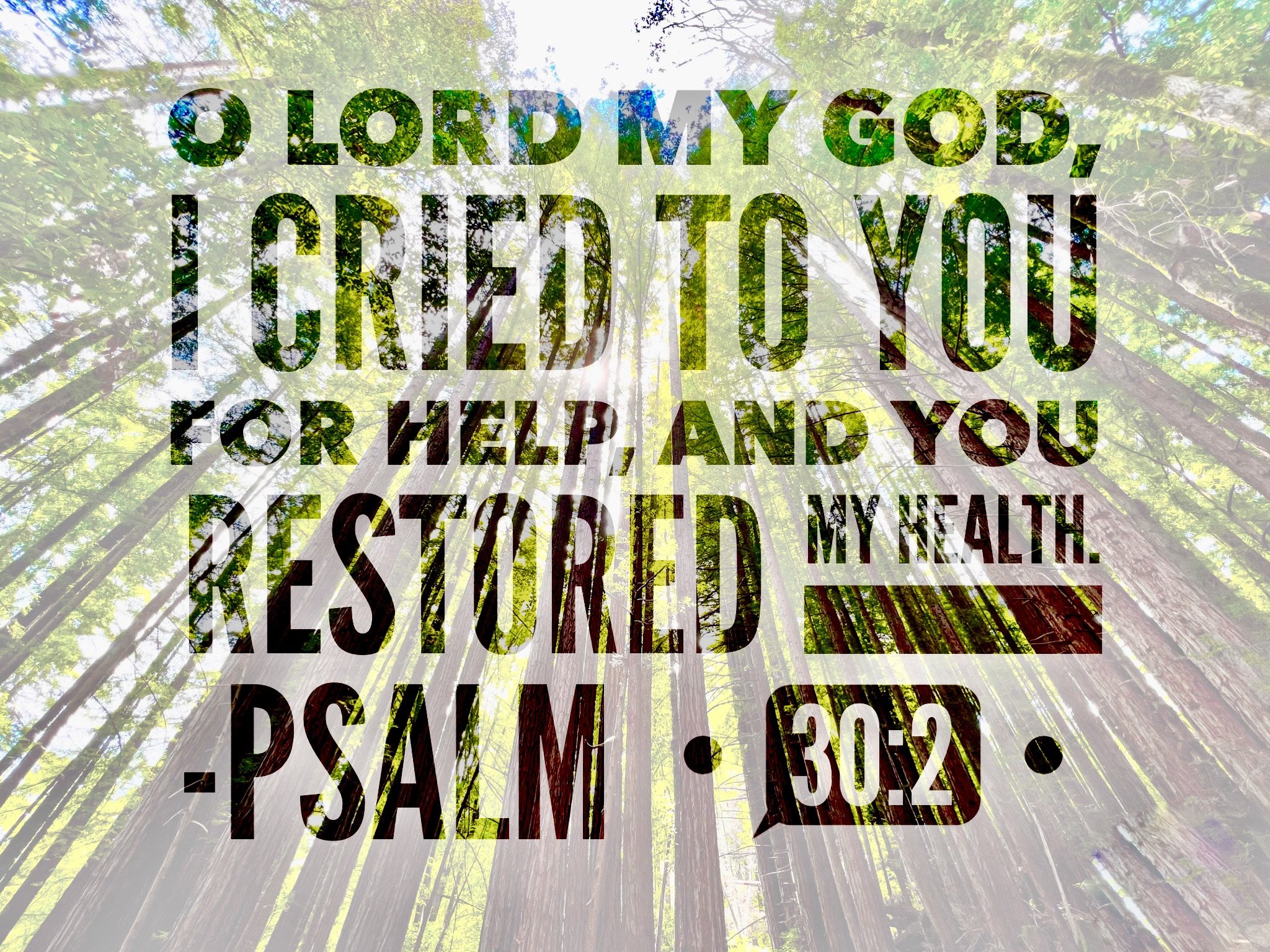
O Lord my God, I cried out to You, and You healed me.O Lord, You brought my soul up from the grave; You have kept me alive, that I should not go down to the pit. (Psalm 30:2-3)
God is the best Physician, even for our bodily infirmities. We do very wickedly and foolishly when we forget God. It was a sin in Asa that he trusted physicians and not God (2 Chronicles 16:12). If we must have a physician, let it be so, but still let us go to our God first of all. And above all remember that there can be no power to heal in medicine of itself; the healing energy must flow from the divine hand. …
If our watch is out of order, we take it to the watchmaker; if our bodies or souls are in an evil plight, let us resort to Him who created them, who has unfailing skill to put them in right condition. As for our spiritual diseases, nothing can heal these evils but the touch of the Lord Christ: if we do but touch the hem of His garment, we shall be made whole….
God has created us as a soul with a body. I believe that physical ailments can be attended to by a medical doctor, emotional distress should be addressed by a counselor, and spiritual issues should have the wisdom of a pastor.
But let’s always remember that since God created our body, soul, and spirit, He is the Ultimate Source of wisdom for any areas that are out of alignment. So as Spurgeon says, seek out a doctor, counselor, or pastor, but go to God first.



 Near the beginning of my interview on the Leading From Alignment podcast with Jim Wiegand and John Opalewski, I was asked to share a bit of my personal background.













 Craig T. Owens