Thursdays With Spurgeon—Aids Of Self-Judgment

This is a weekly series with things I’m reading and pondering from Charles Spurgeon. You can read the original seed thought here, or type “Thursdays With Spurgeon” in the search box to read more entries.

Listen to the podcast of this post by clicking on the player below, and you can also subscribe on AppleSpotify, or Audible. 

Aids Of Self-Judgment

My soul is consumed with longing for Your laws at all times. (Psalm 119:20) 

     Spiritual desires are the shadows of coming blessings. What God intends to give us, He first sets us longing for. Therefore, prayer is wonderfully effective because it is the embodiment of a longing that is inspired by God because He intends to bestow the blessing prayed for! What are your longings, then, my hearer? Do you long to be holy? The Lord will make you holy! Do you long to conquer sin? You will overcome it by faith in Jesus! Are you pining after fellowship with Christ? He will come and make His abode with you! Does your soul thirst, yes, even pant after God as the hart for the water brooks? Then you will be filled with all His fulness…. 

     I say not that it is so with all human wishes, for ‘the sluggard desires and has nothing’ [Proverbs 13:4] and many a man has such evil cravings within his heart that it were contrary to the purity of God for Him to grant them. But where there are intense, heartbreaking earnings of a holy order, depend upon it, they are tokens of good things to come! 

     Where the grace of God reigns in the soul, it makes a man become a stranger among his fellows…. Worldly men care nothing for the judgments of God. No, they care nothing for God Himself! But when a man becomes born anew, a citizen of heaven, there grows up within his spirit a spiritual appetite of which he had felt nothing before—and he longs after God and His Holy Word. See to it, brothers and sisters, whether your souls cry out for God, for the living God, for again I say, by your longings you may test yourselves—by your heart’s desires you may forecast the future—and by your hungering and thirsting you may judge whether you are men of this world or citizens of the world to come. With such aids to self-judgment, no man ought to remain in doubt as to his spiritual condition and eternal prospects.

From Holy Longings

I am currently teaching a series of lessons called Craving. We are learning in these sermons that God created our souls to long intensely, to have cravings. But we go astray when what we crave are things that will merely last during this world. 

John told us, “This world is fading away, along with everything that people crave. But anyone who does what pleases God will live forever” (1 John 2:17 NLT). So by its very definition, worldly things will never satisfy our cravings because the world is temporary. Only an eternal God can give us eternal satisfaction. 

As Spurgeon teaches us here, examining our longings is the best aid of self-judgment and will help us determine our future. Craving God’s presence will bring God’s blessing and His eternal fulfillment of our cravings. Craving anything else will lead to frustration and eternal disappointment. 

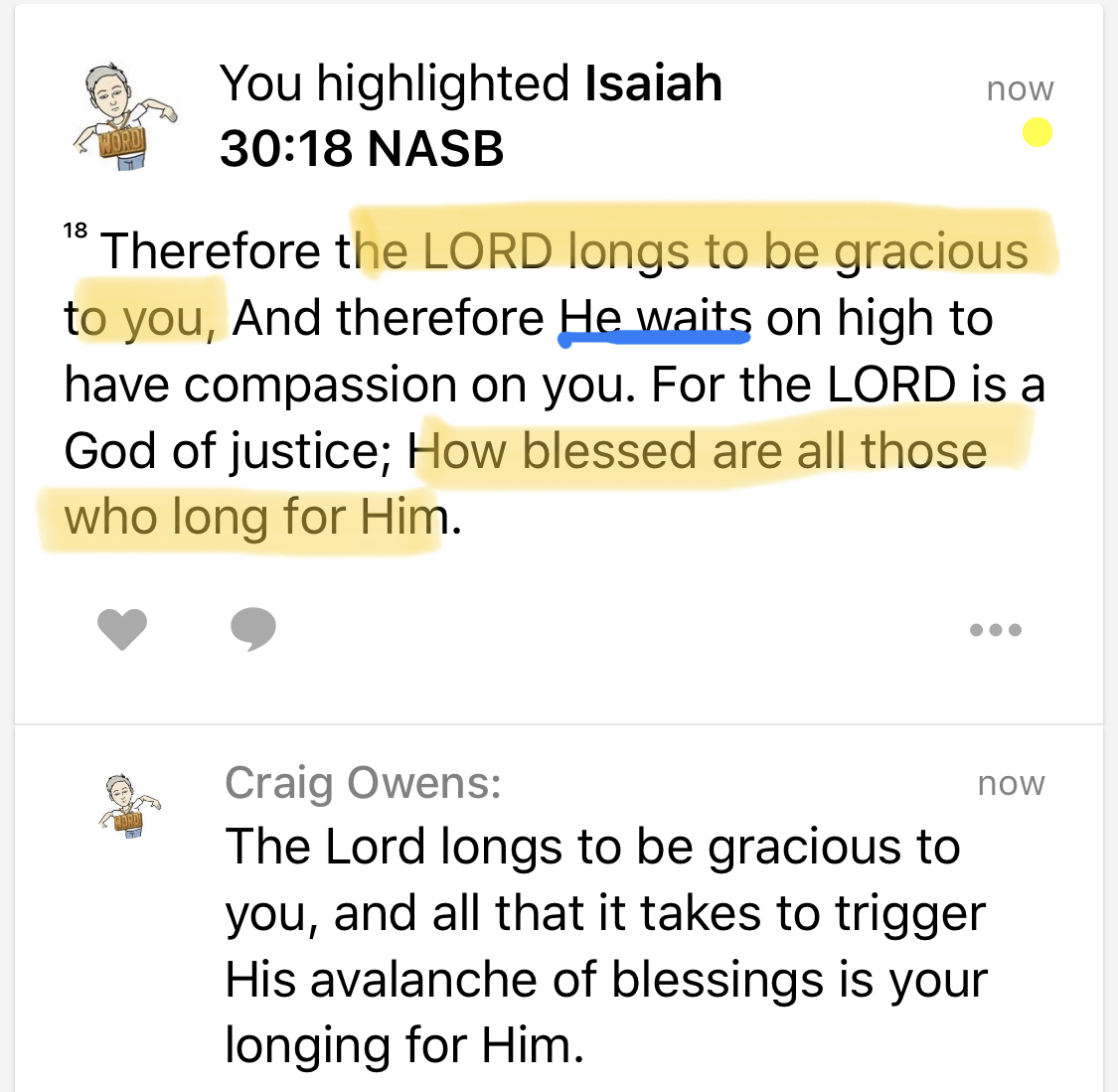
God longs to bless us (Isaiah 30:18) as long as we are craving Him!

►► Would you please prayerfully consider supporting this ministry? My Patreon supporters get behind-the-scenes access to exclusive materials. ◀︎◀︎

Thursdays With Spurgeon—Guided For God’s Sake

This is a weekly series with things I’m reading and pondering from Charles Spurgeon. You can read the original seed thought here, or type “Thursdays With Spurgeon” in the search box to read more entries.

Listen to the podcast of this post by clicking on the player below, and you can also subscribe on AppleSpotify, or Audible. 

Guided For God’s Sake 

In You, Lord, I have taken refuge; let me never be put to shame; deliver me in Your righteousness. Turn Your ear to me, come quickly to my rescue; be my rock of refuge, a strong fortress to save me. Since You are my rock and my fortress, for the sake of Your name lead and guide me. Keep me free from the trap that is set for me, for You are my refuge. Into Your hands I commit my spirit; deliver me, Lord, my faithful God. (Psalm 31:1-5) 

     To lead and to guide are two different things very like each other, but patient thought will detect different shades of meaning, especially as the last may mean ‘provide for me.’ The double word indicates an urgent need—we require double direction, for we are fools and the way is rough. 

     Lead me as a soldier, guide me as a traveler! Lead me as a babe, guide me as an adult; lead me when You are with me, but guide me even if You are absent; lead me by Your hand, guide me by Your Word. The argument used is one fetched from the armory of free grace: not for my sake, but ‘for the sake of Your name’ guide me. 

From Spurgeon And The Psalms

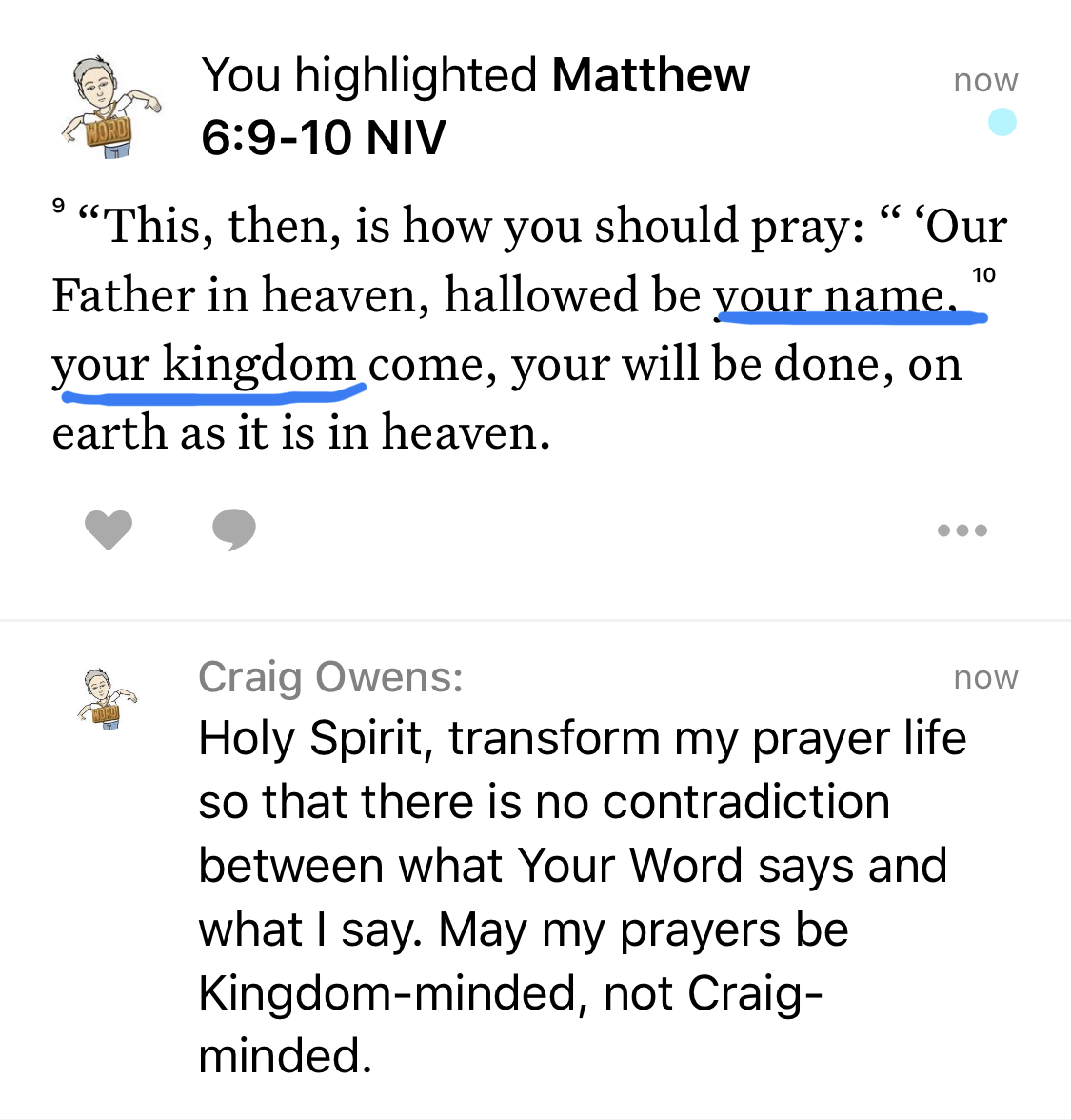
When we let God lead us and guide us, we are never “put to shame.” It’s my own attempts at guiding myself that end up in shame and failure. This is why Jesus taught us to pray for God’s name to be glorified as His will is done. Part of that leading and guiding provides our daily bread and an escape from falling in the face of temptation. 

Interestingly, Jesus prayed the same thing for Himself in the Garden of Gethsemane: “Not My will, but Yours be done.” And then Jesus could confidently use the same words from this Psalm as He hung on the Cross: “Father, into Your hands I commit My spirit.” We can pray with the same assurance when we are allowing the Holy Spirit to both lead and guide us every single day.

►► Would you please prayerfully consider supporting this ministry? My Patreon supporters get behind-the-scenes access to exclusive materials. ◀︎◀︎
Thursdays With Spurgeon—Holy Longings

This is a weekly series with things I’m reading and pondering from Charles Spurgeon. You can read the original seed thought here, or type “Thursdays With Spurgeon” in the search box to read more entries.

Listen to the podcast of this post by clicking on the player below, and you can also subscribe on AppleSpotify, or Audible. 

Holy Longings

My soul is consumed with longing for Your laws at all times. (Psalm 119:20) 

     One of the best tests of a man’s character will be found in his deepest and heartiest longings. You cannot always judge a man by what he is doing at any one time, he may be under constraints that compel him to act contrary to his true self, or he may be under an impulse from which he will soon be free. He may, for a while, back off from that which is evil, yet he may be radically bad. … A man’s longings are more inward and more nearer to his real self than his outward acts—they are more natural in that they are entirely free and beyond compulsion or restraint. 

     As a man longs in his heart, so is he. I mean not every idle wish, as I now speak, but strong desires of the heart. These are the true life of a man’s nature. You will know whether you yourself are evil by answering this question: To what have you the greatest desire? … So then, dear hearers, your heart longings may furnish you with helps for self-examination, and I beg you to apply them, as things of the heart touch the root of the matter.

From Holy Longings

Jesus was constantly taking us back to the examination of our heart. He knew that “out of the heart come evil thoughts—murder, adultery, sexual immorality, theft, false testimony, slander” (Matthew 15:19). He further demonstrated this when He made anger in the heart the same as murder, and lust in the heart the same as adultery (Matthew 5:21-30). 

We can try to change our behaviors all day long, but if we don’t address the heart longings that are prompting those behaviors, we are fighting a losing battle. 

Sigmund Freud called them “Freudian slips” when we said or did something that seemed out of character. I think we should call them eye-opening insights—we just had an opportunity to glimpse what heart longing is at the root of that inappropriate word or action. Thankfully, the same Holy Spirit that reveals these carnal longings to us will also lead us to repentance and a heart change that brings about God-honoring heart longings. 

Don’t try to excuse or cover up what may have slipped out, but use that as a merciful warning of heart longings that need the sanctification of the Holy Spirit. We are all a work-in-progress, which is why I like to remember the word sanctification by saying it “saint-ification.” Let’s yield to the Holy Spirit to bring out greater saintliness by saint-ifying our heart longings.

►► Would you please prayerfully consider supporting this ministry? My Patreon supporters get behind-the-scenes access to exclusive materials. ◀︎◀︎
Amen Indeed

Listen to the podcast of this post by clicking on the player below, and you can also subscribe on AppleSpotify, or Audible. 

I had a great time on the Ailbe Podcast with Rusty Rabon. 

The reason I wrote Shepherd Leadership is because my heart was aching for my fellow pastors who were feeling frustrated maybe even to the point of contemplating resigning their churches. The principles I teach in this book are ones that will get all of us back to a biblical standard of what God says is successful in our ministries. 

Toward that end, I love praying for pastors. Every week I send a Sunday morning prayer to my fellow pastors in my hometown to encourage them to find satisfaction in serving the sheep the Chief Shepherd has placed under their care. 

As we wrapped up our time together, Rusty referred to a prayer I shared in my chapter entitled ‘Stick-to-it-iveness.’ This prayer is adapted from Psalm 23 and is intended to be a source of strength for pastors. 

Take a listen…

I hope this prayer is helpful and energizing to you. I also hope that you will pick up a copy of Shepherd Leadership to infuse some more encouragement into your ministry efforts.  

If you would like to check out the other clips I have already shared from this podcast, please check them out here. Shepherd Leadership: The Metrics That Really Matter is available in print or ebook, and in audiobook through either Audible or Apple. 

►► Would you please prayerfully consider supporting this ministry? My Patreon supporters get behind-the-scenes access to exclusive materials. ◀︎◀︎

Questioning God

Listen to the podcast of this post by clicking on the player below, and you can also subscribe on AppleSpotify, or Audible. 

In the first six chapters of the book of Zechariah, question marks appear 18 times. 

Question marks invite a conversation; whereas, periods or exclamation points tend to end the conversation. Clearly, God enjoys dialogue.

God sometimes asks questions to get Zechariah to evaluate his surroundings or the prevailing culture. Sometimes God asks Zechariah a question to get him to clarify what he is seeing or thinking. 

But without a doubt, most of the questions are posed by Zechariah to either God or to the angelic messenger who sometimes serves as Zechariah’s guide. Not once does God nor the angel tell Zechariah to hold his tongue. Zechariah’s questions are never belittled nor treated as though they were a bother. Nor are his questions ignored. 

Rather, every single question is answered.

God enjoyed talking with Adam and Eve in the garden of Eden, He walked and talked with Enoch, He listened to the questions asked by Job and the psalmists, and here He engages Zechariah in conversation too. 

Prayer is never designed to be a monologue—with us just speaking to God—nor is Bible reading designed to be a monologue—with just God speaking to us. Both prayer and Bible reading are used by the Holy Spirit to keep a dialogue active and engaging. You and I should never be afraid to approach God with our questions, nor should we be afraid to listen to the questions God asks us. 

The dialogue between us and God builds an intimacy that cannot be developed in any other way. So keep asking those questions!

►► Would you please prayerfully consider supporting this ministry? My Patreon supporters get behind-the-scenes access to exclusive materials. ◀︎◀︎

Thursdays With Spurgeon—God Our Healer

This is a weekly series with things I’m reading and pondering from Charles Spurgeon. You can read the original seed thought here, or type “Thursdays With Spurgeon” in the search box to read more entries.

Listen to the podcast of this post by clicking on the player below, and you can also subscribe on AppleSpotify, or Audible. 

God Our Healer

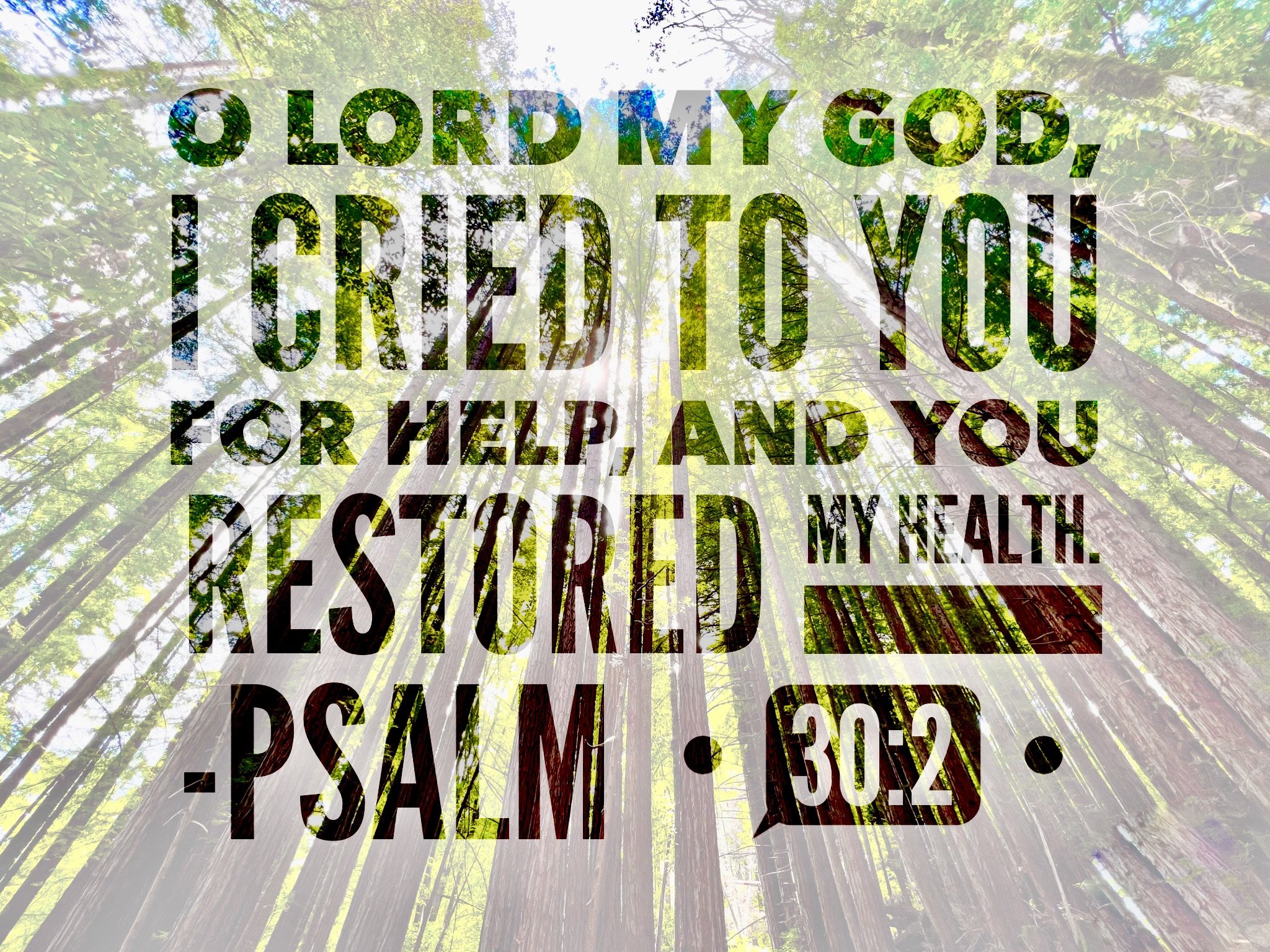
O Lord my God, I cried out to You, and You healed me. O Lord, You brought my soul up from the grave; You have kept me alive, that I should not go down to the pit. (Psalm 30:2-3) 

     God is the best Physician, even for our bodily infirmities. We do very wickedly and foolishly when we forget God. It was a sin in Asa that he trusted physicians and not God (2 Chronicles 16:12). If we must have a physician, let it be so, but still let us go to our God first of all. And above all remember that there can be no power to heal in medicine of itself; the healing energy must flow from the divine hand. …

     If our watch is out of order, we take it to the watchmaker; if our bodies or souls are in an evil plight, let us resort to Him who created them, who has unfailing skill to put them in right condition. As for our spiritual diseases, nothing can heal these evils but the touch of the Lord Christ: if we do but touch the hem of His garment, we shall be made whole….

From Spurgeon And The Psalms

God has created us as a soul with a body. I believe that physical ailments can be attended to by a medical doctor, emotional distress should be addressed by a counselor, and spiritual issues should have the wisdom of a pastor. 

But let’s always remember that since God created our body, soul, and spirit, He is the Ultimate Source of wisdom for any areas that are out of alignment. So as Spurgeon says, seek out a doctor, counselor, or pastor, but go to God first. 

God may bring divine healing that requires no other intervention, or He may heal through medicine or counseling, but ultimately He is THE Healer.

►► Would you please prayerfully consider supporting this ministry? My Patreon supporters get behind-the-scenes access to exclusive materials. ◀︎◀︎

Thursdays With Spurgeon—Blessed Discipline

This is a weekly series with things I’m reading and pondering from Charles Spurgeon. You can read the original seed thought here, or type “Thursdays With Spurgeon” in the search box to read more entries.

Listen to the podcast of this post by clicking on the player below, and you can also subscribe on AppleSpotify, or Audible. 

Blessed Discipline

Blessed is the man whom You instruct, O Lord, and teach out of Your law, that You may give him rest from the days of adversity, until the pit is dug for the wicked. For the Lord will not cast off His people, nor will He forsake His inheritance. But judgment will return to righteousness, and all the upright in heart will follow it. (Psalm 94:12-15) 

     First, I will ask you to notice that God’s children are under instruction. Other children may run about and take holiday. They may wander into the woods, gather the flowers, and do very much what they like, but God’s own children have to go to school. This is a great privilege for them, although they do not always think so. Children are not often good judges of what is best for themselves. … 

     Some of us have learned much from the Lord’s chastening rod! For instance, we have learned the evil of sin. ‘Before I was afflicted I went astray, but now I keep Your Word’ (Psalm 119:67). … Do we not also learn by affliction our own frailty and our own impatience? We are wonderfully patient when we have nothing to suffer, and we are all great heroes and very courageous when there is no fighting to be done. … 

     Do we not, then, learn also the value of prayer? … Do we ever pray in such dead earnest as when everything seems to be sinking from under our feet and our sweetest cups are full of bitterness? … And then how precious the promises become! As we only see the stars when the shadows gather at night, so the promises shine out like newly kindled stars when we get into the night of affliction! …  

     And, oh, dear friends, how should we ever know the faithfulness of God if it were not for affliction? We might talk about it and theoretically understand it, but to try to prove the greatness of Jehovah’s love and the absolute certainty of His eternal faithfulness—this comes not except by the way of affliction and trial! … 

     O Lord, still use the rod if You see that it is necessary. But go on teaching us out of Your Word! We are slow to learn and poor scholars at best, but You may yet make something of us.

From Blessed Discipline

I have learned that there are many lessons that I can learn in no other way than to go through the furnace of affliction. During those dark times, I’ve learned the closeness and the sweetness of God—His presence and His promises became even more precious to me. 

In one of my darkest times of affliction, I stumbled upon this poem from Robert Browning Hamilton:

I walked a mile with Pleasure—
She chattered all the way
But left me none the wiser
For all she had to say.
I walked a mile with Sorrow
And ne’er a word said she,
But, oh, the things I learned from her
When Sorrow walked with me.

If you’re going through a difficult time, don’t try to get out of it, but get closer into God’s presence. He is teaching you invaluable lessons during this trial.

►► Would you please prayerfully consider supporting this ministry? My Patreon supporters get behind-the-scenes access to exclusive materials. ◀︎◀︎

Sure And Secure

Listen to the podcast of this post by clicking on the player below, and you can also subscribe on AppleSpotify, or Audible. 

We have looked at all of the psalms with a Selah pause, but there is one bonus message that we need to consider, and I think it’s a perfect wrap up to this series. 

Outside the book that bears his name, there is no other mention of Habakkuk anywhere else in the Bible. The author himself gives us no biographic information, nor does he give us dates as most of the other prophets do. However, there is enough information inside his short book that allows us to make some solid inferences:

  • based on his instructions in 3:19 we can infer he is a Levite and a worship leader—notice that he says “my instruments” 
  • we know for certain he is a song writer and a prophet (1:1; 3:1) 
  • he is a prophet with a heavy message—the word oracle in in the opening verse is probably better translated a “burden” 
  • he is a contemporary of Jeremiah, who spoke to backsliders, but Habakkuk speaks to the godly remnant to help them make sense of what’s happening in their crumbling culture 

Habakkuk does something that isn’t seen anywhere in the Bible except in the Psalms: he calls godly people to Selah—not once, but three times! 

In our look at the Selahs of Psalm 55 we noted how David’s Selahs almost came as an interruption of his anxious thoughts. Habakkuk’s Selahs follow this same theme. That’s because Habakkuk’s culture (like ours today) was increasingly unrighteous, unstable, and unsure. This prophetic worship leader wants righteous people trying to stand strong in their unrighteous culture to know that our surety and stability must come from our unshakable relationship with our righteous God. 

We’ve said that one of the definitions for Selah is “pause and calmly think of that,” but for Habakkuk’s Selahs I want to modify it slightly: Pause to interrupt your doubtful thoughts and consider this…. What he wants us to consider, I believe, comes from the opening words of his song in chapter 3—

Lord, I have heard of Your fame; I stand in awe of Your deeds, O Lord. Renew them in our day, in our time make them known; in wrath remember mercy (v. 2). 

We are to pause to consider that God has already shown His unrivaled power in the past, and then we stand firm to see Him move again “in our day, in our time” so that the unrighteous will have an opportunity to repent and turn to Him. 

The first Selah is after v. 3 in which Habakkuk references Mount Paran. How did God show His fame there? Moses recorded it this way: 

The Lord came from Sinai and beamed upon us from Seir; He flashed forth from Mount Paran, from among ten thousands of holy ones, a flaming fire, a law, at His right hand. (Deuteronomy 33:2)  

Selah—pause to interrupt your doubtful thoughts and consider this: God did this before and He can do it again. His glory will cover the heavens, His praise will fill the earth, His power will be so evident that the earth will quake and nations will tremble (vv. 4-6). All of this to reassure the righteous and arrest the attention of the wayward unrighteous.  

The second Selah is after v. 9 where Habakkuk is still describing all that God will do personally to rescue His righteous ones. Selah—pause to interrupt your doubtful thoughts and consider this: God did this before—see the almost identical language David uses in Psalm 18:3-17—and He can do it again. All of this to reassure the righteous and arrest the attention of the wayward unrighteous. 

The final Selah is at the end of v. 13 where Habakkuk describes what God will do to the enemies of His people. He uses words of decisive victory—crushed, stripped, pierced, trampled. 

Once again, Selah—pause to interrupt your doubtful thoughts and consider this: God did this before and He can do it again. More specifically, Jesus is the Decisive and Ultimate Victor over sin and death! Check this out: 

Then the end will come, when [Jesus] hands over the kingdom to God the Father after He has destroyed all dominion, authority and power. For He must reign until He has put all His enemies under His feet. The last enemy to be destroyed is death. (1 Corinthians 15:24-26) 

And having disarmed the powers and authorities, He made a public spectacle of them, triumphing over them by the Cross. (Colossians 2:15) 

Do not be afraid. I [Jesus] am the First and the Last. I am the Living One; I was dead, and now look, I am alive for ever and ever! And I hold the keys of death and Hades. (Revelation 1:17-18)

When our culture is becoming increasingly unrighteous, unstable, and unsure, what an unshakable surety and security we have standing on Christ the Solid Rock. As the old hymn reminds us—when all around my soul gives way, He then is all my hope and stay!

If you’ve missed any of the messages in our lengthy Selah series, you can find all of the messages by clicking here. 

►► Would you please prayerfully consider supporting this ministry? My Patreon supporters get behind-the-scenes access to exclusive materials. ◀︎◀︎
Dehydrated

Listen to the podcast of this post by clicking on the player below, and you can also subscribe on AppleSpotify, or Audible. 

I just came back from California where drought-like conditions cause residents a lot of concern—wildfires, crop failure, what happens if too much rain falls too quickly? Being dry causes people a lot of stress. 

Most people live under-hydrated, if not dehydrated. Depending upon the size of the person, the amount of water in the human body makes up 55-75%. That means that when we don’t get enough water, many complications can arise. So if you struggle with…

  • …headaches, don’t take a Tylenol, but trying drinking more water 
  • …bad breath, don’t swish mouthwash, but trying drinking more water 
  • …being tired, don’t guzzle caffeine, but trying drinking more water 
  • …gut problems, don’t pop an Alka-Seltzer or milk of magnesia, but trying drinking more water 
  • …bags under your eyes, don’t get botox, but trying drinking more water 

The introduction to Psalm 143 only says, “A psalm of David,” but nothing about his actual predicament. But we can see the things that were weighing heavy on David: 

  • he pleaded for mercy, which means not getting the punishment he deserved (vv. 1-2) 
  • enemies were pursuing him (v. 3) 
  • he felt faint in spirit and dismayed in heart (v. 4) 
  • he had a failing spirit (v. 7) 
  • he was lost, asking God to “show me the way” (v. 8) 
  • he prayed for God to “preserve my life…bring me out of trouble” (v. 11) 
  • he felt the slander of his enemies (v. 12) 

All of this must have led to David feeling emotionally and spiritually—if not even physically—dehydrated. 

We have said there are three definitions for Selah, but I think the context of this chapter clearly limits it to just one definition: a pause to reflect. David’s Selah in this psalm is actually a quadruple Selah! A dehydrated David reminds himself and us to…

  • remember or recall to mind 
  • meditate or speak to yourself (also see Psalm 42:5-6) 
  • consider—some translations use the word “muse,” a word meaning an inner conversation, including airing our complaints 
  • Selah—the call to “pause and calmly think of that,” as the Amplified Bible defines that word  

All of these things pressing in on David were getting his full attention, so he forgot to drink deeply of the Living Water of God. As a result, David was dehydrated. This is why he calls for that quadruple Selah to be refreshed. 

But what if there are so many problems around us that we cannot even think of anything that we can “drink” from God? What if there are so many troubles that we don’t know what to thank Him for? 

Let me point you to a tiny preposition: IN in vv. 8, 9 (and also in Psalm 42:5-6). David is not saying he has to get a drink, but that he has to go IN to the Source of Living Water. 

Rejoice IN the Lord (Philippians 4:4) and Trust IN the Lord (Isaiah 26:4). As a result, God will then keep us IN His peace (Isaiah 26:3; Philippians 4:7). [Check out all of these verses by clicking here.]

This is what I think David spoke to himself in his remembering, meditating, and considering—in his inner conversations. Let the morning bring me word of Your unfailing love, for I have put my trust IN You. Show me the way I should go, for to You I entrust my life (Psalm 143:8). 

When you’re dehydrated, it’s hard to think of things to be thankful for, but we can look to the unchangeable attributes of God. David did this and it helped him with his actions and attitude: 

God’s love is unfailing so we can rely on Him (v. 8a)
God’s omniscience is infinite so we can trust His leading (v. 8b)
God’s omnipotence is unmatched so we can be secure in Him (v. 9)
God’s sovereign wisdom is unrivaled so we can confidently obey and follow Him (v. 10)
God’s eternal glory is unending so we can have eternal hope (v. 11)
Again David notes that God’s love is unfailing so we can continue to fearlessly serve Him (v. 12), which takes us right back to the opening two verses of this psalm

The Selah time allowed David to make these connections, or rather, it allowed him the quiet time to drink in the Holy Spirit’s reminders of these attributes of God. David always knew who God was, but in his time of dehydration his Selah re-reminded Him of who God was to him. 

When we are feeling dehydrated, we must Selah to drink deeply of the Living Water. This Selah pause plunges us INTO God’s presence and allows us to make His attributes personal.  

If you’ve missed any of the messages in our Selah series, you can find the complete list of them by clicking here. 

►► Would you please prayerfully consider supporting this ministry? My Patreon supporters get behind-the-scenes access to exclusive materials. ◀︎◀︎

God Loves Wicked People

Listen to the podcast of this post by clicking on the player below, and you can also subscribe on AppleSpotify, or Audible.

The first two Selah pauses we see in Psalm 140 are pauses to remember two things: 

  1. There, but for the grace of God, go I. 
  2. God is doing something in me through wicked people and evil times. 

But there is one more Selah in this chapter that we need to consider—Do not grant the wicked their desires, O Lord; do not let their plans succeed, or they will become proud. Selah. (v. 8) 

Most of  us would probably agree with Abraham Kuyper who said, “There is not a square inch in the whole domain of our human existence over which Christ, who is Sovereign over all, does not cry: ‘Mine!’” 

But the amazing thing here is that God allows David—and you and me—to call Him mine! “O LORD, I say to You, ‘You are MY God’” (v. 6). David goes on to say that God is my strong deliverer who shields me against evildoers (v. 7). 

But isn’t David’s God also the God of the wicked? Aren’t they a part of “the whole domain of human existence” that is His? Yes! 

So that must mean that God wants even wicked people to call Him, “My God”! 

This is exactly what Jesus told us: For God so loved the world [including wicked people] that He gave His one and only Son, that whoever [including wicked people] believes in Him shall not perish but have eternal life. For God did not send His Son into the world to condemn the world, but to save the world [including wicked people] through Him (John 3:16-17). 

Just before this third Selah in verse 8 David prays that the plans of the wicked might be thwarted so that proud people don’t become even more proud. That seems okay. But after the Selah David seems to be asking God to let everything that wicked people have planned to boomerang back on them (vv. 9-11).  

Isn’t that hateful? Not if we understand “hate” correctly. 

Hate isn’t the opposite of love, but apathy is the opposite of love. Hate is a very strong emotion that usually comes out when something we love or desire is thwarted or kept from us. 

Just as we learned last week that God allows evil people and their slander and wickedness to prune us and make us more fruitful, can’t God give back to evil people exactly what they need to get their attention? Can’t He use their own evil plans for them just as He used them for us? Yes! 

If God loves us—and He does—then He must hate anything that keeps us from Him. 

If God loves wicked people—and He does—then He must also hate anything that keeps them from accepting the atoning work Jesus did for them on the Cross. 

God is love. There is nothing you can do to make God love you any more. There is nothing an evil person can do to make God love them any less. 

David’s third Selah is really his reminder that he must leave evil people to the only One who can discipline them in perfect measure. We have to leave evil people to God’s care—the only One who can rescue them. That’s why Jesus told us to “love your enemies and pray for those who persecute you” (Matthew 5:44). 

David’s prayer in verses 9-13 does leave evil people in God’s hands, and it’s a prayer you and I can personalize for those whom we desire to know Jesus as their Savior. 

It’s not God’s desire that any should perish. So let’s Selah to call God, “My God,” but to also pray that even the wicked people around us will come to the realization that through faith in Jesus, they too can cry out, “My God!” 

God gave me a unique story when I was walking through a challenging time with a friend that I needed to leave to God’s care. I called the story The Parable of the Lifeguard. You can watch it in the video below, or you can read it by clicking here. 

If you have missed any of the messages in our Selah series, you can find a list of all of those messages by clicking here. 

►► Would you please prayerfully consider supporting this ministry? My Patreon supporters get behind-the-scenes access to exclusive materials. ◀︎◀︎