Jesus Is Wonderful Counselor

Listen to the podcast of this post by clicking on the player below, and you can also subscribe on AppleSpotify, or Audible. 

Jesus made His first appearance as a fully human Man in a stable in Bethlehem. But His Advent—or appearing—had been anticipated for a long time before that. 

In fact, one of the darkest chapters in human history takes place shortly after human history began. Mankind sinned and was separated from God because of that sin. The initial separation foretold an eternal separation (Genesis 3:22), but God shines His light of hope in this darkest hour, foretelling the Advent of our rescue (3:15). 

(Check out all of the Scriptures in this post by clicking here.)

Seven hundred years before Christ’s birth in Bethlehem, the setting is still dark and getting darker. Sin is running rampant, God’s people are groping in darkness, and enemies are pressing in from every side. 

Out of the darkness, God speaks (Isaiah 8:5-10), giving us a glimpse of the Messiah’s glory. Notice the hope-filled words Immanuel (v. 8) and God with us (v. 10). This darkness is the inevitable result of not gazing on God’s glory (vv. 21-22), and yet there appears another glorious promise in a single word: Nevertheless (9:1-7). 

We get a glimpse of Immanuel’s glory in the titles that will describe our Messiah. Let’s look first at Wonderful Counselor. 

Wonder can have two definitions: 

  1. Something so extraordinary that it is hard for our finite human minds to comprehend—Exodus 15:11; Isaiah 25:1 NLT. 
  2. God’s awesome deeds: His works that leave us in absolute awe of His greatness—Jeremiah 32:17 AMPC. 

Counselor is someone who gives counsel; not just any counsel, but perfect counsel because He is omniscient (knows it all) and omnipotent (can do it all)—Isaiah 14:26-27; Psalm 139:1-6; Psalm 32:8. 

Job got a glimpse of this Awesome Counselor too in Job 42:1-6. 

Our First Testament friends only got a glimpse of the Messiah’s glory, but we have the glory revealed to us—Hebrews 1:1-3a; Matthew 1:22-23; John 1:5, 14, 18. 

We have His wonderful counsel revealed to us too—Luke 5:20-26; John 7:37-46. 

And we look forward to seeing His glory undimmed at His Second Advent—John 1:47-51; Mark 14:61-62. 

As we live now between the Advents, we have the joyful privilege and responsibility to proclaim this glory to those still living in darkness—Matthew 28:18; Acts 4:30.  

See how the saints proclaimed Christ’s glory, relying on His wonderful counsel in Acts 4:13, 20, 31; 5:12; 6:8, 10; 8:6-8. This is how we are to live too (2 Thessalonians 2:16-17). 

As you live between the Advents, I pray that the glory of our Wonderful Counselor will become more real to you and that it will shine out of every word you speak and everything you do! 

Check out the other posts in this series Jesus Is… here.

►► Would you please prayerfully consider supporting this ministry? My Patreon supporters get behind-the-scenes access to exclusive materials. ◀︎◀︎

Not Forsaken

Listen to the podcast of this post by clicking on the player below, and you can also subscribe on AppleSpotify, or Audible.

Although some people are afraid of this, the Bible makes it clear that God doesn’t forsake us. But the Bible also makes it equally as clear that we can forsake God. 

Listen to the words God spoke through Moses—

     And the Lord said to Moses, “Behold, you shall sleep with your fathers, and this people will rise up and play the harlot after the strange gods of the land where they go to be among them; and they will forsake Me and break My covenant which I have made with them. Then My anger will be kindled against them in that day, and I will forsake them and hide My face from them. And they shall be devoured, and many evils and troubles shall befall them, so that they will say in that day, ‘Have not these evils come upon us because our God is not among us?’ And I will surely hide My face in that day because of all the evil which they have done in turning to other gods.” (Deuteronomy 31:16-18 AMPC)

To forsake means to depart from someone or to neglect them. 

While we are following God, He will never forsake us. But when His people turn aside in fascination of sinful things, they forsake God by no longer following Him. We read this in the words of God’s people, “Our God is not among us.” 

When we don’t follow God, He still never forsakes us. However, God refuses to bless people who persist on doing their own thing. 

God’s blessing is reserved for those who continue to follow Him. In the language of the New Testament, God’s blessing only flows into the branches that continue to abide in Jesus (see John 15:1-8). 

When we forsake God, we cut ourselves off from His life flow. It is not the Vine who has left us, but we who have severed ourselves from the Vine. 

If God feels distant from you, be assured that He hasn’t forsaken you. Perhaps you could pray a couple of prayers that David prayed. Maybe a prayer asking for the Holy Spirit to reveal to you where you may have detached yourself from the Vine of God (Psalm 139:23-24). Or perhaps a prayer of forgiveness and assurance of God’s forgiveness and restoration (Psalm 51:1-10). 

Don’t give into the feelings of despair, but run back into the embrace of the One who loves you—the One who never leaves you nor forsakes you:

     Be strong, courageous, and firm; fear not nor be in terror before them, for it is the Lord your God Who goes with you; He will not fail you or forsake you. (Deuteronomy 31:6) 

►► Would you please prayerfully consider supporting this ministry? My Patreon supporters get behind-the-scenes access to exclusive materials. ◀︎◀︎

Links & Quotes

Why do you love the power? Servant leaders love what their leadership role allows them to do for other people.

I have a lot of new video content on my YouTube channel every week. Please check it out and subscribe so you don’t miss anything.

“Friendship is a path that leads very close to the perfection which consists of the enjoyment and knowledge of God, such that a man who is a friend of man is made into a friend of God, according to what the Savior said in the gospel: ‘Now I will not call you servants, but My friends [John 15:15].’” —Aelred of Rievaulx

In studying the intense volcanic activity on Jupiter’s moon Io, the ICR concludes, “Since 2013, evidence of a youthful solar system has only gotten stronger. Scientists have been forced to acknowledge that Saturn’s rings are indeed young, and belief in deep time continues to pose real problems for conventional scientists.” The prestigious Nature concurs, saying, “Some such proposals make planetary researchers uncomfortable, because it is statistically unlikely that humans would catch any one object engaged in unusual activity—let alone several.”

Parents and teachers trying to keep up with the ever-changing lexicon of today’s youth will really appreciate this list of slang from Axis.

“Those who are really in earnest must be willing to be anything or nothing in the world’s estimation.” —Susan B. Anthony 

The story of Esther in the Bible is one of my all-time favorites. “While Esther herself has not been identified, nor has the plot to destroy the Jewish people been confirmed, the absence of evidence is not evidence of absence.” To that point, here are 10 pieces of archeological evidence related to this amazing story. 

Charisse Compton asks, “When was the last time meditating on your body elicited worship?” She goes on to make this case from Psalm 139: “Your body, as much as your soul, is one of God’s glorious works. It bears the unmistakable signature of the divine Artist so that, like creation, your body ‘declare[s] the glory of God’ (Psalm 19:1).”

The Prayer Before The Prayer

Listen to the podcast of this post by clicking on the player below, and you can also subscribe on AppleSpotify, or Audible. 

Last week I shared this thought with you from Pastor Tim Keller: “Your prayer must be firmly connected to and grounded in your reading of the Word. This wedding of Bible and prayer anchors your life down in the real God. … Without immersion in God’s words, our prayers may not be merely limited and shallow but also untethered from reality.” 

“Untethered from reality” means that we determine the manner in which we come to God in prayer, the way prayer works, and the way God must respond to our prayer. But what we read in the Bible is the opposite of this (Isaiah 1:11-15). 

(Check out all of the Scriptures in this post by clicking here.)

I think there are two opposite and equal erroneous thoughts about how we approach prayer:

  1. I’m not worthy to come into the presence of an all-holy God 
  2. I can waltz right into God’s presence whenever and however I please 

Both are wrong and both are strategies the devil has used to keep us prayerless. Either we don’t go to God at all or our prayers are unheard because the Bible says that our arrogance has made our prayer ineffectual. 

Our Prayer Book—the Bible—helps us find the balance. George Whitefield noted, “Reading the Bible is a good preparative for prayer, as prayer is an excellent means to render reading effectual.” So here’s what we read about those two errors. 

  1. I’m not worthy. God is unapproachable in His holiness, but Jesus has made it possible for us to enter in through His righteousness (1 Timothy 6:15-16; Isaiah 6:1-5; Hebrews 4:1, 14, 16; John 16:23-24). 
  2. I can come anyway I want to. Passages like Psalm 15:1-5 and Isaiah 58:2-4 make it clear that we cannot simply approach God in a way of our choosing. 

Let’s unpack that second error a little more. We have to be clothed in righteousness in order to come into God’s presence, but we cannot be clothed in a righteousness that is apart from Jesus. When we say that we are praying in the name of Jesus, it means we are praying in the nature of Jesus and through the righteousness of Jesus. We must be wearing His righteous robe (Romans 3:22-24; Isaiah 61:10). 

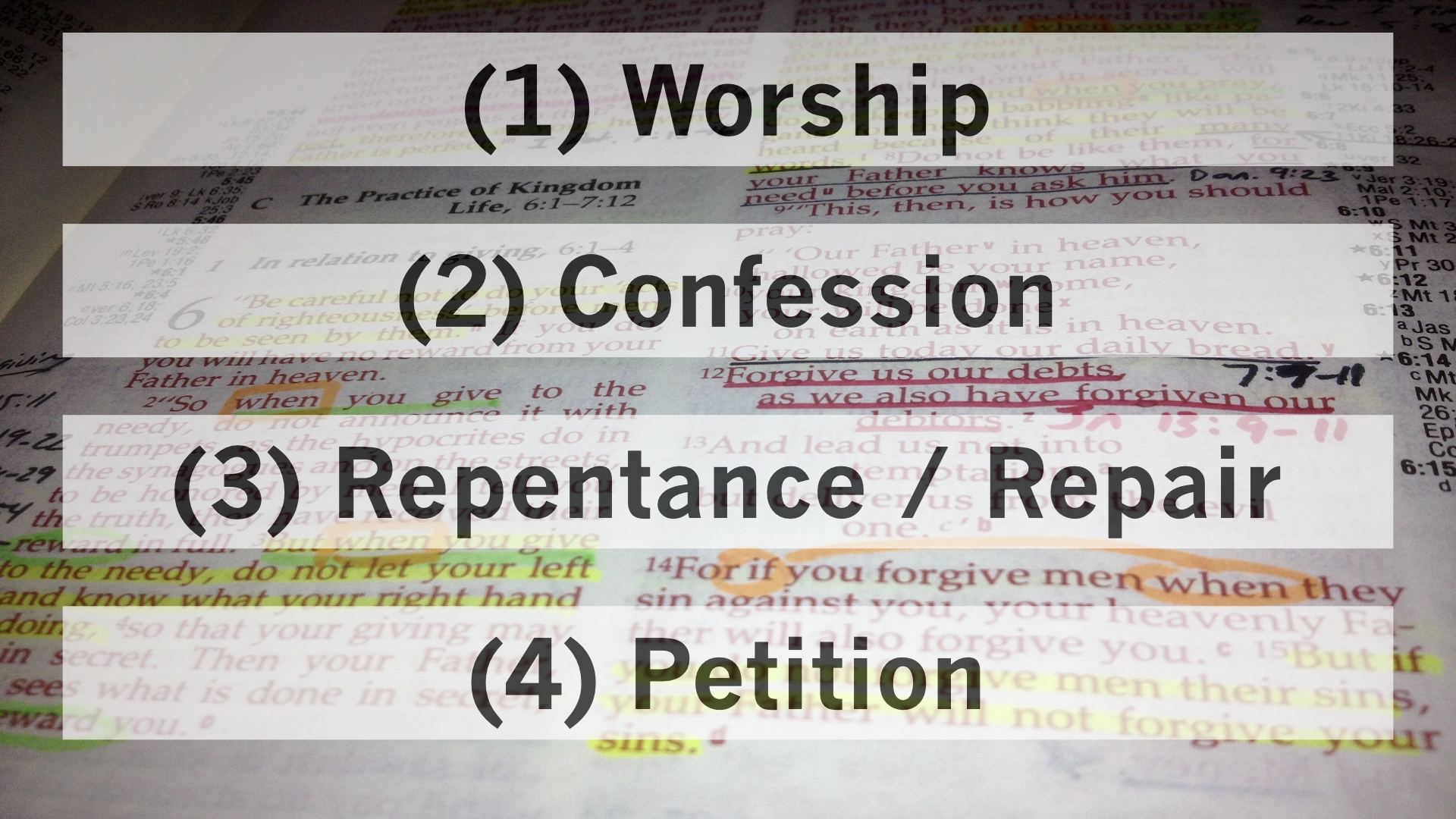
So I think we need to pray before we pray. Let’s try these actions which are tethered to the reality of our Prayer Book. 

  1. Worship. This is a deep pondering of who God is; it is humbly assigning Him the highest worth. In face, the Old English spelling of this word (“worthship”) gives us insight into what worship does. It is this kind of humility that God responds to (Isaiah 6:5-7; 57:15; Luke 18:9-14).
  1. Confession. As we are worshiping, we will see our inadequacies (much like Isaiah did in Isaiah 6, or the tax collector did in Luke 18). We then need to confession these shortcomings. Dick Brogden wrote, “Confessed sin opens the portals of heaven into our darkness, and light and glory overwhelm shame. Confession is our glory for it lifts our heads and eradicates shame.” We see this so vividly lived out in the prayers of David (Psalm 139:23-24; 51:1-2; 19:12-14). 
  1. Repentance. I think we could also call this Repair. After confession where we have fallen short, we resolve now to both take a different path and repair what was damaged (Matthew 5:23-24; Mark 11:25-26; 1 Peter 3:7). 
  1. Petition. After worship, confession, and repentance / repair, our heart’s attitude is now in the place for God to heed our cries for His help (1 Peter 3:12). 

Let’s learn to pray before we pray. Don’t just rush in and rush out of God’s presence. Take time to worship, confession any sins the Holy Spirit reveals, make things right, and then present your petitions. 

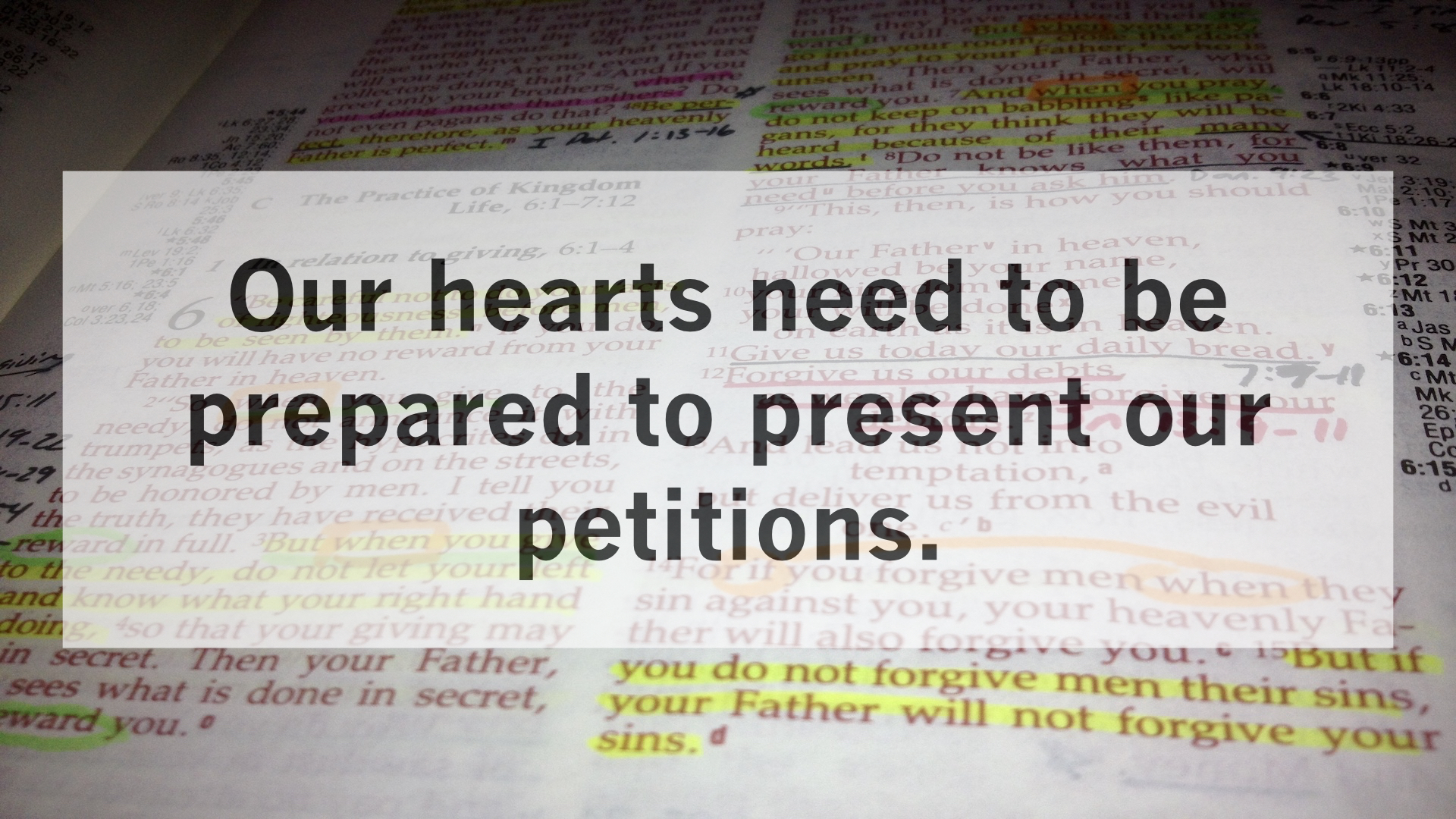
Our hearts need to be prepared to present our petitions. This is how we know that God will hear our voice. 

If you’ve missed any of the messages in our prayer series, you can find them all here. 

►► Would you please prayerfully consider supporting this ministry? My Patreon supporters get behind-the-scenes access to exclusive materials. ◀︎◀︎

Fearless Stewards

Listen to the podcast of this post by clicking on the player below, and you can also subscribe on AppleSpotify, or Audible. 

I’ve noticed over the years that some people get quite nervous—even fearful—with the thought of God coming close to then. Some people have told me, “I can’t go to church—the roof will fall in on me!” 

If I’m honest, I had a time in my life when I feared God’s approach. I didn’t want to pray, “God, use me however You want to” because I just knew He was going to send me somewhere I didn’t want to go, or ask me to give up something that was special to me. 

But from the the birth of Jesus until His ascension, the consistent message is: Fear not! and Rejoice! 

Today we celebrate what is now called Palm Sunday. This is the triumphal arrival of Jesus in the Holy City of Jerusalem, just a few days before His earthly ministry will reach its climax at His crucifixion. This is a story recounted by all four Gospel writers.

Matthew 21:4 says that Christ’s arrival on a donkey was “to fulfill” another one of the jots and tittles. And John adds, “Jesus found a young donkey and sat upon it, as it is written, ‘Do not be afraid, O Daughter of Zion; see, your King is coming, seated on a donkey’s colt’” (John 12:14-15).  

Typically, conquerors came with a show of overwhelming force, not a show of humility. But Jesus came to Jerusalem with the same message repeated at His birth, “Fear not.” 

This is elaborated on in the original prophecy found in Zechariah 9:9-14, where the opening word is, “Rejoice!” We rejoice because He is coming to take away the instruments of war that the occupying forces used to keep the citizens in bondage. He is coming to bring freedom He is coming to announce hope and restoration. 

With all of these jot-and-tittle prophecies, we have been asking three questions. 

(1) What did it mean then? Quite simply, on that first Palm Sunday it meant that this was not the time for judgment. 

(2) What does it mean now? Since the final judgment has not taken place, it must mean it still is not a time of judgment, but a time of favor. God is still drawing people to Himself by His kindness (Romans 2:4). 

Zechariah 9:14 makes it clear that there will be a day of judgment. And Peter says that God’s not being slow about this, but He is demonstrating His patience so that none will have to perish without Him (2 Peter 3:9-10). 

(3) What does it mean for me? It means that I don’t have to fear the approach of God. 

First, there is no fear when God calls me to stand before Him because my sins have been forgiven (Romans 8:1). 

Second, there is no fear when God asks me to give something to Him because God has equipped me ahead of time to respond obediently. When Jesus sent His disciples ahead of Him to bring back the donkey that He would ride into Jerusalem, Jesus must have already informed the donkey’s owners that this would be coming. The disciples were simply to say, “The Master needs the donkey now.” 

God has already prepared me to say, “Yes” to whatever He calls me to do (Psalm 139:16). 

Finally, there is no fear when God asks me to give something to Him because I’m only giving back to Him what is already His. You and I are just stewards of what God has given us. When the disciples talked to the steward of the donkey, they assured him, “The Lord needs it and will send it back here shortly” (Mark 3:11). And the prophecy in Zechariah, God says, “Now I announce that I will restore twice as much to you” (Zechariah 9:12). Maybe not here on earth, but the rewards in Heaven will be incalculable for His faithful servants! 

Those who know Jesus as their Master can live as fearless stewards. 

We don’t fear the requests of our King, but we rejoice to allow Him access. We don’t fear the approach of our Judge, but we rejoice to stand before Him forgiven and rejoicing! 

If you’ve missed any of the other messages in this series, you can find them all here. 

►► Would you please prayerfully consider supporting this ministry? My Patreon supporters get behind-the-scenes access to exclusive materials. ◀︎◀︎

Thursdays With Oswald—God’s Surgery

Oswald ChambersThis is a weekly series with things I’m reading and pondering from Oswald Chambers. You can read the original seed thought here, or type “Thursdays With Oswald” in the search box to read more entries.

God’s Surgery

     It is difficult to realize that it is God who arranges circumstances for the whole mass of human beings; we come to find, however, that in the Providence of God there is, as it were, a surgical knife for each one of us individually, because God wants to get at the things that are wrong and bring us into a right relationship to Himself. … 

     The nature of any dominating lust is that it keeps us from arriving at a knowledge of ourselves. For instance, a covetous man will believe he is very generous. Thank God for the surgery of providence by means of which He deals with these absurdities. … The surgery of the providence of God will break up all ignorance of ourselves. … 

     The Holy Spirit continually urges us to sign away our right to our individual self to Jesus. “Learn of Me,” says Jesus, “for I am meek and lowly in heart.” How few of us do learn of Him! We cling to our individuality like a drowning man to a straw. … Individuality must be transfigured by the indwelling of the Holy Spirit, and that means a sword going through the natural. … 

     God’s providence seems to pay no attention whatever to our individual ideas because He is after only one thing—“that they may be one, even as We are one.” It may look like a thorough breaking up of the life, but it will end in a manifestation of the Christian self in oneness with God. 

From The Soul Of A Christian

In Psalm 139 David confesses how thoroughly God already knows him, but then he prays, “Search me!” David recognizes that there may be part of his individuality that is keeping God from using him completely.

Jesus taught us to pray, “Your kingdom come; Your will be done.” That means my kingdom has to go, and my will has to be set aside.

Christian, we must continually allow the Holy Spirit to search our heart and then perform the necessary surgery to remove the unhealthy clinging to our own kingdom. This is the only way for us to fully know the manifestation of the Christian self in oneness with God.

Thursdays With Oswald—A Dangerous (But Vital) Prayer

Oswald ChambersThis is a weekly series with things I’m reading and pondering from Oswald Chambers. You can read the original seed thought here, or type “Thursdays With Oswald” in the search box to read more entries.

A Dangerous (But Vital) Prayer

     No one but a fool or a sincere soul would ever pray this prayer—‘Search me, O God’ [Psalm 139:23-24] … Any soul who prays that prayer will be answered. … 

     If you want to know what the scrutiny of God is like, listen to Jesus Christ: “For from within, out of the heart of man, evil thoughts proceed…” [Matthew 15:19], and then follows a rugged catalog of things few of us know anything about in conscious life, consequently we are apt to be indignant and resent Jesus Christ’s diagnosis—“I have never felt like a murderer, or an adulterer, therefore those things cannot be in me.” To talk in that way is proof that we are grossly ignorant of ourselves. If we prefer to trust our ignorant innocence we pass a verdict on the only Master of the human heart there is, we tell Him He does not know what He is talking about. The one right thing to do is to listen to Jesus Christ and then hand our hearts over to God to be searched and guarded, and filled with the Holy Spirit. … 

     Jesus Christ has undertaken through His Redemption to put into us a heart so pure that God Almighty can see nothing to censure in it, and the Holy Spirit searches us not only to make us know the possibilities of iniquity in our heart, but to make us “unblameable in holiness” in His sight.

From The Soul Of A Christian

Are you willing to really pray this prayer, listen to what the Holy Spirit says, and then allow Christ’s work of redemption to make you unblameable in holiness?

Or, Chambers asks, “Are we willing to let God scrutinize us, or are we doing the worst of all things, trying to justify ourselves?”

It’s your choice.

Thursdays With Oswald—Out Of The Soup And Into God

Oswald ChambersThis is a weekly series with things I’m reading and pondering from Oswald Chambers. You can read the original seed thought here, or type “Thursdays With Oswald” in the search box to read more entries.

Out Of The Soup And Into God

     As long as we have our morality well with in our own grasp, to talk about Jesus Christ and His Redemption is “much ado about nothing”; but when a man’s thick hide is pierced, or he comes to his wits’ end and enters the confines of an agony, he is apt to find that there is a great deal from which he has been shut away, and in his condition of suffering he discovers there is more in the Cross of Christ than intellectually he had thought possible.

     Beware of believing that the human soul is simple; look at yourself, or read the 139th Psalm, and you will soon find the human soul is much too complex to touch. When an intellectualist says that life is simple, you may be sure he is sufficiently removed from facts to have no attention paid to him. Things look simple as he writes about them, but let him get “into the soup,” and he will find they are complicated. The only simple thing in human life is our relationship to God in Christ.

     Circumstances are the things that twist a man’s thinking into contortions. … 

     The problem I am up against is the muddle inside. Can I see a way out there? Is the God I have only an abstraction? If so, don’t let me treat Him as anything else. Or is He One with Whom I can get into a personal relationship, One Who will enable me to solve my problems? 

From The Shadow Of An Agony

Problems tend to make crystal-clear the difference between how we thought things worked and how they actually work.

This is equally true of those who think they have God all figured out. Then along comes a trial, a pain, a tragedy and they realize they don’t have all the answers. What then?

Then it’s time, as Chambers suggests, to return to something like Psalm 139 to see how intimately God knows you, and to see that your dark time did not take Him by surprise. Getting “into the soup” may be just the thing to help you get into God. It’s so true: “The only simple thing in human life is our relationship to God in Christ.”

May all your problems draw you deeper into Jesus Christ!