11 Quotes From “Pleasure & Profit In Bible Study”

Pleasure & ProfitD.L. Moody’s book Pleasure & Profit In Bible Study is a Bible study rejuvenator for both the novice and experienced reader of the Bible. You can read my full book review by clicking here. Below are some of the quotes I especially appreciated in this book.

“The more you love the Scriptures, the firmer will be your faith. There is little backsliding when people love the Scriptures.” 

“I believe we should know better how to pray if we knew our Bibles better. … And if we feed on the Word, it will be so easy then to speak to others; and not only that, but we shall be growing in grace all the while, and others will take notice of our walk and conversation.”

“It is a very interesting fact that of the thirty-nine books of the Old Testament, it is recorded that our Lord made quotations from no less than twenty-two. … About 850 passages in the Old Testament are quoted or alluded to in the New…. In the Gospel by Matthew there are over a hundred quotations from twenty of the books in the Old Testament. In the Gospel of Mark there are fifteen quotations taken from thirteen of the books. In the Gospel of Luke there are thirty-four quotations from thirteen books. In the Gospel of John there are eleven quotations from six books. In the four Gospels alone there are more than 160 quotations from the Old Testament. … In Paul’s letter to the Corinthians there are fifty-three quotations from the Old Testament; sometimes he takes whole paragraphs from it. In Hebrews there are eighty-five quotations, in that one book of thirteen chapters. In Galatians, sixteen quotations. In the book of Revelation alone, there are 245 quotations and allusions.”

“It is very important that every Christian should not only know what the Old Testament teaches, but he should accept its truths, because it is upon this that truth is based. Peter said the Scriptures are not given for any private interpretation, and in speaking of the Scriptures, referred to the Old Testament and not to the New. … If the Old Testament Scriptures are not true, do you think Christ would have so often referred to them, and said the Scriptures must be fulfilled? When told by the tempter that He might call down the angels from heaven to interpose in His behalf, he said: ‘Thus it is written.’ Christ gave Himself up as a sacrifice that the Scriptures might be fulfilled. Was it not said that He was numbered with the transgressors? And when He talked with two of His disciples by the way journeying to Emmaus, after His resurrection, did He not say: ‘Ought not these things to be? am I not to suffer?’ And beginning at Moses He explained unto them in all the Scriptures concerning Himself, for the one theme of the Old Testament is the Messiah. … Christ referred to the Scriptures and their fulfillment in Him, not only after He arose from the dead, but in the book of Revelation He used them in Heaven. He spoke to John of them on the Isle of Patmos, and used the very things in them that men are trying to cast out. He never found fault with or rejected them.”

“Prophecy is history unfulfilled, and history is prophecy fulfilled. … Between 500 and 600 hundred Old Testament prophecies have been remarkably and literally fulfilled, and 200 in regard to Jesus Christ alone. Not a thing happened to Jesus Christ that was not prophesied from 1700 to 400 years before He was born.”

“Someone has said that there are four things necessary in studying the Bible: Admit, submit, commit and transmit. First, admit its truth; second, submit to its teachings; third, commit it to memory; and fourth, transmit it. If the Christian life is a good thing for you, pass it on to some one else.”

“Application to the Word will tend to its growth within and its multiplication without.”

“We learn that Christ prayed when he was baptized, and nearly every great event in His ministry was preceded by prayer. If you want to hear from Heaven you must seek it on your knees.”

“If you want to reach people that do not agree with you, do not take a club to knock them down and then try to pick them up. When Jesus Christ dealt with the erring and the sinners, He was as tender with them as a mother is with her sick child.” 

“Let us go to the Bible and see what that old Book teaches. Let us believe it, and go and act as if we believed it, too.”

“But we can not be ready if we do not study the Bible. So whenever you hear a good thing, just put it down, because if it is good for you it will be good for somebody else; and we should pass the coin of heaven around just as we do the coin of the realm.”
5 More Quotes From “The Ministry Of God’s Word”

The Ministry Of God's WordThere was simply too many passages I highlighted in The Ministry Of God’s Word by Watchman Nee to share in just one post. Pastor, you must read this book! You can read my full book review by clicking here.

“Each man’s special characteristic is brought out only when he is subject to the Holy Spirit.” 

“No one today can have God’s Word extraneous to the Bible; even the New Testament cannot exist alone, nor can the words of Paul. You cannot cut the Old Testament away and retain much of the New Testament; neither can you excise the four Gospels and keep the letters of Paul. … All the ministries in the Bible are interdependent; none possesses an unconnected revelation totally unrelated to the others and entirely disconnected.”

“How does God interpreted the Bible? How does He explain the words of the Old Testament to the New Testament minister? There are at least three distinct ways of interpretation in the New Testament: (1) prophetic interpretation, (2) historical interpretation, and (3) comprehensive interpretation. When New Testament ministers study the Old Testament words, they will approach the Scriptures from these different angles: they look to the Holy Spirit for interpretation of prophetic words, historical records, or comprehensive messages.” 

“Let us remember that ministry of the Word in our day ought to be richer than that of those who wrote the New Testament. … How, then, do we say that today’s ministry of the Word should be richer? Because Paul had in his hand only the Old Testament as the basis of his speaking, but we have in our hand the writings of Paul and Peter and others in addition to the Old Testament. Paul had only 39 books in his hand, but we have 66 books. Hence our ministry should be richer in Word. We have more materials at the disposal of the Spirit of God, more opportunities for God’s Spirit to explain. Our ministry therefore ought not be poorer but richer.”

“One should never deceive himself by thinking he can be a minister of God’s Word if he simply reads the Bible. The question is not whether he has read the Bible: it is instead, how has he read it?”

You can read other quotes from this book by clicking here and here.

8 More Quotes From “The Ministry Of God’s Word”

The Ministry Of God's WordI stand by what I said: The Ministry Of God’s Word by Watchman Nee is a must read for anyone who preaches the Bible. You can read my full review of this book by clicking here. Below are some more quotes from this amazing book.

“Should anyone fail to see the necessity of having himself dealt with by God, fail to see how his habits, temperament and life need to be pruned and refined, he is of no use to the Word of God.”

“Never forget what the ministry of the Word is. It is the outflowing of the Spirit of God in man as well as in the Word. One part of it consists of God’s Word and the other part of man’s ministry. The Word of God comes to man, who adds in his ministry, and then the two flow out together. God’s Word is not delivered if it is just the Word without the human ministry.”

“Having been set apart as a minister of God’s Word from our mother’s womb, none of us can afford to be foolish before God.”

“A minister of the Word needs to rise very high before God; only then will His Word come through. The pureness of the Word released depends on the amount of discipline received before God. The more the man is broken, the purer the Word; the less that has been learned, the more corrupt its release. The ministry of the Word is based on the condition of the man before the Lord.”

“When the Holy Spirit finds it possible to put the Word in a person’s mouth because the emotion, thought, will, and spirit of that man are under His control, then there is revelation.”

“Every area of our life must therefore be dealt with by God. Always remember that to be a minister of the Word is not a cheap matter.”

“God does not put His Word in man for him to repeat verbatim. He puts His Word in man for the latter to search out with his mind. He gives light to man that man may grasp it and think on it. He places a burden in man for him to find appropriate words to express that burden. It is man who thinks, searches, and speaks; even so, God is able to acknowledge that it is in truth His very own Word.”

“If you as a person have not been pruned and refined by God, your opinion will not be dependable. Any bit of its projection will spoil the Word of God. How God has trusted you as His minister! He gives you a light and burden, and then allows you to think out and feel His Word, even permitting you to form your own opinion. He trusts you. He still works in you that all your opinion, thought and feeling will be like His. This is New Testament prophesying, New Testament ministry of the Word.”

You can read some previously posted quotes from this book by clicking here.

Do You Smell Like Jesus?

Christ's aromaScientists tell us that the sense of smell contributes to more vivid and clear memory recall than any of the other human senses. Have you ever thought about the things Jesus smelled? Or about the memories others recalled about Jesus because of the way He smelled?

Less than a week before His crucifixion, Mary anointed Jesus with a highly-scented spice called spikenard (see John 12:1-8; Mark 14:3-9; and Matthew 26:6-13). Let me rephrase that: Mary didn’t just “anoint” Jesus as we think about that word today, she doused Him in a lifetime supply of this fragrance. Some people complained, but Jesus told those sour people that it was absolutely beautiful what she had done, as Jesus carried this aroma with Him to the Cross.

After He died on the Cross, Joseph and Nicodemus prepared Jesus for burial with 75 pounds of myrrh and aloes (see John 19:38-40). Think about that: seventy-five pounds! In doing so they actually fulfilled a prophesy from the Old Testament about King Jesus’ triumphal return to life—

Your throne, O God, will last for ever and ever; a scepter of justice will be the scepter of Your kingdom. You love righteousness and hate wickedness; therefore God, Your God, has set You above Your companions by anointing You with the oil of joy. All Your robes are fragrant with myrrh and aloes and cassia… (Psalm 45:6-8).

Jesus carried a powerful aroma with Him all the way to the Cross, into the tomb, and when He burst forth alive from the tomb! 

Without Christ, our lives carry the stench of death. We cannot come into our Heavenly Father’s presence because of that putrid smell clinging to us. But when God forgives us of our sins as we place our faith in Jesus, we are wrapped in the robes of Christ: we smell like Him and are welcomed into the Father’s presence.

Easter is a reminder of how a forgiven Christian should now live—

Live a life filled with love, following the example of Christ. He loved us and offered Himself as a sacrifice for us, a pleasing aroma to God (Ephesians 5:2).

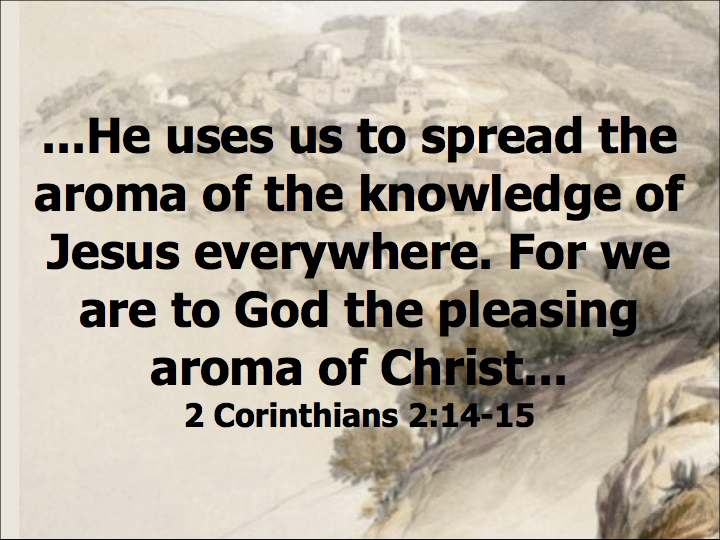
…Now [God] uses us to spread the knowledge of Christ everywhere, like a sweet perfume. Our lives are a Christ-like fragrance rising up to God (2 Corinthians 2:14-15).

How do you smell? Do you smell like Jesus? Are others attracted to the aroma of Christ because of what they smell in you? Smelling good honors the work Jesus did on the Cross and in overcoming the grave.

Links & Quotes

link quote

Some great reading I came across today.

“If your household is not the better for your Christianity—if men cannot say, ‘This is a better house than others,’ then be not deceived—ye have nothing of the grace of God.” —Charles Spurgeon

The pain of Christ’s crucifixion: A Medical Account Of Jesus’ death.

How do we know Jesus was the Messiah? A Look At Old Testament Prophesies.

“Nothing is too great and nothing is too small to commit into the hands of the Lord.” —Arthur Pink

“God is having a difficult time getting through to us because we are a fast-paced generation. We seem to have no time for contemplation. We have no time to answer God when He calls.” —A.W. Tozer

“Gravity explains the motions of the planets, but it cannot explain who set the planets in motion. God governs all things and knows all that is or can be done.” —Isaac Newton

Gems

GemsDo you ever get lost in the “begats” of the Bible? You know those long, tedious lists of who was born to whom? In 1 Chronicles there’s an equally long list of names that goes on for five chapters(!) of who’s in charge of what. But be careful not to skip over these lists. The Holy Spirit included them in the inspired Word of God for a reason, and sometimes you find some real gems buried in these lists.

Here are a few that I recently unearthed…

For David had said… (1 Chronicles 23:25)—David’s heart was so closely knit with God’s heart that the words he spoke were God’s words coming through David’s mouth, as he gave instructions about how worship in the tabernacle should be conducted.

David, together with the commanders of the army, set apart some of the sons of Asaph… (25:1, 3, 7)—Asaph, Hemen and Jeduthun prophesied through their singing in the tabernacle. They didn’t compose music and sing to entertain, but to call people to God. Notice, too, that all of the worship leaders in the tabernacle were “trained and skilled in music for the Lord.” Those God calls, He equips.

For God had blessed Obed-Edom… (26:5-8)—The Ark of the Covenant—the symbol of God’s presence—had been housed in Obed-Edom’s home. God’s presence produces blessing! Listen to how Obed-Edom’s descendants are described:

  • Leaders
  • Capable men
  • Able men
  • Capable men with the strength to do the work

Elihu… (27:18)—Even David’s older brother chose to serve him.

Hushai the Arkite was the king’s friend… (27:33)—In the listing of all the court officials, here is a man with no other title than David’s friend.

God’s Word is alive! Ask the Holy Spirit, Who inspired the men who penned these words, to give you fresh revelation as you read the Bible. Then prepare to be amazed at the gems He will reveal to you!

14 Quotes From “Pentecost”

Pentecost

I thoroughly enjoyed reading Pentecost by Robert P. Menzies, and learned quite a bit. You can read my full book review by clicking here. Here are a few quotes that stood out to me.

“It’s because Pentecostals fuse the biblical and contemporary horizons that we link baptism in the Holy Spirit with speaking in tongues, since that’s what Acts 2 does. It’s why we associate Spirit-baptism with empowerment for mission rather than with spiritual regeneration. And it’s why we expect God to perform ‘signs and wonders’ and to manifest spiritual gifts in worship services. All these things happened in the first Pentecostal community, and their story is our story.” 

“At its heart, the Pentecostal movement is not Spirit-centered but Christ-centered. The work of the Spirit, as Pentecostals understand it, centers on exalting and bearing witness to the Lordship of Christ.”

“Pentecostals are ‘people of the Book.’ Although Pentecostals certainly encourage spiritual experience, they do so with a constant eye to Scripture.”

“So, the stories of Acts are our stories, and we read them with expectation and eagerness: stories of the Holy Spirit’s power, enabling ordinary disciples to do extraordinary things for God. … The hermeneutic of the typical Pentecostal believer is straightforward and simple: the stories in Acts are my stories—stories that were written to serve as models for shaping my life and experience.”

“In Luke’s view, every member of the church is called (Luke 24:45–49; Acts 1:4–8/Isaiah 49:6) and empowered (Acts 2:17–21; cf. 4:31) to be a prophet. Far from being unique and unrepeatable, Luke emphasizes that the prophetic enabling experienced by the disciples at Pentecost is available to all of God’s people. … Through his two-volume work, Luke declares that the church, by virtue of its reception of the Pentecostal gift, is nothing less than a community of prophets. It matters not whether we are young or old, male or female, rich or poor, black or white; the Spirit of Pentecost comes to enable every member of the church, each one of us, to fulfill our prophetic call to be a light to the nations.” 

“Not long ago a Chinese house church leader commented, ‘When Western Christians read the book of Acts, they see in it inspiring stories; when Chinese believers read the book of Acts, we see in it our lives.’”

“Luke’s theology of the Spirit is different from that of Paul. Unlike Paul, who frequently speaks of the soteriological dimension of the Spirit’s work, Luke consistently portrays the Spirit as a charismatic or, more precisely, a prophetic gift, the source of power for service.” 

“Luke crafts his narrative so that the parallels between Jesus’ experience of the Spirit (Luke 3–4) and that of the disciples on the day of Pentecost (Acts 1–2) cannot be missed. Both accounts: 1. Are placed at the outset of Luke’s Gospel on the one hand, and the book of Acts on the other; 2. Associate the reception of the Spirit with prayer; 3. Record visible and audible manifestations; 4. Offer explanations of the event in the form of a sermon that alludes to the fulfillment of Old Testament prophecy.”

“Luke’s understanding of baptism in the Holy Spirit, I have argued, is different from that of Paul. It is missiological rather than soteriological in nature. … The tendency in Protestant churches has been to read Luke in the light of Paul. Paul addresses pastoral concerns in the church; Luke writes a missionary manifesto.” 

“Bold witness for Jesus is recognized as our primary calling and the central purpose of our experience of the Spirit’s power. Missions is woven into the fabric of our DNA.”

“I do not wish to minimize in any way the significance of the great doctrinal truths of Paul’s writings. I merely point out that since Paul was, for the most part, addressing specific needs in various churches, his writings tend to feature the inner life of the Christian community. His writings, with some significant exceptions, do not focus on the mission of the church to the world. … It is probably fair to say that while Paul features the ‘interior’ work of the Spirit (e.g., the fruit of the Spirit, Gal. 5:22–23); Luke features His ‘expressive’ work (Acts 1:8). Thus, by appropriating in a unique way the significant contributions of Luke-Acts, Pentecostals have developed a piety with a uniquely outward or missiological thrust.”

“The clarity of the Pentecostal message flows from the simple, straightforward manner in which we read the Bible. As I have noted, Pentecostals love the stories of the Bible. We identify with the stories that fill the pages of the Gospels and Acts, and the lessons gleaned from these stories are easily grasped and applied in our lives. For Pentecostals, the New Testament presents models that are to be emulated and guidelines that are to be followed. It should be noted that our approach to doing theology is not dependent on mastering a particular set of writings, say, the works of Luther; or coming to terms with a highly complex theological system. Pentecostals also do not worry much about cultural distance or theological diversity within the canon. We do not lose sleep over how we should understand the miracle stories of the Bible or how we might resolve apparent contradictions in the Bible. Our commitment to the Bible as the Word of God enables us to face these questions with a sense of confidence.”

“We must remember that whatever we do, God is measuring the work we do for Him in a qualitative, not quantitative way. … Only the work which is done by the power of the Holy Spirit can be acceptable in the Kingdom of God.” —David Yonggi Cho

“Some will still remain skeptical. They will ask: Is not this approach to church life, with its emphasis on ecstatic experience, emotional response, and spiritual power, filled with inherent dangers? Might it not encourage us to feature emotionally manipulative methods and to focus on superficial matters? Yes, undoubtedly, there are dangers. However, there is more danger in an approach that fails to make room for the full range of human experience, including the emotions, in our encounter with God.”

Pentecost (book review)

PentecostI grew up with this stuff: I’m a fourth-generation Pentecostal, so I cut my teeth on this distinctive doctrine. But I was still amazed at the depth of insight into this dynamic theology that Dr. Robert Menzies shares in Pentecost: This Story Is Our Story.

Although Dr. Menzies shares a number of anecdotal stories to help illustrate certain points, this book is really a serious doctrinal work. Many people have written-off the operational gifts of the Holy Spirit seen in the book of Acts as something that ceased at the death of the apostles, or at the closing of the cannon of Scripture. But Dr. Menzies points out from the outset that Luke’s writings in the Gospel that bears his name and in the book of Acts are not just historical, but doctrinal too.

Many times people look at Paul’s writings as doctrinal, and the four Gospels and Acts as simply historical; thus giving more “weight” to the Pauline epistles. Dr. Menzies persuasively shows that Luke’s writing in Luke-Acts is just as doctrinal, and just as Holy Spirit-inspired, as every other book of the New Testament. In fact, he really goes beyond that to show how Luke’s writing is heavily influenced by Old Testament prophesies about the coming of the Messiah and the subsequent outpouring of the Holy Spirit.

This is not a sensational book, but a scholarly work. It is extensively referenced, as evidenced by the ample endnotes. But don’t let this scare you off as a book just for pastors and theologians, as Dr. Menzies’ writing style is very readable by all.

Anyone who is interested in this distinctive doctrine of the Holy Spirit should read Pentecost.

12 Quotes From “Pouring Holy Water On Strange Fire”

Pouring Holy Water On Strange FireIn Pouring Holy Water On Strange Fire, Frank Viola uses an extensive array of sources, both ancient and contemporary, in his critique of John MacArthur’s book Strange Fire. You can read my full book review by clicking here. I hope you will enjoy these quotes as much as I did.

“For some do certainly drive out devils, so that those who have thus been cleansed from evil spirits frequently both believe, and join themselves to the church. Others have foreknowledge of things to come: they see visions, and utter prophetic utterances. Others still, heal the sick by laying their hands upon them, and they are made whole. Yea, moreover, as I have said, the dead even have been raised up, and remained among us for many years. And what shall I more say? It is not possible to name the number of the gifts which the church throughout the whole world has received from God, in the name of the Jesus Christ (2.32.4) … For this reason does the apostle declare, who speak wisdom among them that are perfect, terming those persons perfect who have received the Spirit of God, and who through the Spirit of God do speak in all tongues, as he used himself also to speak. In like manner we do also hear many brethren in the church, who possess prophetic gifts, and who through the Spirit speak all kinds of tongues, and bring to light for the general benefit the hidden things of God, whom also the apostle terms spiritual, they being spiritual because they partake of the Spirit (5.6.1).” —Irenaeus, Against Heresies

“Now was absolutely fulfilled that promise of the Spirit which was given by the word of Joel: ‘In the last days will I pour out My Spirit upon all flesh, and their sons and their daughters shall prophesy; and upon My servants and upon My handmaids will I pour out of my Spirit.’ Since then the Creator promised the gifts of His Spirit in the latter days; and since Christ has in these last days appeared as the dispenser of spiritual gifts … it evidently follows in connection with this prediction of the last days, that this gift of the Spirit belongs to Him who is the Christ of the predictors … Let Marcion then exhibit, as gifts of his god, some prophets, such as have not spoken by human sense, but with the Spirit of God, such as have both predicted things to come, and have made manifest the secrets of the heart; let him produce a psalm, a vision, a prayer—only let it be by the Spirit, in an ecstasy, that is, in a rapture, whenever an interpretation of tongues has occurred to him; let him show to me also, that any woman of boastful tongue in his community has ever prophesied from amongst those specially holy sisters of his. Now all these signs of spiritual gifts are forthcoming from my side without any difficulty, and they agree, too, with the rules, and the dispensations, and the instructions of the Creator; therefore without doubt the Christ, and the Spirit, and the apostle, belong severally to my God. Here, then, is my frank avowal for any one who cares to require it (Bk. 5, Ch. 8).” —Tertullian, Against Marcion

“Anyone who cuts out portions of Scripture is guilty of very grievous sin … I say once more, there, that to hold such a view [cessationism] is simply to quench the Spirit.” —D. Martin Lloyd-Jones

“Therefore to say that because we now have all the writings of Scripture complete we no longer need the miraculous inspiration of the Spirit among men as in former days is a degree of blindness as great as any that can be charged upon the scribes and the Pharisees. … There is no degree of delusion higher than that which is evidenced by those who profess to teach from the divinely inspired Scriptures that the immediate, continual illumination and working of the Spirit in men’s hearts ceased when the canon of Scripture was complete. To deny the present prophetic gift in the church is to deny also that very manifestation of Christ today to His own which the Scriptures teach is the only means to the reality of Gospel Christianity.” —William Law

“But He has left to us the same power He possess. This [the indwelling Holy Spirit to continue Jesus’s life and ministry and to perpetuate miracles] is the mighty gift of our ascended Lord. This is the supreme need of the church today … the constitution of the church is identical with the twelfth chapter of First Corinthians. … We cannot leave out any part of the gospel without weakening the rest; and if there ever was an age when the world needed the witness of God’s supernatural working, it is the day of unbelief and satanic power.” —A.B. Simpson

“The devil only bothers to counterfeit that which is real and a threat to his kingdom.” —Frank Viola

“A Bible-based sermon can be equal in truth if rooted in Scripture, but not equal in authority to the Bible.” —Frank Viola

“Spirit can embrace intellect, but human intellect won’t comprehend Spirit.” —A.W. Tozer

“We need to learn that truth consists not in correct doctrine, but correct doctrine plus the inward enlightenment of the Holy Spirit.” —A.W. Tozer 

“We cannot make too much of this matter of revelation, illumination, seeing. It is basic in salvation (Acts 26:18). It is essential to effective ministry (2 Corinthians 4:6) and it is indispensable to full knowledge and full growth (Ephesians 1:17)…. The kind of seeing to which we refer is an epoch, an encounter, a revelation, a crisis. There is no power on this earth which could have changed that rabid, fanatical, bigoted Saul of Tarsus, a ‘Pharisee of the Pharisees,’ into ‘the apostle of the Gentiles’ (Romans 11:13)…. Argument would not have done it. Neither persuasion nor persecution nor martyrdom would have effected it. But it was done! That ‘conversion’ stood the test of all persecutions, sufferings, and adversities possible to man for the rest of his life…. Indeed, a fundamental and preeminent work of the Holy Spirit has to do with spiritual enlightenment and supremely as to the significance of God’s Son, Jesus Christ. It is all in the Scriptures, but still our eyes may be holden…. We can be governed by objective truth. It can be ‘the truth’—orthodox, sound, Bible truth. We can be governed by that simply because it is taught; we do it objectively. But there is something more than that. There is such a thing as the Holy Spirit taking hold of the truth of God and making it something that lives in us…. Many Christians are just Christians: that is, after they are saved, their Christian life consists in doing as they are told by the minister because it is presented to them as the thing they should do. But there is a much higher level of life than that. The thing is right, but it is altogether transformed when the Holy Spirit brings it home to us in an inward way, and adjusts us to it. We no longer do it because it has got to be done: we do it because the Lord has done something in us, and shown us that that is the thing that He wants done… it is no more mechanical, it is vital!” —T. Austin Sparks

“To downplay and criticize a genuine desire to know our Lord in greater capacity and to receive clear direction from God’s Spirit in greater measure is contrary to the exhortation and examples found in Scripture. Certainly, spiritual contentment and complacency would have drawn from Paul the strongest reproof. And it did so from Jesus in the book of Revelation.” —Frank Viola

“One thing the charismatic movement has been sent to do, I believe, is to alert us all to the fact that God, when trusted, will show His hand in many thrilling ways, and we should be expecting Him to do that, though without dictating to Him what He must do in particular situations.” —J.I. Packer

17 Quotes From “Jesus”

Jesus A TheographyJesus: A Theography is one of those rare books that I gave a “must read” designation (you can read my full review by clicking here). It’s impossible to share with you all of the incredible thoughts that are in this book, but here are 17 of my favorite quotes from Jesus.

Unless otherwise designated, all the quotes are from Leonard Sweet and Frank Viola.

“In Jesus the promise is confirmed, the covenant is renewed, the prophesies are fulfilled, the law is vindicated, salvation is brought near, sacred history has reached its climax, the perfect sacrifice has been offered and accepted, the high priest over the household of God has taken His seat at God’s right hand, the Prophet like Moses has been raised up, the Son of David reigns, the kingdom of God has been inaugurated, the Son of Man has received dominion from the Ancient of Days, the Servant of the Lord has been smitten to death for His people’s transgressions and borne the sins of many, has accomplished the divine purpose, has seen the light after the travail of His soul, and is now exalted and made very high.” —F.F. Bruce

“Jesus is the Logos. He is the Word, or the self-utterance, of God. So when God speaks, it is Christ who is being spoken about. When God breathes, it is Christ who is being imparted. The Spirit of God’s breath (the words ‘Spirit’ and ‘breath’ are the same in both Hebrew and Greek). The Second Testament tells us clearly that the Holy Spirit’s job is to reveal, magnify, and glorify Christ, Thus, because the Bible is inspired, it all speaks of Jesus. Again, Jesus Christ is the subject of all Scripture.” [The authors refer to the two sections of the Bible as the First and Second Testaments, in place of the usual designations of Old and New Testaments]

“Every word of the God-breathed character of Scripture is meaningless if Holy Scripture is not understood as the witness concerning Christ.” —G.C. Berkouwer 

“Your salvation was established, completed, and sealed before creation itself. Your Lord wrapped it up, won it, and came out victorious before anything ever went wrong.”

“What did He finish? He finished the old creation and the Fall. He finished sin. He finished a fallen world system. He finished the enmity of the Law. He finished satan. He finished the flesh. He put you to death and finished you completely. The person you were in Adam was terminated, swallowed up in death. And then He finished His greatest enemy, the child of sin itself, death. If that isn’t enough, He did something else beyond the rest: He raised you up in resurrection and glorified you.

“In Genesis 2:15, God commanded Adam to cultivate and keep the garden. The Hebrew word for cultivate is abad, and the Hebrew word for keep is shamar. These same Hebrew words are used to describe how the priests cared for the tabernacle of Moses. (The tabernacle was a precursor to the temple of Solomon.) The priests were to cultivate (abad) and keep (shamar) the tabernacle. In addition, we are told that God walked in the garden (Hebrew, hawlak) during the cool of the day. God also walked (hawlak) in the midst of the temple. The meaning is clear. The garden was a temple for God. Like the temple, the garden was the joining together of God’s space and man’s space—the intersection of the heavenly realm and the earthly realm. For this reason, Isaiah called it ‘the garden of the Lord,’ and Ezekiel called it ‘the garden of God.’ …Jesus Christ is the reality of the temple. (In the Greek, John 1:14 says Jesus ‘tabernacled among us.’) He is also the reality of the garden. He is the real Tree of Life and a flowing river. In Christ, God’s space and man’s space are joined together.”

“There are 184 verses in the birth narratives of the Second Testament. These 184 verses presuppose or repeat the words of 170 verses from eighteen verses of the First Testament.” 

“Jesus is the three shepherds: the good shepherd, the great shepherd, and the Chief Shepherd. Jesus presented Himself as both sheep and shepherd, the good shepherd who lays down His life for the sheep. …Jesus died on the cross at the ninth hour (about three o’clock in the afternoon) when the Passover lamb would be sacrificed in the temple. Christ, the Paschal Lamb, was slain to atone for the sins of humanity and to open the gate of the true temple that promises God’s salvation for all people.”

“In the Second Testament, as the sacrificial sign of the new covenant, Jesus Himself becomes the sin offering of humanity. In fact, Jesus’ very words on the cross, ‘It is finished!’ (‘Kalah’), are the words used by a priest at the conclusion of the sacrificial offering in the temple. In the ancient days, when the Jewish priest had killed the last lamb of the Passover, he uttered the Hebrew word Kalah, ‘It is finished.’” 

“At His birth, Jesus received the myrrh. At His death, He rejected it. Jesus’ earthly ministry centered on alleviating human suffering. He was the personification of myrrh. In His crucifixion, however, He was bearing the full brunt of human pain, suffering, and agony on the cross. He bore our shame and sorrows. So He rejected the myrrh and the wine that came with it. Jesus took the full dose of suffering for sin on the cross so we wouldn’t have to. And He rejected the myrrh so we would be able to receive it.”

“When in a garden relationship with God, humanity had no need of the Torah, for we had the Tree of Life. The Torah was the Tree of Life reborn, and Jesus was the Torah reborn.”

“We need the whole Jesus. The complete Jesus. Everything He said. Every detail of what He did.” —Eugene Peterson

“The temptation of Jesus was a playback of two episodes in the First Testament. First, it’s a replay of the first temptation in the garden of Eden. John tells us that the three enemies of the Christian are ‘the lust of the flesh, the lust of the eyes, and the pride of life.’ Each of these temptations was in play in the temptation of Adam and Eve in the garden:

    • The fruit was ‘good for food’ = the lust of the flesh. 
    • The fruit was ‘pleasant to the eyes’ = the lust of the eyes. 
    • The fruit was ‘desirable to make one wise’ = the pride of life. 

“…The temptations that satan leveled at Jesus in the wilderness struck the same three chords. Here is the ordered presented in Luke 4 (paraphrased):

    • ‘Turn these stones to bread’ = the lust of the flesh. 
    • ‘I will give you the kingdom of the world and their glory’ = the lust of the eyes. 
    • ‘Cast yourself down from here and angels will protect you’ = the pride of life.” 

“The Second Covenant knows the First Covenant: the Second Testament quotes from the First Testament more than 320 times, and that does not include times when biblical writers, searching for the scriptural reference, were reduced to admitting that ‘somewhere’ it reads thus and so.”

“Theology is nothing more than the Holy Spirit making His way through our brains, as the Scriptures make their way through our hearts.” 

“In biblical prophesy, the coming of Jesus is viewed as one event separated by parentheses that stretch from the ascension to His royal appearing at the end of the age. We are now living in the parentheses, wherein we look back to His first coming and anticipate His second coming. Put another way, the kingdom has come and will come. Jesus’ first coming inaugurated the kingdom of God; His second coming will consummate it. So the coming of the Messiah is one event separated by two moments: Bethlehem and the end of the age.”

“As followers of Jesus, we have a task before us. That task is to work for the kingdom. To continue the ministry of Jesus in the power of the Holy Spirit… to bear witness to the sovereign lordship of Christ… to embody the message that Jesus is both Lord and Savior, not just of our personal lives but of the entire world. And to find creative ways to manifest that kingdom where we live and travel.”