Embracing Conflict

Listen to the podcast of this post by clicking on the player below, and you can also subscribe on AppleSpotify, or Audible.

A quick survey: Please raise your hand if any of these pertain to you:

  • Have you ever had a disagreement with someone?
  • Have you had a disagreement with someone you love?
  • Have you had a disagreement with someone you love, who also called themself a Christian?

If you raised your hand, you joined 100% of my congregation who answered “yes” to all three.

When we are in close proximity to anyone, there will be conflict. In fact, close proximity usually leads to more conflict because closeness increases friction. For a Christian the issue is not if we will have conflict with others in the Church, but how will we navigate and resolve these conflicts.

The apostle Paul wrote a thank you letter to the church at Philippi, in which he speaks in some of the most glowingly loving terms of any of his letters. Clearly, this was a group of people close to his heart. So when he heard about a conflict between two ladies in this congregation, he took time to address it publicly in his letter—

I plead with Euodia and I plead with Syntyche to be of the same mind in the Lord. (Philippians 4:2)

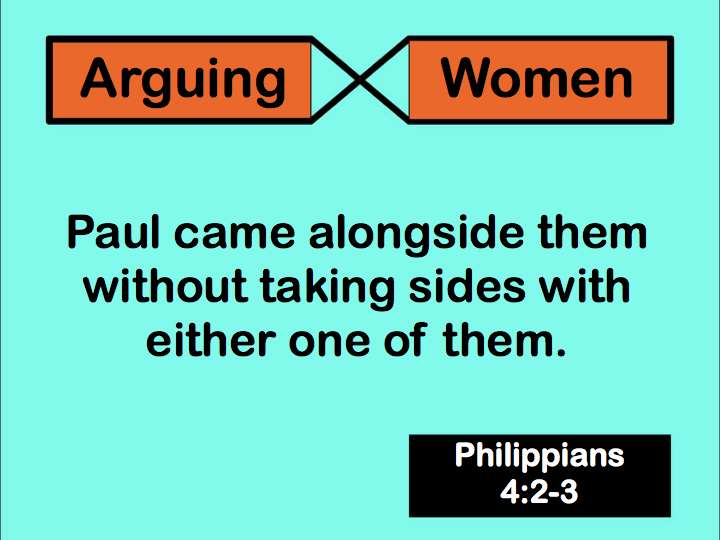
We don’t know why these ladies were arguing but notice that Paul doesn’t take sides. He simply says, “I please with Euodia AND I plead with Syntyche.” The word for plead means someone who comes alongside to help. In using this terminology, Paul gives us an important principle:

We can come alongside those in conflict without taking sides with either one of those in conflict.

In the next verse, Paul implores the rest of the church to join him in this alongsided-ness

And I exhort you too, my genuine yokefellow, help these two women to keep on cooperating…. (v. 3 in the Amplified Bible)

In other words, Paul wants the rest of the church to embrace these at-odds sisters, also without taking sides. He addresses the members of the church as yokefellow. It’s not a word we use too often today (although it is still in the dictionary), but it paints a crystal clear picture of our role. Here’s what we CAN’T do as yokefellow:

  • Look away
  • Mind our own business
  • Hope the situation will work itself out
  • Try to navigate around the problem

Instead, we embrace the conflict by embracing those in the conflict. We help them to cooperate and to work in harmony in the Lord (v. 2 in the Amplified Bible). It’s our responsibility to help maintain the bonds of peace so that the Body of Christ can grow in a way that is healthy and God-honoring.

Do you know someone in conflict right now? Are you in the conflict yourself? Ask God to show you how you can come alongside—not take sides—with those in this conflict so that you can help bring about peace.

If you have missed any messages in this series called Life Together, you can find them all by clicking here.

►► Would you please prayerfully consider supporting this ministry? My Patreon supporters get behind-the-scenes access to exclusive materials, like a map and an app I just shared to help with your personal Bible study time. ◀︎◀︎


Catch ‘Em Doing Right

Listen to the podcast of this post by clicking on the player below, and you can also subscribe on AppleSpotify, or Audible. 

Ken Blanchard is right: we spend way too much time trying to catch someone doing something wrong (or worry that they’re going to do something wrong), and not enough time trying to catch them doing something right.

…if anything is excellent or praiseworthy, think about these things…. (Philippians 4:8)

…love rejoices in the truth…. (1 Corinthians 13:6)

I should be praying for and looking for praiseworthy things. Why? Because people generally live up to someone’s expectations (they live down to their expectations too)—especially someone who has demonstrated they care about them.

Listen to the apostle John’s right-catching statement:

It gave me great joy to have some brothers come and tell about your faithfulness to the truth and how you continue to walk in the truth. I have no greater joy than to hear that my children are walking in the truth. (3 John 3-4)

“The truth” is sometimes taught in a Christian home or in a church, or maybe it’s caught there. The child or the churchgoer has heard the truth, but then do we honestly believe the truth—along with the Holy Spirit reminding them of that truth—somehow becomes ineffectual?

We often act like that.

We seem to be more willing to believe the negative reports than the positive reports. Perhaps, like John, I need to be more ready to catch others doing right. Perhaps I need to be more ready to rejoice in the success stories. Perhaps I need to pray for greater discernment to see the positive changes the truth is making in those I love.

If we make this a matter of prayer, I believe the Holy Spirit will help us catch others doing right.

►► Would you please prayerfully consider supporting this ministry? My Patreon supporters get behind-the-scenes access to exclusive materials. ◀︎◀︎

Responding To The Voice

FlatlandIn 1880, Edwin A. Abbott wrote Flatland, a book that would later become a favorite of Albert Einstein. Abbott was a college-trained mathematician and a theologian; in fact he was actually better known for his theological writings than for Flatland. Later on Einstein would say that “things should be made as simple as possible, not simpler.” In other words, don’t dumb-down the concept, but state it on a level where more people can grasp it. That’s why, I believe, Einstein loved Flatland.

Flatland is told through the eyes of Square, a two-dimensional shape that lives in Flatland. Square has length and width, but no height. So the inhabitants of Flatland can move back-and-forth, and side-to-side, but not up-and-down. To get an idea of this, put your eye right on the level of a tabletop, and look at an item on the table. Imagine you can only see what is touching the tabletop (but nothing that rises any higher or lower than that), and you will get an idea of Square’s two-dimensional world.

One day Sphere visits Flatland. Sphere is three-dimensional, so he can move up-and-down. This means that Square can only see the part of Sphere that happens to be in his line of sight at that immediate moment. So he sees just a “slice” or “layer” of Sphere as Sphere moves through Flatland. Sometimes Sphere is nothing more than a disembodied voice when he is hovering above Flatland.

This gives us a little bit of an idea of how we perceive God. He exists in dimensions that we cannot fully comprehend, so we only see “slices” of Him as He passes though our line of sight. Sometimes He is just a disembodied Voice—or as the Bible calls Him, the Word of God.

But the Word of God compressed Himself into our dimension (John 1:14). All of the fullness—all of the other-dimension-ness—of His omnipotence, omnipresence, omniscience came to our “level” in the Person of Jesus Christ (Philippians 2:6-7). The Word was the complete and total fullness of God (John 1:1-3; Colossians 2:9). But unlike Square who couldn’t fully know Sphere, God is fully knowable in The Word—in Jesus Christ!

The question is: What are you going to do with The Word? The Word of God (the Bible) allows us to fully know The Word of God (Jesus). But we need to be willing to let the Holy Spirit strip away our puny, smaller-dimensioned, finite thinking of God.

Alvin TofflerAlvin Toffler wrote, “The illiterate of the future are not those who cannot read or write, but those who cannot learn, unlearn, and relearn.”

I would modify this to say, “Those illiterate of The Word (Jesus) are not those who cannot read The Word (the Bible), but those who won’t let the Holy Spirit help them learn, unlearn, and relearn who God is.” 

There is so much more to learn about The Word (Jesus), so let the Holy Spirit guide you in your reading of The Word (the Bible). I pray as Paul did that you will begin to experience more of the multi-dimensional-ness of God as revealed in The Word—

I pray that out of God’s glorious riches He may strengthen you with power through His Spirit in your inner being, so that Christ may dwell in your hearts through faith. And I pray that you, being rooted and established in love, may have power, together with all the Lord’s holy people, to grasp how wide and long and high and deep is the love of Christ, and to know this love that surpasses knowledge—that you may be filled to the measure of all the fullness of God. (Ephesians 3:16-19)

If you have missed any of the messages in this series called Who Is Jesus?, you can find them all here.

Love Is… (part 2)

Love is… worksheet 2We are taking a practical look at the incredible definition of love in 1 Corinthians 13. We’re doing this in the context of learning how to love the “unloveable”—or maybe I should say, loving those who are the most resistant to real love. If we can show them love, how much more will the love of Jesus be seen!

All of these verbs are present tense verbs. That means they aren’t exhausted in the past, and they aren’t waiting for future conditions to improve—they are in operation NOW.

Far too many people know Christians more by what we’re against than by what we’re for. So where the biblical text say “love does not” or “love isn’t,” I’ve changed it into the positive “love is.”

You can read about the first five attributes love love by clicking here.

The next five attributes are:

Love is graceful

  • The root word means something that should be covered up, or something we’re ashamed of. Because our words and actions are graceful, they are things we wouldn’t have to defend, or explain, or apologize for later. They are words and actions that wouldn’t embarrass us.
  • Agape will do nothing that misbecomes it.” —Matthew Henry

Love knows our relationship > my rights

  • True love “does not demand its own way” (New Living Translation) nor does it “insist on its own rights” (Amplified Bible). Instead it always seeks ways that the relationship can be repaired or enhanced, even if that means giving up something I consider to be “my right.”
  • NOTE: I’m not saying that you become a doormat. This is not a license for someone to abuse you, but it is a call for us to balance our responses. Romans 12:18 says as far as it depends on you, live at peace with everyone.
  • Here are some great balancing verses. Balance Proverbs 26:4-5 (here is a video where I expand on this idea), and then balance Philippians 2:3-4.

Love is even-tempered

  • The Amplified Bible says it well: love is not touchy or fretful or resentful.
  • This Greek word means not getting stirred up or exasperated. So we need to lighten up!
  • There are some places where we’ve become too sensitive, too touchy, too short-fused. The fire of hurt has replaced the fire of love. So Matthew Henry advises us: “Where the fire of love is kept in, the flames of wrath will not easily kindle, nor long keep burning.”

Love is forgiving

  • The New International Version says love keeps no record of wrongs.
  • This Greek phrase speaks of an accountant tallying up the hurts (where there is an overdrawn account), seeing there is a debt to be paid back, and then appointing himself as the bill collector. True love cancels those IOUs.
  • We don’t forgive others because they deserve forgiveness, but we forgive others because we received forgiveness from God that we did not deserve!
  • For if you forgive people their trespasses [their reckless and willful sins, leaving them, letting them go, and giving up resentment], your heavenly Father will also forgive you. (Matthew 6:14 AMP)

Love is God-honoring

  • Agape loves what God loves and hates what God hates.
  • Agape loves when people find God’s truth, and hates anything that blocks that pursuit.
  • Agape loves the sinner and hates the sin.
  • “The sins of others are the grief of an agape spirit [not] its sport or delight; they will touch it to the quick….” —Matthew Henry

Here’s where the real test comes in: How will you apply these attributes of love to someone in your life? More specifically: to someone you think is “unloveable”?

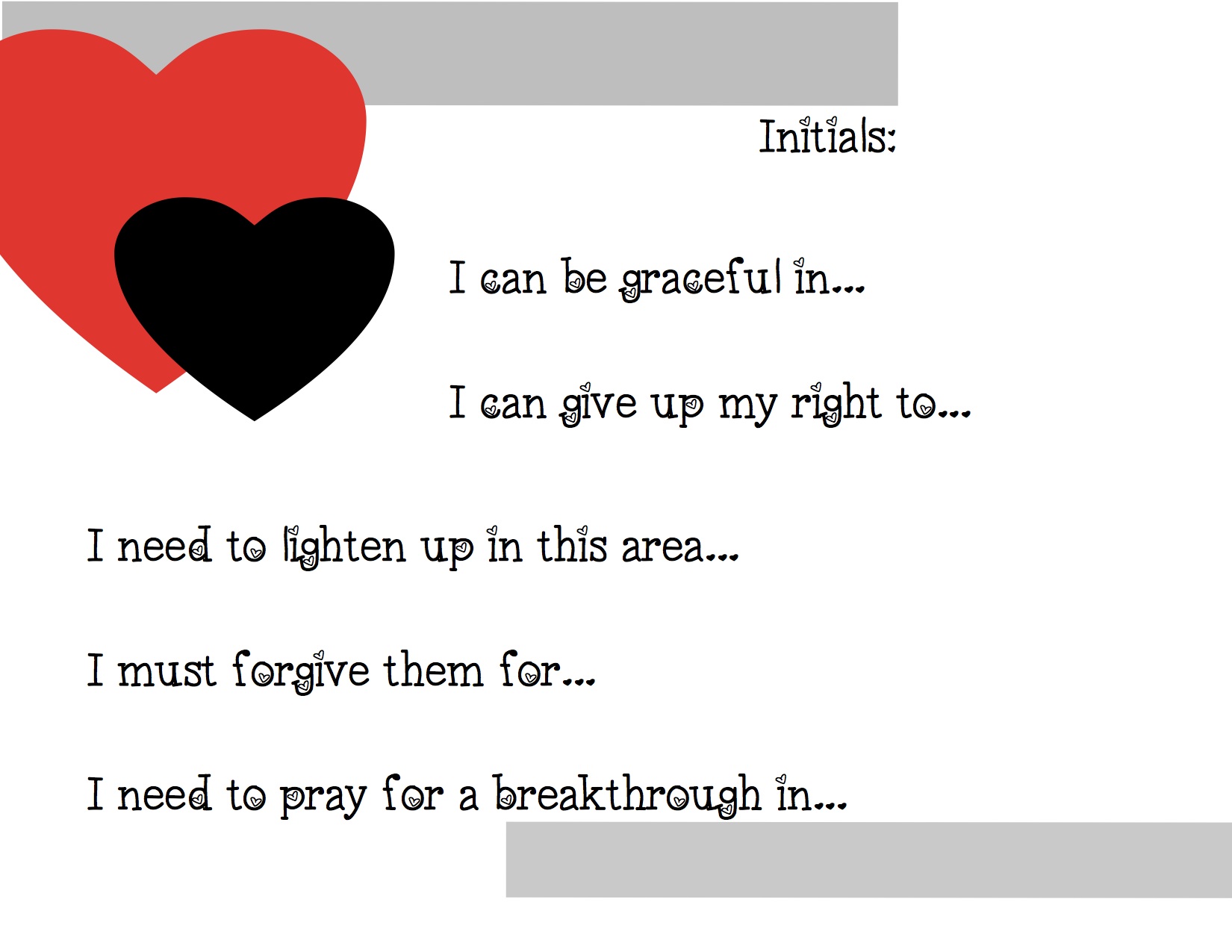
I know you have someone in your life that you think is unloveable. With that person’s face clearly in mind, how will you fill in the blanks:

  1. I can be graceful in…
  2. I can give up my right to…
  3. I need to lighten up in this area…
  4. I must forgive them for…
  5. I need to pray for a breakthrough in…

If you would like a downloadable PDF of this worksheet, click here –> Love is… worksheet 2

If you missed any of the messages in our Loving the Unlovable series, you can check them all our here.

Love Is… (part 1)

Love is… worksheet 1The greatest definition of love in the history of mankind is given to us in 1 Corinthians 13. This is the “gold standard” to which all of us should strive to pattern our lives.

But notice that right at the beginning, Paul says, “Love IS” (verse 4). Not love feels good or even love does; but love is. Love is not love because it makes us feel good. Love is not love because we did something nice. Love is love because it measures up to this standard in 1 Corinthians.

Here are the first five attributes of love.

Love is patient

  • Patient love doesn’t lose heart, but stays hopeful.
  • It endures patiently and bravely in enduring misfortune and disappointment.
  • “It can endure evil, injury, and provocation, without being filled with resentment, indignation, or revenge.” —Matthew Henry

Love is kind

  • It is pleasant and courteous.
  • It both seizes opportunities and makes opportunities to show kindness.
  • …as far as it depends on you, live at peace with everyone. (Romans 12:18)

Love is catching others doing something good

  • The biblical phrase is love is not envious, but I want to turn the positive into a negative. Far too often we Christians are known more for what we against, not what we’re for. So the positive way of saying this: we rejoice when others succeed. Or, we catch them doing something good.

Love is complementing others

  • Again, we turn the negative love does not boast into a positive, and say love complements others.
  • Agape raises the value of the object of its love.

Love is others-focused

  • Again, turning the negative love is not proud into a positive.
  • Do nothing out of selfish ambition or vain conceit, but in humility consider others better than yourselves. (Philippians 2:3)

Here’s where the real test comes in: How will you apply these attributes of love to someone in your life? More specifically: to someone you think is “unloveable”?

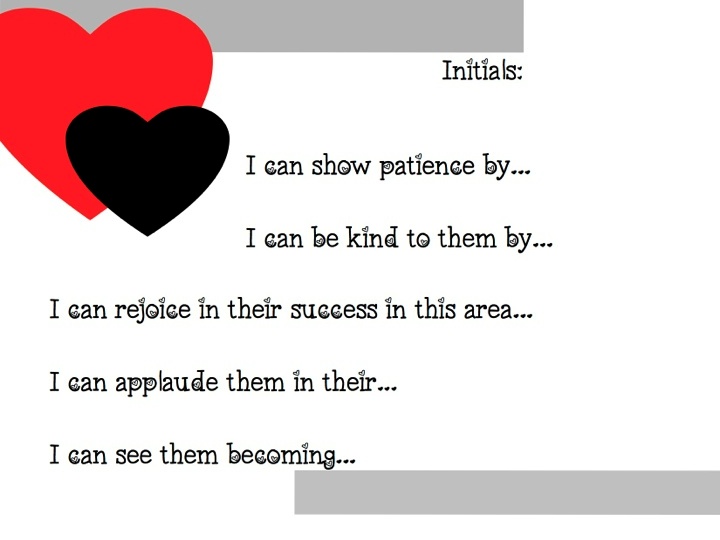
I know you have someone in your life that you think is unloveable. With that person’s face clearly in mind, how will you fill in the blanks:

  1. I can show patience by…
  2. I can be kind to them by…
  3. I can rejoice in their success in this area…
  4. I can applaud them in their…
  5. I can see them becoming…

If you would like a downloadable PDF of this worksheet, click here –> Love is… worksheet 1

If you missed any of the messages in our Loving the Unlovable series, you can check them all our here.

Start With Thanksgiving Day

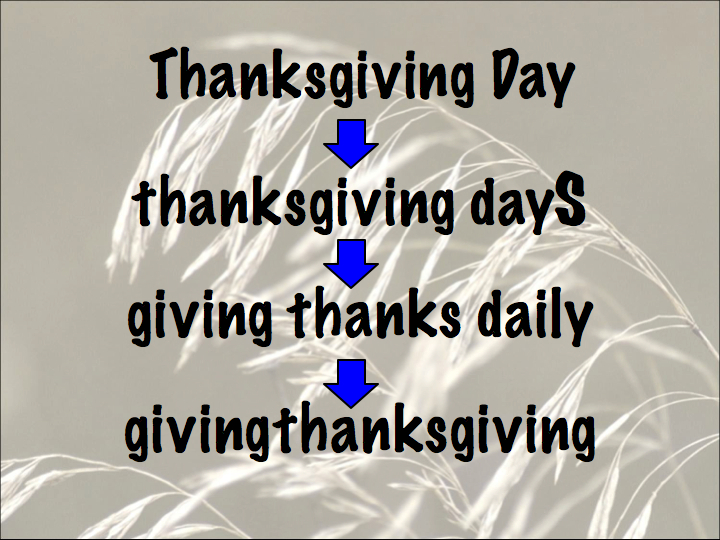
Thanksgiving Day is a good place to start. It’s a good day to begin to flex your gratitude muscles.

But don’t stop there! 

Allow those thankful feelings from Thanksgiving Day to expand into multiple thanksgiving dayS.

But don’t stop there! 

Let multiple thanksgiving dayS expand into a habit of daily thanksgiving.

But don’t stop there! 

Let the habit of daily thanksgiving become a lifestyle of givingthanksgiving—a lifestyle that is always God-focused, Christ-centered, and Spirit-led in constant thanks for everything!

Givingthanksgiving looks like this…

Always giving thanks to God the Father for everything, in the name of our Lord Jesus Christ. (Ephesians 5:20)

Do not be anxious about anything, but ineverything, by prayer and petition, withthanksgiving, present your requests to God. (Philippians 4:6)

For everything God created is good, and nothing is to be rejected if it is received with thanksgiving. (1 Timothy 4:4)

Let’s not limit ourselves to only one day of giving thanks, but a lifestyle of givingthanksgiving every single day!

Giving Thanks For Gifted People

Listen to the podcast of this post by clicking on the player below, and you can also subscribe on AppleSpotify, or Audible.

Have you ever noticed how quickly we label people? We tend to give them a label based on their education, their socio-economic status, their race, their age, their job, even their choice of vocabulary.

We may not verbally express these labels, but we think them. And we will always treat people as we label them! In fact, it’s impossible to treat someone differently than you think about them.

What sort of label does God use? Well, He says that He knit you together in your mother’s womb; that He saw all of the days of your life before you were even a twinkle in your father’s eye; He knows the number of hairs on your head; He knows the thoughts in your head; He knows what you’re going to say before you say it. And then there’s this beautiful thought—

For we are God’s workmanship, created in Christ Jesus to do good works, which God prepared in advance for us to do. (Ephesians 2:10)

The label God puts on you:

My one-of-a-kind, irreplaceable, invaluable masterpiece!

When you are givingthanksgiving for people (that means you are always thankful for people), you will begin to see them as God’s masterpieces too!

Everyone you meet is God’s gift. He gave them to humanity to do the good works which He prepared in advance for them to do. You are surrounded by gifted people!

If you don’t see people this way—or if you tend to label them with less-than-flattering tags—perhaps you should begin to pray for them. Try a prayer like this:

I thank my God for you; in fact, I always thank God for you. And every time I thank God for you, I pray for you, night and day. In all my prayers for you, I always pray with joy, being confident of this, that He who began a good work in you will carry it on to completion until the day of Christ Jesus. And this is also my prayer: that your love may abound more and more in knowledge and depth of insight, so that you may be able to discern what is best and may be pure and blameless until the day of Christ, filled with the fruit of righteousness that comes through Jesus Christ—to the glory and praise of God. So I urge you to join me in offering requests, prayers, intercession and thanksgiving for everyone. (This prayer is taken from Romans 1:8; 1 Corinthians 1:4; Colossians 1:3; 2 Timothy 1:3; Philippians 1:3-11; 1 Timothy 2:1)

Don’t just express your thanks for people on Thanksgiving Day, but be givingthanksgiving all the time. Remember: everyone you meet is a gifted person because everyone you meet is God’s one-of-a-kind, irreplaceable, invaluable masterpiece.

Check out the other message in this two-part series series here.

►► Would you please prayerfully consider supporting this ministry? My Patreon supporters get behind-the-scenes access to exclusive materials. ◀︎◀︎

Your Spiritual Patellar Reflex

Listen to the podcast of this post by clicking on the player below, and you can also subscribe on AppleSpotify, or Audible.

If you’ve ever been to a doctor’s office, you have probably experienced the patellar reflex test. It might be better known as the “knee-jerk reaction.” This is when the doctor taps your knee just below the kneecap to test your body’s involuntary response. How you respond (or don’t respond) tells the doctor a lot about your nervous system’s health.

Did you know that we have a spiritual patellar reflex too?

Consider this verse—

Do not be anxious about anything, but in everything, by prayer and petition, with thanksgiving, present your requests to God. (Philippians 4:6)

How you respond spiritually to stressful things says a lot about your spiritual knee-jerk reflex.

We see this spiritual knee-jerk reflex in the well-known story of Daniel in the lion’s den. Some of the guys who were jealous of Daniel trick the king into passing a law that forbids everyone from praying to anyone other than the king. Look at Daniel’s spiritual knee-jerk reflex:

Now when Daniel learned that the decree had been published, he went home to his upstairs room where the windows opened toward Jerusalem. Three times a day he got down on his knees and prayed, giving thanks to his God, just as he had done before. (Daniel 6:10)

Daniel’s knee-jerk reaction was to hit his knees in prayer!

This is because hitting his knees in prayer was a spiritual habit for Daniel. Check out this key phrase: he got down on his knees and prayed, giving thanks to his God, just as he had done before. The verb tense here is one that means unbroken continuity. In other words, Daniel always prayed, so when anxious times came his spiritual knee-jerk reflex was to do what he always did: Pray, giving thanks to God.

It’s this lifestyle that prompted me to coin the word givingthanksgiving. Giving thanks shouldn’t just be on Thanksgiving Day. It should be a regular activity. And if it is, hitting our knees in prayer will become our spiritual knee-jerk reflex as well.

I want to do better at living this way. I want to pass the spiritual knee-jerk reflex test just like Daniel did. How about you?

Check out the other message in this two-part series series here.

►► Would you please prayerfully consider supporting this ministry? My Patreon supporters get behind-the-scenes access to exclusive materials, like this exclusive video in which I take my supporters behind the scenes of my thought process in designing my confrontation flowchart. ◀︎◀︎

Sola Christo

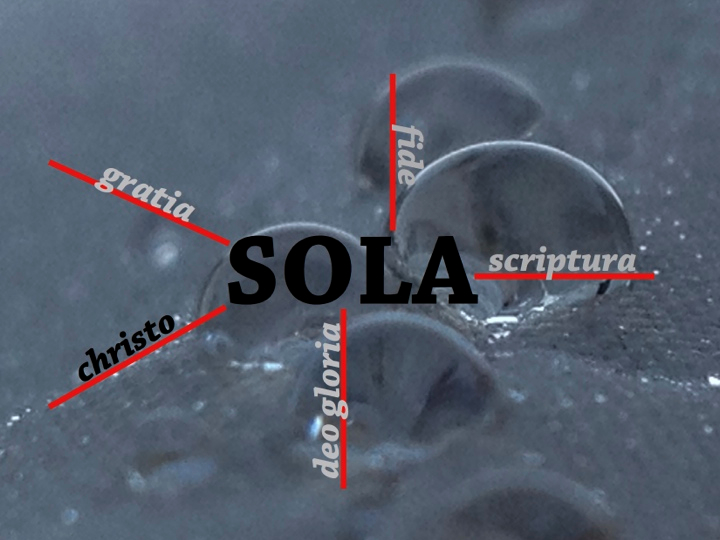
Sola Christo means that it is by Christ’s work alone are we saved. We must get this firmly in our minds, and be aware of anything which reduces Christ, augments Christ, or replaces Christ. 

I don’t believe in studying cults (the counterfeit). Instead, I study the Real, the Authentic, the One and Only. I want to know Jesus so well, that I can easily spot a counterfeit.

God is Spirit (John 4:24)

Jesus is God made flesh (John 1:14)

God is invisible; Jesus is the visible representation of the Godhead (1 Timothy 1:17; Colossians 1:15; Isaiah 9:6)

There’s no way to the Father but through Jesus (1 Timothy 2:5-6)

Jesus wasn’t created; He is Creator (John 1:1-3)

Jesus isn’t a greater angel; He is God (Philippians 2:6)

Jesus isn’t a superior human being; He became a human to save us (Philippians 2:7-8)

Jesus did have a physical body (Luke 24:39)

Jesus did feel pain, experience emotion, wrestle with temptation; get tired and hungry (Matthew 4:2; Matthew 26:38; Hebrews 4:15)

Jesus actually physically died on the Cross and was actually physically resurrected (1 Peter 3:18; 1 Corinthians 15:3-8, 12-28)

Jesus is fully Man and fully God without diluting either of them (Matthew 3:16-17)

Jesus is…

Creator

Sustainer

Savior 

Redeemer

King

Judge

Lord

That’s my King!

If you have missed any of the messages in this series, you can find them all here.

Light The Night

There are so many encouragements that Scripture gives us to make a difference in our world:

  • Jesus tells us to be salt that seasons and light that brightens (Matthew 5:13-14).
  • Let your light so shine before men, that they may see your good deeds and praise your Father in Heaven (Matthew 5:16).
  • Shine like stars in the universe as you hold out the word of life (Philippians 2:15-16).
  • So whether you eat or drink or whatever you do, do it all for the glory of God (1 Corinthians 10:31).

We should look for opportunities to do shine every day. But sometimes there are even more appropriate times to do so. One such time is Halloween … Hallow’s Eve … Reformation Day. October 31 used to be a day that glorified God. Now, sadly, it has become a day to glorify anything but God.

So Calvary Assembly of God will be lighting the night again this Halloween. We will put on the best, brightest, friendliest carnival of the evening right on Main Street in Cedar Springs! We have a prayer team going out 24 hours before this event to pray for protection and favor, and to pray for open doors through which the light of Jesus will shine on October 31.

Here’s how you can help:

  • Pray. Start now and pray through October 31.
  • Bring some candy to the church through October 28.
  • Come pray with us at 5pm on October 30.
  • Signup as a volunteer to shine with us from 4-8pm on October 31.

We’re believing the light of Jesus will be seen as we Light The Night!