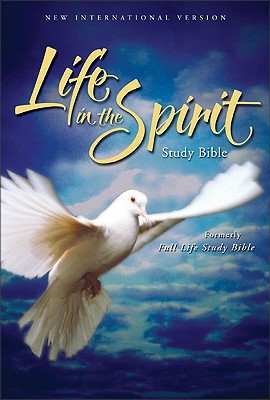
Life In The Spirit Study Bible (book review)

I love to read, averaging about 30 books per year. In addition to books, I have a lot of news feeds that I check daily. But hands down, everything else comes in a distant second place to my number-one read: the Bible. 

I read the Bible for myself. I read the Bible to prepare my Sunday messages. I read the Bible to teach classes. I read the Bible to confirm or refute what I am reading in other books and news feeds. And with all that Bible reading, I have also gravitated toward my favorite study Bible—The Life In The Spirit Study Bible. 

At one time people referred to this Bible as “the fire Bible” because of the graphic on the front cover depicting the fire that fell on praying Christians at the Pentecost celebration immediately following Christ’s ascension into heaven. That fire still falls in my heart every time I read God’s Word!

The study notes in this Bible are fantastic! But don’t be deceived by the name: these are not study notes that focus on the Holy Spirit out of proportion; rather, the role of the Spirit is merely noted where others have ignored it. Far too many people don’t ponder very much about the Holy Spirit’s involvement, except for perhaps the Book of Acts and maybe Paul’s instruction on the operational gifts of the Spirit in 1 Corinthians. The Life In The Spirit Study Bible simply seeks to make us aware of the Spirit’s involvement. 

In addition to the short commentary notes at the bottom of each page, there are several insightful and scholarly articles throughout this whole book that will make the Scripture come alive in new ways. 

This is my “preaching Bible” that I take with me for every sermon I deliver, which means it is the Bible I am diving deep into each day as I study. I cannot recommend this Bible to you highly enough. 

Thursdays With Spurgeon—The Life-Changing Power In The Bible

This is a weekly series with things I’m reading and pondering from Charles Spurgeon. You can read the original seed thought here, or type “Thursdays With Spurgeon” in the search box to read more entries.

The Life-Changing Power In The Bible

     When the Spirit came with His divine life and quickened the entire Book to my newly enlightened soul, the inner meaning shone forth with wondrous glory. … Whatever I found to be in His Word, I received with intense joy. … Moreover, I have found that those points of my character that were most weak have been strengthened, while strong passions have been subdued, evil propensities have been kept under, and new principles have been implanted. I am changed; I am as different from what I was as a man could be who had been annihilated and had then been made over again. Nor do I claim any of the credit for this change—far from it. God has done great things for me, but He has done the same for others and is willing to do it for any soul who seeks His face through Jesus Christ and His great atoning sacrifice. …  

     An idea has long possessed the public mind that a religious man can scarcely be a wise man. It has been the custom to talk of infidels, atheists, and deists as men of deep thought and comprehensive intellect, and to tremble for the Christian controversialist as if he must surely fall by the hand of his enemy. But this is purely a mistake, for the gospel is the sum of wisdom, an epitome of knowledge, a treasure house of truth, and a revelation of mysterious secrets. In it we see how justice and mercy may be married; here we behold inexorable law entirely satisfied and sovereign love bearing away the sinner in triumph. Our meditation upon it enlarges the mind, and as it opens to our soul in successive flashes of glory, we stand astonished at the profound wisdom manifest in it.

From The Autobiography Of Charles Spurgeon 

As Spurgeon experienced, all Christians can experience. Think about this—the same Holy Spirit that inspired the written words of the Bible is the same Holy Spirit in you that can illuminate and apply the words of the Bible to your life! 

Bible-reading, Spirit-empowered Christians should be the most informed, creative, wise people you will ever meet. Not because they have studied nature, but because they are getting to know Nature’s God intimately. The Creator can open up the mysteries of creation better than any scientist or philosopher. 

But we don’t read the Bible just to know God’s Word, but we read the Bible to get to know the God revealed in the Word. He said He would reveal Himself to those who earnestly seek for Him. Ask the Holy Spirit to open your eyes, your mind, your heart as you read your Bible. 

Poetry Saturday—If

If you can keep your head when all about you   
    Are losing theirs and blaming it on you,   
If you can trust yourself when all men doubt you,
    But make allowance for their doubting too;   
If you can wait and not be tired by waiting,
    Or being lied about, don’t deal in lies,
Or being hated, don’t give way to hating,
    And yet don’t look too good, nor talk too wise:

If you can dream—and not make dreams your master;   
    If you can think—and not make thoughts your aim;   
If you can meet with Triumph and Disaster
    And treat those two impostors just the same;   
If you can bear to hear the truth you’ve spoken
    Twisted by knaves to make a trap for fools,
Or watch the things you gave your life to, broken,
    And stoop and build ’em up with worn-out tools:

If you can make one heap of all your winnings
    And risk it on one turn of pitch-and-toss,
And lose, and start again at your beginnings
    And never breathe a word about your loss;
If you can force your heart and nerve and sinew
    To serve your turn long after they are gone,   
And so hold on when there is nothing in you
    Except the Will which says to them: ‘Hold on!’

If you can talk with crowds and keep your virtue,   
    Or walk with Kings—nor lose the common touch,
If neither foes nor loving friends can hurt you,
    If all men count with you, but none too much;
If you can fill the unforgiving minute
    With sixty seconds’ worth of distance run,   
Yours is the Earth and everything that’s in it,   
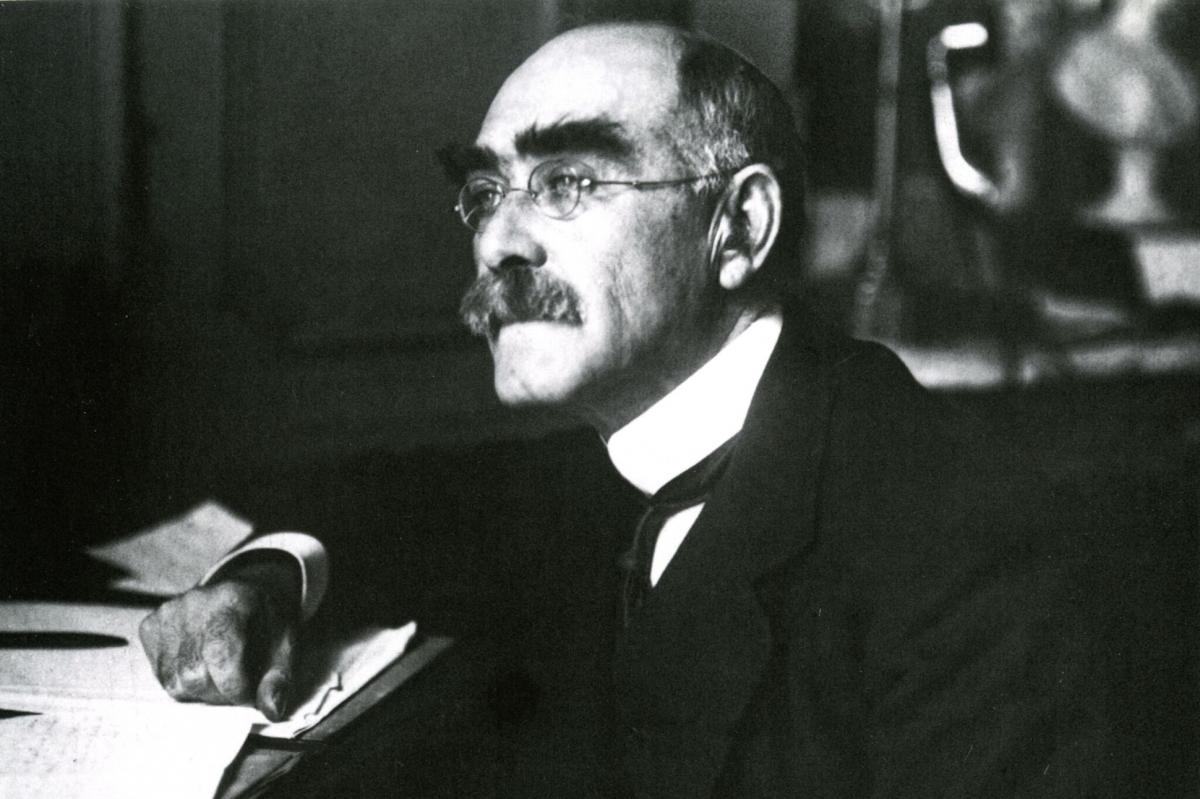
    And—which is more—you’ll be a Man, my son! —Rudyard Kipling

Thursdays With Spurgeon

Nearly 10 years ago I began a series of posts called “Thursdays With Oswald,” in which I shared the thoughts that were working their way through my heart and mind as I journeyed through the complete works of Oswald Chambers. Now, almost a decade later, I have finished all 1500 pages of his wisdom. 

I think it is wise to frequently spend time with the “old guys”—those whom the years have proven their godly wisdom to be true. So I am now moving on to another prolific writer and speaker, the man called the Prince of Preachers: Charles Haddon Spurgeon. 

As with my series with Oswald Chambers, I will be sharing some passages from the Spurgeon book or sermon I am reading. On some, I will offer some thoughts that I’m contemplating in light of that reading, and on others, I will simply let the Prince’s words speak for themselves. 

Let me begin with three simple quotes: 

“The words of God have more power over me than ever David’s fingers had over his harp strings.” 

“It is better to preach five words of God’s Word than five million words of man’s wisdom.” 

“There is a power in God’s gospel beyond all description.”

I love how completely Spurgeon’s thoughts are grounded on God’s Word! Spurgeon had no formal theological training, but he expounded on Scriptures as few ever did or ever have. 

Thursdays With Oswald—Hear And Do

Oswald ChambersThis is a weekly series with things I’m reading and pondering from Oswald Chambers. You can read the original seed thought here, or type “Thursdays With Oswald” in the search box to read more entries.

Hear And Do

     The emphasis in these verses [Matthew 7:24-29] is laid by our Lord on hearing and doing. … We hear only what we listen for. Have we listened to what Jesus has to say? Have we paid any attention to finding out what He did say? Most of us do not know what He said. If we have only a smattering of religion, we talk a lot about the devil; but what hinders us spiritually is not the devil nearly so much as inattention. We may hear the sayings of Jesus Christ, but our wills are left untouched, we never do them. … 

     Pay attention to His words, and give time to doing it. Try five minutes a day with your Bible. The thing that influences us most is not the thing that we give most time to, but the thing that springs from our own personal relationship, that is the prime motive that dominates us. … 

     “Build up your character bit by bit by attention to My words,” says Jesus, then when the supreme crisis comes, you will stand like a rock. … If a man has built himself up in private by listening to the words of Jesus and obeying them, when the crisis comes it is not his strength of will that keeps him, but the tremendous power of God. … All you build will end in disaster unless it is built on the sayings of Jesus Christ; but if you are doing what Jesus told you to do, nourishing your soul on His word, you need not fear the crisis whatever it is. … 

     There is a tendency in all of us to appreciate the sayings of Jesus Christ with our intellects while we refuse to do them. … 

     The Holy Spirit’s voice is as gentle as a zephyr, the merest check; when you hear it do you say, “But that is only a tiny detail, the Holy Spirit cannot mean that, it is much too trivial a thing”? The Holy Spirit does mean that, and at the risk of being thought fanatical you must obey. … What does it matter what anyone thinks of us as long as Jesus Christ thinks we are doing the right thing, as long as we can hear Him say, “Well done, good and faithful servant”?” 

From Studies In The Sermon On The Mount

Hear/read God’s Word → Listen to how the Holy Spirit tells me to apply it to my life → Then apply it to my life → Repeat this process again tomorrow… 

Studies In The Sermon On The Mount (book review)

Many people have called Christ’s Sermon on the Mount the most profound sermon ever preached. It would be hard to argue that conclusion! Reading the Sermon is one thing, but living it out is something entirely different. Oswald Chambers helps us live out these amazing words in his book Studies In The Sermon On The Mount. 

Not only did Chambers provide us with an excellent commentary on this Sermon, but his life showed his devotion to practicing what he preached. At a memorial service for Chambers in December 1917, a close friend described Oswald’s life as “the finest commentary on the Sermon on the Mount I know.” May that be said of all Christians! 

This is one of the finest commentaries I have read on this life-patterning sermon that Jesus gave us. It’s a great read, but it is also quite challenging at times. To be honest, Chambers’ thoughts are so deeply profound at points that it takes several readings to grasp the implications. But it is worth your effort! 

A colleague of Chambers—J.F. Knapp, who founded God’s Bible School in Cincinnati, OH, where Chambers taught for seven months in 1907—described it better than I could: 

“‘But,’ says some simple soul, ‘I don’t understand [Chambers].’ The more is the pity. Leave then the evening newspaper, the book of religious wonder-tales, the high-flown writing watered with adjectives, but empty of thought or power, and read these pages again and again until the truth soaks through to your innermost consciousness. … To heed the words of our Lord’s Sermon on the Mount as interpreted by Oswald Chambers will transform holiness people into holy people, and faithless verbosity into Christian humility. Unto which glorious result God speed the day!”

To Knapp’s words I can only add “Amen!” If you want to understand the Sermon On The Mount better, you shouldn’t miss out on this premier Oswald Chambers book. 

Jesus Prepares Us For The Path

In His final week of ministry leading up to the Cross, Jesus got the most out of every minute He had. 

After a busy Monday where He cleared the temple, Jesus went back to Bethany, where He spent the night, only to return to the same temple courts Tuesday morning to teach His disciples. 

Tuesday is a preparation day. This is His last day in public before His trial and crucifixion and He has many final words to impart to His followers. Much of His teaching comes in response to the increasing onslaught from the religious leadership, who are desperately trying to find a way to silence Him once and for all.

It’s important to note that Jesus doesn’t prepare the path for us, but He prepares us for the path. 

Jesus prepares us for… 

1. OPPOSITION

Not only did Jesus face opposition, but He told His followers that we would too (see Matthew 5:11; 10:17-22). Indeed as Jesus sat in the temple courts teaching on this Tuesday, group after group of religious leaders attacked Him (Matthew 21:23; 22:15, 23, 34-35). There are many lessons we can learn, but here are a few important takeaways: 

    • Answer entrapping questions with a question of your own. 
    • You don’t have to answer everything people ask you.  
    • Either-or questions probably need a both-and answer. 
    • The better we know the Scriptures, the better we can know those both-and answers.
    • Consider the source of the questioner. 
    • We shouldn’t have an unhealthy obsession with nonessential things. 
    • Love fulfills the law. 
    • When we teach in love, some people will finally get it.

2. DAILY LIVING

Between all of the entrapping questions, Jesus taught some valuable lessons. 

    • The power of faith-filled prayer
    • Obedience to God is valuable whenever it happens and in whomever it occurs 
    • We are only stewards of God’s resources 
    • The ugliness of hypocrisy

3. END TIMES EVENTS

Jesus doesn’t want us to be surprised, so He tells us upfront what is coming. Some of what He teaches here would have partial fulfillment in about 30 years when the Romans besieged Jerusalem, but the ultimate fulfillment is still to come—Matthew 24-25; Mark 13; Luke 21. 

Christ’s passionate journey was out of love for us. Which means everything He taught us was for our benefit. To honor Him, we need to know the Scriptures and God’s power (Matthew 22:29). 

So we study the Word of God to get to know the God of the Word. Keeping our eyes on Jesus will keep us prepared for the path ahead of us, no matter how rough it is. 

Remind, Refresh, Recall

It’s been said that repetition is the mother of all learning. Keep on reminding yourself in refreshing ways again and again, and the lessons will become permanent. 

Over the course of a year at Calvary Assembly of God, we cover a lot of ground biblically, crisscrossing the Bible, meeting old friends, learning timeless truths, and discovering how to apply those truths to our everyday lives. 

The apostle Peter wanted his friends to keep biblical truths in the forefront of their minds—So I will always remind you of these things, even though you know them and are firmly established in the truth you now have. I think it is right to refresh your memory as long as I live in the tent of this body. … I want you to recall the words spoken in the past by the holy prophets and the command given by our Lord and Savior through your apostles (2 Peter 1:12-13; 3:2). 

In the spirit of that constant reminding, I will be presenting a year-end review of all the topics we covered throughout 2018. This will be a great morning to invite your friends, as they will get a quick snapshot of what we’re learning. It will also be a wonderful morning for our regularly-attending church family to be reminded and refreshed. 

Join us in person or on Facebook Live.

Expository Thoughts On The Gospels (book review)

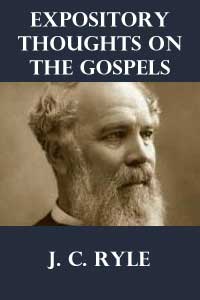
J.C. Ryle was an Evangelical Anglican bishop who lived in England in the latter half of the 19th century. When Ryle’s words—written over 100 years ago—still resound with truth today, I would call that “a classic”! That is exactly what we find in his Expository Thoughts On The Gospels. 

The Gospels obviously focus on the life and teaching of Jesus Christ. Ryle takes how Jesus lived and taught and pulls out of them practical applications for Christians in his day, which still have perfect application for Christians today. I think what keeps his words so relevant is how closely he sticks with the biblical texts, seldom straying into his own opinion, but simply saying to us, “Did you see that?” 

His thoughts are presented to us section-by-section, not verse-by-verse as many biblical commentators do. This method has two distinct advantages for us: (1) It’s easier to get a “big picture” view of what Jesus was doing and teaching, and (2) It’s more manageable to use this book as a complement to a personal or group Bible study. 

In fact, Ryle himself suggested that the design of his commentary was with family devotions in mind. Purposely, he doesn’t delve into deep doctrine so that the youngest or most novice of Christians can gain much insight. But don’t confuse that statement with this being “light reading.” On the contrary, even the most tenured Christian will find ample thoughts to challenge his mind. 

I highly recommend this series of commentaries to those who want a deeper Bible study time.  

12 Quotes From “The Strenuous Life”

Teddy Roosevelt believed firmly that a nation rose or fell as individuals exercised strong character or lived a slothful life. He not only preached it, he lived it! The Strenuous Life is a collect of TR’s speeches that emphasized what he called “the manly characters.” Check out my full book review by clicking here. 

“We do not admire the man of timid peace. We admire the man who embodies victorious effort; the man who never wrongs his neighbor, who is prompt to help a friend, but who has those virile qualities necessary to win in the stern strife of actual life.” 

“A man’s first duty is to his own home, but he is not thereby excused from doing his duty to the State; for if he fails in this second duty it is under the penalty of ceasing to be a freeman. In the same way, while a nation’s first duty is within its own borders, it is not thereby absolved from facing its duties in the world as a whole; and if it refuses to do so, it merely forfeits its right to struggle for a place among the peoples that shape the destiny of mankind.” 

“If we stand idly by, if we seek merely swollen, slothful ease and ignoble peace, if we shrink from the hard contests where men must win at hazard of their lives and at the risk of all they hold dear, then the bolder and stronger peoples will pass us by, and will win for themselves the domination of the world. Let us therefore boldly face the life of strife, resolute to do our duty well and manfully; resolute to uphold righteousness by deed and by word; resolute to be both honest and brave, to serve high ideals, yet to use practical methods. Above all, let us shrink from no strife, moral or physical, within or without the nation, provided we are certain that the strife is justified, for it is only through strife, through hard and dangerous endeavor, that we shall ultimately win the goal of true national greatness.” 

“Scant attention is paid to the weakling or the coward who babbles of peace; but due heed is given to the strong man with sword girt on thigh who preaches peace, not from ignoble motives, not from fear or distrust of his own powers, but from a deep sense of moral obligation.” 

“Strive manfully for righteousness, and strive so as to make your efforts for good count.” 

“We are in honor bound to put into practice what we preach; to remember that we are not to be excused if we do not; and that in the last resort no material prosperity, no business acumen, no intellectual development of any kind, can atone in the life of a nation for the lack of the fundamental qualities of courage, honesty, and common sense.” 

“If a man permits largeness of heart to degenerate into softness of head, he inevitably becomes a nuisance in any relation of life. If sympathy becomes distorted and morbid, it hampers instead of helping the effort toward social betterment.” 

“The quality of self-help is so splendid a quality that nothing can compensate for its loss; yet, like every virtue, it can be twisted into a fault, and it becomes a fault if carried to the point of cold-hearted arrogance, of inability to understand that now and then the strongest may be in need of aid, and that for this reason alone, if for no other, the strong should always be glad of the chance in turn to aid the weak.” 

“The Bible always inculcates the need of the positive no less than the negative virtues, although certain people who profess to teach Christianity are apt to dwell wholly on the negative. We are bidden not merely to be harmless as doves, but also as wise as serpents. It is very much easier to carry out the former part of the order than the latter; while, on the other hand, it is of much more importance for the good of mankind that our goodness should be accompanied by wisdom than that we should merely be harmless. If with the serpent wisdom we unite the serpent guile, terrible will be the damage we do; and if, with the best of intentions, we can only manage to deserve the epithet of ‘harmless,’ it is hardly worth while to have lived in the world at all.” 

“The boy who is going to make a great man, or is going to count in any way in after life, must make up his mind not merely to overcome a thousand obstacles, but to win in spite of a thousand repulses or defeats.” 

“Softness of heart is an admirable quality, but when it extends its area until it also becomes softness of head, its results are anything but admirable.” 

“A man is worthless unless he has in him a lofty devotion to an ideal, and he is worthless also unless he strives to realize this ideal by practical methods. He must promise, both to himself and to others, only what he can perform; but what really can be performed he must promise, and such promise he must at all hazards make good.” 

More quotes from TR are coming soon, so stay tuned!