Willie Mays is arguably the best all-around player in baseball history. There’s only a few that surpass him in individual statistics like home runs, stolen bases, and fielding prowess, but combining all of his stats puts the Say Hey Kid into a rarefied category!
Willie overcame such huge obstacles and racism, took time away from baseball to serve his country during the Korean War and still racked up mind-boggling statistics, and exhibited a loyalty to both teammates and opposing players that make hardly anyone a comparable peer. He played the game competitively, seldom took a day off, always had time for the fans (especially the kids), and has remained an integral part of his beloved San Francisco Giants for more years in retirement than he even did as a player.
He accomplished all of this with class and professionalism.
John Shey compiled twenty-four life lessons from Willie Mays’ life, to match his iconic jersey number. Each chapter tells the story of his life before, during, and after baseball while elaborating on that particular leadership lesson. This book is extremely well written.
Both baseball fans and students of leadership will find many rich lessons in 24, all presented in a very enjoyable format.
[0:58] Our empowerment comes from facing our fears.
[1:35] How does fear paralyze a leader?
[2:14] One fear leaders need to address in themselves and others: The fear of dropping the ball.
[3:00] Leaders need to be aware that confidence can ebb and flow.
[3:50] How we lead through fear.
[4:27] Transparency in a leader empowers the team to greatness. On the other hand, blaming is a defense mechanism that disempowers the team.
[5:49] Greg shares how we lead by example and with transparency.
[7:25] I address the fear that blocks leaders from giving authority to others.
[8:15] Greg suggests we switch our mindset from fear to learning opportunities.
[9:21] I share a Little League lesson that served me well into adulthood.
[10:50] How Greg and I help coach people through their fears.
[11:34] What other fears to leaders face?
[12:50] Creating a culture of safety helps our teammates confront their fears.
[14:03] How can leaders encourage people who are trapped by their fears?
[15:41] Leaders have to go first. I said, “Sometimes bravery is just going one step farther than you went before.”
[16:50] Greg shares a brave moment in his adoption process.
[18:18] We need to assess the gifts that others on our team possess.
[19:20] Greg unpacks a great quote about bravery.
[20:03] I share about the moment when I think bravery begins.
Check out this episode and subscribe on YouTube so you can watch all of the upcoming episodes. You can also listen to our podcast on Spotify and Apple.
A recent article called “Soul Watchers” really caught my attention. Here are a few excerpts to whet your appetite…
Elders are called “overseers” and “shepherds” in their relationship to the congregations of the Lord (1 Peter 5:1-3). … Elders were charged with the responsibility of watching over the flocks of the Lord (Acts 20:28), preserving sound doctrine and right practice in the churches (Acts 15:1-6; Titus 1), and, in particular, keeping watch over the souls of God’s people (2 Corinthians 12:15; Hebrews 13:17). …
The elders appointed to serve the churches of the New Testament were called to be shepherds, leading the Lord’s flocks into fuller realization of His Kingdom and promises. In fact, so vital were elders to the churches of the New Testament that Paul insisted that any church that didn’t have elders was to that extent not “in order” (Titus 1:3).
(Check out the bible verses T.M. references in this piece by clicking here.)
Actually, I want to share with you what others have said about my book:
“If one is searching for an easily understandable road map to biblical leadership, you have an excellent resource in Pastor Craig’s new offering. … Pastor Craig translates deep spiritual truths to simple, attainable processes which will certainly achieve desired results and personal growth.” —Kurt
“Owens has created a concise guide for pastors that will model how Jesus wants them to lead and serve. I highly recommend this book for not only pastors but those attending seminary.” —Anonymous
“After 23 years of Army service, and 17 of those years in a leadership role, I can tell you that this book would have helped me be a better leader back then. It is geared to help the Ministry Leadership; however, after reading it, I believe will help everyone.” —Daniel
“This book is such a good resource, not only for leaders in ministry but any person who wants a refreshing look at leadership relationships in general.” —Anonymous
“This is a great addition to the leadership library and is a must for those in nonprofit, ministry leadership, or considering going into those fields. … Having been led as a layperson in a church that had leaders who lacked humility and security in serving, and seeing the damage they did to people and the Church, this book really spoke to me.” —Steven
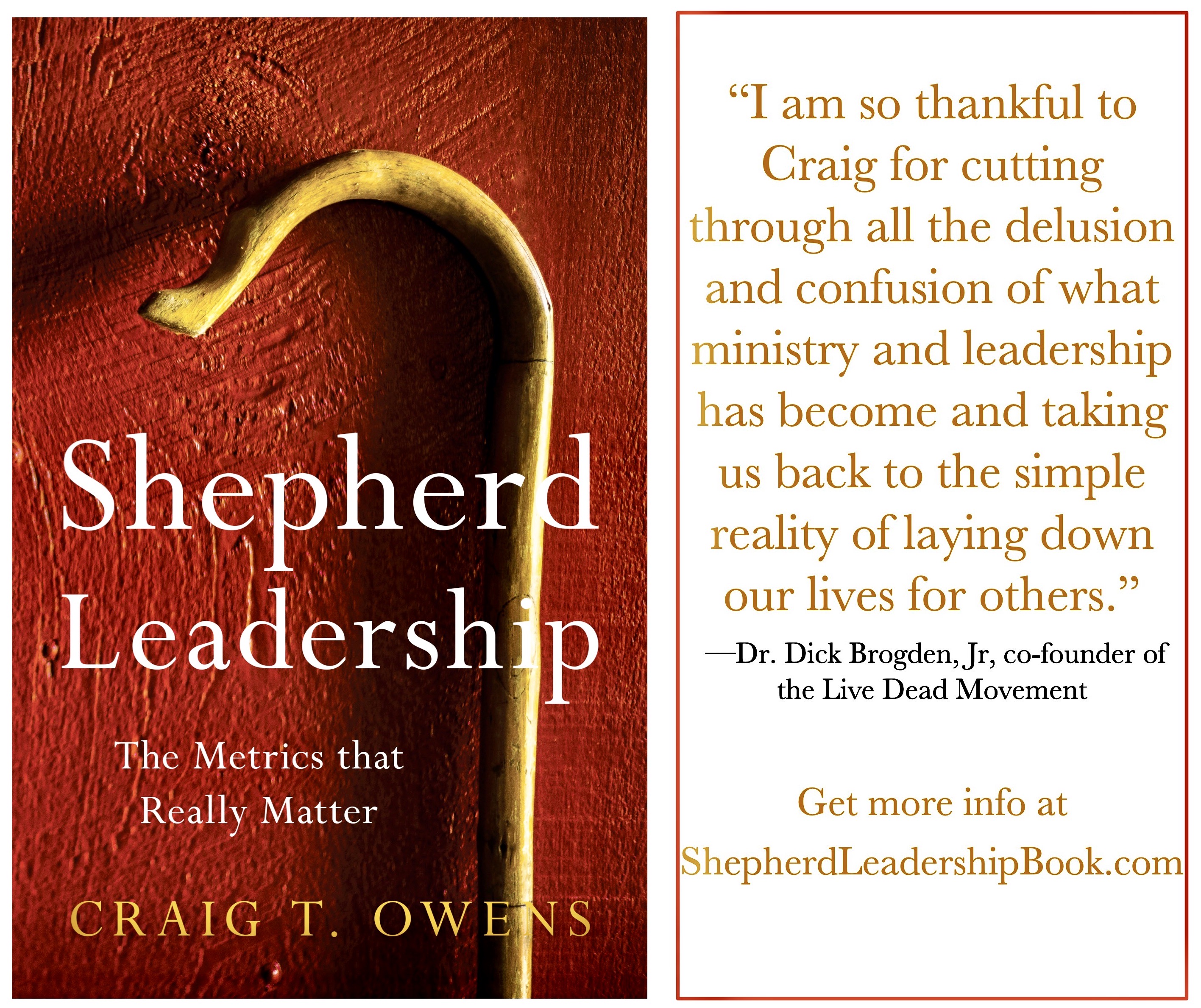
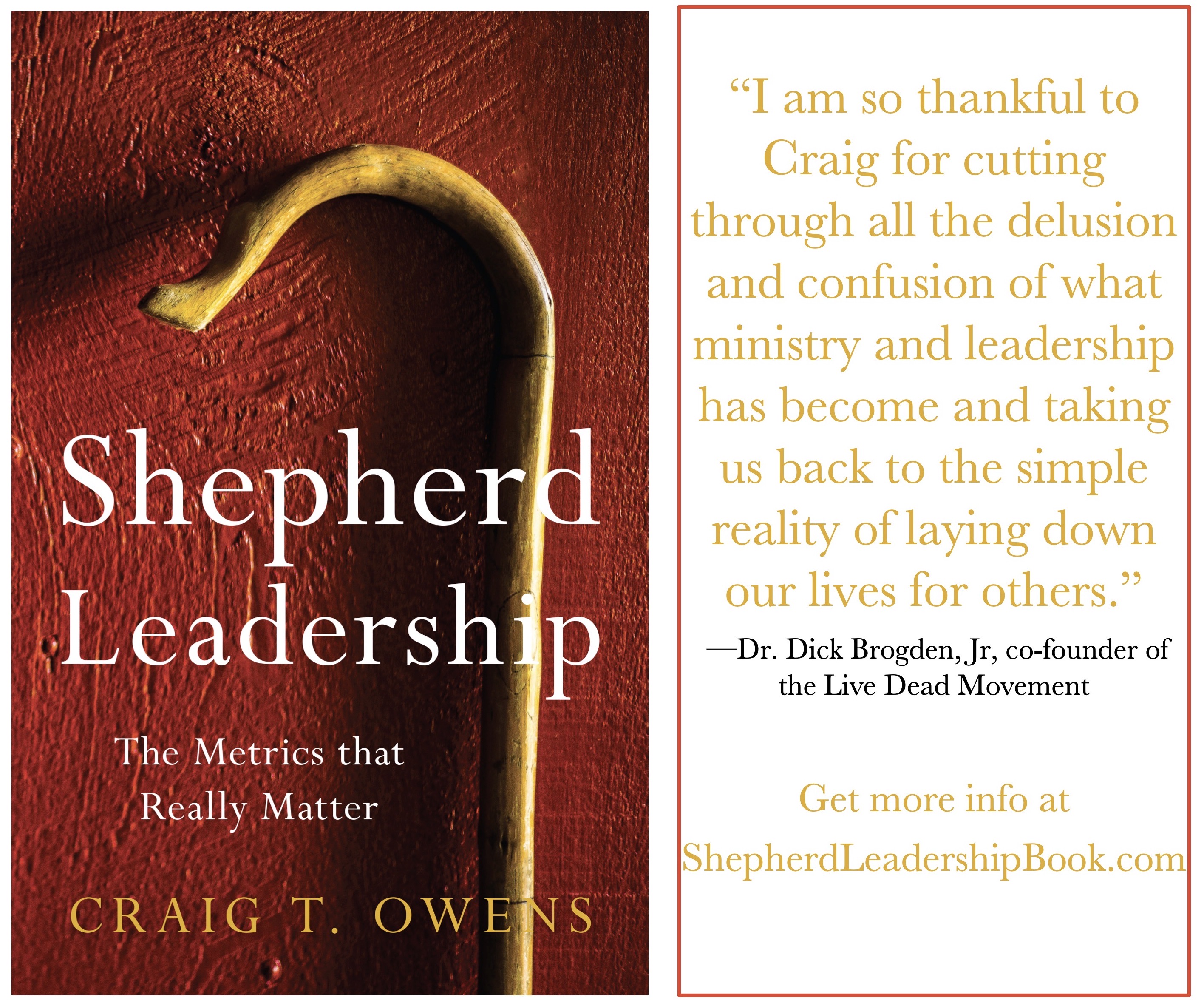
“I am so thankful to Craig for cutting through all the delusion and confusion of what ministry and leadership has become and taking us back to the simple reality of laying down our lives for others. Crucified shepherds are neither popular nor common, but they do look and live like Jesus.” —Dick
“Craig does a great job of reminding us of some simple truths that far too often get lost in the world of leadership. As he calls us back to model our leadership after Jesus, he does so with practical advise and a shepherd’s heart.” —Kevin
“Having served in executive leadership positions on two large church staffs and also on a non-profit paraministry, I can tell you from experience this book is a must-read.” —Steve
“Craig provides a much needed guide, based on biblical principles, on how the church can regain its impact on the culture through more effective leadership.” —Stuart
“Craig Owens describes his Biblical understanding of how leaders serve through humility and confidence, utilizing their mental, physical, spiritual, and emotional health. It is through this balance that effective leaders can honor God with their servanthood.” —Denise
“This book is filled with practical ideas that challenge me to check my priorities. In a world that screams for more, more, more, this book asks me to identify what I want more of.” —Faye
The reviews on Amazon currently have this book rated at 4.9 stars.
I’m so humbled that this book is connecting with so many people! I loved writing it, and I still love talking to people about it.
My book is available in print, ebook, and audiobook. If you’d like to know more about Shepherd Leadership: The Metrics That Really Matter, or to pick up a copy for yourself, please go to ShepherdLeadershipBook.com.
[2:18] Only servant leaders truly know how to breathe hope into the people around them.
[3:17] Greg describes how leaders can become hope dealers.
[3:53] I paraphrase a proverb to help leaders see the immense value in dispensing hope.
[5:59] Greg explains how leaders instill hope into themselves.
[7:48] Hope-filled people are still realistic about the present difficulties they are facing.
[8:59] Hope isn’t just about one-time vision casting—we talked about how leaders keep the message of hope consistent.
[12:29] Leaders have to be around people in order to invest hope into them.
[14:00] Greg notices how hope connects faith and love.
[15:32] Greg gives leaders a challenge to grow as hope-fillers.
[17:42] Leaders give their teammates hope for a better future.
Check out this episode and subscribe on YouTube so you can watch all of the upcoming episodes. You can also listen to our podcast on Spotify and Apple.
Listen to the podcast of this post by clicking on the player below, and you can also subscribe on Apple, Spotify, or Audible.
I’m closing in on 4900 posts on my blog that started back in 2009. About a year ago, I decided to make my blog a little more accessible. I realized that some people didn’t have time to pull out their phone or sit down at their computer every morning to read what I had written, so I begin to record my posts and make them available as a podcast on the Craig T. Owens Audio Blog.
So a similar thought occurred to me as we put the finishing touches on my book Shepherd Leadership: The Metrics That Really Matter. In addition to making it available in its print and ebook format, I also wanted to record an audiobook. I am so grateful to my good friend Kevin Richards who walked me through this whole process. His expertise and encouragement made this project a reality.
Take a listen to this trailer we put together to give you just a small sampling of the audiobook, and if you like what you hear, you can download this book on Audible or in Apple Books.
This is a weekly series with things I’m reading and pondering from Charles Spurgeon. You can read the original seed thought here, or type “Thursdays With Spurgeon” in the search box to read more entries.
Listen to the podcast of this post by clicking on the player below, and you can also subscribe on iTunes or Spotify.
Wart Warning
At the instigation of his wife, Abraham adopted means that were not justifiable in order that he might obtain the promised heir [see Genesis 16]. He used means that may not be so vicious to him as they would be in men of modern times, but that were suggested by an unbelieving policy and were fraught with evil. He takes Hager to wife. He could not leave it to God to give him the promised seed. He could not leave it with God to fulfill His promise in His own time and justifies himself in turning aside from the narrow path of faith to accomplish, by doubtful methods, the end that God Himself had promised and undertaken to accomplish! How shorn of splendor is Abraham seen when we read, ‘And Abraham heeded the voice of Sarah’ (Genesis 16:2). That business of Hagar is to the patriarch’s deep discredit and reflects no honor at all upon either him or his faith.
Look at the consequences of his unbelieving! Misery soon followed. Hager despises her mistress. Sarah throws all the blame on her husband. The poor bondwoman is so harshly dealt with that she flees from the household. … One marvels that such a man as Abraham allowed one who had been brought into such a relationship with him to be heedlessly chased from his house while in a condition requiring care and kindness!
We admire the truthfulness of the Holy Spirit that He has been pleased to record the faults of the saints without extenuating them. Biographies of good men in Scripture are written with unflinching integrity—their evil recorded as well as their good. These faults are not written that we may say, ‘Abraham did so-and-so; therefore we may do it.’ No, brothers and sisters, the lives of these good men are warnings to us as well as examples, and we are to judge them as we should judge ourselves—by the laws of right and wrong.
From Consecration To God
In my book Shepherd Leadership: The Metrics That Really Matter, I also talk about the faults that we see in God’s leaders. In looking at David’s adulterous affair with Bathsheba, Elijah’s slide into depression, and Peter’s denial of Jesus, I see something similar: They were alone.
David stayed in Jerusalem while his army went to fight, Elijah left his servant behind and went into the wilderness alone, and Peter was separated from his fellow disciples. Just like with Abraham, all of these other men were brought back into close fellowship with God. But all of these men now have a “wart” on their biography.
“God designed us to be in relationship with others. His statement to Adam in some of the earliest words of the Bible—‘It is not good for you to be alone’—are words for us still today. As I mentioned earlier [in my book], you will not find the word ‘saints’ in the singular in the New Testament. Instead, you will find such phrases as ‘one another,’ ‘each other,’ and ‘all together’ prominently displayed throughout the New Testament church. Let me say it again: God designed us to be in relationship with others. If you want to go far in your shepherding, you cannot try to go alone.” —from the chapter in Shepherd Leadership called‘Going Farther’
Let’s be forewarned by these examples. Stay close to God, but also stay close to godly friends that will help you in the hard times. Don’t let a wart blemish your record.
most people don’t think this leadership killer impacts them [0:30]
we share our personal experiences of leaders placing “me” in front of “we” [2:06]
here’s what this killer does to our teammates [2:58]
sharing is better than taking—this is a key part of an abundance mindset [3:53]
discontentment and low self-esteem lead to feelings of greed [5:14]
what squashes greed? what is our leadership builder? [5:20]
discontentment is the path of least resistance, so we have to choose to be contented leaders [6:43]
Greg shares a contentment lesson he learned while on a missions trip [9:11]
how the senior leader should address discontentment or greed in other team members [10:56]
leaders are the thermostat for their team [13:20]
where does work fit into the overall scheme of life? [14:14]
Greg gives us a leadership challenge to help us win the battle against greed [15:40]
Check out this episode and subscribe on YouTube so you can watch all of the upcoming episodes. You can also listen to our podcast on Spotify and Apple.
On September 28, 2021, you can purchase the print version and the audiobook. But if you don’t want to wait any longer, the Kindle version is available now—just click here.
As I wrote in the Preface to Shepherd Leadership, “My prayer is that this book liberates you! I want to see all of us get back to the simple shepherding style of leadership that the Bible has portrayed for us, so that our ministries are healthy, energized, effective, sheep-producing, and God-glorifying.”
If you pick up a copy, I’d love for you to post a review on Amazon for me. Thank you!