Links & Quotes

“But friendship is precious; not only in the shade, but in the sunshine of life.” —Thomas Jefferson

“People are just about as happy as they make up their minds to be.” —Abraham Lincoln

“Humility is the foundation of all the other virtues hence, in the soul in which this virtue does not exist there cannot be any other virtue.” —Augustine

When you praise God, despite your surroundings, you magnify Him. And when you magnify God, you invite others to magnify Him with you!

“Manhood first and then gentleness.” —Ralph Waldo Emerson

I have blogged quite a bit about the historicity of the Bible. The Bible Archeology Report has a very informative post of the top 10 historical references to Jesus outside the Bible. These sources are from the first or second century AD, and specifically mention Jesus of Nazareth, not just Christians.

Dan Reiland wrote, “Church leadership always carries with it seasons of success and setbacks, momentum and grind, joy and discouragement. Yet, we all do better through those seasons when we have learned the rhythms of resilience—the lifelines we need.” Check out the 6 sustaining lifelines for leaders that he shared.

The Institute for Creation Research reported, “Two separate studies claim massive tsunamis and earthquakes from an asteroid impact profoundly affected the rock record. … [Yet] these global phenomena are better explained by the global Flood described in Genesis.”

“Anger makes dull men witty, but it keeps them poor.” —Francis Bacon

The Craig And Greg Show: Change Isn’t a Four-Letter Word

Listen to the audio-only version of this podcast by clicking on the player below, or scroll down to watch the video.

On this episode of “The Craig And Greg Show” we talk about: 

  • [0:30] Change is a four-letter word for some people.
  • [2:05] What holds people back from embracing change?
  • [4:39] How does a leader’s pride play into successful change?
  • [5:50] People don’t buy-in to change overnight, which is why a change catalyst is needed.
  • [9:00] Improvement committee can work well to help an organization make changes.
  • [10:49] The unselfishness of leaders is key for making effective changes.
  • [12:22] Who should be on your improvement committee?
  • [14:34] The benefit of diversity on your teams.
  • [16:55] The right and wrong ways to roll out changes.
  • [19:59] Give and get lots of feedback during the change process.
  • [21:14] What is unacceptable for a leader in the arena of change?
  • [23:16] How can leaders overcome the fears that your teammates have about changes?
  • [27:13] We can help you with changes in your organization.

Check out this episode and subscribe on YouTube so you can watch all of the upcoming episodes. You can also listen to our podcast on Spotify and Apple.

Attitude Adjustment

Listen to the podcast of this post by clicking on the player below, and you can also subscribe on AppleSpotify, or Audible. 

Imagine if 700 years before you were born there was a prophecy given about you (Matthew 3:3). Or if on the day of your birth your father said, “And you, my child, will be called a prophet of the Most High; you will go on before the Lord to prepare the way for Him” (Luke 1:76). 

This was John the Baptist.

With these kinds of announcements and the stamp of approval from God Himself, it’s really quite astounding how humble John remained:

  • “After me comes One Who is more powerful than I, Whose sandals I am not worthy to carry” (Matthew 3:11). 
  • “[Jesus] must increase, but I must decrease” (John 3:30). 

The confidence that he was God’s man for the hour gave John boldness to speak truth to religious leaders, wealthy people, and Roman soldiers (Matthew 3:7-12; Luke 3:7-20). Yet his humility was almost his undoing. 

John preached boldly, fulfilling the prophecies that were made about him. But when Jesus came to him to be baptized, John’s humility caused him to defer initially. Then Jesus reminded him that His baptism was necessary “to fulfill all righteousness. Then John consented” (Matthew 3:13-15). 

Whether I am lacking confidence to speak or lead boldly, or lacking humility to let someone else take the lead, I need to return to the Word of God—just as John did. Both his confidence and his humility were balanced by words spoken over him by God. So it must be for you and me too. 

Confidence without humility or humility without confidence can trip me up and cause me to miss out on all that God needs me to do. So my daily prayer must be: Holy Spirit, may I be sensitive to every correction and adjustment You need to make in me. Illuminate the Scriptures that I need to apply to my life that will keep me in a healthy, balanced place. 

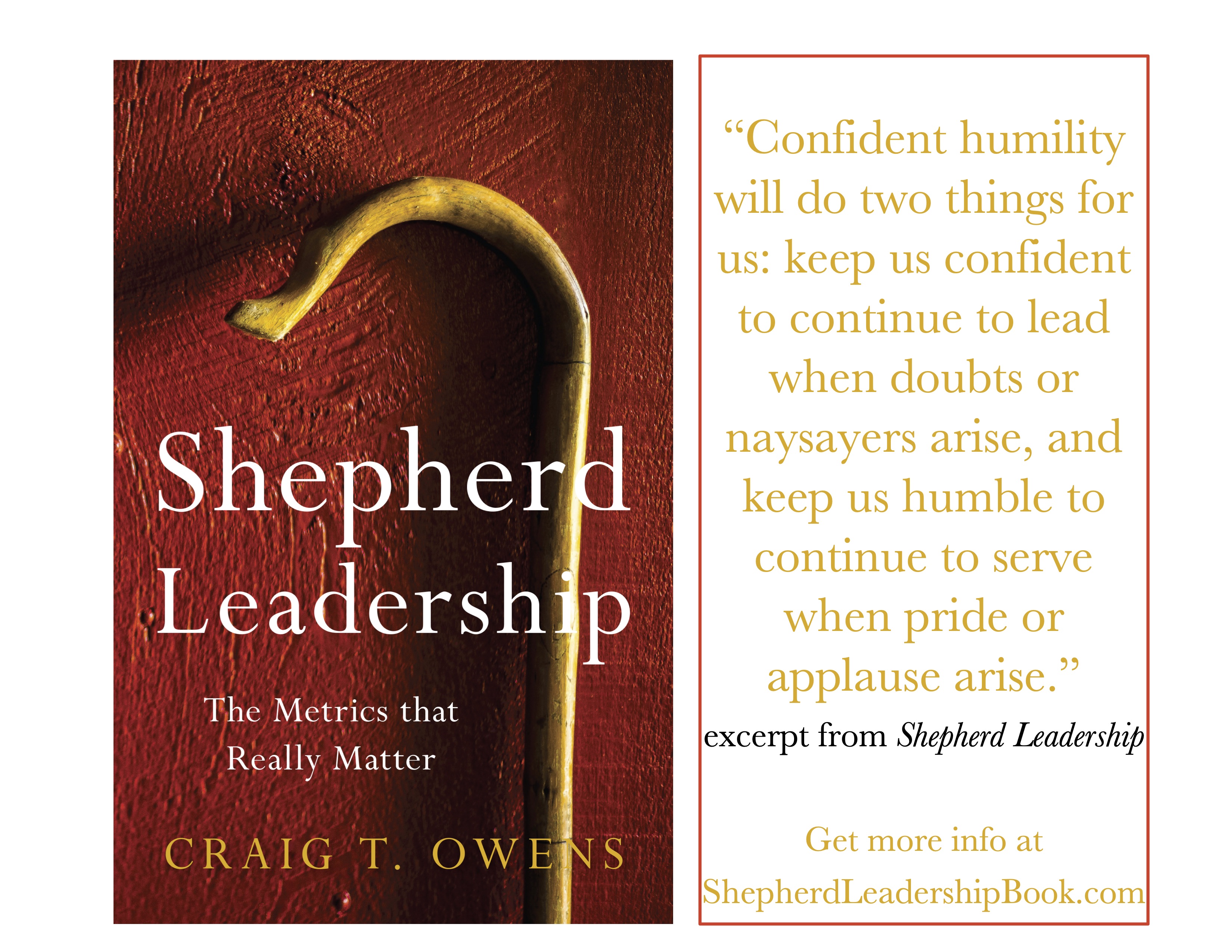
I wrote about this tension between confidence and humility in my book Shepherd Leadership. This was also a topic of conversation in two interviews I did, which you can find here and here. Healthy leaders need the proper balance of confidence and humility to keep their leadership in a place that God can use powerfully. 

►► Would you please prayerfully consider supporting this ministry? My Patreon supporters get behind-the-scenes access to exclusive materials. ◀︎◀︎

You Are A Unique And Unbalanced Leader

Listen to the podcast of this post by clicking on the player below, and you can also subscribe on AppleSpotify, or Audible. 

I read a report that said today the world’s population hit 8 billion people. Demographers estimate that in the history of our planet, 120 billion people have lived on Earth. Amazingly, every single one of these 120 billion people have been unique creations! 

Let me state that more personally: There has never been anyone like you, nor is there anyone like you now, nor will there ever be anyone like you. God made you unique from all others. 

And God made you uniquely unbalanced. 

If you’ve ever taken a personality test or any other kind of assessment you probably noticed that there were areas that scored very high, and perhaps some areas that barely even registered. This is a part of your unique composition. 

Your uniqueness was given to you by God on purpose—He knew exactly what He was doing when He made you you. I recently chatted with the pastoral staff of Faith Wesleyan Church as they are doing a book study on my book Shepherd Leadership: The Metrics That Really Matter. I joined them for their discussion of chapters 4 and 5, in which I talk about the way God has wired leaders to be naturally more confident or more humble. Check this out…

Shepherd leaders, you can best individualize your care of the sheep God has given you when you understand how God has wired you. Don’t make excuses for your unbalancedness, but don’t let your uniqueness hold you back either. Get around other healthy leaders who can speak firmly and lovingly to you. This will allow your uniqueness to be leveraged for God’s glory as you lead His flock that He has entrusted to you. 

I’ll be sharing more clips from this training session soon, so please stay tuned. In the meantime, if you would like me to join your team in a similar discussion of Shepherd Leadership, please get in touch with me. Shepherd Leadership is available in print or ebook, and in audiobook through either Audible or Apple.

►► Would you please prayerfully consider supporting this ministry? My Patreon supporters get behind-the-scenes access to exclusive materials. ◀︎◀︎

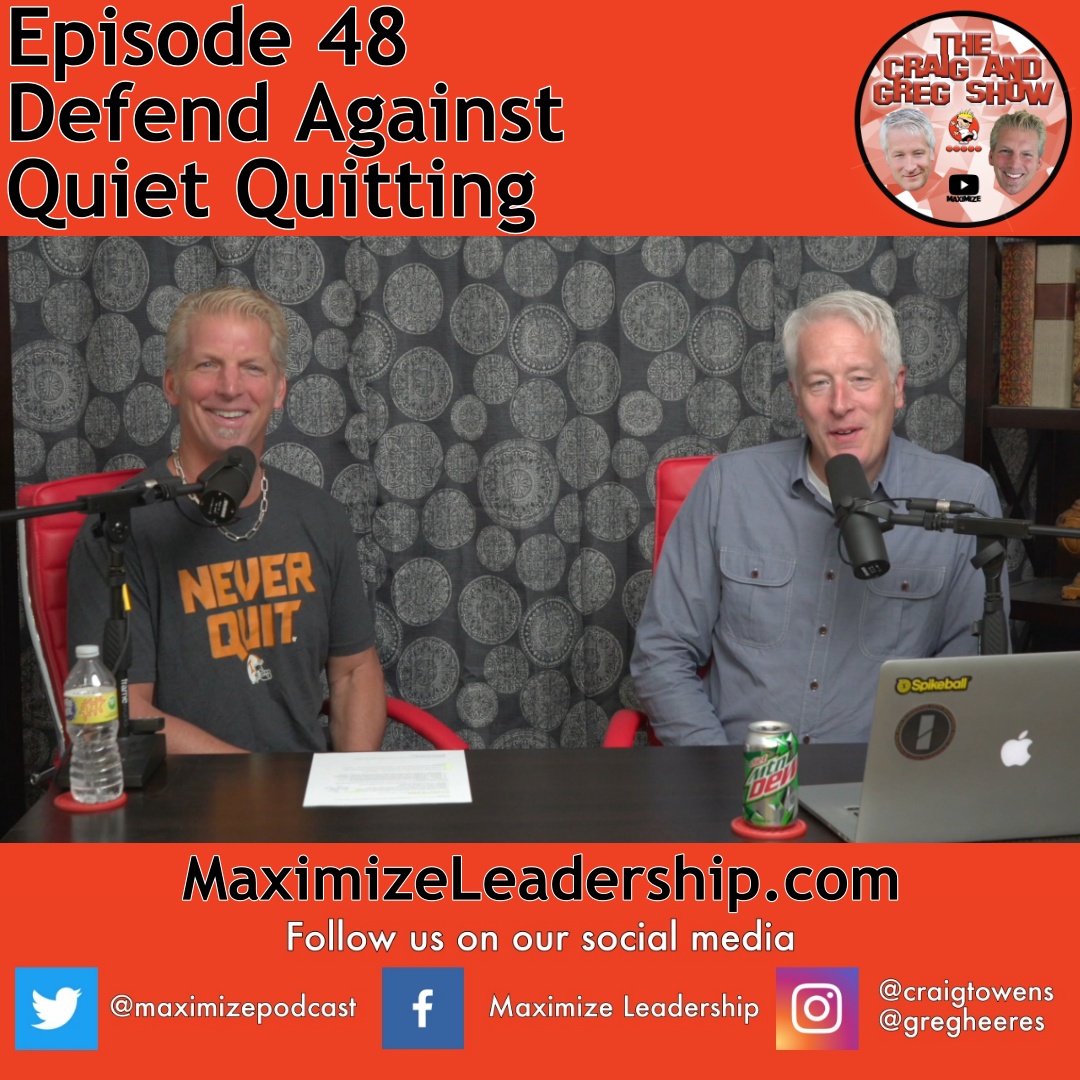
The Craig And Greg Show: Defend Against Quiet Quitting

Listen to the audio-only version of this podcast by clicking on the player below, or scroll down to watch the video.

On this episode of “The Craig And Greg Show” we talk about: 

  • [0:37] What is quiet quitting? 
  • [3:18] Is this just “a generational thing?” The guys say “no.”
  • [3:52] Why are workers quiet quitting?
  • [6:12] Quiet quitters infect the whole organization.
  • [6:44] Leaders need to share a compelling vision.
  • [8:16] How do leaders create an environment that excites workers to contribute?
  • [9:00] Leaders can unleash the potential in their teammates.
  • [9:43] What do leaders need to know about quiet quitters?
  • [11:06] How do leaders really gauge productivity?
  • [12:39] How do leaders “push the button” to motivate their teammates?
  • [13:44] Leaders need to defend a high-productivity culture.
  • [14:28] Craig adapts five principles from a book he read to help us motivate our team.
  • [19:56] The sad fate of leaders who quiet quit.
  • [20:47] Leaders need empowered teammates to expand their influence.
  • [22:22] We celebrate the behaviors we want to see throughout the organization.

Check out this episode and subscribe on YouTube so you can watch all of the upcoming episodes. You can also listen to our podcast on Spotify and Apple.

The Self-Aware Leader (book review)

Listen to the podcast of this post by clicking on the player below, and you can also subscribe on AppleSpotify, or Audible. 

Leaders never “arrive” at a place where they have accomplished everything they want to accomplish. John Maxwell helps leaders keep pressing on in their personal growth in his book The Self-Aware Leader. 

This book is largely autobiographical, as Maxwell leads us through lessons that he learned by not being self-aware. His leadership stumbles served as a wake-up call that allowed him to reflect, learn, and then correct his technique. Then after decades of honing these techniques, he shares with his readers the practical steps for them to become self-aware of a potential stumbling point before it actually trips them up. 

I also appreciated the self-aware leader’s questions for reflection at the end of each chapter. To me, this is an ideal place for leaders who are in mutual accountability to focus their discussion as they meet together. My biggest takeaway from this book is that I cannot become self-aware nor correct the things that could derail my leadership solely on my own. Reading The Self-Aware Leader is a good starting point, but I also highly recommend reading this book with another leader that also desires to grow and improve. 

Leaders who want to uncover the things that could be holding them back will really benefit from reading and applying this book. For my Patreon supporters, I have also shared several noteworthy quotes from this book here. 

►► Would you please prayerfully consider supporting this ministry? My Patreon supporters get behind-the-scenes access to exclusive materials. ◀︎◀︎

How Should Leaders Handle Pushback?

Listen to the podcast of this post by clicking on the player below, and you can also subscribe on AppleSpotify, or Audible. 

Leaders will always get some pushback from the people on their team. It doesn’t matter how much the people love their leader, when the leader shares a change or a correction, there will always be some people that are uncomfortable with that. 

And they will pushback. 

I’ve already shared some thoughts for leaders to make sure the issues they are addressing are biblical issues, not getting caught up in non-biblical controversies that can result in some very unbiblical attitudes! But when a leader is promoting a biblical change, there is a right way to handle it. 

Check out how I discussed this topic with some ministry interns—

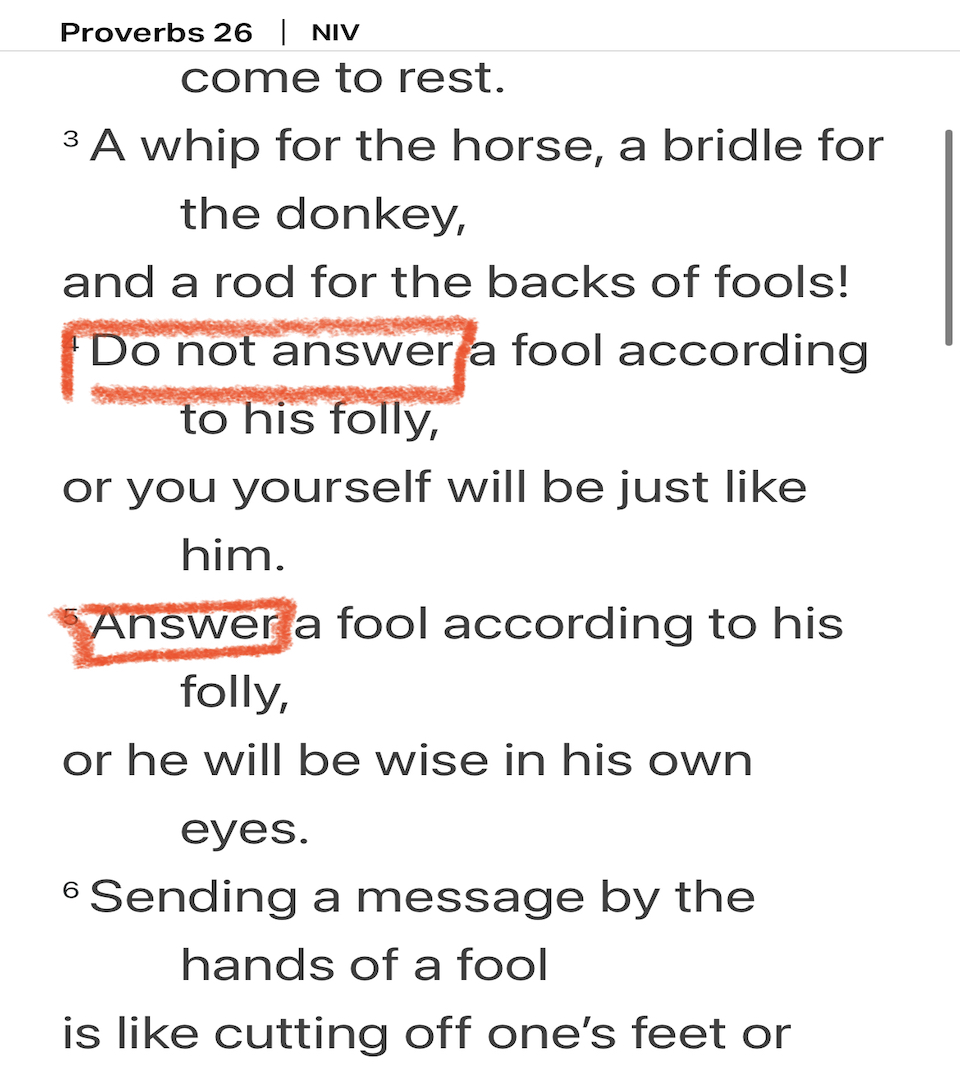
I really do like going back to those two verses in Proverbs: 

Do not answer a fool according to his folly, or you yourself will be just like him. Answer a fool according to his folly, or he will be wise in his own eyes. (Proverbs 26:4-5)

Make sure you are not arguing just to argue. Good leaders only speak up for the good of the team and the individuals on the team. They never speak up just because they need to prove themselves right or they need to win an argument. 

If you would like to go a little deeper into this, you may want to check out a couple of other posts and videos I’ve shared:

Handling pushback the right way is going to be an important component of your leadership, so take some time to get it right the first time. If I can help coach you through a leadership challenge you are facing, please don’t hesitate to get in touch with me. 

►► Would you please prayerfully consider supporting this ministry? My Patreon supporters get behind-the-scenes access to exclusive materials. ◀︎◀︎

Contending For Our All (book review)

Listen to the podcast of this post by clicking on the player below, and you can also subscribe on AppleSpotify, or Audible. 

As someone who thoroughly enjoys studying history and leadership, “The swans are not silent” series of books by John Piper is right up my alley! The fourth book in this excellent series is Contending For Our All. 

As with all of the other books in this series, Contending For Our All explores the lives of three notable men of history around a common theme. This book focuses on the theme of dealing with controversies in the church through the lives of Athanasius, John Owen, and J. Gresham Machen. 

None of these men sought to be controversial, but neither did they shy away from addressing the unbiblical teachings of their day. Even though it cost them prestige, advancement, personal comfort, and even a few friends, these strong men knew that standing for biblical truth was their supreme privilege. Athanasius confronted the heresy of Arianism, Owen was one of the most influential voices for the Puritans, and Machen warned the evangelic church of its drift away from orthodoxy. 

These men counted the joy of serving Jesus even in the face of controversy as the greatest honor they could obtain. They served well and lovingly and earned the highest praise in the voice of their Master saying, “Well done, good and faithful servants.” Their lives are a timely reminder for all Christians living in today’s post-truth culture. 

As with all of the other books in this series, Pastor John does a remarkable job in sharing these biographies in a compelling and memorable manner, and in a way that makes the case for all Christians to stand strong as they too contend for truth. 

If you would like to read the other book reviews I’ve reviewed in this series, check them out here: 

►► My Patreon supporters will have exclusive access to all of the quotes and notes I compiled while reading this book. Would you please prayerfully consider supporting this ministry? My Patreon supporters get behind-the-scenes access to exclusive materials. ◀︎◀︎

Links & Quotes

Don’t rush through your Bible reading time. Slow down to savor the good stuff. And if there’s something you don’t understand, ask the “Chef”—the Holy Spirit loves to make God’s Word clear to you.

On a recent Breakpoint broadcast, John Stonestreet reported, “Even while many nations pump the brakes on radical transgender ideology and healthcare practices, Americans at both the state and federal level continue to push culture-wide affirmation, social transition of minors, hormone therapies, and harmful surgeries. Advocates frequently claim that so-called and misnamed ‘gender-affirming’ treatments—including surgery—‘save lives,’ that gender dysphoria is a permanent condition even among minors, and that regret by those who undergo such treatments are minimal or non-existent. Increasingly, research suggests otherwise.”

“Hazael’s historicity has never truly been in doubt; there are far too many inscriptions from the ancient world testifying to his existence.” Check out this archeological biography of King Hazael who appears several times in the Bible.

Dan Reiland notes, “Leaders navigate within the realm of pressure; it’s part of the landscape. It’s how we handle the pressure that makes all the difference.” Dan shares four ways the pressure of leadership is needed and helpful.

Be careful with non-biblical rules! I went much deeper with this idea in an exclusive video for my Patreon sponsors. If you want to get access to these exclusive lessons, it’s just $5/month. Check out my Patreon page to subscribe → https://www.patreon.com/craigtowens.

John Piper explains that there are three levels of how to live with material things. He then dives deeper into what the purpose of prosperity really is.

T.M. Moore has a stern word for pastors: “If we are faithful in telling the whole truth of the Gospel, not everyone will be thrilled with our preaching. We need to make sure Jesus is. When it comes to sin, let’s not mince words, and let’s not act like it’s not the big deal it is. No progress in faith can be made where sin is not consistently and thoroughly confessed, repented of, and forsaken.”

The Pinnacle Of A Leader’s Health

Listen to the podcast of this post by clicking on the player below, and you can also subscribe on AppleSpotify, or Audible. 

In my book Shepherd Leadership, I take five chapters to unpack the lessons we can learn from the health of Jesus. Yes, Jesus was mentally, physically, spiritually, and relationally healthy. 

On the 200churches podcast with Jeff Keady we talked about a chapter in my book called “The Pinnacle of a Shepherd’s Health.” In that chapter I wrote—

     The phrase Dr. Luke uses about Christ’s growth is, “Jesus grew in favor with men” [Luke 2:52]. People liked having Jesus around. The word Luke uses for favor is from the same root word that is also translated “grace.” Jesus was a graceful Man. Or we could say that He was a Man so full of grace that when He was jostled, only grace spilled out of Him. 

     What does it mean when someone is graceful? It means they are pleasant to be around. It means you feel safe around them, knowing they will never belittle you or put you down. It means that their focus is on your agenda, not their own agenda. It means they are a “there you are!” person, not a “here I am!” person. The bottom line: grace-full people are full of grace for others. 

The way we react as leaders says more about our health than our planned actions do. Once again, let me share with you a passage from Shepherd Leadership

     Let’s return to our perfect example in Jesus. He was treated rudely and spoken to condescendingly, even by people who should have been His allies. Then there were those on a constant mission to try to trip Him up or get Him to say or do something that would have undermined His credibility. Yet Jesus never spoke inappropriately nor acted childishly. Jesus never had to say, “My bad, I misspoke there,” or “Sorry, I shouldn’t have done that.” 

     We can make all of our plans to behave in loving ways toward the sheep under our care, but what happens when the sheep ignore us, bite us, or leave us? As boxer Mike Tyson noted, “Everyone has a plan until they get punched in the mouth.” Surely the best indication of our overall healthiness and servant-like attitude is not so much our actions but our reactions. 

If your reactions are less than what you would like them to be, I believe you will find a lot of excellent content in my book that can help you. 

If you want to catch up on some of the other clips I’ve already shared from this interview, you can find them here, and I’ll be sharing more clips from this 200churches interview soon, so please stay tuned. Shepherd Leadership: The Metrics That Really Matter is available in print or ebook, and in audiobook through either Audible or Apple. 

►► Would you please prayerfully consider supporting this ministry? My Patreon supporters get behind-the-scenes access to exclusive materials. ◀︎◀︎