Listen to the podcast of this post by clicking on the player below, and you can also subscribe on Apple, Spotify, or Audible.
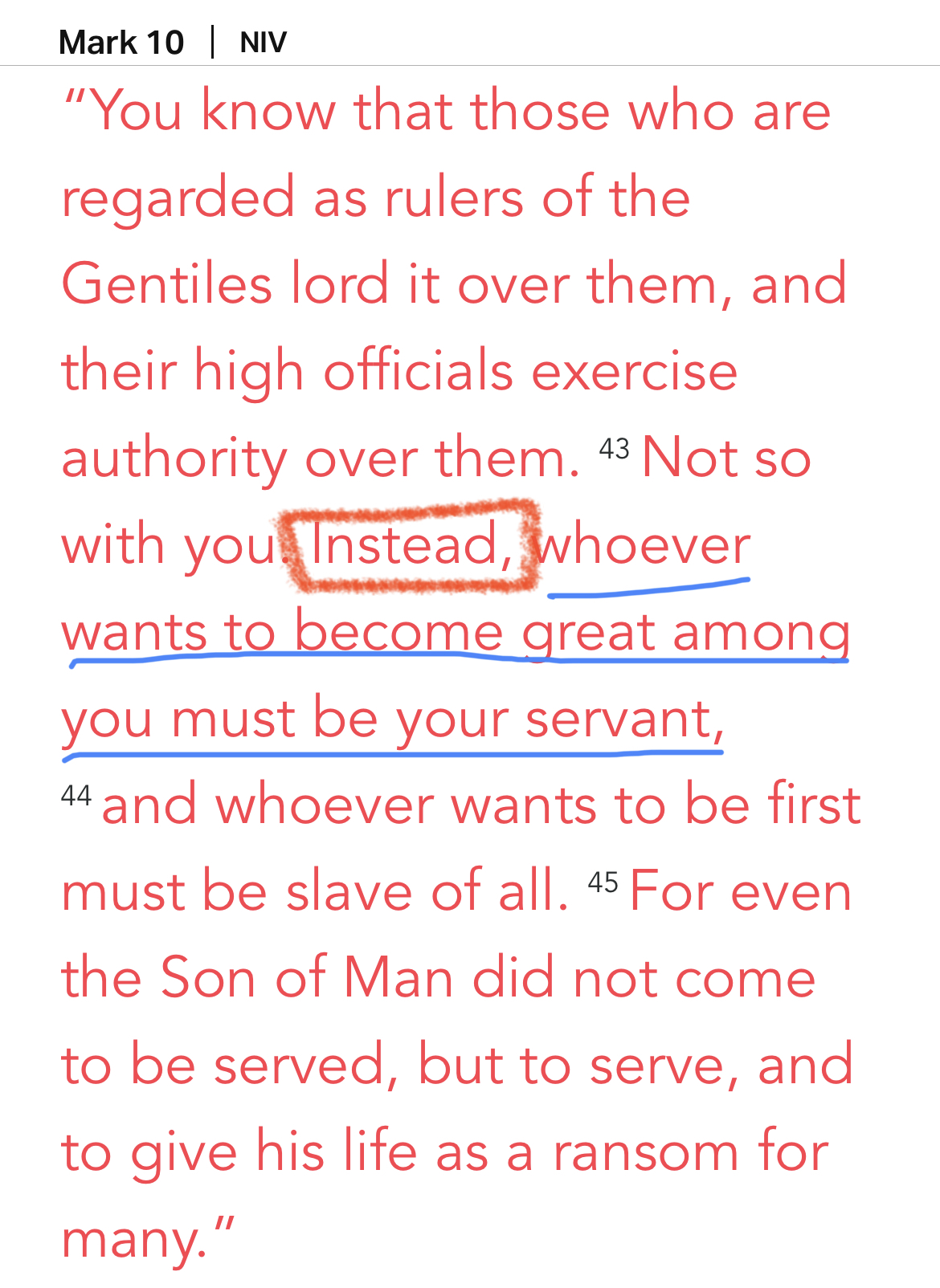
So Jesus called them together and said, “You know that the rulers in this world lord it over their people, and officials flaunt their authority over those under them. Not so with you. Instead…” (Mark 10:42-43).
A Christlike leader is an “instead” leader.
Instead of exercising authority, exercising humility.
Instead of being served, serving everyone else.
Instead of being first in line, being last in line.
Instead of seeking recognition, seeking anonymity.
Instead of collecting titles, collecting calluses.
Instead of receiving, giving.
Jesus, help me to be an “instead” leader—to strive to more consistently lead like You.
Listen to the podcast of this post by clicking on the player below, and you can also subscribe on Apple, Spotify, or Audible.
As Jesus headed towards Jerusalem, Mark records, “with Jesus leading the way” (Mark 10:32).
The Greek word for “lead” is proago. The prefix pro- means before or in front, and the root word -ago means to lead oneself, to lead by accompanying, or to lead by taking hold. This means that Jesus never sends us off by ourselves. He goes before us, with us, alongside us.
One would think that this would give the disciples great comfort. But Mark also records two unexpected responses from these men: “astonished” and “afraid.”
The words “astonished” or “amazed” are both the same word in Greek and are used both here and just a couple of verses earlier (verse 24), when Jesus said how hard it was for a rich person to enter into the kingdom of God. That statement amazed the disciples. Now they are astonished that Jesus is going to Jerusalem. “After all,” they might be thinking, “That’s where His main antagonists are headquartered! Why would He go there?”
It appears that the father they went on their journey, the more their astonishment morphed into fear. The Greek word here is the one for which we get the word “phobia”—the kind of fear that can paralyze us or tempt us to run away.
There are two things that Jesus does here to help His fearful friends:
(1) He gives them the unvarnished facts: “We are going up to Jerusalem…and the Son of Man will be delivered over to the chief priests and the teachers of the law. They will condemn Him to death and will hand Him over to the Gentiles, who will mock Him and spit on Him, flog Him and kill Him….”
Leaders who want to honor Jesus in their leadership would do well to follow this example—Give your fearful friends both the facts (no matter how painful they might seem) and the unshakable hope that God is sovereignly in control.
A mark of a godly leader is one who is striving to lead more and more like Jesus.
Let’s keep studying His life and allowing the Holy Spirit to teach us the lessons we can apply in our leadership roles.
This is part 70 in my series on godly leadership. You can check out all of my posts in this series by clicking here.
I have a series of nearly 70 posts on the topic of godly leadership. Here is the latest installment about going all in. Be sure to check out all of my videos on my YouTube channel.
T.M. Moore writes persuasively to Christians to encourage them to build for the future. He wrote, “For most Christians today, the Kingdom which Daniel saw, Jesus proclaimed and brought near, and the Spirit inaugurated on that first Christian Pentecost—that Kingdom is little more than a theological idea, or a distant hope. It is not a daily reality to be sought, seized, shared, and strengthened in every nook and cranny of our Personal Mission Fields. Christians today are trapped in their past or mired in their present, and they have little or no sense of what it means to build for the future so that righteousness, peace, and joy in the Spirit increase wherever they live, move, and have their being.”
And another piece of research from both paleontologists and entomologists points to the Flood described in the Bible as historically viable. Researchers discovered fossilized giant ants in Canada where evolutionists claim they shouldn’t be. The Institute for Creation Research commented, “There is no need to postulate ants trekking across the Arctic to explain the distribution. Nor is there a need to inject short ‘hyperthermal’ episodes to allow passage from one continent to another. The global Flood explains what we observe the best. The warmer pre-Flood conditions and likely higher oxygen levels explain the large size of the ants. And their fossil distribution is best explained by their transport off the highest pre-Flood hills as the waters were receding.”
“If we were to look at Jesus’s death merely as a result of a betrayer’s deceit and the Sanhedrin’s envy and Pilate’s spinelessness and the soldiers’ nails and spear, it might seem very involuntary. And the benefit of salvation that comes to us who believe might be viewed as God’s way of making a virtue out of a necessity. But once you read Luke 9:51, all such thoughts vanish. Jesus was not accidentally entangled in a web of injustice. The saving benefits of His death for sinners were not an afterthought. God planned it all out of infinite love to sinners like us, and He appointed a time.” —John Piper, Love To The Uttermost reading plan on YouVersion
Listen to the audio-only version of this podcast by clicking on the player below, or scroll down to watch the video.
No need to call anyone out, but when I say “difficult peer” at least one person probably comes to mind right away, right? So what’s the solution: ignore them, scream, tear your hair out? Greg and I think there’s a better solution. In this episode, we walk through how we’ve dealt with difficult peers in the past and give actionable advice on how your leadership and coaching can help them improve.
[0:16] We are continuing our series about leading difficult people from wherever you are in your organization.
[1:24] Our goal as leaders should be to figure out why a particular peer is so difficult to work with.
[2:00] A warning about the least productive thing you can do when you are frustrated with a coworker.
[3:44] A great example from Jesus for those striving to be servant leaders.
[5:17] Some questions to ask ourselves to determine if our difficult teammates are coachable.
[7:31] We need to learn the best ways to communicate with our teammates.
[9:18] Where does mistrust play a role in these difficult situations?
[13:13] Leaders at every level need to learn the art of diplomacy.
[15:02] Where does defeatism come into play?
[17:03] A shepherd’s heart must be cultivated for us to lead well—especially leading difficult peers.
[18:45] “When you’re ready” is a great posture for a leader, but it must be lived out.
Check out this episode and subscribe on YouTube so you can watch all of the upcoming episodes. You can also listen to our podcast on Spotify and Apple.
There is something very important that mature leaders need to remind themselves of so that they can help emerging leaders become successful. You can watch out this full conversation about mulligans and do-overs on the most recent episode of The Craig and Greg Show. Be sure to check out all of my videos on my YouTube channel.
In my sermon on Sunday, I talked about the sovereignty of God over world affairs and world leaders. This is a great reminder from John Newton:
Sovereignty is but another name for the unlimited exercise of wisdom and goodness.
Merat Sultan was born in the shah of Iran’s palace in 1876. He became the chief of police and of the army in Tabriz, Iran. When the Russians invaded and occupied that area, they made plans to execute Sultan. How he escaped actually led him to a relationship with Jesus as Sultan became a Christian. Check out this fascinating story from the website Praying For Muslims. I would also urge you to check out their weekly prayer guide.
“No voice. No contribution. No significance. No meaning.
“Invisible.
“That’s the way many women probably felt at the time Jesus lived. And every person with an illness—cancer, leprosy, epilepsy, mental disabilities—every one of those people were marginalized. In Jesus’ day, what careers were on the lowest rung of the corporate ladder?—fishermen and shepherds. Yet when you read every account of Jesus, who do you see Him hanging around? Fishermen, shepherds, women, and people dealing with health issues.
“Jesus wanted it that way. He took every opportunity He had to bring people in from the fringes and give them His full attention. He saw them. He listened to them. He loved them in ways they’ve never been loved before. They had never experienced anything like it.”
T.M. Moore wrote, “We are becoming so accustomed to the forsaking of traditional values, the undermining and fragmenting of long-established institutions, and the breakdown of morality and civility that we can begin to think that these conditions are the new normal, the best we can hope for in an age in flight from God. Everywhere we look in our day, the prophetic words of William Butler Yeats, in his 1919 poem, ‘The Second Coming,’ seem to be coming true: ‘Things fall apart; the centre cannot hold;/Mere anarchy is loosed upon the world./The blood-dimmed tide is loosed, and everywhere/the ceremony of innocence is drowned.’ But the appearances, which press upon us daily, are only a matter of perspective.” Check out the rest of his post.
When things are going well, how can we talk about our success in a way that glorifies God? John Piper had a thoughtful answer to a businessman who asked how he could talk about the success of his business and make God look great while he was doing so.
Listen to the audio-only version of this podcast by clicking on the player below, or scroll down to watch the video.
I am not a very good golfer, so when Greg and I hit the course together Greg is generous enough to give me a mulligan—sometimes a lot of them! In the same way, we as leaders need to be willing to give our team members chances to learn from and improve upon their mistakes. In this episode, we discuss how embracing a “mulligan culture” in your organization helps everyone grow and thrive.
[0:22] I explain what Greg gives me that is a huge blessing
[1:25] Leaders need to be gracious.
[2:56] What is the goal of mulligans?
[4:10] Mulligans can cost our business something. How do we calculate that?
[7:18] Success usually goes up with the mulligan attempt.
[9:54] Expect greater success in the second chances.
[11:04] Mulligans need to be given in a safe environment.
[13:06] Second chances and comeback stories are inspiring!
[14:31] Remember that people are the focal point of our mulligans.
[14:55] Greg shares about an unusual phobia with which many people struggle.
[16:50] An important reminder seasoned leaders need to share with emerging leaders.
[18:22] High-performing leaders make it look easy because of the mulligans other people gave them along the way.
Check out this episode and subscribe on YouTube so you can watch all of the upcoming episodes. You can also listen to our podcast on Spotify and Apple.
These co-hosts wanted to discuss two back-to-back chapters in my book Shepherd Leadership where I talk about the balance between leading confidently and leading humbly. Most of us are wired to lean toward one of these poles, but godly leaders are learning how to find the healthy tension between them.
In this part of our conversation, we talked about leaders who haven’t learned to add confidence to their humility.
I’ll be sharing more clips from this Leading From Alignment interview soon, so please stay tuned. Shepherd Leadership: The Metrics That Really Matter is available in print or ebook, and in audiobook through either Audible or Apple.
T. M. Moore has been presenting an outstanding series of posts in the series To Stop The Lie. In his most recent post, he wrote, “Winds of false doctrine blow across the sails of the Church continuously, bringing lies against the ship of truth to drive it off its Kingdom course. Wafting in from worldly thinking, these false doctrines downplay the Word of God, make the needs of people rather than the glory of God the focal point of religion, introduce alien practices to worship and church life, and becalm the Body of Christ into complacency. Such lies must be exposed, deconstructed, and stopped.” Check out the post from which this quote came by clicking here, and then you can follow the thread to read the other posts in this series.
“We are more fulfilled when we are involved in something bigger than ourselves.” —John Glenn
NASA has a really cool interactive map that allows you to track the flight of asteroids and comets as they orbit around the sun. You can go forward or backward in time, zoom in or out, and angle the solar system to see the flights and orbits from a different perspective.
Too many people in leadership positions think that leadership means that others do things for them. In actuality, godly leaders view their elevated position as an opportunity to serve more—to do more things for more people. I dive deeper into this in my book Shepherd Leadership: The Metrics That Really Matter.