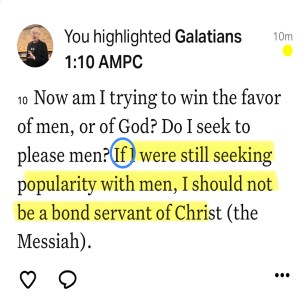
Now am I trying to win the favor of men, or of God? Do I seek to please men? If I were still seeking popularity with men, I should not be a bond servant of Christ (the Messiah). —Galatians 1:10 AMPC
Trying to please men ultimately becomes a lose-lose attempt.
First, people are fickle and I cannot please all of them all of the time. Second, in attempting to please some people I would have to compromise the truth of the Bible.
The only favor I should seek is the One who saved me and sent me. It is Christ’s voice alone that I long to hear say, “Well done, good and faithful servant.”
Listen to the podcast of this post by clicking on the player below, and you can also subscribe on Apple, Spotify, or Audible.
The apostle Paul had spent 18 months living and teaching in Corinth, he had likely visited them at least a couple of times, he had written two letters to them, and his associates had visited Corinth on his behalf. Bottom line: The Corinthians knew Paul well.
With that in mind, Paul boldly states, “Now this is our boast: Our conscience testifies that we have conducted ourselves in the world, and especially in our relations with you, with integrityand godly sincerity” (2 Corinthians 1:12).
Integrity means “the virtue of one who is free from pretense and hypocrisy.” Some biblical translations use the word holiness here. Indeed, for Christians integrity and holiness should be synonymous. The conclusion of this verse goes on to state that Paul could live this way “not according to worldly wisdom but according to God’s grace.” Paul knew that even more than the Corinthians, God knew Paul’s holy integrity.
Paul also says that his conduct was with godly sincerity. You might think that the idea of sincerity or mental honesty is implied in the word integrity, but godly sincerity is a pureness that stands up to intense scrutiny. It’s not just a public act, but it is a consistently God-honoring way of living both publicly and privately.
These two qualities give a godly leader moral authority like nothing else can. It’s authority that is felt as well as seen—it’s the “It Factor” that marks the Holy Spirit’s anointing on a leader.
Paul is aware that his lifestyle could cause people to think well or to think poorly of the Gospel of Jesus. Just a few verses later, Paul uses the phrase “yes and no” twice (vv. 18-19).
First, Paul reminds the Corinthians that he doesn’t “in the same breath say both ‘Yes, yes’ and ‘No, no.’” This means he doesn’t want his lifestyle to negate his preaching.
Second, Paul wants to assure them that all of the promises of God are “‘Yes’ in Christ” (v. 20). He knows that a preacher who lives contrary to his preaching—whose walk doesn’t align with his talk—is not only a hypocrite before God, but a stumbling block to all who have put their faith in Jesus as a result of that preacher’s message.
Integrity and godly sincerity are absolutely essential for those who proclaim the Gospel.
Godly leaders must be vigilant. They must be ruthless with themselves so there isn’t even the slightest lapse of integrity. Any infractions in a leader’s integrity and godly sincerity could cause others to doubt that Christ’s “Yes” is truly a trustworthy “Yes.”
May we all live in such a way that we, like Paul, can stand before those who know us best and assuredly say, “I have lived with all integrityand godly sincerity before both God and you!”
Listen to the podcast of this post by clicking on the player below, and you can also subscribe on Apple, Spotify, or Audible.
Watermelon is a great summer treat. However, sometimes a nice green exterior can hide rotten fruit on the inside. When this happens we don’t say, “Well, at least the outside was nice,” but we throw the whole thing out! We can fall into a similar trap in our leadership, focusing on creating a great exterior while we let our vital interior development rot away. In this episode, Greg and I encourage you to focus first on your internal development, and through that your external image will improve as well.
[0:59] A lot of leaders are more interested in what’s on the outside than what’s on the inside.
[1:39] Why do leaders naturally gravitate to making the outside look better than the inside?
[4:10] Greg wonders if perhaps we enhance our exterior because we’re afraid to be vulnerable.
[5:25] If you have to tell people you’re a leader you’re probably not
[6:40] Greg and I discuss a list of things we usually recognize, alongside the things we should equally recognize
[6:48] 1. Talents and gifts alongside integrity and character.
[19:35] If we ignore the inside stuff what’s the inevitable result?
[20:51] Greg likes to ask the question, “What’s new?” as a simple way to assess growth in others.
[21:50] I share a discovery from my Bible reading in Romans.
[23:03] Greg tells a cautionary tale about a former coworker who didn’t know how to engage in deeper conversation with his team.
[24:24] “The best mirror is in a good friend’s eye.” Greg and I would love to be this good friend for you. Reach out to us at here if you’re interested in personalized coaching.
Check out this episode and subscribe on YouTube so you can watch all of the upcoming episodes. You can also listen to our podcast on Spotify and Apple.
Listen to the podcast of this post by clicking on the player below, and you can also subscribe on Apple, Spotify, or Audible.
Far too many leaders spend more time making sure things look good on the outside than they do addressing whether things are good on the inside. Of course, I’m talking about issues like character, and humility, and servant-mindedness.
Greg and I addresses this on a recent episode of our leadership podcast The Craig and Greg Show.
Listen to the audio-only version of this podcast by clicking on the player below, or scroll down to watch the video.
Have you thought about what you’d like said at your funeral? Stick with me here, this isn’t an episode about contemplating your death. In this episode, Greg and I want to encourage you to begin with the end in mind, and live as the type of leader that you picture yourself being remembered as.
[0:15] Hang with us on this one: We’d like you to take a moment to think about your funeral.
[3:15] We could think of our own epitaph like we’re building a house.
[4:14] Greg asks me what I would like on my epitaph.
[6:00] We aren’t talking about planning our funeral, but about doing lasting and beneficial things with “the dash” between our birth date and our death date.
[9:20] There is a leadership caution when we’re thinking about this topic.
[10:21] Greg has been thinking about one word that could sum up his life.
[13:31] Here’s what we need to live for today.
[15:41] I give an example of someone whose character and reputation didn’t align.
[18:09] I brag on something special Greg does for others.
[20:54] How do leaders get beyond themselves?
[24:05] We need to be living our leadership story every single day.
Check out this episode and subscribe on YouTube so you can watch all of the upcoming episodes. You can also listen to our podcast on Spotify and Apple.
Listen to the podcast of this post by clicking on the player below, and you can also subscribe on Apple, Spotify, or Audible.
Good leaders hold themselves—at a minimum—to the same standard for the rest of their team. But the best leaders hold themselves to an even higher standard.
Check out this humorous story that makes this point so clear.
Check out this full conversation Greg and I had on an episode of The Craig and Greg Show called “Be honest with yourself.”
Listen to the audio-only version of this podcast by clicking on the player below, or scroll down to watch the video.
Honesty is a vital part of a successful organization, something that every good leader is well aware of. However, when was the last time you asked the question, “Am I being honest with myself?” In this episode, Greg and I unpack how honest self-reflection is a powerful tool to help improve your leadership.
[0:14] A challenging quote to kick off this episode.
[1:14] My breakthrough moment regarding my own self-assessment.
[3:37] What’s the difference between who I think I am and who I really am?
[6:00] We all operate with certain assumptions about ourselves.
[7:37] We share some good and bad experiences with interactions we have observed from other leaders.
[10:27] Leaders need to hold themselves to the same standards as the rest of their team.
[13:47] Why do leaders hesitate to self-evaluate?
[15:19] How do leaders create a safe environment to self-evaluate?
[18:45] Greg sends us down a rabbit trail!
[19:53] What does leadership integrity look like?
[22:17] Leaders need to know what their tendencies are.
Check out this episode and subscribe on YouTube so you can watch all of the upcoming episodes. You can also listen to our podcast on Spotify and Apple.
Romans 8:28 tells us that God uses ALL things to accomplish His purpose for our lives. Too many times I tried to rush through things without getting anything out of it. I have lots of new content every week, which you can check out on my YouTube channel.
He is 98 years old and he’s still busy serving other people! I pray we can all be as selfless and vibrant in ministering to others until the day God calls us home.
“When with an eye of faith we behold Christ crucified we ought to weep, not for Him, but for ourselves. We must not be affected with the death of Christ as with the death of a common person whose calamity we pity, or of a common friend whom we are likely to part with. The death of Christ was a thing peculiar; it was His victory and triumph over His enemies; it was our deliverance, and the purchase of eternal life for us. And therefore let us weep, not for Him, but for our own sins, and the sins of our children, that were the cause of His death; and weep for fear (such were the tears here prescribed) of the miseries we shall bring upon ourselves, if we slight His love, and reject His grace, as the Jewish nation did, which brought upon them the ruin here foretold.” —Matthew Henry, on Jesus’ word, “Do not weep for Me” in Luke 23:28
J. Warner Wallace shares three responses Christians can give to those who make the claim that Jesus didn’t think He was God. In this video, Detective Wallace talks about a section of his website that gives further evidence. You can find that section here.
The Institute for Creation Research is a group of scientists explaining how science points to a Creator. What does Creation have to do with Easter? “Any view of Christianity that incorporates long ages of death and suffering before Adam makes a sham of the Cross. This Easter season, as we remember our salvation made possible by the death of our Lord Jesus Christ on the Cross and His triumphant resurrection from the grave, let us understand it within the ‘big picture’ of a ‘very good’ creation that was ruined by our rebellion but restored by the willing sacrifice of our great Creator-Savior.”
“One measure of the greatness of a man is not only that he practices what he preaches, but also that he doesn’t consider himself above the ordinary means of grace that all Christians need.” —John Piper
“Beware of idleness—satan sows most of his seed in fallow ground.” —Thomas Watson
He turned to God and the people put away their idols <or>
He turned from God and the people turned to their idols
It’s true: As goes the leader, so go the people.
In my life, I’ve experienced that the good things that I do over-the-top are only moderately emulated by those around me. But the unhealthy things that I even slightly indulge in are adopted quickly by everyone else.
Godly leaders must be so aware of how their example impacts everyone around them, and they must fight to maintain biblical standards. When we miss the mark, we must be quick to admit our shortcoming, repent, and get back on track.
In Hosea 4:9, God warns that the people will follow the ungodly example of their leaders, which is why God’s punishment is often more severe for those leaders.
On the positive side, in Leviticus 9, Moses and Aaron demonstrate the leadership example of spending time in God’s presence and fully obeying everything God had revealed to them there. Then verse 23 it says that after they came out of His presence, God’s glory appeared to all the people. The positive example of the leaders led to huge blessings for all the people!
A mark of a godly leader is one who increasingly aware of the power of his example.
Leaders, let’s be first to go first in…
…being in God’s presence
…obeying God’s commands
…repenting when we fall short
…asking forgiveness of those who have seen our poor example
…asking God to bless His people because of our good example
This is part 77 in my series on godly leadership. You can check out all of my posts in this series by clicking here.
Listen to the podcast of this post by clicking on the player below, and you can also subscribe on Apple, Spotify, or Audible.
If we are wise, we can learn invaluable leadership lessons even from those who fell short in their attempts. For example, consider Lot, the nephew of Abraham.
Lot was found “sitting at the gate” in Sodom. This was a place of leadership, the place where legal and business matters were discussed. That means Lot appeared to be accepted by the townsfolk (see Genesis 19:1-14).
But that also means Lot had compromised his values.
Lot didn’t walk right into this leadership role. The Bible tells us how Lot first lived in the vicinity of Sodom and Gomorrah, but then steadily moved closer and closer to the city, until eventually he compromised his values enough to be accepted into a civic leadership position.
Lot obviously did not live or speak according to God’s righteous standards because when he attempted to appeal to a depraved mob of Sodomites, they ridiculed him, reminding him that he was not one of them. And then when Lot tried to warn his future sons-in-law (men who were also Sodomites) about God’s impending judgment on the city, they only laughed at him.
Jesus warned us, “Woe to you when all men speak well of you, for so did their fathers to the false prophets” (Luke 6:26).
The Sodomites spoke well of Lot when he was in the city gate, going along with them, not standing up for righteousness.
So too for us: People of the world will appear to be your friend as long as you don’t make them uncomfortable by standing up and speaking up for the truth. As soon as Lot tried to stand for God, the Sodomites showed him their true colors.
On the other hand, look at the examples of Joseph, Mordecai, Esther, Daniel, and Nehemiah to see righteous people who didn’t compromise their commitment to God’s ways in order to achieve a leadership position in earthly governments. Instead, their righteousness was blessed by God, and He gave them favor.
Ironically, Lot compromised God-honoring values to try to earn favor with men, and in the end, lost favor with them. Those other godly leaders resolutely stood for God regardless of what anyone may have said about them and God gave those leaders favor with men.
A mark of an ungodly leader is one who compromises godly values to gain a leadership status in the world’s eyes.
This is part 76 in my series on godly leadership. You can check out all of my posts in this series by clicking here.

















 Craig T. Owens