[VIDEO] John Maxwell has a great word for leaders: Don’t.
“God is very careful to whom He speaks. It is only to those who value His voice so much that they shut out the whole world to get alone and wait for Him.” Read more from David Wilkerson on prayer in his post It’s Time To Close The Door.
“We who follow Christ are men and women of eternity. We must put no confidence in the passing scenes of the disappearing world. We must resist every attempt of satan to palm off upon us the values that belong to mortality. Nothing less than forever is long enough for us.” —A.W. Tozer
“Because divorce runs so rampant even in the church, it makes sense that we tend to overcompensate by emphasizing marriage more than Scripture does. But by doing so, we may be hurting marriages rather than mending them.” See what Francis Chan has to say about Marriage On The Edge Of Eternity.
“He will be the best Christian who has Christ for his Master, and truly follows Him. Some are disciples of the church, others are disciples of the minister, and a third sort are disciples of their own thoughts; he is the wise man who sits at Jesus’ feet and learns of Him, with the resolve to follow His teaching and imitate His example. He who tries to learn of Jesus Himself, taking the very words from the Lord’s own lips, binding himself to believe whatsoever the Lord hath taught and to do whatsoever He hath commanded—he I say, is the stable Christian.” —Charles Spurgeon
“I have learned…that the Lord can fill the soul with Himself, when He takes away what seemed indispensable to our happiness on earth.” —Andrew Bonar
“In a day of endless distraction and diversion, there is no greater remedy for our clouded heads and hectic lives than the sober mind of Christ.” Read more in this post: Finding A Level Head In A Hectic World.
“Prayer really is simple. Resist the urge to complicate it. Don’t take pride in well-crafted prayers. Don’t apologize for incoherent prayers. No games. No cover-ups. Just be honest—honest to God. Climb into His lap. Tell Him everything that’s on your heart. Or tell Him nothing at all. Just lift your heart to heaven and declare, ‘Father … Daddy.’ Stress. Fear. Guilt. Grief. Demands on all sides. And all we can summon is a plaintive, ‘Oh, Father.’ If so, that’s enough. Your heavenly Father will wrap you in His arms!” —Max Lucado
“The time for speaking seldom arrives, the time for being never departs.” —George MacDonald
“The Word of God ignores size and quantity and lays all its stress upon quality. Christ, more than any other man, was followed by the crowds, yet after giving them such help as they were able to receive, He quietly turned from them and deposited His enduring truths in the breasts of His chosen 12.” —A.W. Tozer
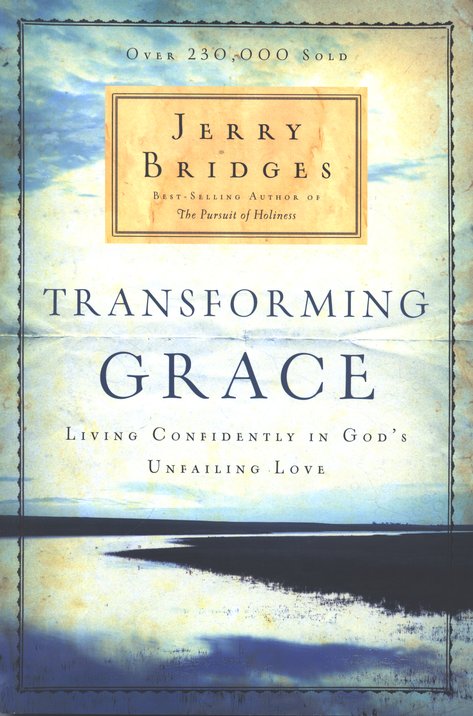
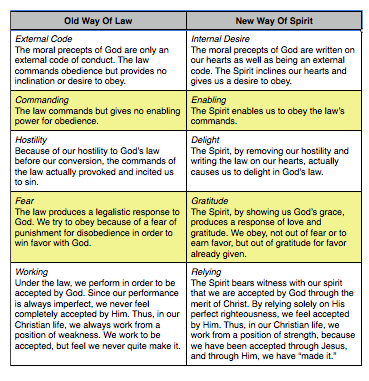
Jerry Bridges wrote a book that was an eye-opener for me called Transforming Grace. I’ve shared a couple of other posts with quotes from this book (you can read them by clicking here and here), but these quotes zero-in on the battle some people have in their minds between law and grace.
“Under a sense of legalism, obedience is done with a view to meriting salvation or God’s blessing on our lives. Under grace, obedience is a loving response to salvation already provided in Christ, and the assurance that, having provided salvation, God will also through Christ provide all else that we need.”
(click for a larger view)
You can download a PDF version of this chart here → Law and Grace ←
“Do you view God’s moral precepts as a source of bondage and condemnation for failure to obey them, or do you sense the Spirit producing within you an inclination and desire to obey out of gratitude and love? Do you try to obey by your own sheer will and determination, or do you rely on the Spirit daily for His power to enable you to obey? Do you view God as an ogre who has set before you an impossible code of conduct you cannot keep, or do you view Him as your divine Heavenly Father who has accepted you and loves you on the basis of the merit of Christ? In other words, in terms of your acceptance with God, are you willing to rely solely on the finished perfect work of Jesus, instead of your own pitifully imperfect performance?”
“We are much more concerned about someone abusing his freedom than we are about his guarding it. We are more afraid of indulging the sinful nature than we are of falling into legalism. Yet legalism does indulge the sinful nature because it fosters self-righteousness and religious pride. It also diverts us from the real issues of Christian life by focusing on external and sometimes trivial rules.”
“That is the way a lot of manmade ‘dos and don’ts’ originate. They begin as a sincere effort to deal with real sin issues. But very often we begin to focus on the fence we’ve built instead of the sin it was designed to guard against. We fight our battles in the wrong places; we deal with externals instead of the heart. … For all of us, it may be good to have some fences, but we have to work at keeping them as just that—fences, helpful to us but not necessarily applicable to others. … I’m not suggesting you jump over fences just to thumb your nose at the people who hold on to them so dearly. We are to ‘make every effort to do what leads to peace and mutual edification’ (Romans 14:19). Use discretion in embracing or rejecting a particular fence. But don’t let others coerce you with manmade rules. And ask God to help you see if you are subtly coercing or judging others with your own fences.”
“Spiritual disciplines are provided for our good, not for our bondage. They are privileges to be used, not duties to be performed. … I do think we should actively promote spiritual disciplines. They are absolutely necessary for growth in our Christian lives. And since ours is a largely undisciplined age, many believers are losing out on the benefits of those disciplines that could help them grow to maturity in Christ. But we should promote them as benefits, not as duties.”
You can read my full book review of Transforming Grace by clicking here.
“No man is worthy to succeed until he is willing to fail. No man is morally worthy of success in religious activities until he is willing that the honor of succeeding should go to another if God so wills.” —A.W. Tozer
“Prayer is not a privilege for the pious, nor the art of a chosen few. Prayer is simply a heartfelt conversation between God and His child. When we invite God into our world, He brings a host of gifts: joy, patience, resilience.” —Max Lucado
“If evangelical Christianity is to stay alive it must have men again—the right kind of men. It must repudiate the weaklings who dare not speak out, and it must seek in prayer and much humility the coming again of men of the stuff of which prophets and martyrs are made.” —A.W. Tozer
“Heaven will solve our problems, but not, I think, by showing us subtle reconciliations between all our apparently contradictory notions. The notions will all be knocked from under our feet. We shall see that there never was any problem.” —C.S. Lewis
“I believe the biggest reason why families are being redefined today is not because of liberal vs. conservative ideology. It’s because we had to embrace a new ‘community’ when the nuclear family exploded. Traditional families have been broken, yet people still want to be in a ‘family,’ even if it’s temporary. Sadly, this family thing often fails. Whether in a home, a team, a dorm, a company, a gym or a church, we tend to walk away rather than work at difficult relationships. We’re like porcupines—we tend to hurt each other when we get close.” Read more of the outstanding post from Tim Elmore: How Eating Alone Costs More Than You Think.
“According to some research, over half of women who have abortions do so under pressure, while those who resist can face violence and death. …The Center for Disease Control lists homicide as a leading cause of death among pregnant women.” Here are more facts contradicting the pro-abortion crowd’s rhetoric.
“This is the wisdom of God: Purchase the day! Purchase the hour! Purchase the moment! Spend whatever it takes to buy each hour and harness it in the chariot of your highest, eternal goal—the glory of God.” —John Piper
“Yet let the love of righteousness suppress this thirst for ambitiousness…. For this is a great enemy to our faith, if the desire of glory have more room in our hearts than he fear or love of our God….” —Augustine
“No, there is no merit in late hour prayers, but it requires a serious mind and a determined heart to pray past the ordinary into the unusual.” —A.W. Tozer
“In times of extraordinary crisis ordinary measures will not suffice. The world lives in such a time of crisis. Christians alone are in a position to rescue the perishing. We dare not settle down to try to live as if things were ‘normal.’ Nothing is normal while sin and lust and death roam the world, pouncing upon one and another till the whole population has been destroyed.” —A.W. Tozer
“I want you to know how to study theology in the right way. I have practiced this method myself. … The method of which I am speaking is the one which the holy king David teaches in Psalm 119. … Here you will find three rules. They are frequently proposed throughout the psalm and run thus: Oratio, meditatio, tentatio [prayer, meditation, trial]. …
“You should completely despair of your own sense and reason, for by these you will not attain the goal. … Rather kneel down in your private little room and with sincere humility and earnestness pray God through His dear son, graciously to grant you His Holy Spirit to enlighten and guide you and give you understanding. [Psalm 119:18, 27, 33, 34-37]. …
“Second, you should meditate. This means that not only in your heart but also externally you should constantly handle and compare, read and reread the Word as preached and the very words as written in Scripture, diligently noting and meditating on what the Holy Spirit means. … Therefore, you observe how in this psalm David always says that he will speak, think, talk, hear, read, day and night and constantly—but about nothing else than God’s Word and Commandments. For God wants to give you His Spirit only through the external Word. [119:11, 15, 48, 24, 47, 93, 97] …
“Third, there is the tentatio, the trial. This is the touchstone. It teaches you not only to know and understand, but also to experience how right, how true, how sweet, how lovely, how mighty, how comforting God’s Word is: it is wisdom supreme. This is why you observe that, in the psalm indicated, David so often complains of all sorts of enemies. … For as soon as God’s Word becomes known through you, the devil will afflict you, will make a real [theologian] of you.” [119: 67-68, 71] —Martin Luther, on the 119th Psalm
“Christians are priests, but how priests if they offer no sacrifice? Christians are lights, but how are they lights unless they shine for others? Christians are sent into the world, even as Christ was sent into the world, but how are they sent unless they are sent to pray? Christians are meant not only to be blessed themselves, but in them shall all the nations of the earth be blessed, but how if you refuse to pray?” —Charles Spurgeon
“Reason does not know that salvation must come down from above; we want to work up from below so that the satisfaction is rendered by us.” —Martin Luther
“No matter the society or culture, the city or town, God has never lacked the power to work through available people to glorify His name.” —Jim Cymbala
“Commend me to the Christian who says, ‘I bless God I am saved; now what can I do for others?’ The first thing in the morning he prays, ‘God help me to say a word to some soul this day.’ During the day, wherever he may be, he is watching his opportunity, and will do good if he can.” —Charles Spurgeon
“There’s a great deal of trust in the love of God, and a great deal of love in the trust of God.” —John Piper
On the Biblegateway website, Jacob Edson has taken my chart and added even more details and cross-references to related Scriptures for each of the kings on this chart.
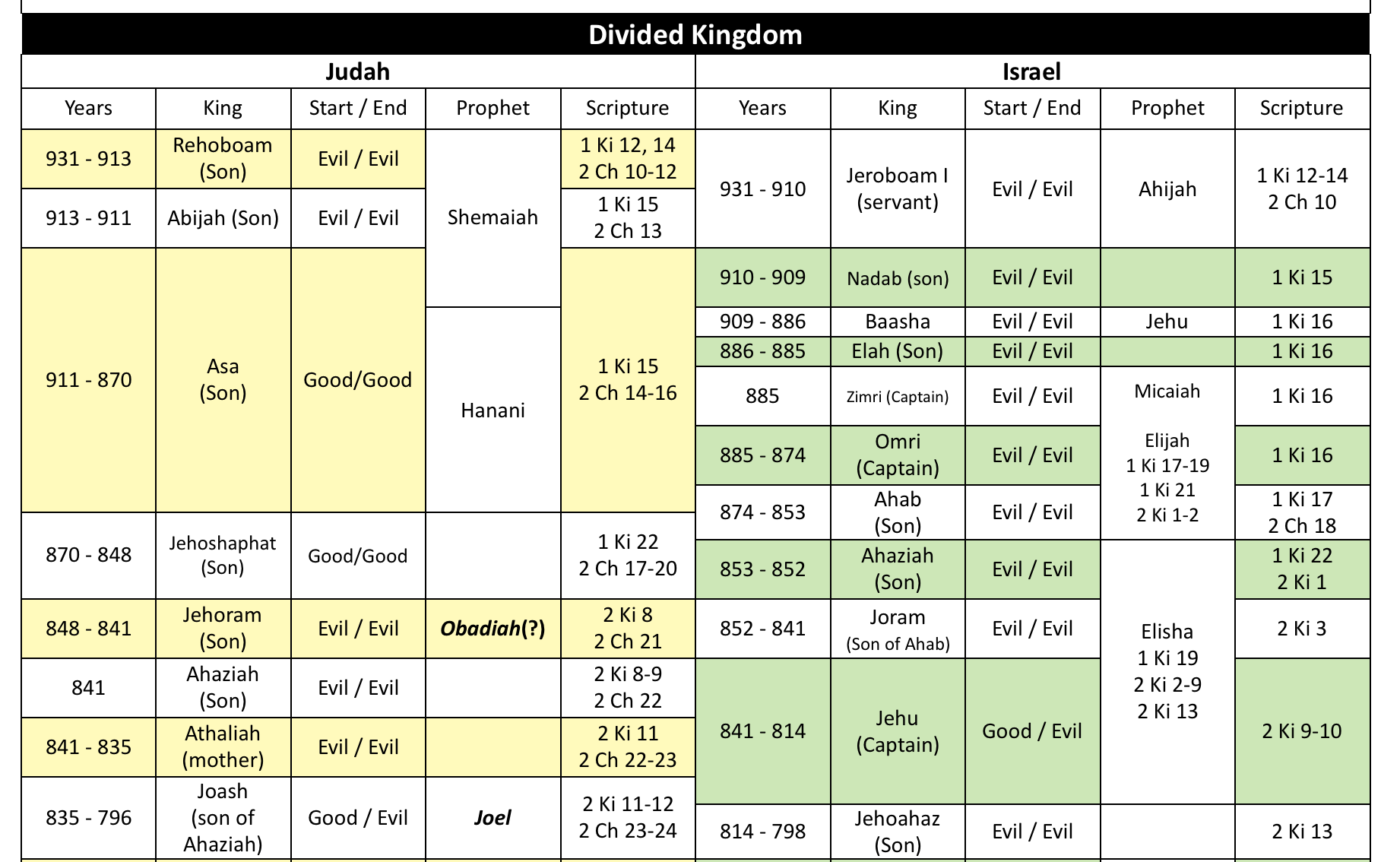
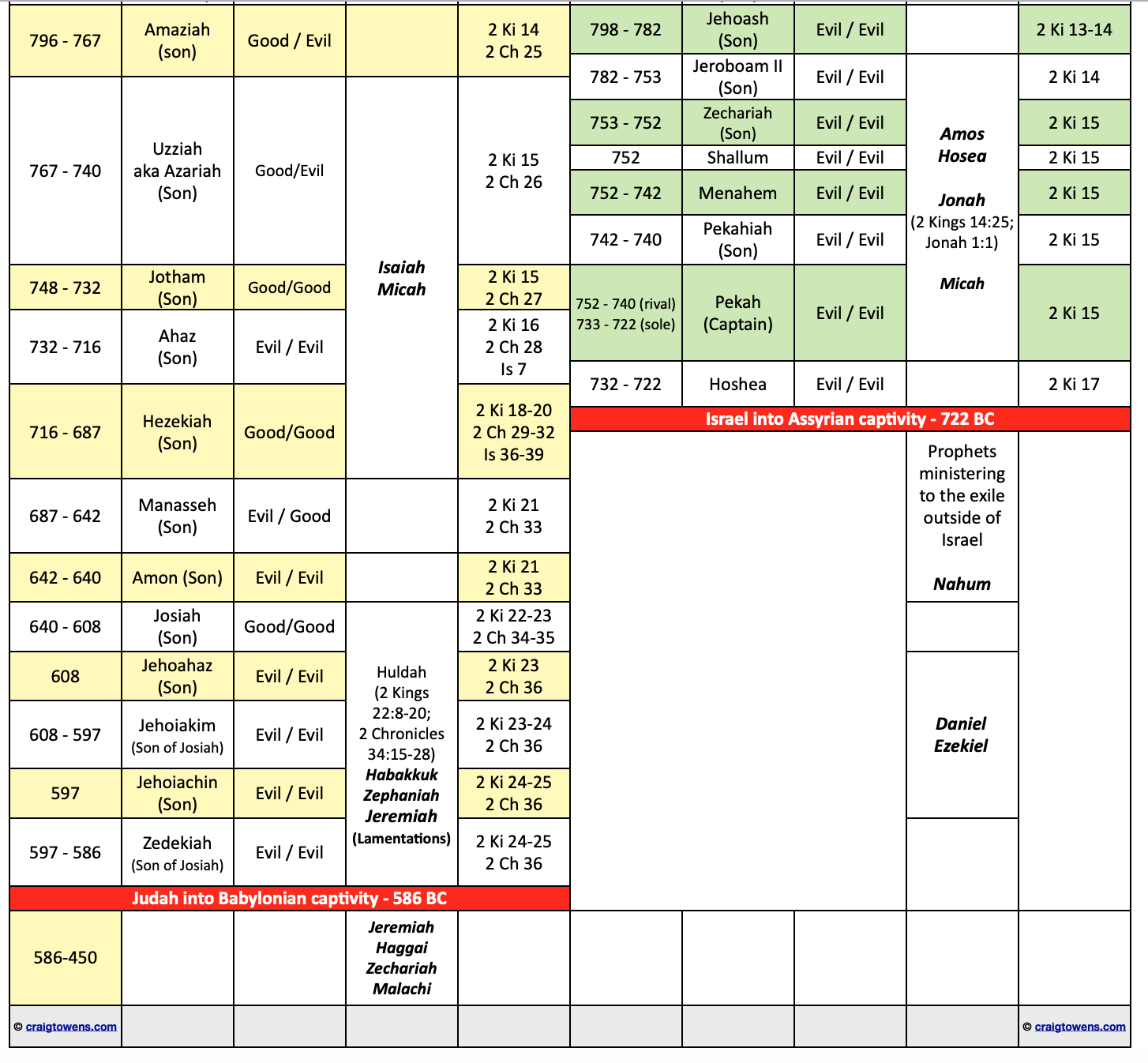
One challenging point in history is the divided kingdoms of Israel (the 10 northern tribes) and Judah (the 2 southern tribes). What makes it challenging when reading straight through the Bible is the history is covered in 1 and 2 Kings and then again in 1 and 2 Chronicles. In the midst of these kingdoms, several prophets are sent by God. Some of these prophets only have their words recorded in Kings or Chronicles, while others have their words recorded elsewhere in the Bible (usually the book name is the prophet’s name).
In trying to keep all of these people and messages clear in my mind, I have put together a list of all the kings and prophets during the period of the divided kingdom (roughly 931-586 BC).
You can click the picture above to get a larger view, or you can download a PDF copy by clicking here → Kings of Israel & Judah ←
I am not a biblical scholar, nor do I have a history degree. This is just a chart I put together to help me in my Bible reading, and I thought it might help someone else too. I would welcome any corrections or clarifications that anyone would offer on this humble work.
Not all of these updates are reflected in the screenshots on this page, but they are all in the PDF version.
**UPDATE 1: several people pointed out some tweaks I needed to make to this chart, and I am grateful for the input! This is the revised copy as of August 28, 2017.
**UPDATE #2: a few more tweaks … this is the revised version as of July 31, 2014.
**UPDATE #3: I have posted a chart zooming in on the chronology of the Old Testament prophets which I recreated from the Archeological Study Bible. You can read it and download it by clicking here.
A couple of notes:
Prophets who also have their words recorded in a book that bears their name are listed in bold italics.
The “start / finish” designation for each of the reign of the kings is clearly my subjective opinion.
Sometimes you will see dates for two kings’ reigns that overlap. These are where there was a co-regency (that is a father and son ruling simultaneously).
The prophets that are listed under the Israel side after Israel had gone into captivity are the prophets that God was using to speak to the Israelites in exile.
**UPDATE #4: I continue to do more research and get feedback from people far wiser than me. The latest version is dated August 28, 2017.
**UPDATE #5:The original chart stopped when Israel and Judah went into captivity. I have now added another line to show the prophets who continued to prophesy to both the exiles in Babylon, as well as to those who returned to Israel later.
**UPDATE #6: Scholars are unsure of the date of Obadiah. We know that it took place after invaders had caused problems in Judah (Obadiah 11)—and Edom responded in a way that angered God. Some scholars place this date after Nebuchadnezzar’s conquest of Judah in 586 BC, but since post-exilic prophets always named Nebuchadnezzar or Babylon, I think it’s more likely to have occurred during the reign of Jehoram around 840 BC (see also 2 Chronicles 21:8-10). Added Huldah as a prophetess during the reign of Judah’s King Josiah.
**UPDATE #7: Thanks to Anthony Wimmer, this chart is now available in French → Rois d’Israel & Juda
**UPDATE 8: I am always appreciative of the interaction with those who have downloaded my chart and are digging into the dates. After a few conversations, I have modified the chart slightly on the lower right quadrant of the last page to show those prophets who were ministering to the Israelites who were in captivity.








 Craig T. Owens