Don’t Quit

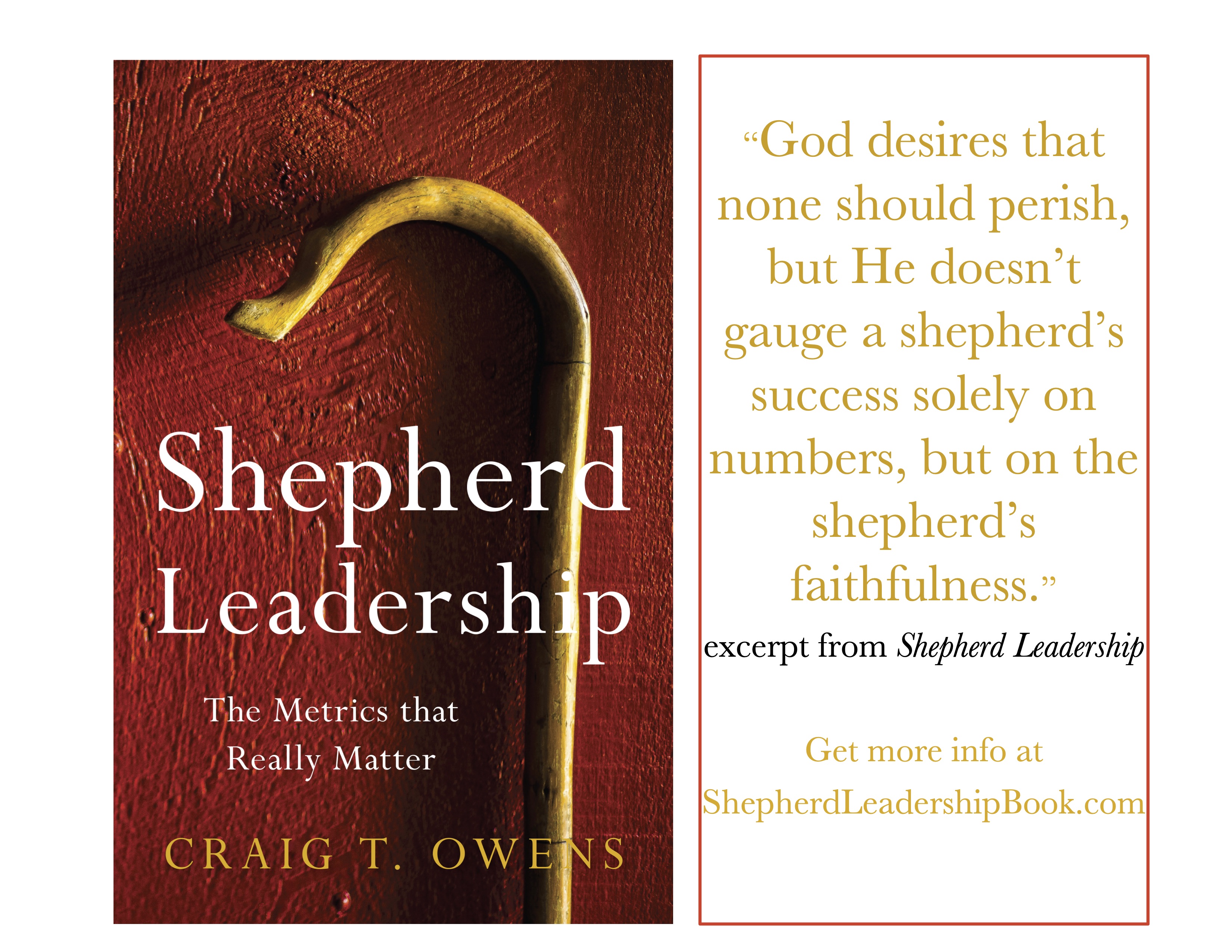
Easy roads teach us very few valuable lessons. In my book Shepherd Leadership: The Metrics That Really Matter, I talk about how the Holy Spirit uses our challenging times to develop the leadership qualities that are necessary for us to grow. 

My friend, let me encourage you with two words: Don’t quit. If God has called you to your position of leadership, He will also train you to be successful. I really believe the principles I share in my book will help you, and I hope you will pick up a copy soon.

Abiding In God’s Omnipresence

Listen to the podcast of this post by clicking on the player below, and you can also subscribe on AppleSpotify, or Audible. 

Why do Christians say things like, “Let’s go to church” or “Let’s go meet with God”? 

Do we forget that Jesus said He would never leave us, or that He sent the Holy Spirit to be our constant Companion, or that our very heart is the temple of God’s presence (Matthew 28:20; John 14:16; 1 Corinthians 3:16)? We are naturally self-focused creatures. It takes discipline on our part to keep reminding and re-reminding ourselves that God is always with us. 

Psalm 84 and its two Selahs is one way of re-reminding ourselves of God’s abiding presence. The Selahs are reminders to pause and consider, “Where am I?” and to know that the answer can always be, “Surely I am in God’s presence!” 

This psalm is divided into three 4-verse stanzas. Stanzas 1 and 2 end with the call to Selah, and all three stanzas feature a powerful name for God: LORD Almighty. When we see LORD in all capital letters, that is God’s covenant name: Yahweh or Jehovah, which means that He is the “I AM that I AM.” Almighty signifies that He is the invincible, un-defeatable Captain of angel armies. 

In these two combined titles, we have the personal intimate God of love and the unstoppable God of limitless power! If He were just the God of love, we may not be able to trust His power. If He were just the God of power, we may not be able to approach Him. He is the All-Loving, Ever-Approachable Power. 

Another important recurring theme in Psalm 84 is the word blessed. It’s used three times in this psalm, more than in any other single psalm. This word means God’s unmerited favor, and the word either begins or ends each of the three stanzas.  

In stanza 1 (vv. 1-4), twice we have that combined title of LORD Almighty. But we must always remember that our God is not distant and unapproachable, but the sons of Korah call Him “my King” and “my God.” At the end of this first stanza, we are invited to Selah—a pause to praise our glorious King! 

Stanza 2 (vv. 5-8) begins with that reminder that we are blessed. The psalmists tell us that God’s blessings flow even in my Valley of Baca (or weeping). With God’s presence surrounding me, I can go fromstrength to strength” because the LORD Almighty hears my prayer and responds to my prayer! So at the end of this stanza, we are again invited to Selah—this time it’s a pause to pray to our listening God. 

In stanza 3 (vv. 9-12), another important word is featured that reminds us that our God is not a stingy King, but One who delights in His children and wants to lavishes them with His blessings: the word is favor. We read, “look with favor on Your anointed one” and “the LORD bestows favor and honor; no good thing does He withhold from those whose walk is blameless.” God’s favorable blessings flow toward us as eternally as He exists! 

This psalm is circular: it begins as it ends, so it invites us to continue to praise, continue to pray, and continue to abide in His presence. We’re called not just to know about God’s presence, but to rejoice in His presence. 

It’s one thing to know about God’s omnipresence, but it’s an entirely different thing to abide in God’s omnipresence! 

This isn’t something that happens overnight. Brother Lawrence reminds us that this is a progressive revelation for Christians: “One does not become holy all at once. … The more one knows Him, the more one desires to know Him. And as knowledge is commonly the measure of love, the deeper and more extensive our knowledge shall be, the greater will be our love: and if our love of God were great we should love Him equally in pains and pleasures.” 

I encourage you to Selah frequently so that you can move from mere head knowledge of God’s presence to becoming intimately aware of His closeness! 

If you’ve missed any of the messages in our series looking at the Selahs in the Psalms, you may find the full list by clicking here. 

►► Would you please prayerfully consider supporting this ministry? ◀︎◀︎

My Theme Song

Listen to the podcast of this post by clicking on the player below, and you can also subscribe on AppleSpotify, or Audible. 

… my hands … my mouth … my lips … my heart … my head … my words … my eyes … (Psalm 141) 

David’s all-in attitude toward God reminds me of the words of Jesus: Love the Lord your God with all your heart and with all your soul and with all your mind and with all your strength (Mark 12:30). 

Clearly, David wants God to have full access—no part of his life is exempt from God’s lordship:

  • hands lifted in worship
  • mouth and lips free from ungodly words 
  • heart not drawn to unrighteousness 
  • head receptive to godly correction 
  • words always well-spoken and God-pleasing 
  • eyes fixed steadfastly on God 

This is also what the Holy Spirit wants to do for me in the process of sanctification: Bringing me into the place where no part of my life is exempt from His lordship. This reminds me of the words of an old hymn, “All to Jesus I surrender, all to Him I freely give.” 

May this ever be the theme song of my life! 

►► Would you please prayerfully consider supporting this ministry? ◀︎◀︎

Thursdays With Spurgeon—A Word To Preachers

This is a weekly series with things I’m reading and pondering from Charles Spurgeon. You can read the original seed thought here, or type “Thursdays With Spurgeon” in the search box to read more entries.

Listen to the podcast of this post by clicking on the player below, and you can also subscribe on iTunes or Spotify.

A Word To Preachers

I planted, Apollos watered, but God gave the increase. So then neither he who plants is anything, nor he who waters, but God who gives the increase. Now he who plants and he who waters are one, and each one will receive his own reward according to his own labor. For we are God’s fellow workers; you are God’s field, you are God’s building. (1 Corinthians 3:6-9) 

     Paul is a laborer, Apollos is a laborer, Cephas is a laborer, but not so much as a foot of the farm is Paul’s, nor does a single parcel of land belong to Apollos, or the smallest allotment to Cephas. ‘You are Christ’s, and Christ is God’s’ (1 Corinthians 3:23). The fact is that in this case the laborers belong to the land and not the land to the laborers, ‘for all things are yours: whether Paul or Apollos or Cephas’ (3:21-22). … 

     Brothers, a laborer may work very hard at a whim of his own and waste his labor, but this is folly! Some discourses do a little more than show the difference between a Tweedledum and Tweedledee, and what is the use of that? … 

     All God’s laborers must go to Him for their seed, or else they will scatter tares. All good seed comes out of God’s granary. If we preach, it must be the true word of God or nothing can come of it. … A sermon is vain talk and dreary word spinning unless the Holy Spirit enlivens it. … 

     Here we have mention of a personal service and a personal reward: ‘Each one will receive his own reward according to his own labor.’ The reward is proportionate, not to the success, but to the labor! Many discouraged workers may be comforted with that expression. You are not to be paid by results, but by endeavors.

From Farm Laborers

My dear preacher friend, God sees you. He has placed you in the field where He needs you to be, and He has given you the skills you need to have to labor for Him. Never doubt that! 

You may be the one breaking up hard ground, or the one sowing seed, or the one watering, or the one bringing in the harvest. Wherever you are and whatever you are doing, rely on the strength God gives you. He will illuminate His Word to your heart first so that you can share a timely word with those under your care. Then He will send the Holy Spirit to enliven all that you preach. 

God has given you the tools and skills, now you must diligently supply the effort. Don’t become discouraged by what seems to be a lack of “success.” As God tells us through Paul, He will reward your faithful labor in His field. 

My book Shepherd Leadership: The Metrics That Really Matter elaborates on this point. The thoughts in this book will remove from you the burden of trying to live up to any unbiblical metric of “success” in your ministry. I hope you will get a copy of this book! Check out ShepherdLeadershipBook.com for more details.

►► Would you please prayerfully consider supporting this ministry? ◀︎◀︎
Eternal

Listen to the podcast of this post by clicking on the player below, and you can also subscribe on AppleSpotify, or Audible. 

Psalm 119 is divided into twenty-two 8-verse segments, with each verse of the segments beginning with its own Hebrew letter. Lamedh is found in verses 89-96, and lamedh is the tallest of all the Hebrew letters, so that means it stands out. 

Lamedh shows us big proportions. Words like eternal, boundless, established, enduring, and forever are prominent in these eight verses. The psalmist is inviting us to climb up into God’s Word and get a bigger view, a higher vantage point of who God is. 

Consider the opening verse of this section: Your Word, O LORD, is eternal; it stands firm in the heavens. Eternal—think of the implications! If what God says—His Word—is eternal, then…

  • it continues through all generations (v. 90) 
  • it endures even when everything else fades away (vv. 90-91) 
  • it has no limits or frontiers (v. 96) 

At every single moment in my life, my eternal, enduring, limitless God knows the outcome or consequence of each option I could choose. His Word can so transform my mind that I can always choose the most Christ-glorifying option. The Spirit of Truth—my eternal Counselor—can guide me with God’s Word. 

I never have to be at a loss. I am never stumped. I always have access to eternal Truth. 

The psalmist got this: If Your law had not been my delight, I would have perished in my affliction (v. 92). 

Through God’s firmly-established Word I have—

  • Eternal Counsel 
  • Enduring Help 
  • Limitless Strength

And you have all of this, too, through God’s Word! 

Psalm 119 is a great place to start to make Bible reading a daily habit. Scientists tell us that you only need 21 days to make a new habit, and in Psalm 119 you have 22 days of daily reading that will transform your heart and mind. 

►► Would you please prayerfully consider supporting this ministry? ◀︎◀︎

Thursdays With Spurgeon—Sent To Show Jesus To The World

This is a weekly series with things I’m reading and pondering from Charles Spurgeon. You can read the original seed thought here, or type “Thursdays With Spurgeon” in the search box to read more entries.

Listen to the podcast of this post by clicking on the player below, and you can also subscribe on iTunes or Spotify.

Sent To Show Jesus To The World

And the glory that You gave Me I have given them, that they may be one just as We are One: I in them, and You in Me; that they may be made perfect in one, and that the world may know that You have sent Me, and have loved them as You have loved Me. (Jesus, in John 17:22-23)

     The essence and cause of the glory that the Father gave the Son was, first of all, that He endowed Him with the Holy Spirit. ‘God does not give the Spirit by measure. The Father loves the Son, and has given all things into His hand’ (John 3:34-35). The Holy Spirit descended upon our Lord in His baptism and abode upon Him so that in the power of the indwelling Spirit He lived, spoke, acted, and in all that He did, the Spirit of God was manifest. …  

     Now this glory, our Lord has given to all His disciples. Upon each true disciple, the Spirit of God rests according to his measure. If we have not the anointing to the fullest, it is either from lack of capacity or by reason of our own sin, for the Spirit of God is given to the saints—He dwells with us and will be in us always. My brothers and sisters, I would to God we realized this, that the glory of the Holy Spirit that was given to Christ is also given to us, so that it is ours to think, to feel, to speak, to act under His guiding influence and supernatural power! What are we apart from the Holy Spirit? How can we hope to convince even one man, much less the world, that God has sent His Son unless the Holy Spirit is with us? …  

     If men would see God, let them look at Jesus, for there is He to be seen! And with bated breath we add—let them look at Christ’s people, for there also is God revealed! It is the glory of the saints that they are the mirror of the divine character! … 

     Christ Jesus was sent to reveal the Father, sent to reclaim the wandering souls of men, sent to seek and to save the lost. And this is exactly what every true Christian is sent into the world to do. He is commissioned to reveal God in his every act and word. He is commissioned to win back rebellious hearts. He is commissioned to save the sons of men and bring them up out of the horrible pit into which their sins have cast them. …

     Jesus was the Son of God, and He overcame the world in the power of His Sonship. Now, this glory that the Father gave Him, He has given us, that we, too, may be accepted; that we, too, may have access; that we, too, may have prevalence in prayer; that we, too, may have the Spirit of Adoption; and that we, too, may trample upon sin and overcome the hosts of darkness. This is the glory that rests upon all the faithful!

From The Glory, Unity, And Triumph Of The Church

Jesus commissioned His followers to go into all the world as His witnesses, but He never intended for us to go in our own strength. As Spurgeon asked, “How can we hope to convince even one man, much less the world, that God has sent His Son unless the Holy Spirit is with us?” 

That’s why I always stress that Christians not be content with merely having received the salvation that comes with the forgiveness of their sins, but that they press on to be baptized in the Holy Spirit. It’s this empowerment that will allow us to be effective witnesses for Jesus.

Maturing Reactions

Listen to the podcast of this post by clicking on the player below, and you can also subscribe on Apple or Spotify.

Jesus lived out the example of wholly healthy growth. The way Dr. Luke records it, the pinnacle of Christ’s health (and our health too) is seen in our relationships with other people.  

Why is relational maturity at the peak of the pinnacle? How else could you know whether you truly have mental, physical, and spiritual health unless it’s put to the test? And the ultimate test is how we react when we’re caught off guard. Our so-called Freudian slips can reveal an area of immaturity. C.S. Lewis reminds us that the suddenness of the provocation that caused the slip didn’t create our immature response, but it actually revealed what is really inside our hearts. Surely our unplanned reactions are a better indicator of our spiritual maturity than our planned actions! 

Jesus told us that our “slips” reveal what’s really inside (Matthew 15:19), but are these really unknown to us? If we’re really honest, how many times do we think unpleasant things without saying them or doing them? The Holy Spirit—the Spirit of Truth—knows so well what’s on the inside (Psalm 139:1-4). 

When we experience one of these slip ups, the devil loves to pounce! Paul calls it “sin seizing an opportunity” (Romans 7:7-11). But even as sin pounces, Paul assures us, “Therefore there is no condemnation for those who are in Christ Jesus” (Romans 8:1). 

What is the “therefore” there for? After the “therefore” the Holy Spirit as the Spirit of Adoption reminds us we are in Jesus and children of God, and the Holy Spirit as the Spirit of Intercession help us pray perfect, childlike prayers. So what comes before the “therefore” must be something that makes us feel unworthy, distant, and condemned. 

Paul explains that “we died to sin” (Romans 6:2). That word “died” means to be separated from one thing which brings about the destruction of the other thing. When we are separated from God by our sin we are dead, when are separated from our sin by God we are alive. At that moment of salvation, we stand before Almighty God justified—just as if I’d never sinned. That is irrevocable: God will never go back on that, we will never slip away from His grace. But that moment of salvation also begins a lifelong process of sanctification—or as I like to say it saint-ification. 

Remember that pyramid of growth Jesus demonstrated for us? Paul says, “I myself in my mind am a slave (Romans 7:25). The mind is where the Spirit of Truth begins His maturing, saint-ifying process in us. As our minds are transformed, then our bodies and our mouths can live out a Christlike lifestyle (see Romans 12:1-2). It’s this mind and body transformation that matures our spiritual health, which is then revealed in our relationships with others.  

Notice that it is after we have been through this transformation of mind, body, and spirit that Paul tells us the standard for God-honoring living. This is where we see even our unplanned reactions becoming more and more Christ-like (Romans 12:9-21). We cannot live out this Romans 12 mandate solely on our own willpower. We aren’t trying to become self-made people, but instead, we are allowing the Holy Spirit to make us transformed saints. Transformed saints that are known by their unplanned Christlike reactions. 

This is why I keep stressing for Christians to not stop at salvation, but to press on to be baptized in the Holy Spirit. 

If you’ve missed any of the messages in our series We Are: Pentecostal, you can access the full list by clicking here.

►► Would you please prayerfully consider supporting this ministry? ◀︎◀︎

Two Perfect Prayers

Friends, I recently shared a message in which I talked about how the Holy Spirit helps us in our prayer life, specifically how the Spirit reminds Christians that we have been adopted into God’s family. 

In this clip from that sermon, I talk about the only two times that we can pray perfect prayers, and I make reference to two passages of Scripture: John 14:26 and Romans 8:26-27. Take a listen… 

The Spirit of Truth reminds us of everything God has said to us in His Word, and He helps us turn those promises into prayers (see John 14:26). 

The Spirit of Intercession gives us a prayer language unknown to our logical mind, whereby we pray in a language in which we have no control over the words being spoken (see Romans 8:26-27; 1 Corinthians 12:4-10). 

Only when we pray God’s Words directly back to Him, or when we pray in tongues as the Holy Spirit enables us, are we praying a perfect, unselfish, God-glorifying prayer.

►► Would you please prayerfully consider supporting this ministry? ◀︎◀︎

Powerful Childlike Prayer

Listen to the podcast of this post by clicking on the player below, and you can also subscribe on Apple or Spotify.

I was at a friend’s house and interacting with their two young children. Their son was very energetic and playful, but not very talkative. When the tikes climbed up to the kitchen counter for lunch, their mom asked them what they wanted to eat. The little girl placed her lunch order and then said, “He wants PB&J with milk.” I asked him, “Is that really what you want?” He smiled a big grin and nodded his head. Isn’t nice to have someone give us words when we are lacking in our own vocabulary? 

Last week we learned how the Spirit of Truth would help us speak truthful words to those who were antagonistic to the Good News of Jesus. If the Holy Spirit will do this when we are speaking to people who are enemies of the Cross of Christ, how much more so will He help us when we are speaking to our loving Heavenly Father! 

Here’s something we never have to doubt: God’s love for us. We don’t have to try to get our Father’s attention because He wants to lavish His love on us (Matthew 6:7-8; Luke 11:9-13; Ephesians 1:5). 

Jesus likens our coming to God as a child coming to its father. Sometimes we come with fears or tears, sometimes with hunger or thirst, or sometimes just to feel His closeness. The Holy Spirit is also called the Spirit of Adoption, and He loves to keep on reminding us how much our Father loves us (Romans 8:14-17). 

“When our perplexed spirit is so befogged and beclouded that it cannot see its own need and cannot find out the appropriate promise in the Scriptures, the Spirit of God comes in and teaches us all things and brings all things to our remembrance whatever our Lord has told us. He guides us in prayer and thus He helps our infirmity. … He will write the prayers that I ought to offer upon the tablets of my heart, and I will see them there and so I will be taught how to plead! It will be the Spirit’s own Self pleading in me and by me and through me before the throne of grace!” —Charles Spurgeon 

Our loving Father is not looking for well-polished prayers; He’s looking for real, childlike prayers. Let’s be honest: Not even the most educated person in the world has a vocabulary sufficient enough to accurately communicate with The Almighty God! So He wants us to come to Him in simple, childlike anticipation. Jesus reminded us, “Your Father knows the things you have need of before you ask Him.” Our Father wants to answer our prayers, and He has given us His Holy Spirit to help us pray in a way that He can answer (Romans 8:26-27). 

The Holy Spirit turns our tearful, childlike prayers into powerful, poetic prayers!

Don’t try to spruce up your vocabulary before you come to God in prayer. Just come to God in prayer, trusting that the Holy Spirit will make a beautiful prayer even out of your childlike groanings! The Holy Spirit turns our groans into prayerful poetry in our Father’s ears! 

If you’ve missed any of the messages in our series called We Are: Pentecostal, I’ve shared the complete list here.

►► Would you please prayerfully consider supporting this ministry? ◀︎◀︎

The Spirit Of Truth

Listen to the podcast of this post by clicking on the player below, and you can also subscribe on Apple or Spotify.

When I was 4 years old, I heard my echo for the first time as I yelled “Hello!” to a barn on the other side of a pasture. I was totally convinced that I had a friend in that barn yelling back to me, and I ended up being a bit disappointed later when I discovered that it was just my own sound waves bouncing back to me. 

To my 4-year-old brain, a little friend yelling back from the barn was absolutely true. It was maturity and new information that taught me differently. Isn’t this an ongoing story for all of us? Many things seem true from our current perspective, but then as we get older or smarter we realize that our original belief—what we really believed to be true—is now invalidated. 

Rarely does anyone admit, “I was immature back then,” but we usually try to justify ourselves by saying, “If I would have known back then what I know now….” But the fact is it will always be an impossibility for you to know then what you know now. 

In 1880, Edwin A. Abbott wrote Flatland, a favorite book of Albert Einstein. Abbott was a college-trained mathematician and theologian; in fact, he was actually better known for his theological writings than for this book. In this fabulous little book, Square, who lives in two-dimensional Flatland, cannot perceive height or depth. So what appears to him to be a wall, would merely be a line to you and me. One day Sphere from three-dimensional Spaceland visits Flatland, trying to explain to Square what his world was really like, but Square and his other Flatlanders could never fully grasp the idea. 

When Jesus was interviewed by Pilate, it sounds as though Pilate is missing a “dimension.” Pilate tries to state things the way that he understands them, but Jesus is revealing to him a whole new dimension (see John 18:33-38). The word Jesus uses for “truth” in this conversation means objective truth: something that is always true, regardless of where or when we live. Jesus explained that He as God IS objective truth. Any of our truth statements that aren’t grounded in God are subjective truth statements at best. 

Listen to how John describes Jesus: In the beginning—before all time—was the Word (Christ), and the Word was with God, and the Word was God Himself. He was continually existing in the beginning co-eternally with God. All things were made and came into existence through Him; and without Him not even one thing was made that has come into being. In Him was life and the power to bestow life, and the life was the Light of men. The Light shines on in the darkness, and the darkness did not understand it or overpower it or appropriate it or absorb it and is unreceptive to it. (John 1:1-5 AMP) 

Here’s the absolutely amazing thing: Jesus wants us to have this same insight into heavenly dimensions! Jesus said He would ask the Father to send us the Holy Spirit, Whom He called “the Spirit of Truth” (John 14:6, 16-17; 15:26; 16:12-13).

The Spirit of Truth…

  • …reminds us of the words of Jesus—John 14:26 
  • …helps us testify to others about the Truth—John 15:26-27 
  • …continually reveals objective truth to us—John 16:12-13 
  • …gives us truthful words to share with other “Flatlanders” who doubt the words of God—Matthew 10:16-20 
  • …and helps us spot and refute the falsehoods of the antichrist—1 John 2:18-27  

[Check out all of these Scriptures by clicking here.]

I love the King James Version of 1 John 2:20—But ye have an unction from the Holy One, and ye know all things. Being baptized in the Spirit of Truth means that you have access to an eternal perspective. You are no longer bound by the dimensions and paradigms of this “Flatland” but you are seeing things from God’s transcendent perspective. 

The unction of the Holy Spirit will allow you to speak THE Truth to a world blinded by the spirit of the antichrist. 

If you’ve missed any of the messages in our series We Are: Pentecostal, you can access the full list by clicking here.

►► Would you please prayerfully consider supporting this ministry? ◀︎◀︎