A Different Response To Attacks

Listen to the podcast of this post by clicking on the player below, and you can also subscribe on AppleSpotify, or Audible. 

Sir Isaac Newton may have said for every action there was an equal and opposite reaction, but that’s not true for God-fearing leaders. 

Check out this episode of The Podcast. 

The story of Paul and Barnabas that I reference in this video is found in Acts 14:1-21. 

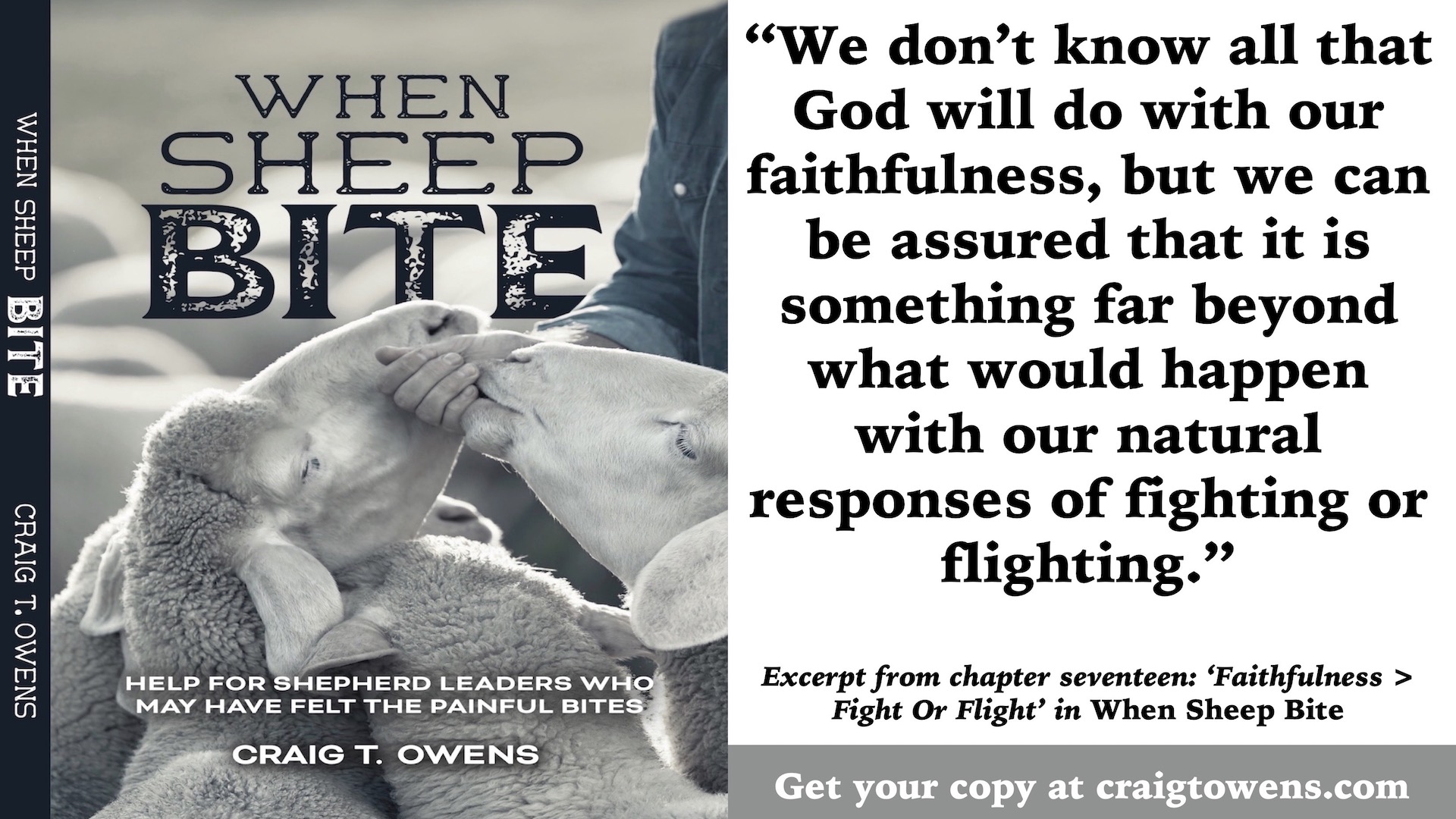
My book When Sheep Bite is divided into three section. In the first section I talk about a shepherd leader’s heart and section two diagnosis the sheep bites leaders endure. The final section is all about the faithfulness to finish well—not giving in to the natural responses of fight or flight. 

I open that final section of the book like this—

     Psychologists and medical doctors have all described what happens to our minds and bodies when we are under attack. They are universal responses that our loving Creator has implanted in all of us to be able to respond to threats that come at us. When confronted with a biting sheep, without consciously thinking about it our minds and bodies prepare for fight or flight. 

     But let’s consider those responses in the context of a shepherd pasturing his sheep. Is it an effective strategy for the shepherd to fight his sheep? No, of course not. Paul told Timothy that a shepherd is “not quarrelsome but forbearing and peaceable” (1 Timothy 3:3 AMPC). 

     Is it allowable for the shepherd to run away from the threat, leaving the flock without a shepherd? Again, no, as Jesus told us that one who resorts to flight isn’t worthy to be called a shepherd but is considered a mere “hired hand [who] cares nothing for the sheep” (John 10:12-13). 

     So if godly shepherds cannot give in to the natural responses of fight or flight, what are we to do? Since we serve an all-power, all-loving Chief Shepherd we must look to Him for the supernatural response of faithfulness. 

     Not fight. Not flight. But faithfulness. 

Check out some of my other posts about godly leadership too. 

►► Would you please prayerfully consider supporting this ministry? My Patreon supporters get behind-the-scenes access to exclusive materials. ◀︎◀︎
Not Forsaken

Listen to the podcast of this post by clicking on the player below, and you can also subscribe on AppleSpotify, or Audible.

Although some people are afraid of this, the Bible makes it clear that God doesn’t forsake us. But the Bible also makes it equally as clear that we can forsake God. 

Listen to the words God spoke through Moses—

     And the Lord said to Moses, “Behold, you shall sleep with your fathers, and this people will rise up and play the harlot after the strange gods of the land where they go to be among them; and they will forsake Me and break My covenant which I have made with them. Then My anger will be kindled against them in that day, and I will forsake them and hide My face from them. And they shall be devoured, and many evils and troubles shall befall them, so that they will say in that day, ‘Have not these evils come upon us because our God is not among us?’ And I will surely hide My face in that day because of all the evil which they have done in turning to other gods.” (Deuteronomy 31:16-18 AMPC)

To forsake means to depart from someone or to neglect them. 

While we are following God, He will never forsake us. But when His people turn aside in fascination of sinful things, they forsake God by no longer following Him. We read this in the words of God’s people, “Our God is not among us.” 

When we don’t follow God, He still never forsakes us. However, God refuses to bless people who persist on doing their own thing. 

God’s blessing is reserved for those who continue to follow Him. In the language of the New Testament, God’s blessing only flows into the branches that continue to abide in Jesus (see John 15:1-8). 

When we forsake God, we cut ourselves off from His life flow. It is not the Vine who has left us, but we who have severed ourselves from the Vine. 

If God feels distant from you, be assured that He hasn’t forsaken you. Perhaps you could pray a couple of prayers that David prayed. Maybe a prayer asking for the Holy Spirit to reveal to you where you may have detached yourself from the Vine of God (Psalm 139:23-24). Or perhaps a prayer of forgiveness and assurance of God’s forgiveness and restoration (Psalm 51:1-10). 

Don’t give into the feelings of despair, but run back into the embrace of the One who loves you—the One who never leaves you nor forsakes you:

     Be strong, courageous, and firm; fear not nor be in terror before them, for it is the Lord your God Who goes with you; He will not fail you or forsake you. (Deuteronomy 31:6) 

►► Would you please prayerfully consider supporting this ministry? My Patreon supporters get behind-the-scenes access to exclusive materials. ◀︎◀︎

Joyful Proof

Listen to the podcast of this post by clicking on the player below, and you can also subscribe on AppleSpotify, or Audible. 

This whole series of messages is about how God can turn our grief into joy. On Easter Sunday we celebrate the most joy-filled event in all of history: the resurrection of Jesus! 

At our Good Friday service, we talked about how the day was anything but good for those who were there. The day is only good for people who have been rescued from eternal, inescapable grief. 

The Bible tells us that all of us have sinned and the penalty for that sin is eternal separation from God (Romans 3:23, 6:23a). But Jesus died in our place (Romans 5:8) to turn our eternal grief into eternal joy. Check out this out: God promises to exchange the cup of wrath and judgment with the cup of righteousness and peace (Isaiah 51:17-22). That’s exactly what Jesus accomplish with this death and resurrection! 

(Check out all of the biblical references in this post by clicking here.) 

On Friday, no one was joyful. In fact, it was just the opposite: Grief gripped their hearts and held them in fear. Probably the only one who was happy on that day was the devil. 

On Saturday, the clouds of grief and fear darkened even more. It was the Sabbath day, and the Jewish followers of Jesus would still have to attend the synagogue and go through the motions of the day. Can you imagine how hollow and meaningless all of the activities seemed? 

Then Sunday morning arrived. Jesus had predicted this (Matthew 12:40), but when some of the women who attended to His needs during His years of ministry came to the tomb, they were completely unprepared for what they found (Luke 24:1-7). 

Jesus told them that they would see their grief turned to joy (John 16:20, 22; Luke 22:53), but when these ladies told His disciples, they still couldn’t comprehend it (Luke 24:9-12, 19-24). 

Grief can so grip our emotions, that it will effect us physically as well: our eyes are clouded, our mind is fuzzy, and our ears seem stuffed with cotton (John 20:14-16; Luke 24:15-17). 

So what finally convinced them? Their own hearts! 

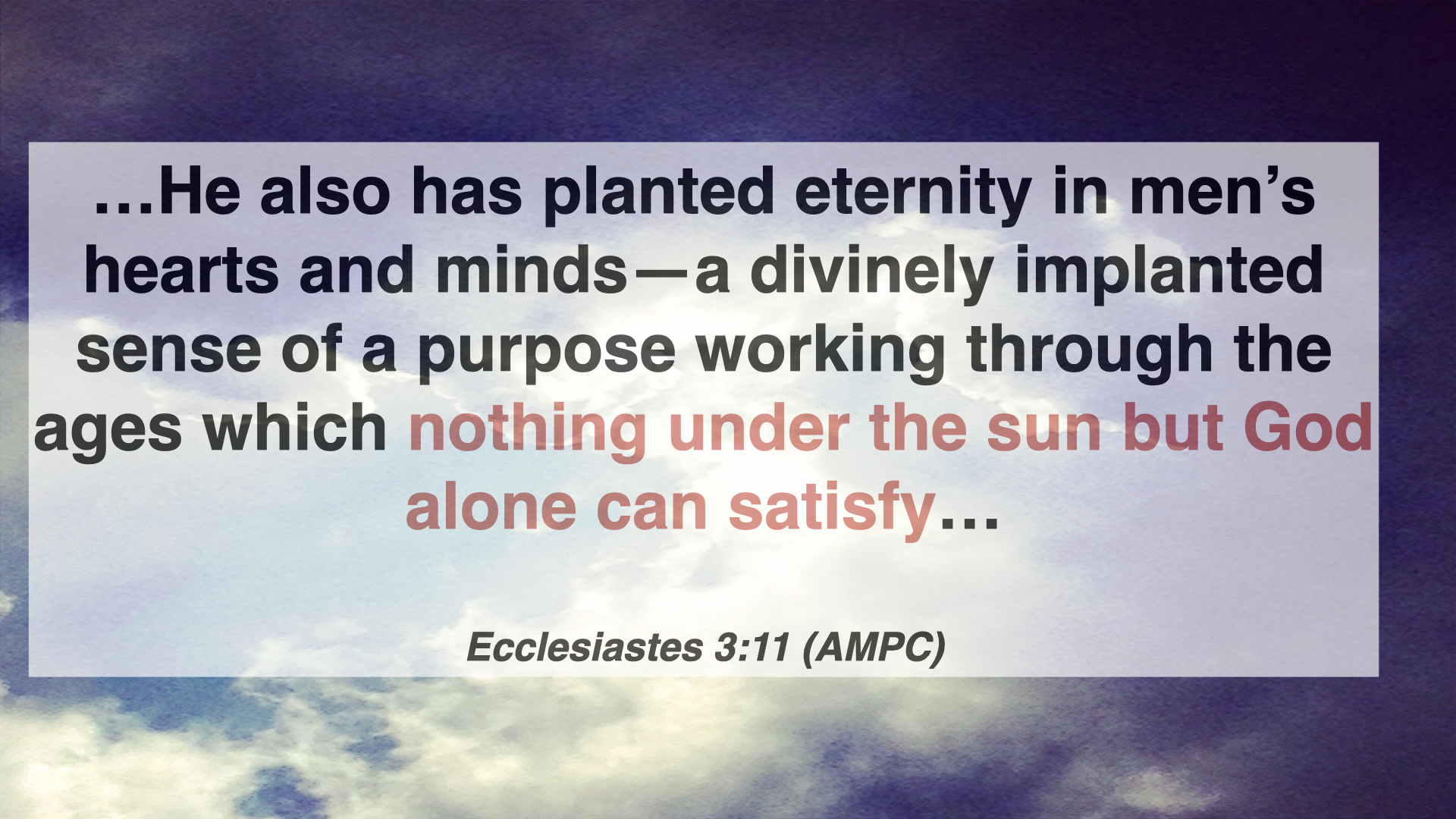
Solomon wrote, “He has planted eternity in the human heart” (Ecclesiastes 3:11). The AMPC says: He also has planted eternity in men’s hearts and minds—a divinely implanted sense of a purpose working through the ages which nothing under the sun but God alone can satisfy. 

Mary finally saw Jesus and saw her grief turned to joy when she heard Jesus say, “Mary.” 

These men on the road said their hearts burned in them when Jesus explained the Scripture to them (Luke 24:31-32, 27). 

And when the other disciples were locked away for fear of the Jews (John 20:19), Jesus spoke to them about how His Word was fulfilled in His actions (Luke 24:44-46). 

There is a hymn that ends, “You ask me how I know He lives, He lives within my heart.” There is something unmistakable and irrefutable when someone knows what it is to have their sins forgiven—to have their grief turned to unquenchable joy! 

In fact, the best proof of a risen Savior is seeing a life freed from gripping grief that used to plague them.  

If you don’t know Jesus as your Savior, the thought of the end of life and what comes next probably fills you with a sense of uneasiness. It doesn’t have to be this way! 

If you do know Jesus, please remember that your best testimony is a life that doesn’t get bogged down in the same grief the world experiences. When you can show supernatural joy while everyone else is gripped by grief, people will turn to you (1 Peter 3:15). 

Please check out the other messages in this series called Grief Into Joy by clicking here. 

►► Would you please prayerfully consider supporting this ministry? My Patreon supporters get behind-the-scenes access to exclusive materials. ◀︎◀︎

Temporary Sorrow For Eternal Joy

Listen to the podcast of this post by clicking on the player below, and you can also subscribe on AppleSpotify, or Audible. 

On Sunday we looked at the thought that our grief often comes because our current situation isn’t what we expected it to be. Notice that we say, “what we expected,” as though we can control anything!  

Today we remember the horrific death of Jesus on the Cross and we call it Good Friday. We can only call it “good” now because we see the results on the other side. If we were to go back in time to the weeks, days, and even moments before Jesus was arrested and so cruelly treated, those around Him would call that time anything but good. 

Look how the disciples responded to this coming event (Matthew 16:21-22). Grief can also come when we give more weight to today’s pain than we do to eternity’s joy. 

(Check out all of the Scriptures in this post by clicking here.) 

This has always been a strategy of the devil to get people to look at now and not consider eternity. That’s how he tempted Adam and Eve, who gave in to this ploy. And then he tried the same strategy on Jesus, but failed (see Genesis 3:1-5; Matthew 4:1-10). 

Jesus knew why He came to earth (Matthew 20:28). And as He got closer and closer to the day of His crucifixion, the weight began to build (John 12:27). 

Look at how Jesus fought grief by making sure He gave more weight to eternity. He turned His pain into prayer so His Father could exchange His grief for His joy (Matthew 26:36-44).

Jesus prepared His disciples by trying to give them an eternal focus (Luke 22:14-20). He told them to pray that they wouldn’t give in to this temptation to trade eternal joy for momentary pain, but they didn’t understand. This is what focusing on the pain of now does—the weight of it exhausts us emotionally, physically, and spiritually.

But look at the eternal focus in vv. 17-19:

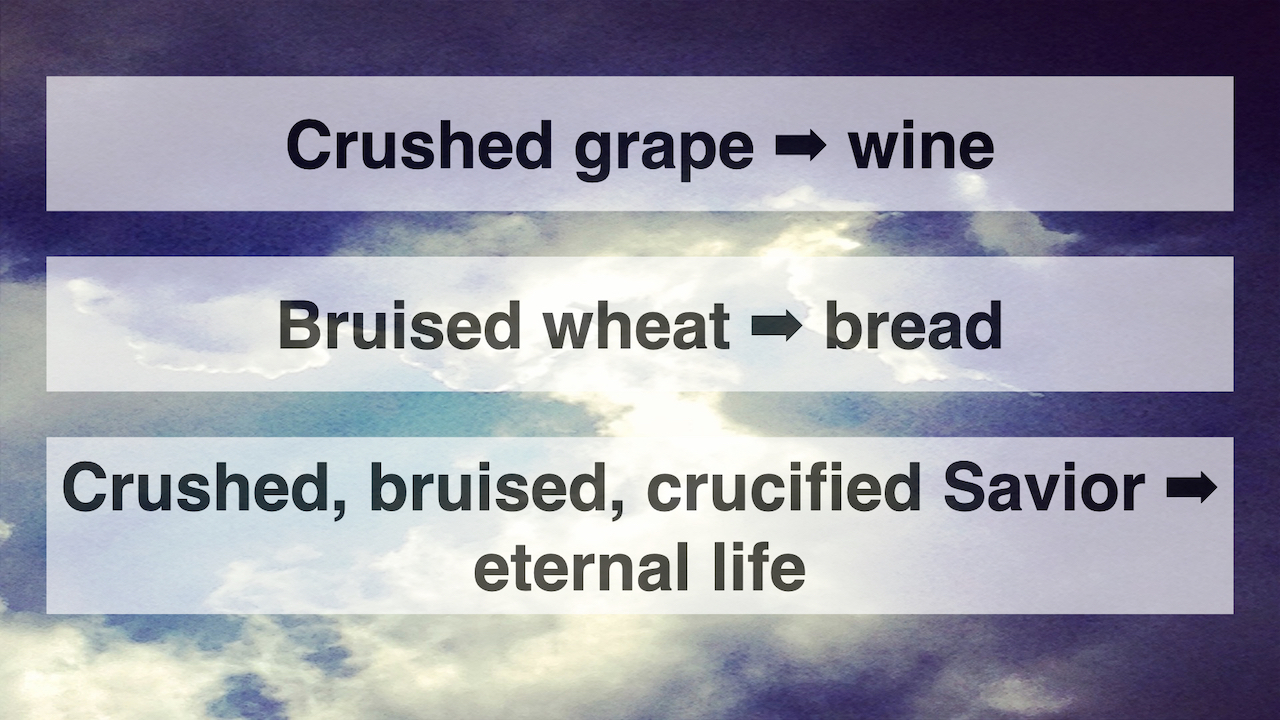
  • The crushed grape gives us wine 
  • The bruised wheat gives us bread 
  • The crushed, bruised, crucified Savior gives us eternal life  

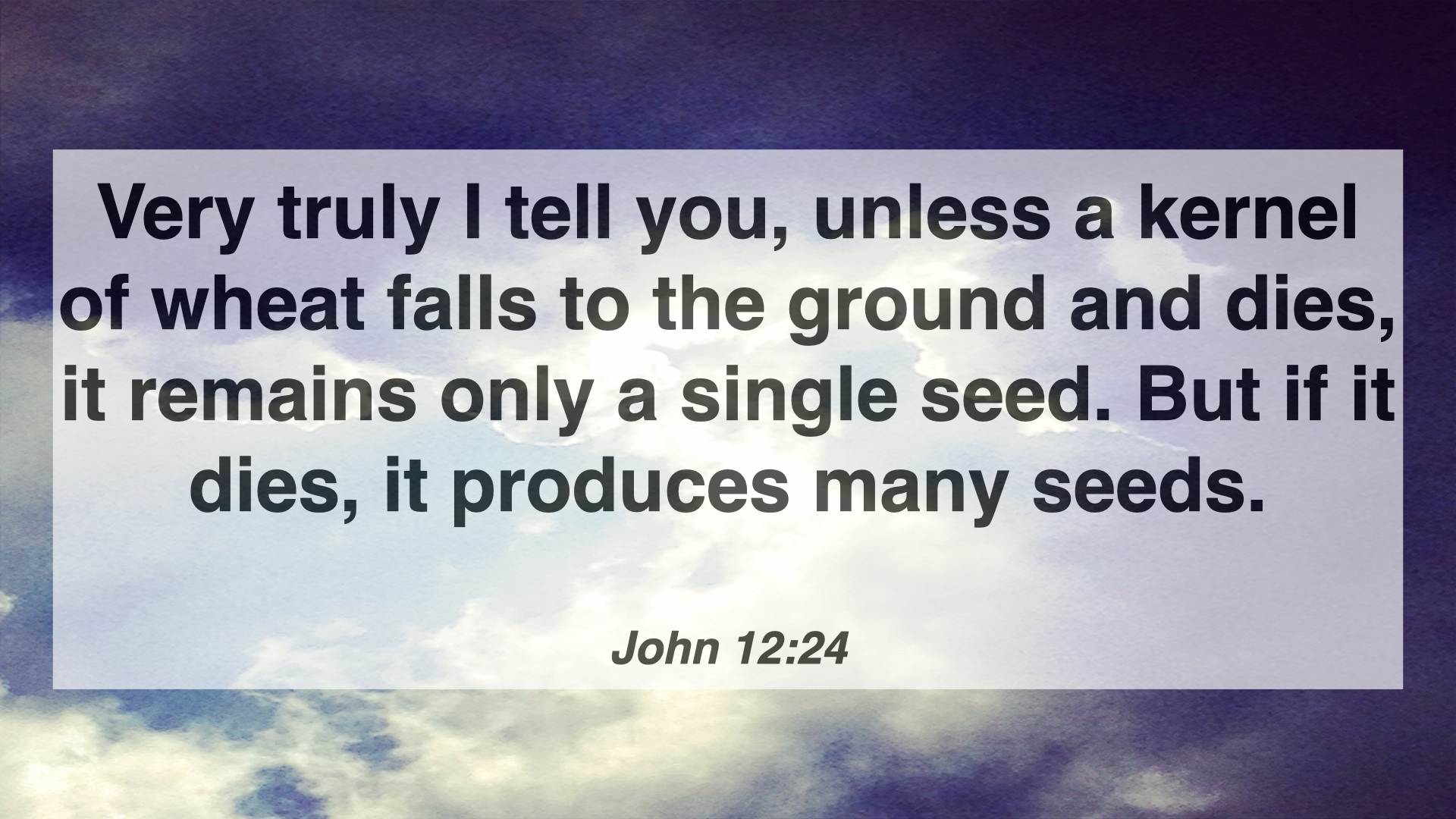
“Very truly I tell you, unless a kernel of wheat falls to the ground and dies, it remains only a single seed. But if it dies, it produces many seeds” (John 12:24).

Remember the devil’s strategy: get us so focused on the pain of now that we forget about the far greater joy that lasts forever. 

Jesus wants us to “do this in remembrance of Me”—to see the crushed grape and the bruised wheat and the crucified Savior in the light of eternity. 

Check out the other messages in this series called Grief Into Joy by clicking here.

►► Would you please prayerfully consider supporting this ministry? My Patreon supporters get behind-the-scenes access to exclusive materials. ◀︎◀︎
Let Others Have The First Pancakes

Listen to the podcast of this post by clicking on the player below, and you can also subscribe on AppleSpotify, or Audible. 

If you’re a leader, I have a very interesting challenge for you. I would like to challenge you to let other people eat the first pancakes. 

A mark of a godly leader is one who lets others eat the pancakes first!

The Scriptures I reference in this video are Mark 10:45; Romans 15:1-2; John 13:1-17. 

I elaborate on the example Jesus gave us in John 13 in my posts Only One Kind of Leader Can Serve Well and Are You Healthy Enough to Love Serving Others? 

If you would like to hone your leadership to be more Christ-like, check out my book Shepherd Leadership and When Sheep Bite. 

This is part 83 in my series on godly leadership. You can check out all of my posts in this series by clicking here.

►► Would you please prayerfully consider supporting this ministry? My Patreon supporters get behind-the-scenes access to exclusive materials. ◀︎◀︎
Links & Quotes

Why do you love the power? Servant leaders love what their leadership role allows them to do for other people.

I have a lot of new video content on my YouTube channel every week. Please check it out and subscribe so you don’t miss anything.

“Friendship is a path that leads very close to the perfection which consists of the enjoyment and knowledge of God, such that a man who is a friend of man is made into a friend of God, according to what the Savior said in the gospel: ‘Now I will not call you servants, but My friends [John 15:15].’” —Aelred of Rievaulx

In studying the intense volcanic activity on Jupiter’s moon Io, the ICR concludes, “Since 2013, evidence of a youthful solar system has only gotten stronger. Scientists have been forced to acknowledge that Saturn’s rings are indeed young, and belief in deep time continues to pose real problems for conventional scientists.” The prestigious Nature concurs, saying, “Some such proposals make planetary researchers uncomfortable, because it is statistically unlikely that humans would catch any one object engaged in unusual activity—let alone several.”

Parents and teachers trying to keep up with the ever-changing lexicon of today’s youth will really appreciate this list of slang from Axis.

“Those who are really in earnest must be willing to be anything or nothing in the world’s estimation.” —Susan B. Anthony 

The story of Esther in the Bible is one of my all-time favorites. “While Esther herself has not been identified, nor has the plot to destroy the Jewish people been confirmed, the absence of evidence is not evidence of absence.” To that point, here are 10 pieces of archeological evidence related to this amazing story. 

Charisse Compton asks, “When was the last time meditating on your body elicited worship?” She goes on to make this case from Psalm 139: “Your body, as much as your soul, is one of God’s glorious works. It bears the unmistakable signature of the divine Artist so that, like creation, your body ‘declare[s] the glory of God’ (Psalm 19:1).”

The Glorious Gospel

Listen to the podcast of this post by clicking on the player below, and you can also subscribe on AppleSpotify, or Audible. 

Paul opens his letter to the saints at Rome with two powerful words: the gospel (Romans 1:1).

(Check out all of the biblical references in this post by clicking here.)

The word gospel simply means the good news about the salvation that comes only through Jesus.

Paul loves this word! 

Interestingly, although we refer to the first four books of the New Testament as “The Gospels,” the word itself barely appears: 

  • Matthew—4 times 
  • Mark—8 times 
  • Luke—0 times 
  • John—0 times

And even though these four opening books are the Gospels about Jesus, He Himself only uses the word nine times, with the other three times attributed to someone else mentioning what Jesus was doing. 

Peter only uses this word twice (Acts 15:7; 1 Peter 4:17). And John uses it just once (Revelation 14:6). 

Paul, however, uses this word 64 times! 

It becomes such a part of who he is and how he thinks, that he calls it “my gospel” twice (Romans 2:16, 16:25) and “our gospel” three times (2 Corinthians 4:3; Colossians 1:23; 2 Thessalonians 2:14). 

For Paul and for us this Good News is—

  • God’s promises fulfilled 
  • salvation power 
  • the fullness of God’s blessing 
  • the opening of mysteries 
  • the guide for godly living 
  • glorious light 
  • the expression of God’s grace 
  • the standard of all truth 
  • a key part of the Christian’s spiritual armor 
  • the empowerment for ministry 
  • the anchor of unshakable hope 
  • the means by which we experience Christ’s glory 
  • the only door to life and immortality 

For those of us who have been called to preach this Gospel, these thoughts should both humble and empower. 

For those of us who have been saved by believing this Gospel, these thoughts should cause us to desire to know more, and more, and more about our Savior. 

What a glorious Gospel this is! 

►► Would you please prayerfully consider supporting this ministry? My Patreon supporters get behind-the-scenes access to exclusive materials. ◀︎◀︎

Never Self-Sufficient

Listen to the podcast of this post by clicking on the player below, and you can also subscribe on AppleSpotify, or Audible. 

There is a cliche people love to quote: “Give a man a fish and you feed him for a day. Teach a man to fish and you feed him for a lifetime.” 

Is this how Christians should live? 

It sounds like the experienced fisherman may be annoyed at having to catch a fish every day just to give it to someone else. If you want to put a noble spin on the cliche, you could say that the wise and patient fisherman invested his time to teach someone else to provide for themselves, never needing to return to their teacher. 

This certainly wouldn’t be the example of Jesus. 

As He was teaching the large crowd of people, whom He thought of as sheep without a shepherd, they became hungry. Jesus directed His disciples to feed them. He didn’t tell them to teach the crowd to provide for themselves. 

As Jesus miraculously fed thousands of people, notice that He kept on giving until they were all satisfied—

     And taking the five loaves and two fish, He looked up to heaven and, praising God, gave thanks and broke the loaves and kept on giving them to the disciples to set before the people; and He also divided the two fish among them all. And they all ate and were satisfied. (Mark 6:41-42 AMPC)

The example in the Old Testament was to look to God for a supply of manna every single day. In the New Testament, Jesus taught us to pray for our daily supply of bread every single day (Exodus 16:14-17; Matthew 6:11; John 6:35).

Jesus never wants us to become self-sufficient. Instead, He wants us to remain steadfastly connected to Himself—as surely as a branch is connected to the vine. 

Far from teaching us to provide for ourselves, Jesus says, “If you remain in Me and I in you, you will bear much fruit; apart from Me you can do nothing” (John 15:5). 

Jesus is never wearied by our continually coming to Him; rather, He is delighted when we do! He wants to be our supply each and every day for all of eternity! 

►► Would you please prayerfully consider supporting this ministry? My Patreon supporters get behind-the-scenes access to exclusive materials. ◀︎◀︎
Praying For Our Fellow Saints

Listen to the podcast of this post by clicking on the player below, and you can also subscribe on AppleSpotify, or Audible. 

We tend to be pretty self-centered creatures, filtering everything through our lens. This becomes especially true when we are going though a difficult time. 

When I walked through a dark valley, I battled both physical and spiritual forces. People attacked me, but so did my own thoughts. “Why me?” and “I didn’t do anything to deserve this!” led to prayers like, “God, why didn’t You protect me from this? Why won’t you get me out of this?” 

Do you hear a common theme? I didn’t while I was in the midst of the battle, but perhaps you hear it—“Why me? I didn’t do anything to deserve this! God, why didn’t You protect me from this? Why won’t You get me out of this?” 

In his book Winning With People, John Maxwell shared ‘The Big Picture Principle’: “The entire population of the world, with one minor exception, is composed of others.” 

On the other side of my dark valley I learned something about my time in the dark valley—I had grown:

  • I could help others diagnose depression 
  • I could empathize with others
  • I could share helpful strategies to those who were struggling 
  • I could intercede for them in prayer 

My definition for intercede is to pray for people in a meaningful way because they are too beat up to pray for themselves. 

In order to pray for them, I have to know what and how to pray. I can’t know what and how to pray unless I have firsthand experience. So perhaps my dark valley wasn’t for me, but for someone else (see Romans 8:28; 2 Corinthians 1:3-11). 

(Check out all of the Scriptures in this post by clicking here.)

As Christians, we’re in this life together. 

I have talked and blogged so many times about the phrases “one another” and “each other” throughout Scripture. That means that Christian faith is best seen when we are with each other, supporting one another. 

Jesus taught us to pray, “Our Father” (Matthew 6:9). The “our” signifies we are praying…

  • …with Jesus—John 14:13-14 
  • …with other saints—Matthew 18:18-20 

Even more than praying with us, Jesus intercedes for us (Hebrews 4:15-16). And Jesus gives us the Holy Spirit (John 14:26) who also intercedes for us and with us (Romans 8:26-27). 

We join with our High Priest, helped by our Advocate, as we pray to our Heavenly Father on behalf of our brothers and sisters.  

Listen to the interceding and expectation of a joyful answer that David writes in Psalm 20, and also notice how the saints are together—

    May the LORD answer you when you are in distress; may the name of the God of Jacob protect you. May He send you help from the sanctuary and grant you support from Zion. May He remember all your sacrifices and accept your burnt offerings. May He give you the desire of your heart and make all your plans succeed. May we shout for joy over your victory and lift up our banners in the name of our God. May the LORD grant all your requests. Now this I know: The LORD gives victory to His anointed. He answers him from His heavenly sanctuary with the victorious power of His right hand.  Some trust in chariots and some in horses, but we trust in the name of the LORD our God. They are brought to their knees and fall, but we rise up and stand firm. LORD, give victory to the king! Answer us when we call!

My cousin Dick Brogden wrote, “Jesus never intended us to suffer alone. We may not physically be able to cross oceans or deserts and sit in lonely cells with colleagues—but we are intended to traverse that distance spiritually and to bear the burdens of our brothers in prayer. Followers of Jesus under duress are empowered to bear unimaginable suffering when they know that they do not agonize alone.” 

In your prayer time, I encourage you to ask the Spirit to show you lessons you have learned in your dark valleys, and then begin to intercede for your fellow brothers and sisters with the help you have already received. 

If you’ve missed any of the messages in this prayer series, you can find them all here. 

►► Would you please prayerfully consider supporting this ministry? My Patreon supporters get behind-the-scenes access to exclusive materials. ◀︎◀︎

T-I-M-E

Listen to the podcast of this post by clicking on the player below, and you can also subscribe on AppleSpotify, or Audible. 

My podcast partner Greg Heeres asked me if I had found one thing that really worked in developing or deepening relationships. My answer is short and to the point. 

Check out the full episode of The Craig and Greg Show where we use my book Shepherd Leadership to talk about the all-around healthiness of leaders. 

The Scriptures I reference in this video are John 13:1-4 and Proverbs 27:6. 

Here is a poem from one of my children that keeps me aware of the value of my presence in their lives. It’s called He’s Here To Keep. 

You might also be interested in these related posts:

►► Would you please prayerfully consider supporting this ministry? My Patreon supporters get behind-the-scenes access to exclusive materials. ◀︎◀︎