Temporary Sorrow For Eternal Joy

Listen to the podcast of this post by clicking on the player below, and you can also subscribe on AppleSpotify, or Audible. 

On Sunday we looked at the thought that our grief often comes because our current situation isn’t what we expected it to be. Notice that we say, “what we expected,” as though we can control anything!  

Today we remember the horrific death of Jesus on the Cross and we call it Good Friday. We can only call it “good” now because we see the results on the other side. If we were to go back in time to the weeks, days, and even moments before Jesus was arrested and so cruelly treated, those around Him would call that time anything but good. 

Look how the disciples responded to this coming event (Matthew 16:21-22). Grief can also come when we give more weight to today’s pain than we do to eternity’s joy. 

(Check out all of the Scriptures in this post by clicking here.) 

This has always been a strategy of the devil to get people to look at now and not consider eternity. That’s how he tempted Adam and Eve, who gave in to this ploy. And then he tried the same strategy on Jesus, but failed (see Genesis 3:1-5; Matthew 4:1-10). 

Jesus knew why He came to earth (Matthew 20:28). And as He got closer and closer to the day of His crucifixion, the weight began to build (John 12:27). 

Look at how Jesus fought grief by making sure He gave more weight to eternity. He turned His pain into prayer so His Father could exchange His grief for His joy (Matthew 26:36-44).

Jesus prepared His disciples by trying to give them an eternal focus (Luke 22:14-20). He told them to pray that they wouldn’t give in to this temptation to trade eternal joy for momentary pain, but they didn’t understand. This is what focusing on the pain of now does—the weight of it exhausts us emotionally, physically, and spiritually.

But look at the eternal focus in vv. 17-19:

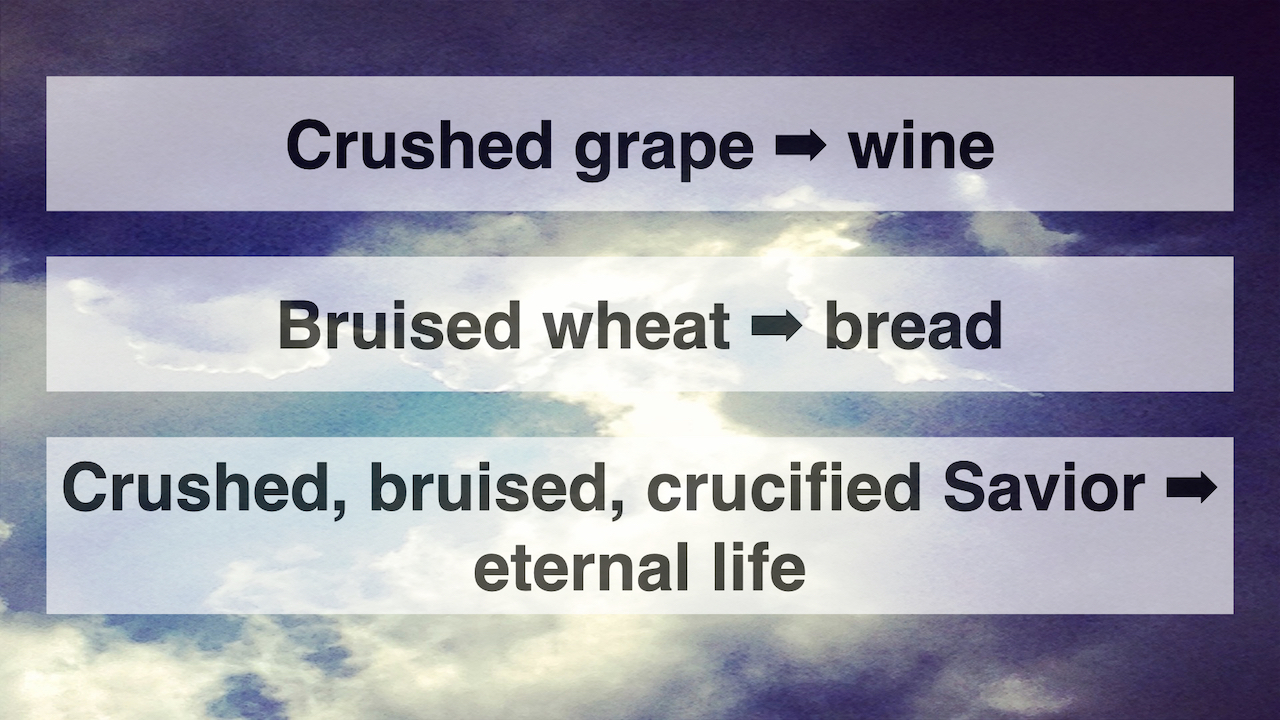
  • The crushed grape gives us wine 
  • The bruised wheat gives us bread 
  • The crushed, bruised, crucified Savior gives us eternal life  

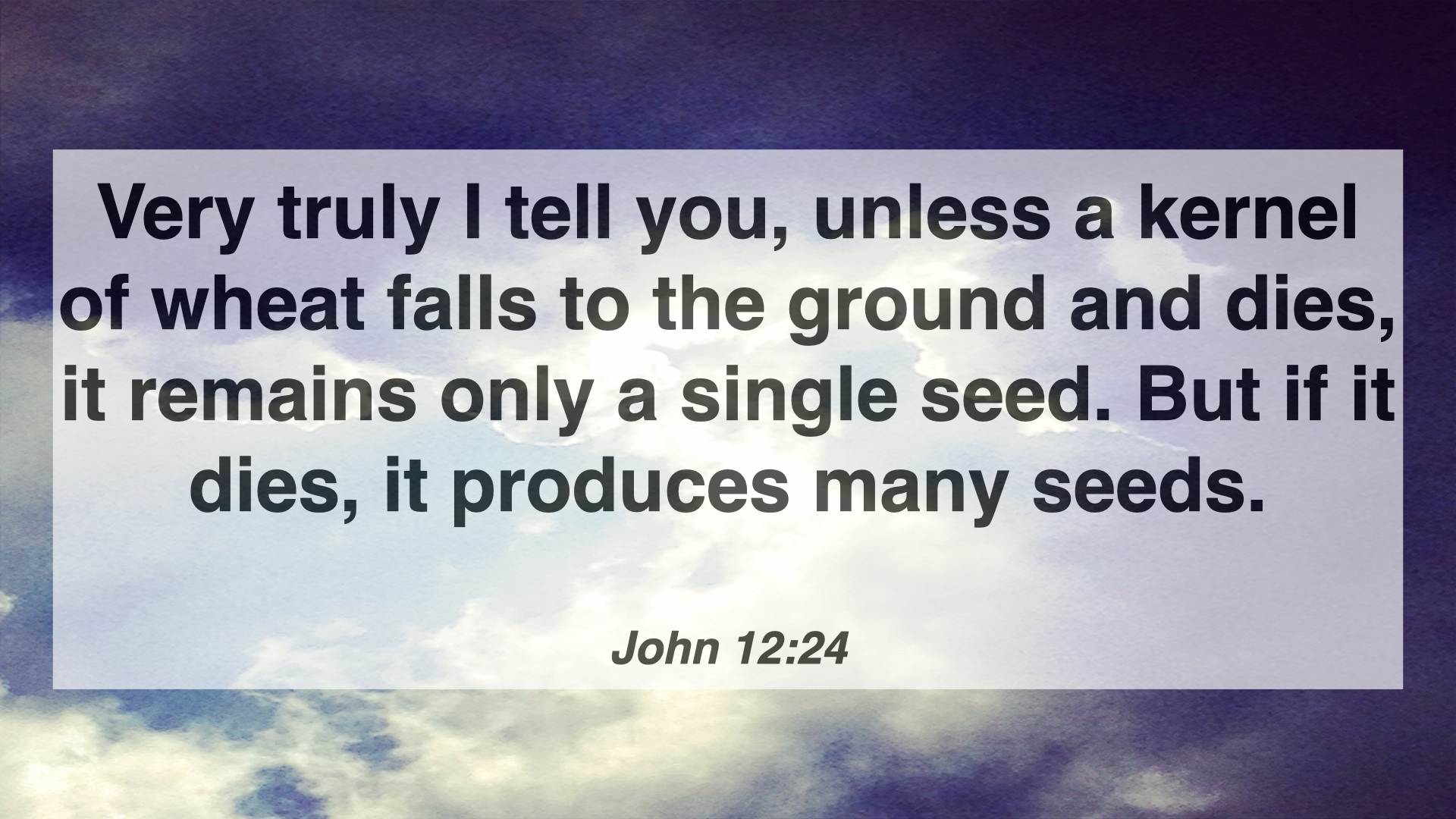
“Very truly I tell you, unless a kernel of wheat falls to the ground and dies, it remains only a single seed. But if it dies, it produces many seeds” (John 12:24).

Remember the devil’s strategy: get us so focused on the pain of now that we forget about the far greater joy that lasts forever. 

Jesus wants us to “do this in remembrance of Me”—to see the crushed grape and the bruised wheat and the crucified Savior in the light of eternity. 

Check out the other messages in this series called Grief Into Joy by clicking here.

►► Would you please prayerfully consider supporting this ministry? My Patreon supporters get behind-the-scenes access to exclusive materials. ◀︎◀︎
Grief Into Joy

At the end of your rope … down for the count … nothing but gray skies all around … unable to see any light at the end of the long, dark tunnel. Ever been there? The reality is, we all have been there. 

But the good news is that we don’t have to stay there! 

God is always at work to turn our apparent no-win, dark, hopeless situations into something bright and glorious! He is working in ways that no human mind could have dreamed up, and working on our behalf in a way no human power could ever hope to rival. 

God specializes in turning grief into joy! 

We are approaching the time of year where we remember the death of Jesus. Without a doubt that was the darkest, most grief-stricken day in all of history. Yet that time of mourning was completely forgotten in the overwhelming joy that exploded from an empty tomb on Resurrection Sunday! 

Please join me at Calvary Assembly of God for this hope-filled series as we learn how God is at work in all of our grief-darkened circumstances to bring about something gloriously joyful!

Follow along with all the messages in this series:

Links & Quotes

The devil wants us to remember what we’ve done or what we still need to do, but Jesus wants us to remember what He has already done. There is a huge difference! Check out this whole message here. I have lots of new content every week, which you can check out on my YouTube channel.

“The most likely man to go to hell is the man who has nothing to do on earth. Idle people tempt the devil to tempt them.” —Charles Spurgeon

“What were we made for? To know God. What aim should we have in life? To know God. What is the eternal life that Jesus gives? To know God. What is the best thing in life? To know God. What in humans gives God most pleasure? Knowledge of Himself.” —J.I. Packer

The Bible Archeology Report shares the Top 10 archeological discoveries related to the resurrection of Jesus.

We can learn childlike faith by simply watching and listening to how young children interact with their loving parents. This video is a clip from one of the message in our series called Kingdom Praying.

Technological advancements abound all around us. How are Christians supposed to interact with technology: embrace it? ignore it? This is a thoughtful message to give us a biblical paradigm for our daily use of technology. 

“We must quit bending the Word to suit our situation. It is we who must be bent to that Word, our necks that must bow under the yoke.” —Elizabeth Elliot

“The things you pray about are the things you trust God to handle. The things you neglect to pray about are the things you trust you can handle on your own.” —H.B. Charles 

“Learning to pray doesn’t offer us a less busy life; it offers us a less busy heart.” —Paul Miller

Just Knowing Or Really Knowing?

Listen to the podcast of this post by clicking on the player below, and you can also subscribe on AppleSpotify, or Audible. 

I wonder how well you know the word “know”? Let’s find out.

Check out this episode of The Podcast.

Here are some helpful resources from this episode:

The Scriptures I referenced are 1 Samuel 2:12-17, 22; Genesis 2:25; John 1:4-5; Psalm 119:18; Ephesians 1:17.

I mentioned a blog post and video in this podcast about the work Jesus did on our behalf on the Cross. That was called Right Remembering.

My new book When Sheep Bite is available for pre-order!

Here are a bunch of ways to get in touch with me and follow along with other projects on which I am involved

►► Would you please prayerfully consider supporting this ministry? My Patreon supporters get behind-the-scenes access to exclusive materials. ◀︎◀︎
Right Remembering

Listen to the podcast of this post by clicking on the player below, and you can also subscribe on AppleSpotify, or Audible. 

Jesus hung on the Cross for about 6 hours. He was mostly silent during this time—His seven statements from the Cross would have taken less than a minute to say them all back-to-back. 

He hung silently and thoughtfully. I know He was thoughtful because John records, “Later, knowing that all was now completed, and so that the Scriptures would be fulfilled, Jesus said, ‘I am thirsty’” (John 19:28). 

Movie directors will often show a flashback scene where their character looks back to remember what came before. I think during this silent time on the Cross, Jesus reviewed His public ministry. He reviewed every jot and tittle of every promise His Father had made, and He knew that each and every one had been completed.  

This culminating event on the Cross was the fulfillment of the big picture that God had been painting all along. The system of sacrifices centered in the tabernacle or the temple had been trying to show us something. 

There were daily sacrifices and annual sacrifices; there were sacrifices for willful sins and sacrifices for unintentional sins; there were sacrifices for priests and for laypeople. Day after day, week after week, month after month, year after year, decade after decade, century after century these sacrifices continued, never feeling like the work was finished. 

These practices were only a shadow, but a shadow that foretells the Reality—

The law is only a shadow of the good things that are coming—not the realities themselves. For this reason it can never, by the same sacrifices repeated endlessly year after year, make perfect those who draw near to worship. … The reality, however, is found in Christ. (Hebrews 10:1; Colossians 2:17) 

(Check out all of the Scriptures in this post by clicking here.)

Jesus knew that He had come as the Reality (John 13:1), but before this final event on the Cross that would fully reveal the Reality, Jesus had one last thing to do: He wanted to share a final meal with His friends (Luke 22:7-15). 

Jesus said that eagerly desired to eat the Passover meal with them. This Passover remembrance looked backwards to the deliverance from Egypt and was celebrated year after year, decade after decade, century after century. 

The events were so long ago that they may have seemed like fading shadows to those who were celebrating this meal over a millennia after the fact. Jesus brought Reality. 

Jesus knew He was the most powerful Person on earth, but He also knew that He had come to serve (Mark 10:45; John 13:3-5). To demonstrate His servanthood…

  • He washed the feet of His betrayer 
  • He washed the feet that would run away from Him in terror 
  • He prepared them for what was coming 

Peter boldly declared that he would never run away, and Matthew and Mark record that all of the other disciples declared the same thing—(Luke 22:33; Matthew 26:35; Mark 14:31). But Jesus knew the prophecy that said, “I will strike the Shepherd, and the sheep of the flock will be scattered (Matthew 26:31). 

So Jesus prepared them by praying for them, and He prepared them by showing them the Reality of all those daily, weekly, monthly, annual, and Passover sacrifices (Luke 22:17-20, 31-32). 

Jesus was the completion of this sacrifices (Hebrews 7:26-28, 9:11-14)! 

The prophecy God gave in Jeremiah was completed in Christ’s broken body and spilled blood on the Cross—“For I will forgive their wickedness and will remember their sins no more” (Jeremiah 31:31-34; Hebrews 8:12). 

The purpose of this Last Supper—this meal that completes so many jots and tittles—is to remember. The devil wants you to remember what YOU did. Jesus wants you to remember what HE did. 

Good Friday and the celebration of Communion helps us remember correctly that Jesus paid in-full the penalty for our sins, so now our forgiven sins are forgotten sins. The moment we sin, there is already the remedy for our sins that has been paid for. We repent, ask forgiveness, and receive His immediate cleaning. 

Such amazing love! 

If you have missed any of the messages in this series looking at some of the jots and tittles of prophecy that are fulfilled in Jesus, you can check them all out by clicking here.  

►► Would you please prayerfully consider supporting this ministry? My Patreon supporters get behind-the-scenes access to exclusive materials. ◀︎◀︎
A Week To Slow Down

Listen to the podcast of this post by clicking on the player below, and you can also subscribe on AppleSpotify, or Audible. 

I would like to make a case for you to really slow down this week.

Check out this episode of The Podcast.

Here are some helpful resources from this episode:

I have two series of messages focusing on the Passion Week that will help you go deeper in  your Bible study time: Christ’s Passionate Journey (which I mentioned in this podcast) and Bold Claims.

This is a helpful timeline of the whole Passion Week, and this timeline focuses on the events of the crucifixion.

I loved the book The Blood of the Cross by Horatius Bonar. It is an eye-opening (and heart-opening) devotional book that has stood the test of time.

My new book When Sheep Bite is available for pre-order!

Here are a bunch of ways to get in touch with me and follow along with other projects on which I am involved

►► Would you please prayerfully consider supporting this ministry? My Patreon supporters get behind-the-scenes access to exclusive materials. ◀︎◀︎

An Unlikely Convert

There is a man that we meet in just a couple of verses of Scripture. We know that he is a Roman centurion. I gave him an appropriate Roman name of Vitellius. I created a fictional backstory for this centurion, but all of the events are well documented in both biblical history and contemporary history books of the time. I have listed below all of the scripture references that you may want to consult, along with some quotes from notable historians. 

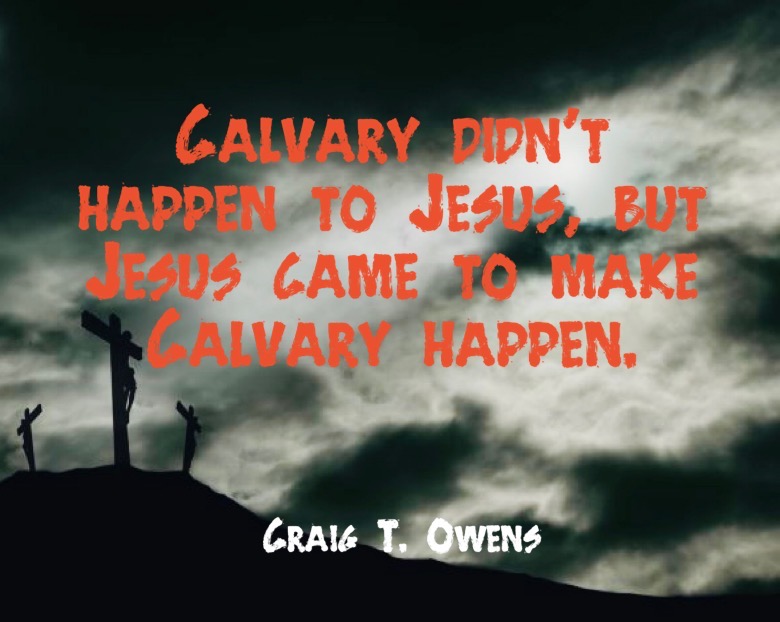
What isn’t fictional is the fact that the Cross didn’t happen to Jesus, but He came to make Calvary happen. 

Jesus said this about His crucifixion, “And I, when I am lifted up from the earth, will draw all people to Myself” (John 12:32). That’s what happened to the thief, and to the centurion Vitellius, and to me, and to all who have acknowledged that Jesus is the Savior. 

Vitellius’ bold claim on the day Jesus was crucified still rings true 2000 years later: “Certainly this was a righteous Man!” 

Looking at Jesus who was lifted up on that Cross, we can appreciate the beauty of the 700-year-old prophecy about Him:

He had no beauty or majesty to attract us to Him, nothing in His appearance that we should desire Him. He was despised and rejected by mankind, a man of suffering, and familiar with pain. Like one from whom people hide their faces He was despised, and we held Him in low esteem. Surely He took up our pain and bore our suffering, yet we considered Him punished by God, stricken by Him, and afflicted. But He was pierced for our transgressions, He was crushed for our iniquities; the punishment that brought us peace was on Him, and by His wounds we are healed. (Isaiah 53:2-5)

Which is what we celebrate in Communion still to this day. “And [Jesus] took bread, gave thanks and broke it, and gave it to them, saying, ‘This is My body given for you; do this in remembrance of Me.’ In the same way, after the supper He took the cup, saying, ‘This cup is the new covenant in My blood, which is poured out for you’” (Luke 22:19-20). 

The way Christians live today can still lift Jesus up for all to see. Jesus told His followers, “Whoever wants to be My disciple must deny themselves and take up their cross and follow Me. For whoever wants to save their life will lose it, but whoever loses their life for Me will find it” (Matthew 16:24-25). 

When we live this way, our lives become the aroma of life to even sin-hardened thieves and war-hardened soldiers.  

Check out this video of Vitellius’ personal experience—

Here are some further resources for you to check out:

  • The Bible verses that form the background for this centurion’s story—Luke 23:1-47; Matthew 27:11-54; Mark 15:1-39; John 18:28-19:34
  • Historian William Barclay wrote this about the centurions, “The centurions were the backbone of the Roman army. In a Roman legion there were 6,000 men; the legion was divided into sixty centuries, each containing 100 men, and in command of each century there was a centurion. These centurions were the long-service, regular soldiers of the Roman army. They were responsible for the discipline of the regiment, and they were the cement which held the army together. … A centurion was the equivalent of a regimental sergeant-major; and the centurions were the backbone of the Roman army.”
  • The horrific torture of crucifixion

If you have missed any of the other messages in our series of Bold Claims, you can find them all my clicking here.

Bold Claims

“That’s a pretty bold claim. Are you prepared to back that up?” 

I’ll bet you have heard something like that said to you, and maybe you have even said that yourself to someone else who made a big, audacious statement. 

After Jesus is arrested by the religious leaders—an arrest that will ultimately lead to Jesus being crucified on the Cross—there are some incredibly bold claims spoken by key people in this part of the Story. For the most part, these are claims that we don’t read earlier in any of the Gospels, but as this story is heading toward its most crucial moment, we have these audacious statements pronounced. 

But here’s the most important part: These bold claims weren’t just made, but they were backed up with proof as well. 

As we head toward the remembrance of Christ’s death on the Cross and His resurrection three days later, please join us for this look at these eye-opening bold claims. I would love to have you join us in person, but if you are unable to do that, we will make all of the messages available on Facebook and YouTube. If you’ve missed any of the messages, or simply want to review what we’ve already learned, you can find all of these messages here:

…The Certainty Of Eternal Light

Listen to the podcast of this post by clicking on the player below, and you can also subscribe on AppleSpotify, or Audible.

Even though Jesus explicitly told His followers about His crucifixion, it was clear on that Friday on Golgotha that they didn’t fully grasp what was going on. 

We see the same thing in Heman’s maskil of Psalm 88: The faint hope that his Savior would rescue him from death, but still not fully grasping what was happening. Just as Jesus cried out, “It is finished” and His disciples thought the darkness had fallen, Heman ends his psalm with, “You have taken my companions and loved ones from me; the darkness is my closest friend” (Psalm 88:18). 

There is the reality of darkness in this world—but it is only temporary darkness. This is why I entitled our look at Psalm 88 as “The reality of temporary darkness” because, in the second part of this couplet of maskil psalms, Ethan moves right into the light of Resurrection Sunday: “I will sing of the Lord’s great love forever” (Psalm 89:1). 

Consider this Good Friday-to-Resurrection Sunday thought from Jesus: “…In the world you will have tribulation; BUT be of good cheer, I have overcome the world” (John 16:33). This tells us of both the temporary darkness and the conquering Light. But also notice that Jesus said our peace would come from knowing that both darkness and light are realities: “These things I have spoken to you, that in Me you may have peace.” Whether we are in temporary darkness or looking forward to the eternal light, our peace is only found in Jesus. 

When the followers of Jesus came to His tomb on Sunday morning, the angels asked them a penetrating question, “Why are you looking for a living Person in a place where there are dead people?” Then they began to stimulate their memory to get them to recall Christ’s words. Finally, we read, “THEN they remembered” (Luke 24:5-8). Then they had to choose to obey the word of God. 

Ethan recalls God’s words and uses his “will” three in the opening two verses. 

The disciples also could bank on Christ’s words, just as Ethan chose to bank on Jehovah’s words. The central part of Psalm 89 is God speaking: Check out His assurance in the “I will” statements within the quotation marks in verses 19-37. Then we are called to Selah to let that soak in. 

Notice what radiates out from this foundational assurance:

  • Ethan uses the pronouns You/Your 20 times in reference to God to assure us that God is in sovereign control (vv. 8b-14). Then he tells us of the blessings of God’s favor on our obedience to His word (vv. 15-18). 
  • On the other side of the central quotation from God, Ethan again uses the pronouns You/Your 13 times in vv. 38-45, but then he tells us of the blessing of God’s discipline on our disobedience.
  • Radiating out further, Ethan asks seven questions—much like his brother Heman did in Psalm 88—in verses 5-8 and 46-48. 
  • Finally, we see the psalm both opening and closing with praising God as we remember His covenant word (vv. 1-4, 49-52). 

Remember we said the darkness cannot prevail. The darkness is temporary (Romans 8:18) but Ethan repeatedly reminds us of God’s foreverness (vv. 1, 2, 4, 29, 52). 

  • The Selah after v. 4 is to pause in wonder at God’s words and break into rejoicing!
  • The Selah after v. 37 is again to pause after remembering God’s covenant, and to reflect on our own obedience or disobedience. 
  • The Selah after v. 45 is a pause to mourn and repent from our disobedience. 
  • The Selah after v. 48 is to pause to reflect on the forgiveness purchased on Calvary and the eternal light and life that bought. 
  • Finally, v. 52 harkens back to v. 1 as the praise is restored and the cycle begins all over again. In fact, the praise of God’s light continues forever! 

Heman and Ethan both remind us of this important truth—

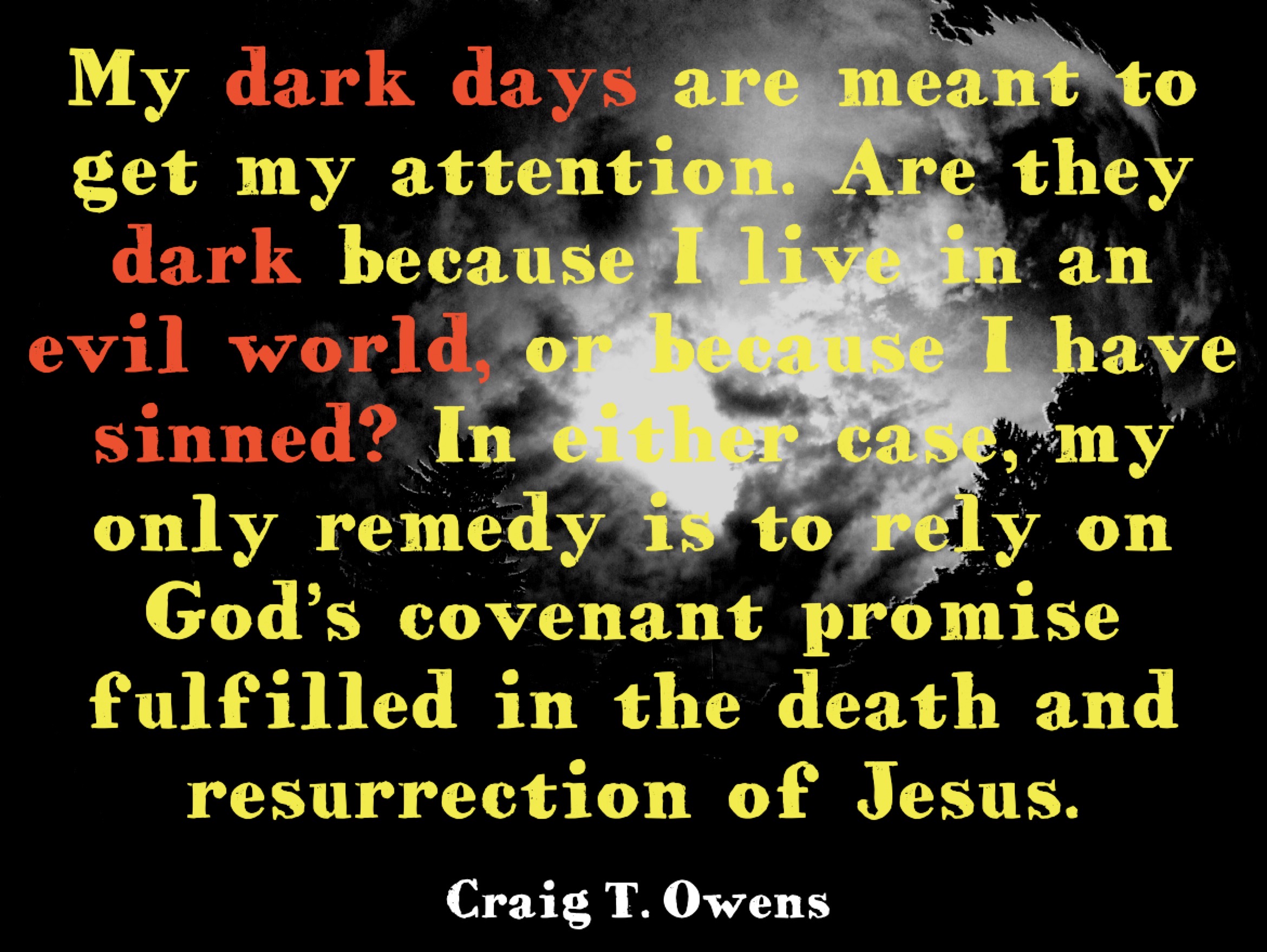
My dark days are meant to get my attention. Are they dark because I live in an evil world, or because I have sinned? In either case, my only remedy is to rely on God’s covenant promise fulfilled in the death and resurrection of Jesus. 

If you’ve missed any of the other messages in our Selah series, you can find a complete list by clicking here.

►► Would you please prayerfully consider supporting this ministry? My Patreon supporters get behind-the-scenes access to exclusive materials. ◀︎◀︎

The Reality Of Temporary Darkness…

Listen to the podcast of this post by clicking on the player below, and you can also subscribe on AppleSpotify, or Audible.

A father came home from work and noticed a note addressed to him taped to his teenage son’s door:

Dear Dad, 

Jason and I borrowed Mom’s car to go to Taco Bell. I know I didn’t have permission, but I thought we’d be back before you and Mom got home. Unfortunately, I hit a pothole and blew out the front right tire. 

We jacked up the car to put on a spare tire, but the jack slipped and the car rolled backward into the ditch. 

Bill came with his pickup to pull us out, but the tow strap pulled off the front bumper and the car rolled further down the hill and sunk in the pond. 

I bought a bus ticket to get out of town and go enlist in the Army. Give Mom a hug and I’ll see you both in about 2 years. 

Love, your son

P.S. None of the above is true. Mom took her car to Aunt Jan’s house and I rode my bike to Jason’s house. However, I hope the fact that none of these bad things actually happened will help you put in perspective the D+ on my report card. 

We like to manage expectations, don’t we? We frequently deliver bad news with the good news close by. 

Psalms 88 and 89 are written by brothers: both of them are called Ezrahite, and both of them were worship leaders in the tabernacle. And until Solomon, these guys were considered the wisest in the land (1 Chronicles 2:6; 15:19; 1 Kings 4:29-34). 

I believe these two psalms form a couplet. They make up the last two psalms of Book III in the Psalter, with Psalm 89 ending with, “Amen and Amen.” Both of them label their psalms a maskil which means “a poem of contemplation” (NKJV). And look how Psalm 88 leaves us in the dark, while Psalm 89 shines a light in the dark.

In Psalm 88, Heman soberly prepares us for his two-Selah psalm in his introductory remarks. He uses a phase mahalath leannoth which means someone who is so physically weak from emotional grief that they are now battling depression. The NLT calls it “the suffering of affliction.”  

Heman is describing a reality: We will all experience pain in this life. Maybe even for our entire earthly life—from my youth I have been afflicted and close to death (v. 15). Heman’s reality is seen in his words in the first five verses of this psalm. 

His first Selah is breathtaking because he wants us to pause to realize that God has allowed all of this (notice the pronoun You in vv. 6-8, 16-18). But still, Heman knows God saves because he has made a decision to continue to praise Him even in the dark times (vv. 1-2, 9, 13).  

Heman’s second Selah comes in the middle of a series of five questions (vv. 10-14) that sound a lot like both questions Jesus asked in Gethsemane and from the Cross, and the reality of the temporary darkness He was facing (Psalm 22:1-2; Luke 22:53; John 19:11). 

Even the way Heman closes his psalm foreshadows the darkness surrounding the death of Jesus: “My God, My God, why have You forsaken Me? 

Jesus tasted all of this darkness for us so that He could be our perfect and empathetic High Priest (Hebrews 5:7, 4:15-16). 

Psalm 88 shows us the reality of temporary darkness (like Good Friday), but Psalm 89 points us to the certainty of eternal light (like Resurrection Sunday)! 

So when you are battling your dark times, let me give you these assurances: 

  1. This darkness is only temporary (Romans 8:18) 
  2. Jesus walks with us in our dark times (Romans 8:26-39)
  3. The darkness cannot prevail—Jesus tasted all of this temporary darkness for us so that He could be our eternal High Priest!

If you’ve missed any of the messages in our Selah series, you can check them out by clicking here. Please join me on Sunday when we will look at Ethan’s words in Psalm 89 about the certainty of the eternal light. 

►► Would you please prayerfully consider supporting this ministry? My Patreon supporters get behind-the-scenes access to exclusive materials. ◀︎◀︎