Greg and I challenge you to take a phrase from our amazing military personnel: Change “I work here” to “I serve here.” Then just as we express our thanks to our active duty and retired service members—“Thank you for your service”—others at our workplaces can say the same thing to us.
“The human mind never goes so fast as that except when it has got into a groove.” —G.K. Chesterton
“In the opening paragraph of Revelation, we’re met by the encouragement, ‘Blessed are those . . . who keep what is written in [this prophecy]’ (1:3). Then at the conclusion we’re reminded, ‘Blessed is the one who keeps the words of the prophecy of this book’ (22:7; see also 22:9).” Justin Dillehay then outlines three ways Christians can “keep” the Book of Revelation.
“For it is not so much of our time and so much of our attention that God demands; it is not even all our time and all our attention; it is ourselves. … When we try to keep within us an area that is our own, we try to keep an area of death. Therefore, in love, He claims all. There’s no bargaining with Him.” —C.S. Lewis, The Weight of Glory
T.M. Moore also wrote about the Intimate Glory we have in Jesus: “The greatness of our great salvation is to be known in the Presence of Jesus, God With Us, and the intimacy of peace, safety, rest, and joy we know in Him. Take away all the outward trappings and benefits of our salvation, and we will still, like Peter, be overjoyed just to be with Jesus. The hope of sharing in His glory—not just then and there but now and here in all we do—refreshes and excites our soul and energizes our bodies for daily obedience.”
And a voice came from the throne, saying, “Give praise to our God, all you His bond-servants, you who fear Him, the small and the great.” Then I heard something like the voice of a great multitude and like the sound of many waters, and like the sound of mighty peals of thunder, saying, “Hallelujah! For the Lord our God, the Almighty, reigns.” (Revelation 19:5-6)
What a song of praise is raised in Heaven!
You can join that heavenly choir every day when your life (and words) express your firm belief that your God is sovereign and you are His servant. That means your life lifts a mighty “Hallelujah!” when you live like this: “Not my will but Yours! May Your will be done on earth as it is in Heaven. Not to me, but may all of the glory and honor go to You!”
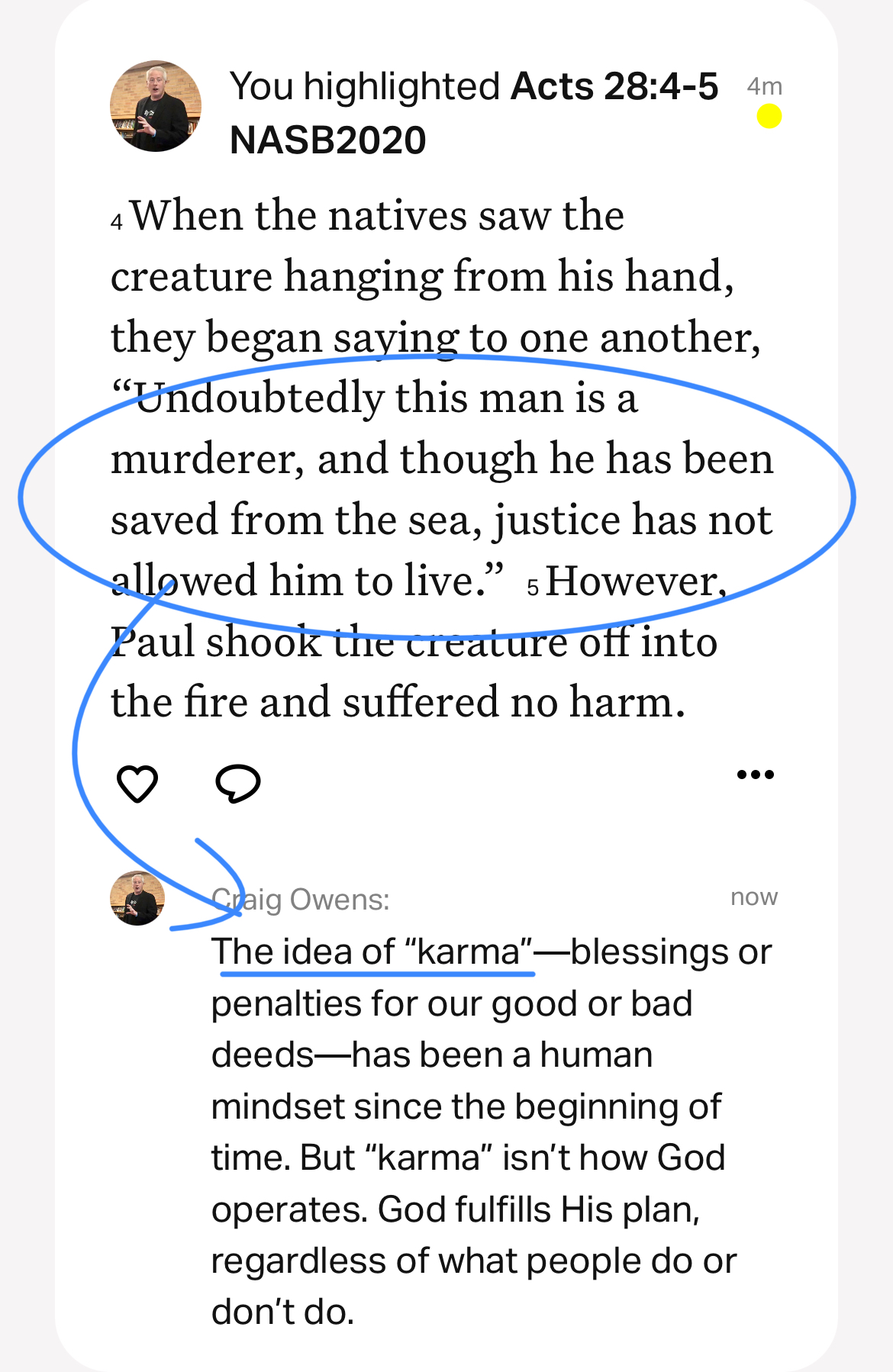
When the natives saw the creature hanging from his hand, they began saying to one another, “Undoubtedly this man is a murderer, and though he has been saved from the sea, justice has not allowed him to live.” However, Paul shook the creature off into the fire and suffered no harm. (Acts 28:4-5)
The residents of Malta thought the apostle Paul was experiencing karma.
The idea of “karma”—blessings or penalties for our good or bad deeds—has been a human mindset since the beginning of time.
This is really the mindset among Job’s three friends: Good things always happen to good people and bad things always happen to bad people. Except Job’s friends were wrong. We know this because we see behind the scenes in Heaven at the beginning of the story, and we hear God reprimand these men at the end of the story.
“Karma” isn’t how God operates. God fulfills His plan, regardless of what people do or don’t do.
In this story in Acts 28, God had promised Paul, “You must testify about Me in Rome,” so Paul was invincible until that promise from God was fulfilled.
To chalk things up to “karma” is to deny God’s sovereign plan. We have to guard our minds against this kind of thinking because it slips in so naturally. A part of renewing our minds (Romans 12:1-2) is not jumping to our conclusion, but trusting that God is sovereignly at work.
You may also want to check out these related blog posts:
Listen to the podcast of this post by clicking on the player below, and you can also subscribe on Apple, Spotify, or Audible.
The events in the Bible are rooted in history. These are actual events in which real people lived in a moment in recorded history. The songs of ascent were sung both pre-exile and post-exile. The post-exile pilgrims were returning to Jerusalem after the edict of King Cyrus (2 Chronicles 36:22-23).
The first pilgrims to go up to Jerusalem after the exile were the rebuilders of both Jerusalem and the temple, and they faced heavy opposition (Ezra 4:1-5; Nehemiah 4:1-3, 7-8). In light of these events, I think the song of ascent in Psalm 125 is especially pertinent to this situation.
The middle verse of Psalm 125 contains a warning to godly people. God’s followers may be tempted to grab earthly political power to try to make things right—to “fight fire with fire.” The phrase “the scepter of the wicked” symbolizes the royal authority of a foreign conqueror. In other words, we might justify using the scepter of the wicked because we think “the ends justify the means.” But notice the warning if we do: “the righteous might use their hands to do evil.”
You can see this in a couple of other biblical translations. The Amplified Bible says, “lest the righteous (God’s people) stretch forth their hands to iniquity and apostasy,” and the New Living Translation says, “the godly might be tempted to do wrong.”
Instead, we are called to look to God for our security. Psalm 125:1-2 sounds like an echo of Psalm 121, in which we are reminded that our God is unshakable, unrivaled, and eternal. Political parties come and go, even evil dictators and tyrannical regimes come and go, but the Sovereign God remains forever. All of History is His story!
Chuck Colson used to frequently remind his audiences, “Salvation does not arrive on Air Force One!”
The motto on our US currency is still accurate: In God we trust! Psalm 125:4 says the same thing: God does good to those who trust Him.
Earlier I mentioned the opposition that Ezra and Nehemiah recorded. Let me also share with you how these God-fearing men instructed the Jewish people to respond. Ezra says that the prophets called them to remember “the name of the God of Israel, who was over them,” and three times Nehemiah records that their response was prayer to God (Ezra 5:1; Nehemiah 4:4, 9; 6:9).
In God we trust, not in political power. On the flip side, Psalm 125:5 warns us that God treats as evildoers those who look to the worldly scepter to try to get ahead.
So when opposition and even persecution come, we should pray to God and ask for Him to remove the scepter of the wicked. Let’s pray for God to put His favor in the hearts of even ungodly leaders. Ezra recognized this when he said—
Praise be to the Lord, the God of our ancestors, who has put it into the king’s heart to bring honor to the house of the Lord in Jerusalem in this way and who has extended His good favor to me before the king and his advisers and all the king’s powerful officials. Because the hand of the Lord my God was on me, I took courage and gathered leaders from Israel to go up with me.(Ezra 7:27-28)
The New Testament calls on Christians to pray for those in governmental leadership over us (1 Timothy 2:1-2). But perhpas you ask, “What exactly are we to pray for these leaders?” Solomon wrote, “The king’s heart is like channels of water in the hand of the Lord; He turns it wherever He wishes” (Proverbs 21:1). So perhaps a God-honoring prayer is to ask for our leaders’ hearts to be moved as King Cyrus’ heart was.
“God is King of kings and ultimately always wins, always gets His way. Even when it seems that earthly authorities continually rebel against the Lord and His Anointed, the reality is that even their most heinous acts are turned against them. It must be very frustrating to be the devil and to constantly see how God turns situations to gospel good and God’s unique glory. God is so wise that He turns the hearts of authorities without them knowing it. Smug on their decaying thrones, the power brokers of this world revel in their supposed autonomy and imagined resistance, never realizing how foolish they look to the angel hosts who are privy to God’s unmatched strategic dominance.”
Let’s never try to fight fire with fire, but let’s turn repeatedly to God in prayer whenever opposition arises against God-fearing people anywhere.
Listen to the podcast of this post by clicking on the player below, and you can also subscribe on Apple, Spotify, or Audible.
As Jesus headed towards Jerusalem, Mark records, “with Jesus leading the way” (Mark 10:32).
The Greek word for “lead” is proago. The prefix pro- means before or in front, and the root word -ago means to lead oneself, to lead by accompanying, or to lead by taking hold. This means that Jesus never sends us off by ourselves. He goes before us, with us, alongside us.
One would think that this would give the disciples great comfort. But Mark also records two unexpected responses from these men: “astonished” and “afraid.”
The words “astonished” or “amazed” are both the same word in Greek and are used both here and just a couple of verses earlier (verse 24), when Jesus said how hard it was for a rich person to enter into the kingdom of God. That statement amazed the disciples. Now they are astonished that Jesus is going to Jerusalem. “After all,” they might be thinking, “That’s where His main antagonists are headquartered! Why would He go there?”
It appears that the father they went on their journey, the more their astonishment morphed into fear. The Greek word here is the one for which we get the word “phobia”—the kind of fear that can paralyze us or tempt us to run away.
There are two things that Jesus does here to help His fearful friends:
(1) He gives them the unvarnished facts: “We are going up to Jerusalem…and the Son of Man will be delivered over to the chief priests and the teachers of the law. They will condemn Him to death and will hand Him over to the Gentiles, who will mock Him and spit on Him, flog Him and kill Him….”
Leaders who want to honor Jesus in their leadership would do well to follow this example—Give your fearful friends both the facts (no matter how painful they might seem) and the unshakable hope that God is sovereignly in control.
A mark of a godly leader is one who is striving to lead more and more like Jesus.
Let’s keep studying His life and allowing the Holy Spirit to teach us the lessons we can apply in our leadership roles.
This is part 70 in my series on godly leadership. You can check out all of my posts in this series by clicking here.
There is something very important that mature leaders need to remind themselves of so that they can help emerging leaders become successful. You can watch out this full conversation about mulligans and do-overs on the most recent episode of The Craig and Greg Show. Be sure to check out all of my videos on my YouTube channel.
In my sermon on Sunday, I talked about the sovereignty of God over world affairs and world leaders. This is a great reminder from John Newton:
Sovereignty is but another name for the unlimited exercise of wisdom and goodness.
Merat Sultan was born in the shah of Iran’s palace in 1876. He became the chief of police and of the army in Tabriz, Iran. When the Russians invaded and occupied that area, they made plans to execute Sultan. How he escaped actually led him to a relationship with Jesus as Sultan became a Christian. Check out this fascinating story from the website Praying For Muslims. I would also urge you to check out their weekly prayer guide.
“No voice. No contribution. No significance. No meaning.
“Invisible.
“That’s the way many women probably felt at the time Jesus lived. And every person with an illness—cancer, leprosy, epilepsy, mental disabilities—every one of those people were marginalized. In Jesus’ day, what careers were on the lowest rung of the corporate ladder?—fishermen and shepherds. Yet when you read every account of Jesus, who do you see Him hanging around? Fishermen, shepherds, women, and people dealing with health issues.
“Jesus wanted it that way. He took every opportunity He had to bring people in from the fringes and give them His full attention. He saw them. He listened to them. He loved them in ways they’ve never been loved before. They had never experienced anything like it.”
T.M. Moore wrote, “We are becoming so accustomed to the forsaking of traditional values, the undermining and fragmenting of long-established institutions, and the breakdown of morality and civility that we can begin to think that these conditions are the new normal, the best we can hope for in an age in flight from God. Everywhere we look in our day, the prophetic words of William Butler Yeats, in his 1919 poem, ‘The Second Coming,’ seem to be coming true: ‘Things fall apart; the centre cannot hold;/Mere anarchy is loosed upon the world./The blood-dimmed tide is loosed, and everywhere/the ceremony of innocence is drowned.’ But the appearances, which press upon us daily, are only a matter of perspective.” Check out the rest of his post.
When things are going well, how can we talk about our success in a way that glorifies God? John Piper had a thoughtful answer to a businessman who asked how he could talk about the success of his business and make God look great while he was doing so.
Listen to the podcast of this post by clicking on the player below, and you can also subscribe on Apple, Spotify, or Audible.
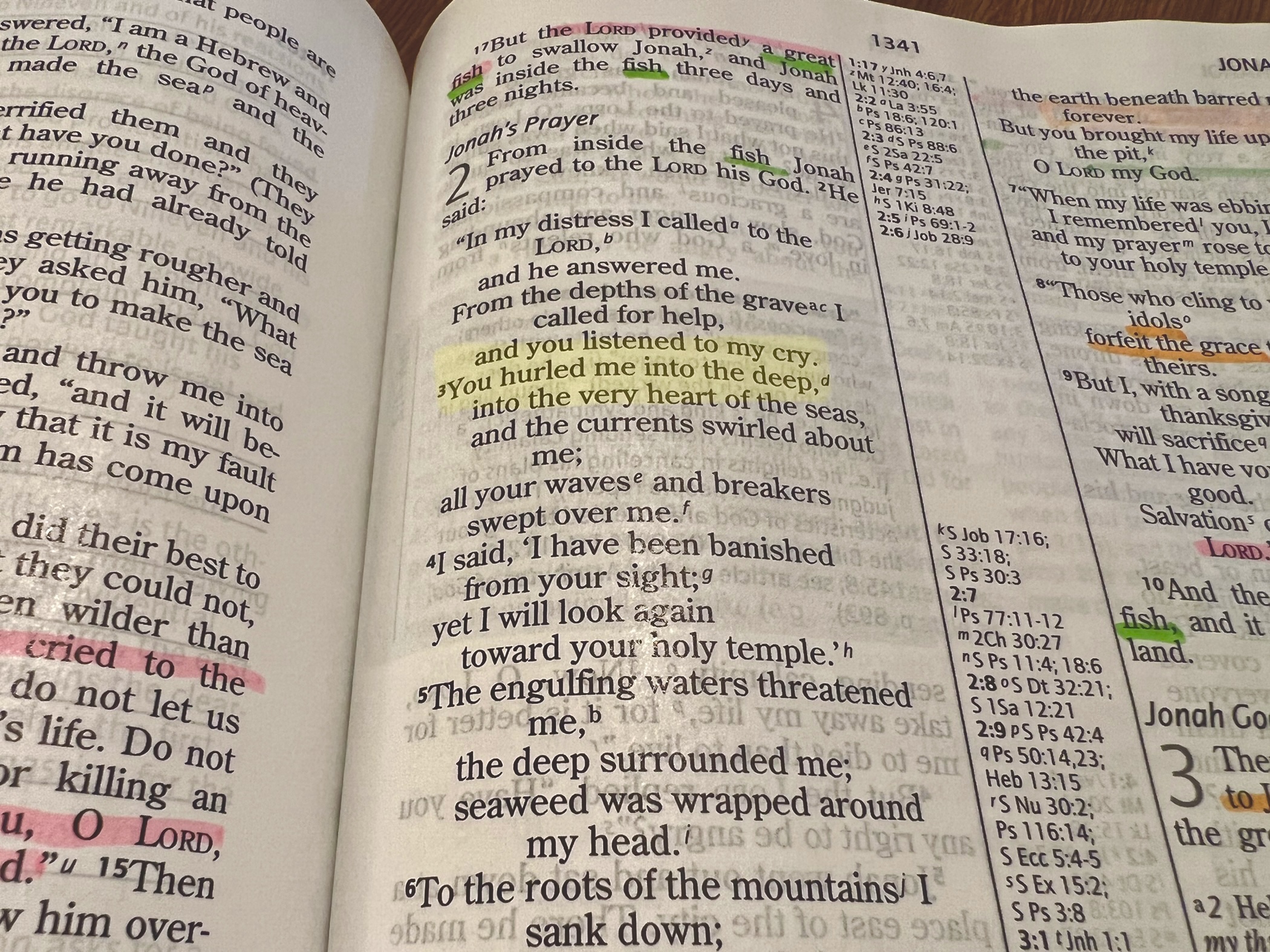
I think the story of Jonah is pretty well-known. God calls Jonah to take His message to Nineveh. Jonah agrees to do this, but then promptly boards a ship heading in the opposite direction. To get his attention, God sends a storm that rocks this boat so violently that the sailors can do nothing to make any headway. Ultimately, Jonah asks the sailors to throw him overboard. As soon as Jonah hits the water, the storm stopped and Jonah is swallowed alive by a great fish that God had provided.
The story continues with this narrative: “From inside the fish Jonah prayed to the Lord his God” (Jonah 2:1). In the next verse, Jonah repeats, “In my distress, I called to the Lord, and He answered me.”
It appears that Jonah’s first prayer may have been on the deck of the storm-tossed ship. Perhaps he prayed something like, “God, I know I have sinned against You. Please have mercy and get me out of this! I promise I’ll obey You this time.”
How did God answer that prayer? Jonah says God answered like this: “You hurled me into the deep.”
That probably is not the answer to prayer that Jonah was expecting!
I remember when my friend was in a similar place. He had sinned against both God and his employer, and found himself in a whole lot of hot water. As a result, he lost his job.
That probably is not the answer to prayer that my friend was expecting! And yet it was the best answer. He shared with me several months later that getting fired not only got his attention, it helped him put his focus back on God, and put him on a path where God could use him again.
My friend learned what Jonah also learned: Even in our sinful state, God hears our prayers and He answers our prayers. The answer may not immediately be what we would have selected! But our sovereign God knows the best answer, and we must always trust Him.
Jonah declared, “Salvation comes from the Lord,” and he also promised God, “What I have vowed I will make good” (Jonah 2:9). And he did. This time Jonah did go to Nineveh, he delivered the message God had given, and he called those people to repentance. They responded by humbly turning to God, and God showed them mercy.
My friend, the next time you find yourself in hot water, or in an inescapable storm at sea, or a dire situation at work, remember that you can always call to God. He will answer you. His answer may not be exactly what you expected, but it will be the best answer!
Tomorrow I will release a new full-length video exclusively for my Patreon supporters. This video will tell us how and why we can live as peaceful influencers in a culture that is dark and confused.
For just $5 per month, you can have access to all of my exclusive content as well. Get all the details here.



 Greg and I challenge you to take a phrase from our amazing military personnel: Change “I work here” to “I serve here.” Then just as we express our thanks to our active duty and retired service members—“Thank you for your service”—others at our workplaces can say the same thing to us.







 Craig T. Owens