Praying The Promises (book review)

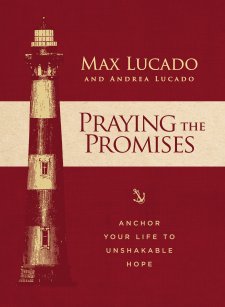
There is no more powerful way to pray than to pray using the Scriptures. If you are a parent, you probably know what it is to have a child say to you, “Mom/Dad, you said….” When we pray to God using God’s Word we’re essentially doing the same thing. A great resource to help you learn how to do this is Max Lucado’s newest book Praying The Promises. 

In the introduction, Max says, “As people who believe God’s promises, we have an advantage. We can determine to ponder, proclaim, and pray the promises of God. We can be like Abraham, who ‘didn’t tiptoe around God’s promise asking cautiously skeptical questions. He plunged into the promise and came up strong’ (Romans 4:20 The Message). We can choose to filter life through the promises of God. For every problem in life, God has given us a promise. When struggles threaten, we can find hope by praying those promises.”

Every chapter contains: 

  • a short “unshakable hope” reminder, 
  • a handful of biblical passages that are the foundation for our unshakable hope, 
  • a model prayer using those passages of Scripture, 
  • a simple declarative “I am” or “I will” statement to carry with you the rest of the day. 

In our hurly-burly, topsy-turvy, anxiety-prone world we need something that can put our feet on solid ground. There can be no more unshakable truth than to know that God keeps His Word, and that we can stand on those rock-solid promises. The prayers in Praying The Promises will, I trust, help you read the Bible in a new light, as you see more and more promises which you can turn into prayer to our All-loving, All-powerful Heavenly Father. 

I am a Thomas Nelson book reviewer.

The Power Of Praying Scripture

I have always been a huge proponent of allowing the Scriptures to help form my prayers. I think there is great value in speaking God’s Word back to Him. 

“Knowing God’s Word helps us pray, and praying helps us know God’s Word.” —Craig T. Owens

I am currently reading Max Lucado’s book Praying The Promises in which he makes the same case. For instance, consider the following passages—

The rain and snow come down from the heavens and stay on the ground to water the earth. They cause the grain to grow, producing seed for the farmer and bread for the hungry. It is the same with My word. I send it out, and it always produces fruit. It will accomplish all I want it to, and it will prosper everywhere I send it. (Isaiah 55:10-11) 

[Abraham] was fully convinced that God is able to do whatever He promises. (Romans 4:21) 

For no matter how many promises God has made, they are “Yes” in Christ. And so through Him the “Amen” is spoken by us to the glory of God. (1 Corinthians 1:20) 

Here’s how Max Lucado turned those passages into a prayer—

Lord, You are the Maker and Keeper of promises. Your Word does not return void. When You say You will do something, You do it. You are able to do whatever You promise. So many years ago You made a covenant with Your people, and You have been faithful to the covenant.

Sometimes it is easier to put my faith in my circumstances rather than in Your promises. I want to rely on myself, my earthly possessions, and the people in my life, but these so often fail me. But Your promises will never fail me!

As I read through Your promises, give me a new passion for them. Show me what promises I have forgotten over the years and need to cling to again. Reveal Your true character to me. Remind me of the power of Your love and Your grace. Strengthen my faith, and teach me to lean on Your Word rather than on myself.

Thank You for keeping Your promises. I’m grateful for the ultimate promise I have in Your Son, Jesus. Amen.

Why don’t you start making this a regular habit yourself.

Thursdays With Oswald—Isaiah 30

Oswald ChambersThis is a weekly series with things I’m reading and pondering from Oswald Chambers. You can read the original seed thought here, or type “Thursdays With Oswald” in the search box to read more entries.

Isaiah 30 

[These are the notes on Oswald Chambers’ lecture on Isaiah 30.] 

     The test of true religion is the knowledge of the character of God. As long as you think of God in the quietness of a religious meeting you will never know God—what kind of God have you got when you are in touch with the wrong, bad, evil things? God’s Book reveals that it is right in the midst of the very opposite of God that His blessings occur. The very things which seem to be making for destruction become the revealers of God. It is an easy business to preach peace when you are in health and have everything you want, but the Bible preaches peace when things are in a howling tumult of passion and sin and iniquity; it is in the midst of anguish and terror that we realize Who God is and the marvel of what He can do. …  

     God makes His people sing where in the eyes of the world it seems ironical to sing—in a besieged city where things are going to ruin, in the suburbs of hell, in the valley of the shadow of death. When you see lives in the midst of turmoil and anguish full of amazing brightness and uncrushable elasticity of faith in God, if you do not know God you will say, “However can they go through it? how is it that they remain undiscouraged and undismayed?” The explanation is the presence of God made real in His promises.” 

From Notes On Isaiah 

When you go through a “howling tumult” there are some things to remember:

  1. God is with you
  2. God is in control 
  3. God will help you sing through the storm
  4. Others are watching you
  5. God can be glorified in your undismayed faith in His presence through the tumult 

15 Reasons Not To Fear

Listen to the podcast of this post by clicking on the player below, and you can also subscribe on AppleSpotify, or Audible.

In the first 39 chapters of Isaiah, there is a lot of doom-and-gloom prophecy about coming judgment. But as the fortieth chapter opens, there is a decidedly more upbeat outlook as prophecies about the Messiah and the coming of God’s Kingdom unfold before us. 

Fittingly, there is a recurring phrase that wasn’t heard in the first 39 chapters of Isaiah—FEAR NOT. 

Why does Isaiah tell us so many times to banish fear? Here are 15 reasons that God gives: 

  1. God says, “I am with you.” 
  2. God says, “I will strengthen you.” 
  3. God says, “I will uphold you.” 
  4. God says, “Those who contended with you shall be as a nonexistent thing.” 
  5. God says, “I will hold your hand.” 
  6. God says, “I am in control.”
  7. God says, “I will make you into something irresistible.” 
  8. God says, “Everyone will see the amazing things I will do for you.” 
  9. God says, “Anything apart from Me is worthless.” 
  10. God says, “I have redeemed you.” 
  11. God says, “You are Mine.” 
  12. God says, “I know you by name.” 
  13. God says, “I will go through floods and flames with you and you will not be drowned or burned.” 
  14. God says, “Nothing ever takes Me by surprise.” 
  15. God says, “I alone am God and everyone else is a mere man.” 

Bottom line: God’s Word gives us ample reasons to root out fear from our heart. 

Read these promises for yourself in Isaiah 41:10, 13, 14; 43:1-2; 44:8; 51:12.

►► Would you please prayerfully consider supporting this ministry? My Patreon supporters get behind-the-scenes access to exclusive materials. ◀︎◀︎

Help!

David and his men are on the run from King Saul, but they hear that the small town of Keilah is being harassed by the Philistines. The bad guys are stealing the harvest from the people of Keilah, making it a very real possibility that they would starve during the upcoming winter. In his usual habit, David prays and asks God if he should help the people of Keilah, and God gives him the go-ahead to attack.

David and his men defeat the Philistines, not only returning the crops that had been stolen but also delivering some livestock that they took from the defeated Philistines. You might expect that David and his men were given a ticker-tape parade. Instead, as soon as David was within the city’s walls, he finds out that the people of Keilah are planning to sell him out to King Saul. Talk about ingratitude!

David and his men flee to the Desert of Ziph, where they won’t be a bother to anyone. Except the Ziphites get word to King Saul that they will gladly turn him over to the King whenever he asks for it.

What is David’s response? As usual, it’s prayer. His prayer is short and straight to the point—

Help, Lord, for the godly are no more; the faithful have vanished from among men.

In other words, David asks God, “Where have all the decent people gone?” It’s no different in our day, as Paul told his friend Timothy that people will only become more hypocritical liars, with their conscience not bothering them a bit!

What I love about David’s prayer is that he quotes God back to God. Check out the quotation mark: “Because of the oppression of the weak and the groaning of the needy, I will now arise. I will protect them from those who malign them.” And then David is quick to add that God’s words never fail! 

I am convinced that our spiritual battles are largely lost or won in our minds. We need to recall God’s Word—Yet this I call to mind and therefore I have hope: Because of the Lord’s great love we are not consumed, for His compassions never fail (Lamentation 3:21-22).

So we cry, “Help!” to God because He is the only One who can help us: The Lord is my Helper; I will not be afraid. What can man do to me? (Hebrews 13:6).

But David has an important question to ask: “How long do we continue to call for help?” Have you ever asked God that?

Jesus said that the key to our successful praying is for us to remain in Him and for His Words to remain in us, like a branch remains connected to the vine (John 15:7). So let me ask you a question: How long should the branch remain connected to the vine before it’s ready to go off on its own?

The answer is simple—if the branch wants to remain alive and fruitful, it must stay in relationship with the vine forever!

So once again, look at how Jesus answers the “How long?” question—Keep on asking and it will be given you; keep on seeking and you will find; keep on knocking reverently and the door will be opened to you. (Matthew 7:7)

“Help!” is a great prayer that God loves to answer. “How long” do we pray that prayer? Until it’s answered … keep on, keep on, KEEP ON!

10 Quotes From “Longing For A Changed World”

Longing For A Changed World will help you (re)establish a prayer focus that could be the beginning of the next great revival! You can check out my full book review here, and then enjoy some of the quotes that especially caught my attention.

“Our age, severed from its Biblical moorings, is neglecting history’s lessons.”

“Another characteristic of today’s Church is a lack of prayer. Instead of communing and listening to God, lifting our needs and concerns to the Lord, we rely on our own abilities and in technology to compensate for any inadequacy we may have. Thus armed, we are confident in taking on the challenges of our day, even those spiritual in nature.”

“True revival impacts all aspects of life, even to the concerns of the last, the least, and the lost. A people who uphold justice and righteousness and seeks to alleviate the plight of the poor and needy, are a people truly gripped with revival. For when we are consumed with God’s holiness and how blessed we are by His grace, we are compelled to take this Gospel to all aspects of our culture.”

“Our propensity is to focus on being doers—to be on the battlefield, sword in hand, fighting for the Kingdom and for righteousness. But as in the battle with the Amalekites, battles are won by God’s people lifting up their arms to the Lord.”

“I have been more focused on what I wanted to say in my prayer than on Whom I am approaching in prayer. This often leads to prayer that amounts to a tallying-up of my wants, without proper regard for the One into Whose presence I have come.”

“Our prayers as a whole, and prayers for revival, should reflect our poverty and powerlessness before a God who is forgiving and gracious.”

“Pray for boldness in the church—boldness to proclaim God’s Word and to firmly stand on it. Pray for boldness to confront sin yet boldness accompanied with humility as the church is aware (painfully aware) of its own sinfulness. And pray for boldness to present Christ as the Way and the Truth.”

“Praying expectantly requires us to pray to God in line with His Word and His promises. Thus a decline in biblical literacy has resulted in our prayer life wavering as well.”

“Our pleas for revival will go unheeded until we stand up for God’s Word, forsake the idols of our age, shake off the trappings of our secular and materialistic age, and embrace God’s truth.”

“As we pray for revival—for changed lives, renewed churches, and a transformed culture—our tendency might be to enlist the charismatic, the eloquent, and those who project confidence and success, traits that so readily appeal to us. But God’s manner of bringing revival has often been through ordinary people who endure affliction, hardship, and suffering, much as he did with Paul and Timothy and the Apostles.”

I’ll be sharing more resourced and thoughts from this book soon, so stay tuned!

How Our Faith Is Perfected

“God’s promises and His provision do not lift us from the world of common sense and everyday trials, for it is through these very things that our faith is perfected.” —Lettie Cowman, in Streams In The Desert

9 Quotes From “Know Who You Are”

Tim Tebow is not only an upbeat athlete, he is an enthusiastic encourager to others too. His latest book is called Know Who You Are—Live Like It Matters. Although mainly written to help homeschool families with some journaling ideas, this book is jam-packed with uplifting thoughts. You can check out my full book review by clicking here.

“The world does not define you: Not the clothes you wear. Not the kind of music you listen to. Not the mistakes you’ve made. Not the trophies you’ve won. You are not defined by what others think of you, good or bad, or how many people follow or like you on Instagram or Snapchat or Facebook. You are not defined by the talents you have or don’t have. There is only one thing, one Person, who defines your identity. His name is Jesus Christ.”

“If you do the right thing just to do the right thing, you’re going to wear yourself out at some point. We should always do the right thing because we want to honor Jesus, because we want to be like Him in everything we think, say, and do. … This is why we seek to have integrity. This is why we build good character. This is why we do the right thing. Because Jesus did it first and our mission is to be like Him.”

“What happens when we hide God’s Words in our hearts? We grow our faith. When we grow our faith, we root our identity deeper and deeper in Whose we are. We become empowered with what we need so we can face the highs and lows of life.”

“When our identity is grounded in God, we live differently. Our priorities change. Our relationships reflect this truth—or at least they should. We aren’t desperate for attention because God fulfills all our needs. Instead of using people to make us look good, we learn how to be faithful friends. We treat others with love, respect, and kindness. We watch what we say. We apologize when we make mistakes.”

“If you hear a rumor about someone else, stop it from going any further. Don’t repeat it. You can also turn the conversation into something positive. Say something nice about that person. Show some grace. That’s a sure way to honor God and fan the flames of love.”

“If we mean it when we say ‘I’m sorry,’ do you know what that does for us? It keeps our hearts tender. Not weak, just open to God shaping us into the young men and women He has created us to be.”

“We live in such a me-focused world. We take pictures of ourselves all the time. We tell the world on Facebook and Instagram what we’re doing, what we like, where we are going. We want all eyes on us. But that’s not what we’re called to do as Christians. We’re called to be others-minded. We are called to love others. We’re called to serve others. We are called to be like Jesus to a world who doesn’t know Him.”

“The stand you take may not be the biggest deal to the entire world, but it can be a big deal for one person. For instance, you don’t have to feed all of Africa, but feeding one person can have more of an impact than you may realize.”

“We are never going to be perfect in this life. But we can stretch and we can change. If you want to live bigger, you need to grow. No matter how many times you get knocked down or mess up, you need to hold on to God’s promises. You need to believe that He has a better plan. You need to cling to His truth. And day by day, moment by moment, you will become more and more like Jesus.”

The Promised Power Of Pentecost

When the Israelites were delivered from Egypt on the night of Passover, fifty days later they arrived at Mount Sinai where God delivered the Ten Commandments to them. This became the birth of the Jewish nation. For millennia following this, not only did the Jewish people observe Passover but they also celebrated “The Feast of Weeks” (also known as Pentecost) fifty days following Passover.

But on the first Pentecost after Christ ascended to Heaven, something amazing happened which was a game-changer for the new Christians. An event which became the birth of the Christian nation.

On that Pentecost Sunday, the Holy Spirit was poured out on Christ’s followers in a way never before seen in history. Although this had never been seen before, it was the fulfillment of something God had promised thousands of years before.

  1. Promised

This blessing of the Holy Spirit had been hinted at when God first called Abraham, as He promised that from Abraham would come a blessing for all peoples on earth (Genesis 12:3). Jesus said that this blessing would be realized with the outpouring of the Holy Spirit, and then Peter tied the Day of Pentecost experience to the fulfillment of those promises (Acts 2:38-39).

  1. Commanded

Jesus had this empowerment of the Holy Spirit and He wanted all of His followers to have it too, so His directive to His follower is not a suggestion. Twice when Jesus tells His followers to receive the baptism in the Holy Spirit, the verbs He uses are commands (see Luke 24:49 and Acts 1:4).

  1. Normal Experience

For the first Christians, the baptism in the Holy Spirit was a normal experience for them following salvation. This baptism gave them power to…

  1. Initial Evidence

The baptism in the Holy Spirit is accompanied by an initial physical evidence of speaking in a language you’ve never studied. This is to be an unmistakable proof—primarily to you—of the Spirit’s outpouring. But the ongoing development of Christlike character is the continual evidence of the baptism in the Holy Spirit.

So what’s the controversy? Why do people spend so much time arguing this baptism isn’t for us, or for now? If we start down that path, what else are we going to say is outdated or exclusive for some?

Doesn’t it seem much more logical to simply accept what God promised all His people?!

So here’s the question I would ask you—Have you been baptized in the Holy Spirit? If not, why not?

7 Quotes From “The Dawning Of Indestructible Joy”

the-dawning-of-indestructible-joyThe Dawning Of Indestructible Joy is a wonderful book from John Piper to prepare your heart for celebrating Christ’s First Advent! It’s arranged as a 25-day countdown until Christmas morning. Check out my review of this book here, and then enjoy a few quotes that caught my attention.

“The coming of Jesus was a search-and-save mission. ‘The Son of Man came to seek and save the lost’ [Luke 19:10]. So Advent is a season for thinking about the mission of God to seek and to save lost people from the wrath to come. … ‘As the Father has sent Me, even so I am sending you’ (John 20:21). It’s the story of how the vertical advent of God in the mission of Jesus bends out and becomes the horizontal advent of Jesus in the mission of the church. In us.”

“If there is a longing in your heart this Advent for something that the world has not been able to satisfy, might not this longing be God’s Christmas gift preparing you to see Christ as consolation and redemption and to receive Him for who He really is?”

“Christmas is about the coming of the Son of Man who ‘came not to be served but to serve, and to give His life as a ransom for many.’ These words in Mark 10:45, as a brief expression of Christmas, are what I hope God will fix in your mind and heart this Advent. Open your heart to receive the best present imaginable: Jesus giving Himself to die for you and to serve you all the rest of eternity.”

“Take the very personal words of the Apostle Paul and make them your own. ‘The life I now live in the flesh I live by faith in the Son of God, who loved me and gave Himself for me’ (Galatians 2:20). This is how Jesus destroyed the works of the devil and rescued us from our sin. Don’t leave Christmas in the abstract. Your sin. Your conflict with the devil. Your victory. He came for this.”

“The point is that when Jesus comes, He confirms the truth of all God’s promises. He shows that God is trustworthy; He keeps His word. … Christ came to prove that God tells the truth, that God keeps His promises. Christmas means that God can be trusted.” 

“It is God’s message of hope this Advent that what is good need never be lost and what is bad can be changed. The devil works to take the good and bring the bad. And Jesus came to destroy the works of the devil [1 John 3:8].”

“This is what God does again and again. He may be doing it for you this Advent season—graciously and tenderly frustrating you with life that is not centered on Christ and filling you with longings and desires that can’t find their satisfaction in what this world offers, but only in the God-man. What a Christmas gift that might be! Let all your frustrations with this world throw you onto the Word of God. It will become sweet—like walking into paradise.”