Links & Quotes

The writer of the Book of Hebrews challenges Christians to learn how to better encourage others and spur them on to their very best. This means we have to go deeper in our relationships with people. Here’s one way not to do this. 

I have a lot of new video content on my YouTube channel every week. Please check it out and subscribe so you don’t miss anything.

T.M. Moore cautions us against having a “too small God” mindset. He writes, “We are short-changing the people of God unless our preaching and teaching fits them to seek the Kingdom of God and the restoration of the world in all our life and work. We do not expect to recreate the original conditions that existed before the fall, but to remember them, to recall them, to recover a measure of them for the life of the world and, by so doing, to point ahead to the new and better and fully remade world that is to come.”

More archeological evidence from the city of Jericho helps scholars date the exodus from Egypt more precisely as well. All of this reinforces the absolute historicity of the biblical accounts. 

“The Pentecostal movement emerged at the turn of the 20th century, resulting from a series of overlapping revivals that occurred around the world.” One of those revivals was in Wales. 

“Although [traditional scientists] feel certain that dinosaurs went extinct 66 million years ago, unremitting soft tissue discoveries from dinosaur fossils openly challenge such age options and validate the creation model.” Check out how the Raman spectroscopy tests are aligning paleontological discoveries with the biblical timeline of Creation.

What Would You Ask For?

If God said to you, “Ask for whatever you want,” what would you ask for?

God did ask Solomon that very question in 1 Kings 3:5. Here’s how Solomon replied—

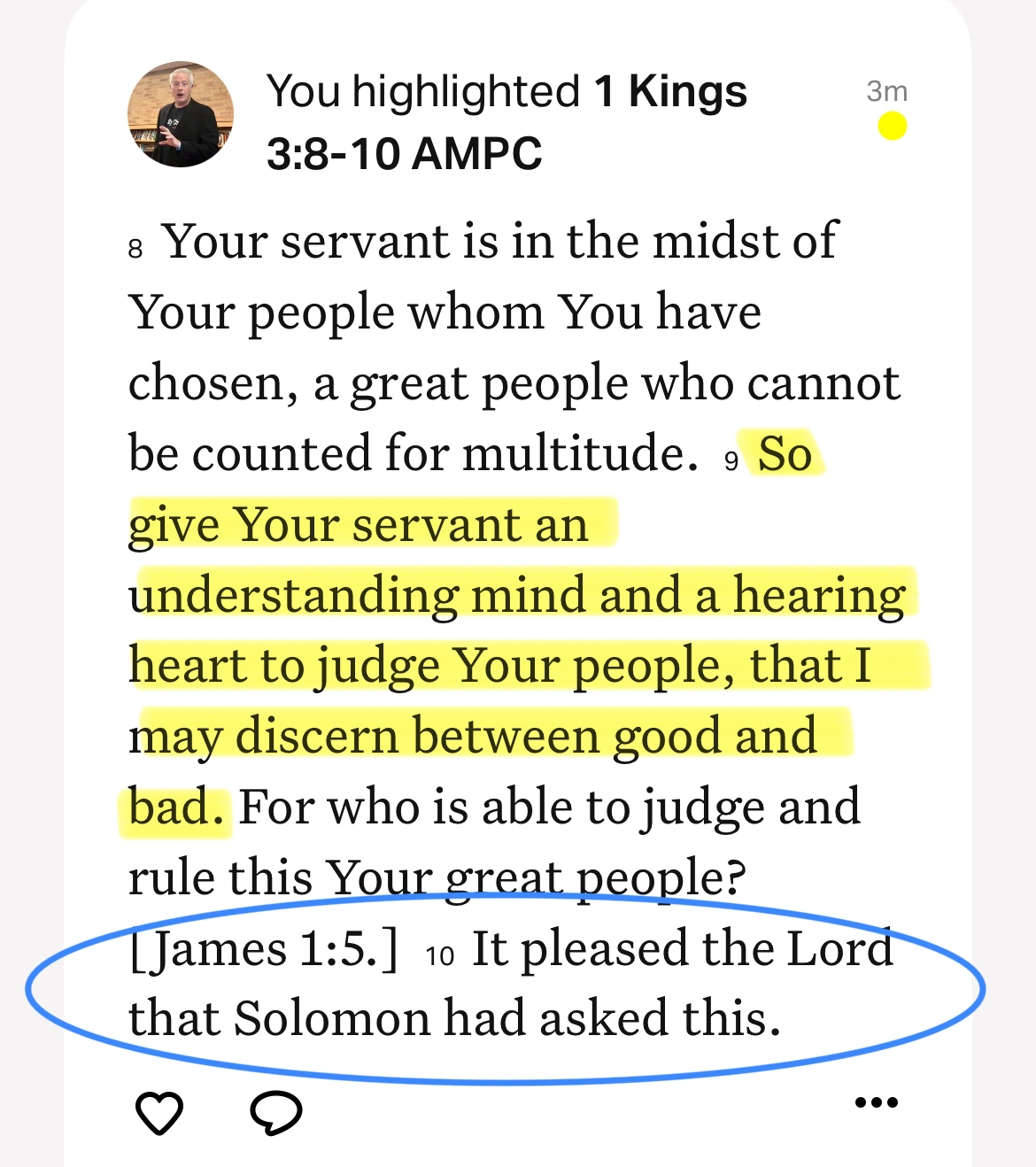
“Your servant is in the midst of Your people whom You have chosen, a great people who cannot be counted for multitude. So give Your servant an understanding mind and a hearing heart to judge Your people, that I may discern between good and bad. For who is able to judge and rule this Your great people?” (1 Kings 3:8-9 AMPC) 

And how did God respond to this request? “It pleased the Lord that Solomon had asked this” (v. 10).

Solomon didn’t ask for things but for a greater intimacy with God—he wanted to know God’s mind. Sadly, we tend to reverse this, saying, “Because I have things, I bless God for them.” 

Instead, our prayer should echo what Solomon prayed here in 1 Kings 3 and what Jesus taught us in His Sermon on the Mount: My desire is solely for Your glory and Your Kingdom (see Matthew 6:9-10, 33). When you pray this way, it will please that Lord that you had asked that! 

Check out these related blog posts and videos:

The Father’s Business

Listen to the podcast of this post by clicking on the player below, and you can also subscribe on AppleSpotify, or Audible. 

The Holy Spirit’s involvement in our lives isn’t reserved for just the “big” things, but He wants us to be aware of and tuned in to His voice and His thoughts all the time. There shouldn’t be a secular-sacred divide in our activities, but we should make every place holy ground and every moment a divine opportunity for God to be glorified. Or said another way, we shouldn’t have times of work and times of worship, but our worship should be seen in every single thing we do. 

I think everyone of us has experienced at one time or another a poor employer or manager. Maybe it’s an employer that demands results but doesn’t give you the training or the tools to do the job. Or maybe you have the training and tools but you don’t know exactly how much you are able to use these things without crossing a line. 

Maybe you have known a boss that is barely present, but when they do stop by the worksite, they aren’t happy with the work that has been done. On the opposite side, maybe it’s a boss who does everything and then gets mad that you aren’t keeping up or working as hard as them. It’s drudgery working for someone like this! 

But, somewhat surprisingly, Jesus used more work examples to talk about the Kingdom of God than He did worship examples. He talked about farmers, bakers, builders, employers, managers, and employees way more than about worshiping, singing, or preaching. 

One of the few glimpses we have of the early life of Jesus shows Him talking about His mission while on earth. Consider the story of Jesus in the temple in Jerusalem when He was 12 years old (Luke 2:41-49). The phrase in the NIV where Jesus says that He must be “in My Father’s house” can be translated…

  • about My Father’s business (NKJV) 
  • dealing with the things of My Father (MSG) 
  • occupied about My Father’s business (AMPC) 

(Check out all of the Scriptures in this post by clicking here.)

Jesus was consistent about this idea of working while He was on earth (John 5:17, 36; 9:4; 17:4). For Jesus, His work was a delight because it was directed by the Holy Spirit (Luke 3:21-22; 4:1, 18-19; Acts 10:38). 

Remember that I mentioned the unreasonable employer that gives us no training, no tools, no goals for which to aim, but expects us to work for his benefit alone. This was not the case with Jesus! He trained us, provided us with the Holy Spirit to guide us, told us the goal for which we were to aim, and said that both His Father would be glorified and we would be rewarded by our Kingdom work done on earth. 

Jesus wants us to work as He did, and He promised that the Holy Spirit would help us in this (John 14:10-12, 24:49; Mark 16:19-20). 

We saw that Luke 2:49 in the AMPC has Jesus saying, “occupied about My Father’s business.” In Luke 19:13 Jesus tells us to “occupy till I come” (KJV). This word is also translated into phrases like: 

  • put this money to work (NIV) 
  • do business (NKJV) 
  • invest this (NLT) 

Jesus is talking about the “talents” given to His stewards (Luke 19:11-13, 16-23). Every servant received the same thing: one mina. We all have been given one life to live; we all have been given 24 hours in a day; we all have been given opportunities to be occupied about our Father’s business. 

The Holy Spirit as our Counselor is there at every moment, every conversation, every decision to help us hear His voice, think His thoughts, and sanctify every experience. Jesus says that He will reward our occupying until He returns. Just doing things like feeding the hungry, giving water to the thirsty, taking care of those in need. This sounds a lot like the work of Jesus in Luke 4:18-19 and Acts 10:38. This Spirit-empowered work earns the commendation from our Master, “Well done, good and faithful servant! Enter into your Master’s happiness!” 

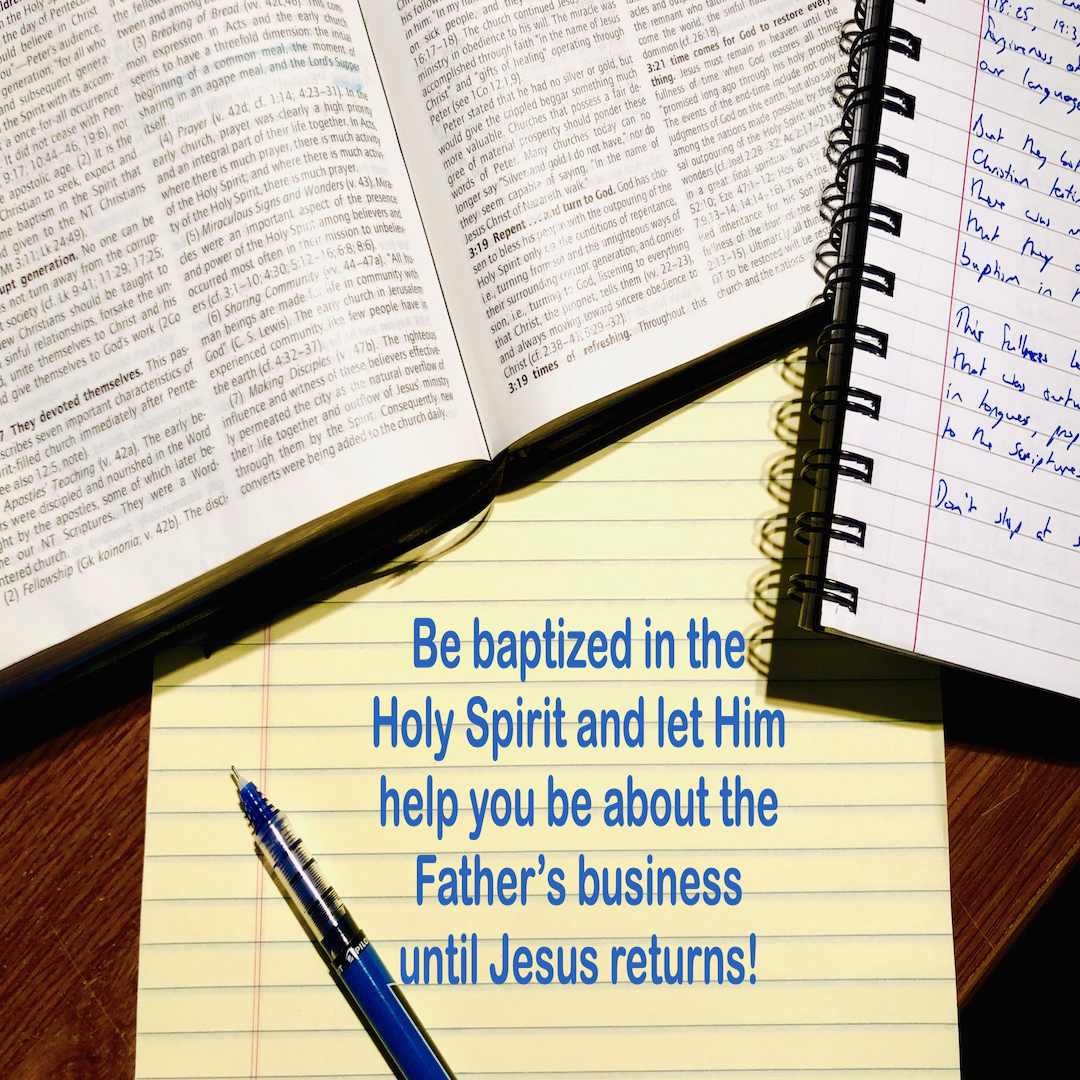
Be baptized in the Holy Spirit and let Him help you be about your Father’s business until Jesus returns. 

If you’ve missed any of the messages in our We Are: Pentecostal series, you can check them all out here. 

►► Would you please prayerfully consider supporting this ministry? My Patreon supporters get behind-the-scenes access to exclusive materials. ◀︎◀︎

Don’t Confuse The Temporal With The Eternal

Listen to the podcast of this post by clicking on the player below, and you can also subscribe on AppleSpotify, or Audible. 

Politics are a reality for anyone who lives under a human government. But Christians need to be cautious that we don’t put more weight on temporal politics than we do on the eternal Kingdom of God. 

You can check out the full sermon that this clip came from here. 

And I’ve shared quite a bit about praying for those in governmental leadership positions:

►► Would you please prayerfully consider supporting this ministry? My Patreon supporters get behind-the-scenes access to exclusive materials. ◀︎◀︎

Links & Quotes

God’s laws, precepts, and commands are given to us because He loves us and wants to keep us safe. His laws keep us in a place where we can experience His abundant blessings!

I have lots of new content every week, which you can check out on my YouTube channel.

“Establishing the Kingdom of God means ending evil, which happens not through violent force or coercive threats but through loving-kindness and patient forgiveness. It’s a world compelled by love instead of fear. … This [the outpouring of the Holy Spirit on the Day of Pentecost] is the beginning of a new world. The old world creates enemies and divides people, falsely claiming that some are loveable and others are throwaways, but not so in the Kingdom of God! In God’s empire, all people mutually love one another without partiality.” —Why Is Pentecost Important? reading plan on YouVersion

In the weekly Culture Translator newsletter from Axis Ministry, they had this insightful reminder about the worldview of pornography: “Pornography is not just sexual entertainment; it is a form of propaganda about what human beings are. In the same way that Scripture has a vision for humanity (that all people are God’s beloved children, worthy of honor and respect, with inherent dignity as his image-bearers), pornography also has a vision for humanity: that people (especially women) are objects to be gawked at, violated, and discarded at will. Porn offers a worldview, and like any other worldview, it shapes the way we think about what people are for—and how they should be treated. ‘Pornography teaches us lies that we ingrain into aspects of our relationships and our lives,’ argues Sam Black, Covenant Eyes’ Director of Recovery Education. These lies include the notion that we can’t live without sex, that sex equals love (or acceptance), and/or that what gives humans value is exclusively their sexual attractiveness. ‘Pornography warps our views of our relationships,’ Black continues, ‘and we haven’t even realized it.’”

“I always turn to the sports page first. They record people’s accomplishments. The front page has nothing but man’s failure.” —Chief Justice Earl Warren

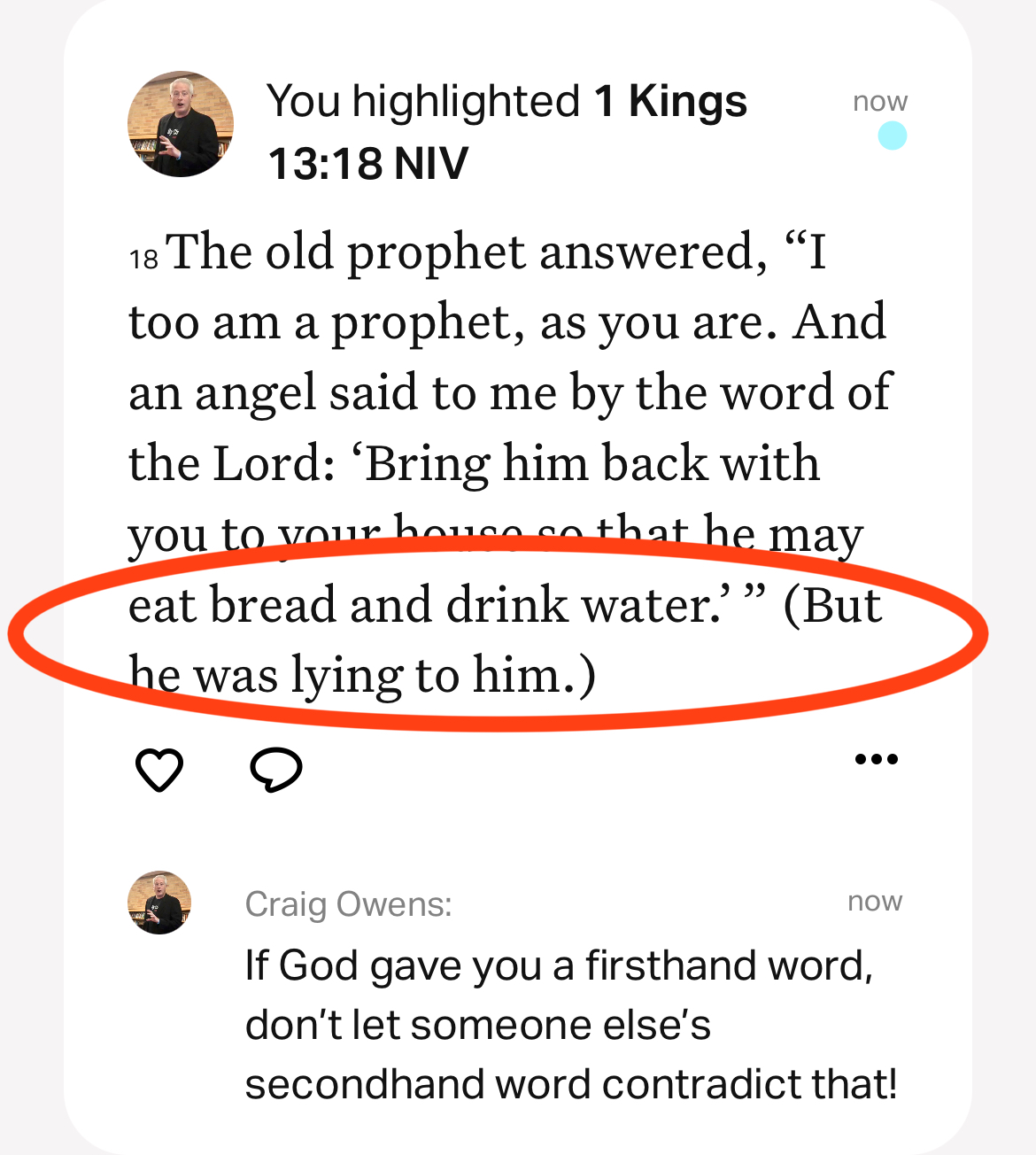
There is a very unusual story told in 1 Kings about a couple of unnamed prophets. One prophet heard from God, delivered the powerful warning God directed him to give, but then disobeyed God because of something another prophet told him that he had heard from God. I shared this commentary on YouVersion, “If God gave you a firsthand word, don’t let someone else’s secondhand word contradict that!”

“All religions are either a preview or a perversion of Christianity.” —C.S. Lewis

“If our relationships with other human beings are going to be meaningful, they will cost us something. Relationships are demanding.” —Herbert Wagemaker

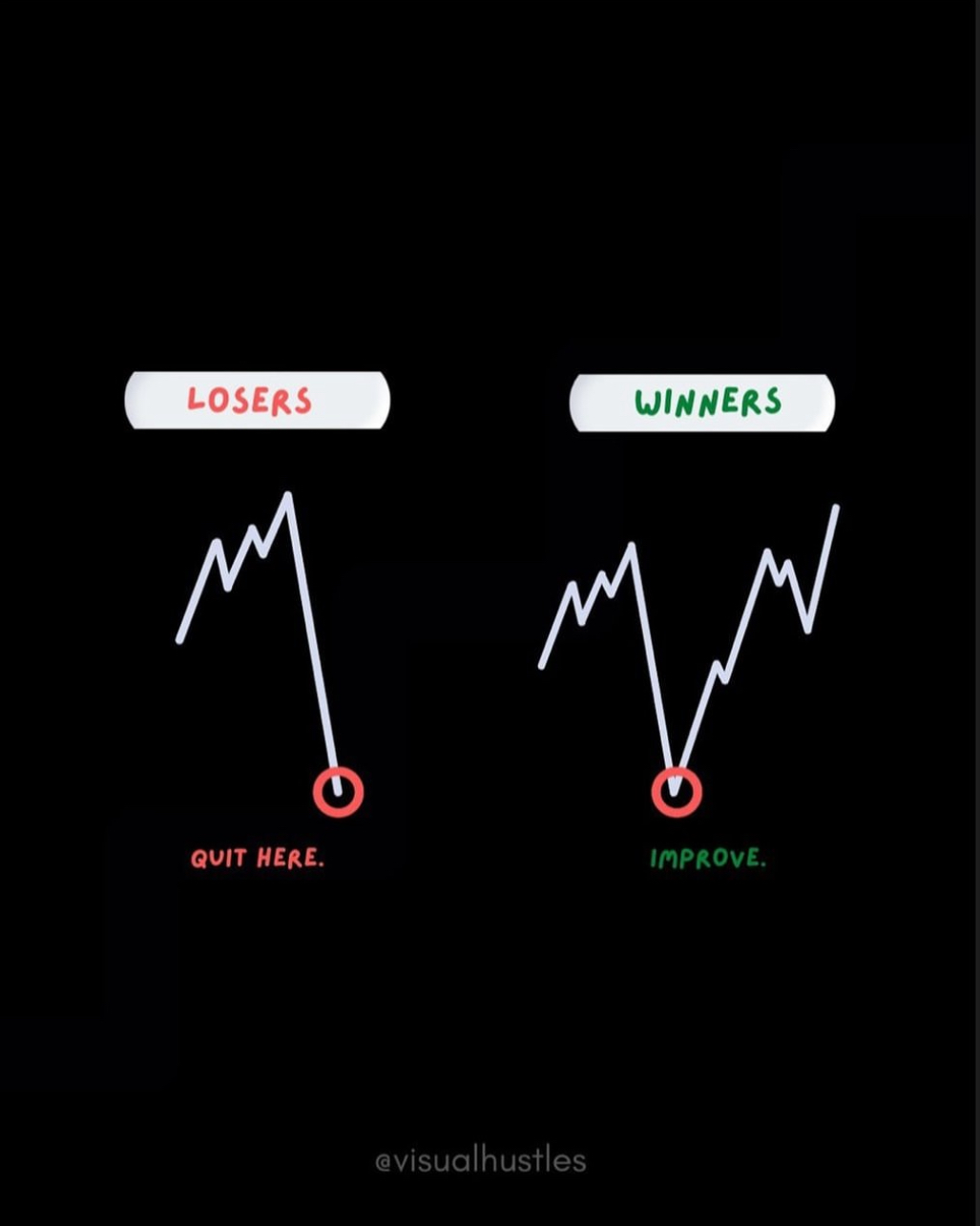
I saw this side-by-side graphic and so many thoughts about perseverance, grit, and stick-to-it-iveness came to mind. It is so true: we all have moments of stumbling. Losers tend to quit when they fall down, but winners learn something from their stumble, improve, and continue to grow. And then I came across this related quote from John D. Rockefeller, “I do not think that there is any other quality so essential to success of any kind as the quality of perseverance.”

Links & Quotes

Many of the examples Jesus used to tell us about the Kingdom of God seem like such small things. But those small beginnings have irresistible growth potential! Check out more thoughts in my series of posts called Kingdom Praying. I have lots of new content every week, which you can check out on my YouTube channel.

My wife is a school teacher and I also work quite a bit in our local schools. I think T.M. Moore is spot-on in his analysis of the breakdown in our current educational system: “This commitment to the Law and Word of God as foundational to the education of the young was everywhere practiced throughout the pre-revolutionary period in colonial America. It was unthinkable in the colonies that young people should be submitted to any instruction for any length of time without being taught the commandments and statutes of God, including the Gospel of Jesus Christ. Parents insisted on it, colonial and local statutes required it, and local school boards dutifully saw to it in all their schools.Since the middle of the previous century, assailed by specious invocations of ‘the separation of Church and State,’ educational policy in America has increasingly denied a place to God, His commandments, and His Word in the public-school curriculum. Generations of American children have grown up in a ‘disenchanted’ world (Charles Taylor), a world in which God, spiritual things, and the Law of God are deemed to be irrelevant if not oppressive, or at least a nuisance. The present crisis of morality, culture, and social upheaval is only the most visible consequence of that policy.”

David Mathis shared some thoughts about the healthy pace of ministry Jesus demonstrates for us. He said, “Let’s sit together at the feet of Jesus, and consider the pace and patterns of His life and ministry. He was not idle. Nor was He frenzied. From all we can tell from the Gospels, Jesus’s days were full. I think it would be fair to say He was busy, but He was not frantic. He lived to the full, and yet He did not seem to be in a hurry. In Jesus, we observe a human life with holy habits and patterns: rhythms of retreating from society and then reentering to do the work of ministry. Even as God Himself in human flesh, Jesus prioritized time away with His Father. He chose again and again, in His perfect wisdom and love, to give His first and best moments to seeking His Father’s face.“ These words resonate with me, because they are thoughts that I considered quite extensively for my book Shepherd Leadership.

I love reading stories like these that show how a relationship with Jesus utterly transforms a person’s life! “Opal W. Eubanks joined the Mississippi Highway Patrol during the race riots of 1964. A large, broad-shouldered white man, he relished the opportunity to strike fear in the hearts of African-Americans who were in trouble with the law. By his own admission, he was a foul-mouthed sinner who liked ‘rough stuff.’ A radical conversion to Christ in the early 1970s altered the course of Eubanks’ life, and his hardened heart became tender toward African-Americans in his rural community. He and his wife, Thelma, ultimately pioneered an Assemblies of God congregation consisting mostly of African-Americans, which they pastored for 21 years.”

The Greek word for “teaching” in Mark 9:31 means an ongoing dialogue. It’s an imperfect verb here because it is an activity that is never fully completed. Jesus wants us to abide with Him—to dialogue with Him—to continually learn from Him. The New Living Translation says it this way, ”For He wanted to spend more time with His disciples and teach them.” This is just as true for us today! 

J. Warner Wallace addresses the claims that the Old Testament prophets actually foretold that Jesus would be the Messiah. I love considering the apologetics for the death and resurrection of Jesus Christ, and this video will become an added resource for me in the future.

Praying To Hallow God’s Name

Listen to the podcast of this post by clicking on the player below, and you can also subscribe on AppleSpotify, or Audible. 

We said our protocol in approaching Almighty God in prayer is found in just two words: Our Father. 

Notice the transition: your Father (3x in Matthew 6:6, 8) to Our Father (6:9). How does this happen? Jesus makes it possible and the Holy Spirit continually reminds us of Christ’s completed work (Hebrews 2:11; John 14:13-14; Romans 8:15-16). 

It’s not just “our Father” but “our Father in Heaven.” Let’s remember that our Father is both All-loving and All-powerful. The phrase in Heaven reminds us of His absolute sovereignty. “Our God is in heaven; He does whatever pleases Him” (Psalm 115:3). What pleases Him? To give us His kingdom (Luke 12:32). 

Then there’s another phrase that is vital: Our Father in Heaven, hallowed be Your name. 

Hallowed means both to acknowledge His greatness and to keep Him separate from any profane things. What is profane? The dictionary says it is irreverence or contempt for God. The opposite of profane is holiness—something set apart exclusively for God. This is not something better than something else, but something exclusively that will bring glory to our Father in Heaven.

The root word for hallowed is “holy.” We see this literally translated in the name Holy Spirit. It is a word also referring to Jesus when He is called “the Holy One of God” (see Mark 1:24). The angel uses the word twice when he says, “The Holy Spirit will come on you, and the power of the Most High will overshadow you. So the Holy One to be born will be called the Son of God” (Luke 1:35). 

And that same word translated hallowed and holy is also translated saints. Literally that means “holy ones” or set apart people. 

Jesus is teaching us that our prayer is BOTH an acknowledgment of how God’s name is to be hallowed AND a request that He would empower us to pray and live in ways that makes that happen. 

This means our attitude needs to be focused on God’s reputation not my reputation (as in Matthew 6:5, 7:21-23). 

Our Father in Heaven, hallowed be Your name” is both an attitude of prayer and a lifestyle. 

We hallow God’s name when our prayer and daily lifestyle bring Him the supreme glory that is due exclusively to His awesome name! When we keep our eyes and hearts on Him, He will provide everything else we need (see Matthew 6:32-33). 

To follow along with all of the message in this prayer series called Kingdom Praying, please click here. 

►► Would you please prayerfully consider supporting this ministry? My Patreon supporters get behind-the-scenes access to exclusive materials. Like this exceptional Bible study tool to help with Creation apologetics. ◀︎◀︎

The Prayer Protocol

Listen to the podcast of this post by clicking on the player below, and you can also subscribe on AppleSpotify, or Audible. 

Every monarch or president on the planet has certain protocols for anyone who interacts with them. There are requirements on how to walk into the room, titles that have to be used, the way you have to act, things you can or can’t say, and the list goes on and on. 

So it’s natural to think that this is how we also have to approach the Sovereign King of the Universe. But this King so desires intimate conversation with His people that Jesus gave us this simple protocol: “Our Father” (Matthew 6:9-13). 

Jesus told us that He wanted us to dispense with the world’s expected protocols. He said that when we approach God, those protocols are gone. In the preceding verses, He told us that we pray…

  • NOT for show or else we are called hypocrites—putting on an act or performance to earn applause or approval.
  • NOT with “alien” vocabulary or else we are pagans—adopting manners that aren’t our own as a means to be accepted. 

The prayers of Jesus seldom sound like our modern idea of “prayer.” Instead, they sound more like an everyday conversation when He’s talking to His Father, and the sound like commands when He’s casting out demons or healing diseases (see examples in Matthew 8:3, 13, 26, 32; John 11:40-44). 

Jesus also reminded us that we pray because… 

  • He told us to 
  • He wants us to seek God’s Kingdom 
  • He wants us to receive God’s Kingdom 
  • He wants us to live in the power of God’s Kingdom every single moment 

(Matthew 6:5-7, 6:33-34, 16:16-19, 17:16-21; Mark 9:29; Luke 12:32) 

Let me repeat: our protocol for prayer is nothing like the world’s protocols for interacting with rulers. Our protocol is simply coming to our Heavenly Father in simple, childlike love and anticipation. 

Kingdom praying should be as natural as talking to the most loving Father you can imagine! 

Check out the others messages in our series Kingdom Praying by clicking here. 

►► Would you please prayerfully consider supporting this ministry? My Patreon supporters get behind-the-scenes access to exclusive materials. Like this exceptional Bible study tool to help with Creation apologetics. ◀︎◀︎

Kingdom Praying

Jesus made it clear time and time again that He came to reveal the Kingdom of God to us. He described what the Kingdom was like and told us that He came to be the means by which we could enter God’s Kingdom. 

He also told us how God’s children could access the power and privileges of our Heavenly Father through the means of prayer. He assured us with words like, “Do not be afraid, little flock, for your Father has been pleased to give you the Kingdom” (Luke 12:32). 

Jesus said quite simply that we had access to our Father through prayer. And then to make sure we didn’t miss out on this awesome privilege, He instructed us, “This, then, is how you should pray” (Matthew 6:8). 

Please join me this Sunday as we go point-by-point through this Kingdom-accessing model prayer. We will learn just how truly expansive and all-encompassing this short prayer is.

Check out all of the messages:

Links & Quotes

If God seems distant, get your eyes off other things and put them back on Him. Check out the full sermon hereI have lots of new content every week, which you can check out on my YouTube channel.

T.M. Moore is in a series of posts about the Kingdom of God being revealed on earth. He wrote, “Jesus’ vision of the proximity of the Kingdom, therefore, was a threefold vision: The Kingdom is yet to come in all its fullness (there and then); nevertheless, at the same time, the Kingdom is unfolding in our midst (here and now); and thus every follower of Jesus Christ must make it their primary concern to seek and attain to more and more of the Kingdom of God every day of their lives. Then and there, here and now, more and more: This is how we must think about the Kingdom of God and our involvement in it.”

For many years, the theory of evolution has been unraveling. As more and more discoveries are being made, Darwin’s theory is becoming less tenable. John Stonestreet and Shane Morris wrote a recent blog post on this. Their article opens with this: “In 1973, evolutionary biologist Theodosius Dobzhansky wrote that “nothing in biology makes sense except in light of evolution.” Almost 50 years later, an increasing number of scientists are asking whether evolution makes any sense in light of what we now know from biology.”

The most effective leaders consistently see the world through their teammates’ eyes. Check out this full conversation on The Craig And Greg Show.

“Imagine yourself as a living house. God comes in to rebuild that house. At first, perhaps, you can understand what He is doing. He is getting the drains right and stopping the leaks in the roof and so on: you knew that those jobs needed doing and so you are not surprised. But presently He starts knocking the house about in a way that hurts abominably and does not seem to make sense. What on earth is He up to? The explanation is that He is building quite a different house from the one you thought of—throwing out a new wing here, putting on an extra floor there, running up towers, making courtyards. You thought you were going to be made into a decent little cottage: but He is building a palace. He intends to come and live in it Himself.“ —C.S. Lewis

“No prophet or priest, king or great leader has ever told us to dare to address God as our Father, except Jesus! He is the only One who has taught us to call God, our Maker and Creator, Father. In the Old Testament, that relationship is mentioned only a few times (for example, Exodus 4:22-23; 2 Samuel 7:14). But in the gospels, it is mentioned 165 times. Jesus wanted to instill in us how important God’s fatherhood is. It is not a mere creed. It is a relationship that is central to our new life in Christ and essential in our worship to Him.” —Sobhi Malek