I pray that your partnership with us in the faith may be effective in deepening your understanding…. (Philemon 6 NIV)
Faith works! As Dr. Henry Halley noted, “Working faith is a sharing faith.”
Faithful working deepens our understanding of all the good things Jesus has given us. Those good things should then fuel us to share the good things—and the Source of all good things—with others.
I pray that the faith you share with us may deepen your understanding of every blessing that belongs to you in Christ. (Philemon 6 NET)
A faith that merely believes without acting would be an ineffective faith. A faith that works becomes a lifestyle testimony that points others to Jesus.
And I keep praying that this faith we hold in common keeps showing up in the good things we do, and that people recognize Christ in all of it. (Philemon 6 MSG)
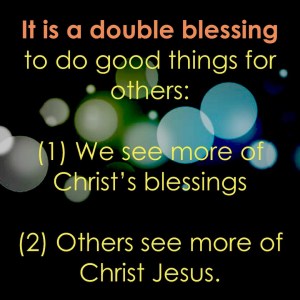
It is a double blessing to do good things for others:
Look back through the pages of history and you will see a common theme. Whether it’s world history or your own personal history, you have so much for which you can give thanks.
In tough times, we tend to become forgetful because we are so focused on the intensity of the moment. But if we will simply look back in time, we will see just how faithful God has been to us. We bring our focus back to Him in our trying times when we remember and rehearse “the wonderful things He has done” (Psalm 107).
The season of Thanksgiving is a good time for us to be reminded of the powerful resource we have when we are giving thanks for our blessings. Thankful people are confident people because they choose hope in God’s faithful provision over grumbling about their current circumstances.
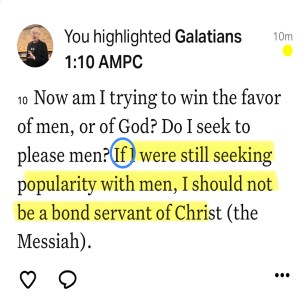
Now am I trying to win the favor of men, or of God? Do I seek to please men? If I were still seeking popularity with men, I should not be a bond servant of Christ (the Messiah). —Galatians 1:10 AMPC
Trying to please men ultimately becomes a lose-lose attempt.
First, people are fickle and I cannot please all of them all of the time. Second, in attempting to please some people I would have to compromise the truth of the Bible.
The only favor I should seek is the One who saved me and sent me. It is Christ’s voice alone that I long to hear say, “Well done, good and faithful servant.”
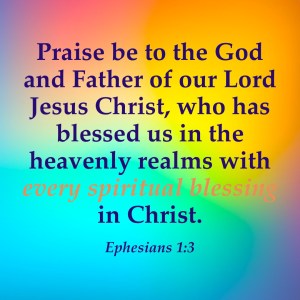
Praise be to the God and Father of our Lord Jesus Christ, who has blessed us in the heavenly realms with every spiritual blessing in Christ. (Ephesians 1:3)
These blessings are not found just anywhere. They are found only in Jesus and because of Jesus.
The completeness of perfect blessing is found in Who my Heavenly Father is for me because of the finished work of Jesus!
(1) God allows the humble to know Him more intimately. For though the Lord is high, yet has He respect to the lowly—bringing them into fellowship with Him—but the proud and haughty He knows and recognizes only at a distance (Psalm 138:6).
(2) God gives the humble help to overcome evil. But He gives us more and more grace—power of the Holy Spirit, to meet this evil tendency and all others fully. That is why He says, “God sets Himself against the proud and haughty, but gives grace continually to the lowly (those who are humble enough to receive it)” (James 4:6).
(3) God gives His favor to the humble. …Clothe (apron) yourselves, all of you, with humility—as the garb of a servant, so that its covering cannot possibly be stripped from you…. For God sets Himself against the proud—the insolent, the overbearing, the disdainful, the presumptuous, the boastful—and He opposes, frustrates, and defeats them, but gives grace (favor, blessing) to the humble (1 Peter 5:5).
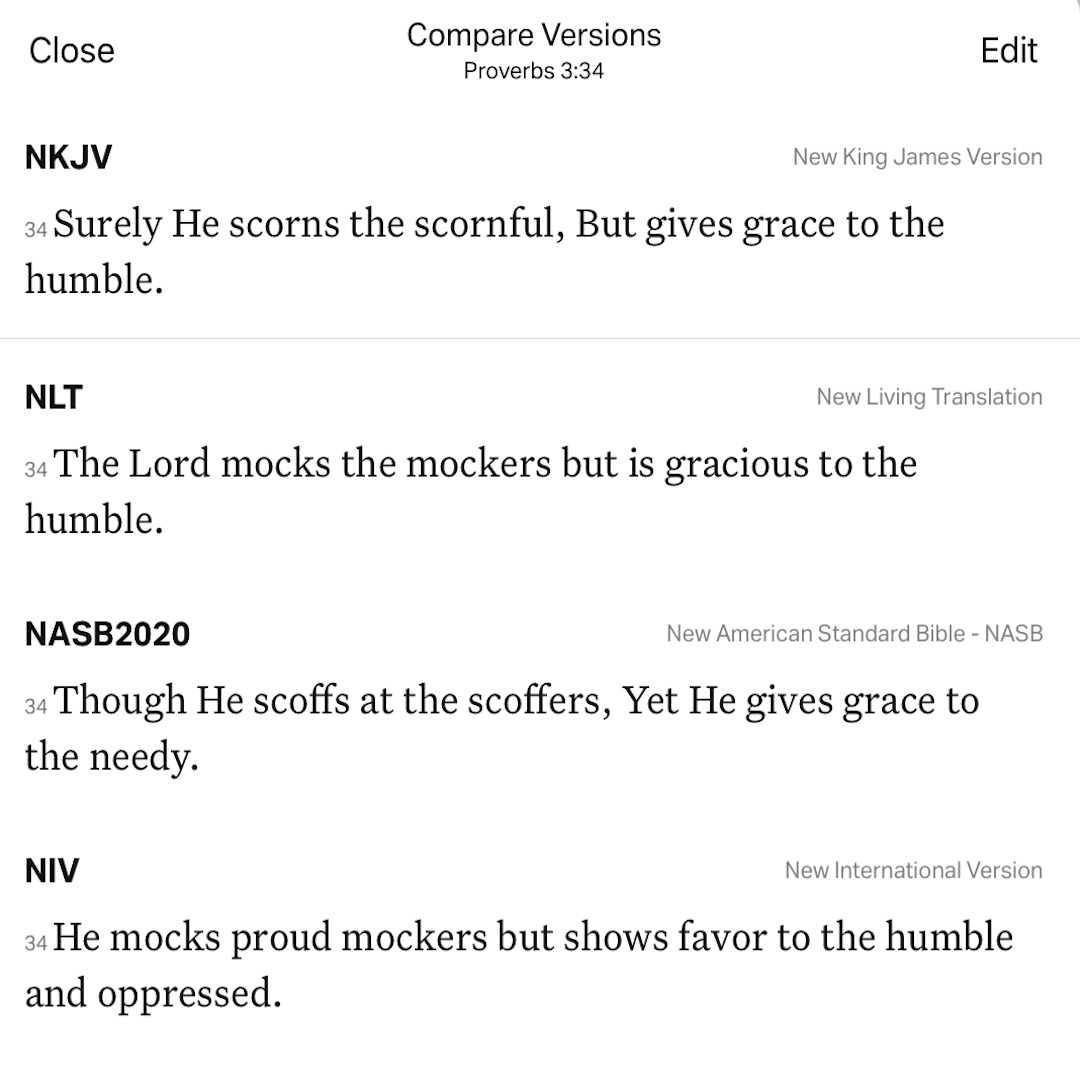
The bottom line—God mocks proud mockers but shows favor to the humble and oppressed (Proverbs 3:34).
Listen to the podcast of this post by clicking on the player below, and you can also subscribe on Apple, Spotify, or Audible.
Think of the most well-known Christian evangelist you can imagine preaching before tens of thousands of people all over the world, broadcasting his sermons online, selling books, and being invited to pray with the world’s leaders.
Now think of a pastor you may know in a rural community ministering to a small congregation. He has no online presence, no books, and is hardly known outside of his own town.
The apostle Paul would say to both of them, “You are only servants of God.”
“What, after all, is Apollos? And what is Paul? Only servants, through whom you came to believe—as the Lord has assigned to each his task. … This, then, is how you ought to regard us: as servant of Christ” (1 Corinthians 3:5, 4:1).
Only servants of Christ.
God calls His servants to do their servant’s work with care and quality (1 Corinthians 3:10, 14). And he also says, “The one who plants and the one who waters have one purpose, and they will each be rewarded according to their own labor” (v. 8).
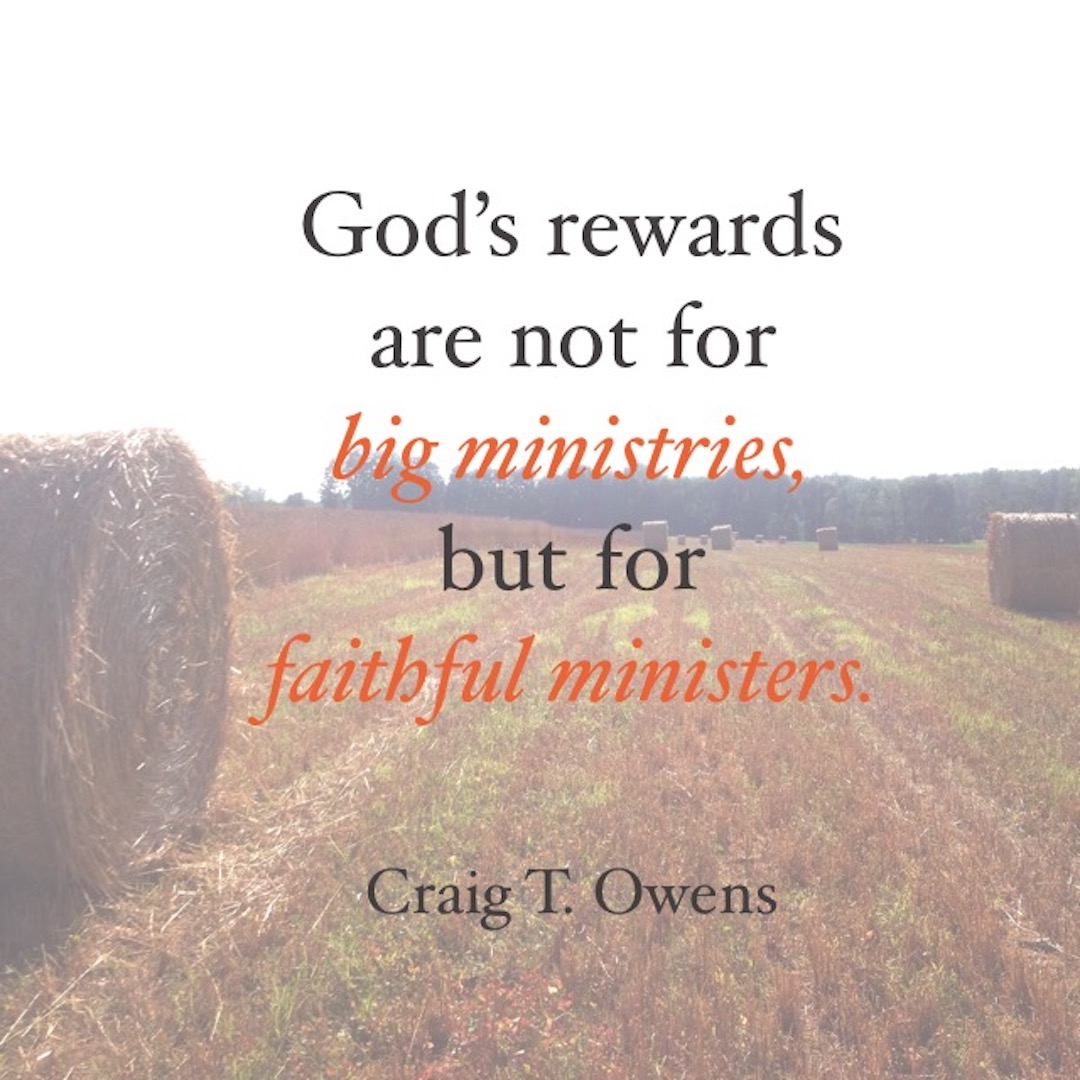
God’s rewards are not for big ministries, but for faithful ministers.
I talk a lot about faithfulness in my book Shepherd Leadership. In the chapter entitled ‘Stick-to-it-iveness,’ I wrote this—
Peter instructs us that our example for the flock must be God-honoring. People do what people see. If I would have arrived on that Saturday bent out of shape that things weren’t working out as I had planned, I would have robbed people of the enjoyment that they should have had that day. Remember that when Jesus told us that He had set an example for us (John 13:15), it was an example of putting others’ needs ahead of His own. Did Jesus want to wash those dirty feet? Probably not. But He not only washed them well, but He also had such a good attitude that its impact is still being felt today.
Peter was there on that day. He heard Jesus say this about following His example of such others-focused leadership: “Now that you know these things, you will be blessed if you do them.” So Peter reminds his readers that the Chief Shepherd is returning with rewards for the faithful under-shepherds. Occasionally, we will get some rewards here, but keeping our steadfast focus on the rewards and blessings that are still to come will help us stick with our responsibilities, even on those days when no one else seems to notice or even care.
Let’s listen to the words of the apostle Paul again: “So, then, no more boasting about human leaders!” (1 Corinthians 3:21).
And let me repeat myself—
God’s rewards are not for big ministries, but for faithful ministers.
Listen to the podcast of this post by clicking on the player below, and you can also subscribe on Apple, Spotify, or Audible.
The Jordan River was a powerful border guard. For years it had served the Canaanites well, protecting their eastern border from large-scale attacks from their enemies. Now the Jordan was all that stood between the Israelites on the east side of the river and their promised land on the west side.
Joshua gave some unusual instructions to the priests that carried the ark of the covenant of the Lord. He told them to carry the ark while they walked into the middle of the flood-level river. He said they should trust that God would stop the flow of the river while they stood there (see Joshua 3:1—4:11).
I can imagine the two priests carrying the ark at the front stepping into the water, feeling the current rush around their ankles, and holding their breath as they took their next steps deeper into the river.
Step after step the two priests in front waded into the Jordan. Until finally they walked far enough that the priests carrying the ark from the back stepped into the Jordan.
And all of a sudden, the water levels begin to go down! Lower and lower until the priests were standing on a damp riverbed that had been completely covered by water just a few minutes earlier. To their left, as they looked downstream, no water was to be seen. To their right, as they looked upstream, they might have glimpsed the wall of water piled up as the invisible Hand of God held it back.
Only then did the Israelites began crossing the previously uncrossable river. Family after family, tribe after tribe began to march at long last into their promised land.
And while all Israel passed over on dry ground, the priests who bore the ark of the covenant of the Lord stood firm on dry ground in the midst of the Jordan, until all the nation finished passing over the Jordan. … For the priests who bore the ark stood in the midst of the Jordan until everything was finished that the Lord commanded Joshua to tell the people…. (Joshua 3:17, 4:10)
It was only after every Israelite had crossed the Jordan, and memorial stones had been gathered from the riverbed and carried to the shore, that the priests carrying the ark of the covenant of the Lord came across themselves. It was immediately after this that the mighty Jordan River began flowing again at full strength.
Second, godly leaders stand their ground until all the people enter into God’s blessing. Remember that God is patient, “not wanting anyone to perish, but everyone to come to repentance” (2 Peter 3:9).
So leaders, let me encourage you—
Keep going first in obeying God, keep standing firm in His promises, keep showing others the path they need to follow to step into God’s blessings, and keep encouraging people to walk into that blessing.
Don’t be slow in obeying. Don’t fear going first into the unknown. And don’t become weary or frustrated or nervous and walk away too soon.
Listen to the podcast of this post by clicking on the player below, and you can also subscribe on Apple, Spotify, or Audible.
Although some people are afraid of this, the Bible makes it clear that God doesn’t forsake us. But the Bible also makes it equally as clear that we can forsake God.
Listen to the words God spoke through Moses—
And the Lord said to Moses, “Behold, you shall sleep with your fathers, and this people will rise up and play the harlot after the strange gods of the land where they go to be among them; and they will forsake Me and break My covenant which I have made with them. Then My anger will be kindled against them in that day, and I will forsake them and hide My face from them. And they shall be devoured, and many evils and troubles shall befall them, so that they will say in that day, ‘Have not these evils come upon us because our God is not among us?’ And I will surely hide My face in that day because of all the evil which they have done in turning to other gods.” (Deuteronomy 31:16-18 AMPC)
To forsake means to depart from someone or to neglect them.
While we are following God, He will never forsake us. But when His people turn aside in fascination of sinful things, they forsake God by no longer following Him. We read this in the words of God’s people, “Our God is not among us.”
When we don’t follow God, He still never forsakes us. However, God refuses to bless people who persist on doing their own thing.
When we forsake God, we cut ourselves off from His life flow. It is not the Vine who has left us, but we who have severed ourselves from the Vine.
If God feels distant from you, be assured that He hasn’t forsaken you. Perhaps you could pray a couple of prayers that David prayed. Maybe a prayer asking for the Holy Spirit to reveal to you where you may have detached yourself from the Vine of God (Psalm 139:23-24). Or perhaps a prayer of forgiveness and assurance of God’s forgiveness and restoration (Psalm 51:1-10).
Don’t give into the feelings of despair, but run back into the embrace of the One who loves you—the One who never leaves you nor forsakes you:
Be strong, courageous, and firm; fear not nor be in terror before them, for it is the Lord your God Who goes with you; He will not fail you or forsake you. (Deuteronomy 31:6)
Listen to the podcast of this post by clicking on the player below, and you can also subscribe on Apple, Spotify, or Audible.
Last week we saw how the Israelites in exile had their time of grief—being targeted for annihilation—turned to joy when God granted favor to Queen Esther.
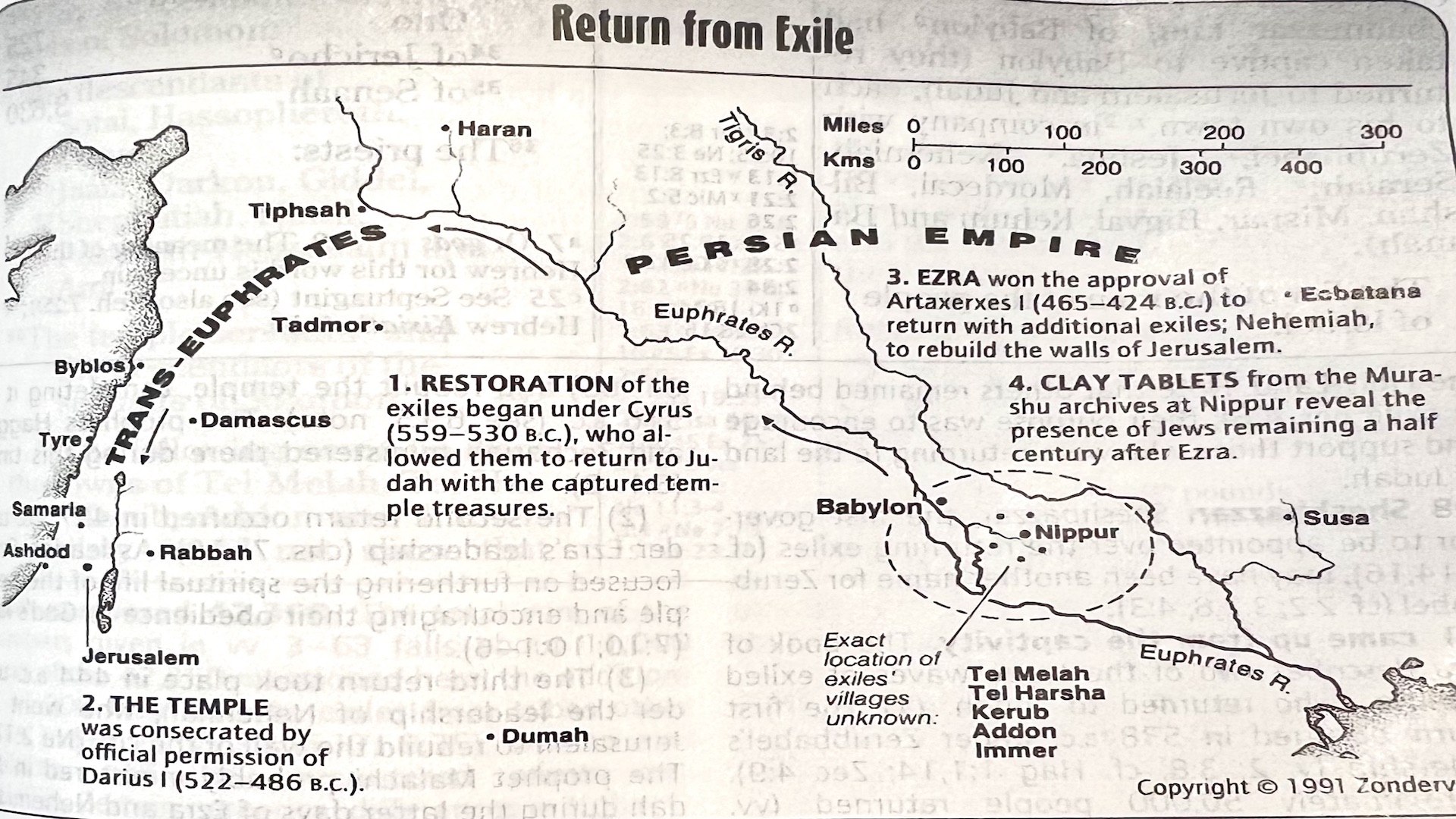
The books of 1 and 2 Chronicles, Ezra, and Nehemiah are all written during this time period as the exiles are returning in waves to Israel. This is another grief-into-joy moment! More than likely, all four of these books were written by Ezra. Notice the note of joyful celebration that is repeated in the last words of 2 Chronicles and the opening words in the Book of Ezra (2 Chronicles 36:22-23; Ezra 1:1-4). We don’t know which psalmist wrote Psalm 126, but it sounds the same joyful note.
Not all the exiles returned at once. In fact, the Book of Daniel shows us that Daniel likely stayed in his position of leadership to these governments until his death.
The exiles were returning in waves. As the worship practices at the temple were reestablished and as people returned to lands allotted to each tribe, it was important for the leaders to make sure the right people were in the right places. So 1 Chronicles opens with genealogies.
Beginning with Adam and Noah (1:1-4)
The spiritual fathers (1:34)
The family line of the Messiah (2:1-15; Matthew 1:1-6) through the family tree of David (3:1-24)
Then 1 Chronicles 4 lists more clans in the tribe of Judah. Of special note is the Calebite clan (2:9, 18).
In the Calebite clan we meet Jabez in 1 Chronicles 4:9-10. His name literally translated is sorrow. I wonder: is this a nickname or his birth name? how did he even get this name?
His mother is quoted, “I gave birth to him in pain.” Did that mean it was physically a difficult birth? Did she die after childbirth? Was he born during the painful exile? His father isn’t mentioned, so maybe his birth reminded everyone of the father who was no longer there. The Amplified Bible says his mother named him “sorrow maker.”
Whatever the case, Jabez has become aware that his name or his presence is causing grief to others. There is a bit of a play on words here: “his mother named(Hebrew: qara) … Jabez cried out (Hebrew: qara) to the God of Israel.” In essence, Jabez is saying, “Since my mother cried out in pain—or thinks I am a sorrow maker—I have no where else to go but to cry out to God!”
I believe Jabez was a teenager at this time. One medical journal says, “Adolescents are physically, cognitively, and socioemotionally more advanced than children but prone to behave in ways that are inconsistent with adult values and norms. … Adolescents also frequently report greater self-consciousness, and are more concerned with and interested in others’ perceptions of self.”
This means that as the brain matures during adolescence, teenagers begin to look at themselves through the eyes of others. They are beginning to make decisions that will earn approval from their peers and their family.
This describes Jabez. He doesn’t want to be the sorrow maker any longer.
Grief happens when my reality falls short of my expectations. Jabez has become self-aware that he is a painful reminder to everyone around him. He is living in a place of grief
Jabez is called “more honorable than his brothers” (v. 9) because he turns his pain into his prayer. His brothers may either have not been as self-aware, or maybe they were aware but simply didn’t care. Jabez realized, “People have been calling me sorrow maker my whole life. There’s nothing I can do about it on my own, so the only thing I can do is call on the only One who can turn my grief into joy” (v. 10).
Look at his noble prayer:
bless me—God, You are the only One whose favor I desire
enlarge my territory—even out of this grief, bless me so that I can be a blessing
let Your hand be with me—only Your hand can restore my fortunes, can help me reap a harvest, and can allow me to sing Your songs of joy (see Psalm 126:1-6).
Let us follow this example from Jabez’s life and begin to turn every pain into prayer.
God doesn’t want to give us temporary relief from our pain, but He desires for us to know His never-ending joy (Isaiah 25:7-9; Revelation 21:3-4).
Listen to the podcast of this post by clicking on the player below, and you can also subscribe on Apple, Spotify, or Audible.
The dictionary defines a rhetorical question this way: A question asked solely to produce an effect or to make an assertion of affirmation or denial. In other words, the question is asked with the assumption that the answer is obvious.
The apostle Paul does this five times in five consecutive verses at the end of Romans 8 (see verses 31-35). These questions are Paul’s way of getting us to reaffirm our rock-solid assurance of just how amazing it is that God holds us so securely.
Even though these are rhetorical questions, I want to add the extra assurance by giving you the answer to each question.
(1) Who can stand against me? No one!
Because Almighty God is for me.
(2) Who can cause God’s blessings to be withheld from me? No one!
Because God didn’t withhold His Son Jesus, He won’t withhold any other lesser blessing either.
Because Jesus intercedes for me and imputes His righteousness to me.
(5) Who can separate me from God’s love? No one!
Not a single thing, person, or circumstance can diminish any part of God’s love for me.
Don’t ever buy into the devil’s lies—not even for a second—that somehow you have put yourself in a place where God’s love for you is questionable. Whenever you hear these lies, return again and again to these five powerful rhetorical questions to reassure your heart, mind, and soul of just how securely you are held in God’s grip of grace.
























 Craig T. Owens