Seeing Only The Best In Your Spouse

Researchers have found that the biological responses of your body and brain to being “in love” only last two years. So guess when most newlyweds begin experiencing problems in their marriage? Yep, you guessed it: about two years into marriage.

After the in love buzz wears off, what can you do to maintain a happy, fulfilling marriage? Quite simply you have to choose to see only the best in your spouse.

Solomon was so wise to write to us that our spouse should be the only one who captivates us … the only one who satisfies us … the only one who keeps making our hearts go pitter-pat! When we choose to see the best in our mate, we can keep that in love buzz going for the life of the marriage.

Check out this excerpt from a WebMD article (you can read the full article here)—

Most often, self-assessments are grounded in reality, the researchers write. The way we see ourselves is fairly accurate. The way we see others, they continue, is often shaped by hope. With that in mind, they took one partner’s self-assessment at face value and compared it to the other partner’s assessment, as well as that partner’s description of his/her ideal partner.

For example, John’s ideal mate is funny and warm. And that is how he chooses to see Jane, who he has just married, despite the fact that Jane describes herself as moody and distant. Will John change his tune over time and come to regret his marriage to Jane? Or will his positive—if skewed—view of his wife help maintain his happiness?

Fortunately for John, the researchers found the latter to be true. In tallying the data, they discovered that those who did not idealize their partners when they got married tended to be more dissatisfied with their marriage by the end of the study compared to those who had an unrealistically idealistic view of their partner. Those in the “idealistic” group tended to be happier and more satisfied with their marriage.

In other words: you will bring out of your spouse what you see in your spouse.

Do you want a fun-loving wife? See her as your favorite playmate.

Do you want a confident husband? See him as a strong, self-assured provider for your home.

I like how the Apostle Paul states this (especially in the Amplified Bible)—

However, let each man of you without exception love his wife as being in a sense his very own self; and let the wife see that she respects and reverences her husband—that she notices him, regards him, honors him, prefers him, venerates, and esteems him; and that she defers to him, praises him, and loves and admires him exceedingly.

Just as God sees the best in you and loves you for who He sees you becoming, love your spouse and see only the best in him/her.

Thursdays With Oswald—Yielded

This is a weekly series with things I’m reading and pondering from Oswald Chambers. You can read the original seed thought here, or type “Thursdays With Oswald” in the search box to read more entries.

Yielded

       There is a distinct period in our experience when we cease to say—“Lord, show me Thy will,” and the realization begins to dawn that we are God’s will, and He can do with us what He likes. We wake up to the knowledge that we have the privilege of giving ourselves over to God’s will. It is a question of being yielded to God.

From Facing Reality

For we are God’s workmanship, created in Christ Jesus to do good works, which God prepared in advance for us to do. (Ephesians 2:10)

Thank You for making me so wonderfully complex! Your workmanship is marvelous—how well I know it. (Psalm 139:14)

God has a plan for my life. He prepared me in advance to fulfill His will and plan for me. Will I yield to Him? Or will I continue to try to find my own way?

What a supreme privilege it is to yield to His will for my life!

Thinking About And

These are my “raw notes” from The And Conference. If anyone wants to add on, modify, or delete, please feel free.

Alan Hirsch

Cultural differences – imagine numbers 1-4 as barriers to even starting a conversation (m1-m4).

In western culture we’re pushing more toward m3 or m4. In fact, the gap between m0 and m1 is shrinking.

Our idea of church is 17 centuries old (tracing back to Constantine), so there is a HUGE assumption we’re making when we think “church.” From m0 to m1 is the church’s current domain. No cultural barriers have to be crossed. However, much of culture is in m3-m4.

If we act attractionally in a missional setting, we’ve extracted them from their “m” zone. New believers in 3-5 years after becoming a Christian will have no non-Christian friends. We’ve extracted them!

Most people feel good about God, Jesus, and spirituality. However, there are negative feelings about “church.” Most people remember or focus on only three things in their “perceived set.” Marketers try to get their product/service in that perceived set.

Jesus, yes; church, no. Kind of like iPhone, yes; AT&T, no. But now the Apple logo on the iPhone reminds people of AT&T.

The dechurched have been inoculated against the church.

Dream out-loud at high volume about what the church could be!

“As the Father sent Me, so I send you.” How did the Father send Jesus? He stepped into culture, He lived in the culture and spoke to people out of culture. Church should come out of mission, not mission out of church. Just like the Acts church didn’t require Gentile believers to adopt Jewish practices. So we don’t plant churches, we plant the Gospel and let the church grow out of that.

The Bible doesn’t know the difference between “clergy” & “laity.” Why do we persist in putting people in these categories?

————–

“Apostolic” is the Greek version of the Latin “missional.” We need an apostolic environment to take movements to a place of spontaneous expansion. The apostle is a catalyst to growth.

Paul starts churches which start churches = movement → expansion.

Paul then teaches. He is the custodian of the movement’s DNA. He is also the guardian of the purity of the DNA.

An “apostle” is not an apostle if it’s a top-down leadership. An apostle is a servant leader.

Ephesians 4

  • vv. 7-11  APEST = apostle, prophet, evangelist, shepherd, teacher.
  • vv. 12-16  maturity—cannot get to maturity without all of APEST. Most denominations focus just on S & T. “Shepherd” is only used once in the New Testament, and the New Testament says, “Not many of you should presume to be teachers.”

Leadership is a calling within a gifting. APEST gifts are given to everyone, but some are called to be leaders within their gifting.

APEST gifts carry more of a vocational weight. Gifts of the Spirit are more of empowerments for the moment. The gifts of Romans 12 are motivational/paradigmal gifts.

———-

Re-Jesus = a renewed focus on full Christology: most of our focus is on the Cross, resurrection & return. We need to include Incarnation & His life among humanity. We make Him Savior, but not Lord.

Re-mission = who God is must determine what the church does.

Re-organize = missional churches are responsive to the world around us. Our churches must be organized to be nimble.

Tim Stevens

Every new term that comes out tells us we’re doing church wrong. So Tim says “Missional schmissional!” and “Attractional schmactional!”

Most churches are defined as “Come to us.” But this only works for <40% of people. People are still “spiritual,” but they don’t like “church.”

Do we attract the unchurched 60% OR missionalize the churched 40%. How about BOTH-AND? We have to help the 40% reach their 60%.

We can still say “Come and see,” but emphasize “So that” = “Come and see what Jesus does so that you can tell others.”

There is no one-plan-for-all method for churches to do BOTH-AND. Each church must discover what works for them in their community.

Jason Miller

Linear thinking is how our brains process info. That’s why telling stories with a plot twist is so powerful. Like when Jesus said, “You have heard… but I tell you….” Twists get people’s attention.

People in the world have had their imaginations devastated by culture who says love is conditional. When we talk about God’s unconditional love, it’s a plot twist they never imagined.

We have a mandate to do something beautiful. Beauty awakens imaginations to see God’s love. Like sympathetic vibrations: God’s beauty begins to resonate and awaken imagination.

“The church is God’s imagination to the world.”

Dave Ferguson

What can we do for those who won’t come to church?

Missional people (micro level) + Multiplying churches (macro level) = Missional movement

How to create a missional culture: (1) Ordain every member; (2) Lead with a “Yes”; (3) Make heroes of everyday people.

Saying “Yes” doesn’t mean funding the project or even announcing the project. It just means giving people permission to reach out.

Business paradigm that makes money but not movements: say “No” to anything that you haven’t fully researched.

Matt Carter

We can’t have “professional Christians” that do ministry & those that only receive ministry.

Christianity today needs to look like what we see in Acts.

What if instead of attracting new people to church, we released current attendees to do ministry?

What if it wasn’t “come and see” but “go and do”?

Small group success = seeing & addressing a need in the community. “Nothing builds community better than mission. When we aim at community, we may get it. But when we aim at mission, we get that and community too.”

Need to share success stories and failure stories. This creates a culture that let’s everyone know that it’s okay to try.

Hugh Halter

We need to redefine “disciple” because now we define them as “church attendee.”

Two categories: missional and sojourners. Missional people prepare the way for sojourners to become missionals by making the Kingdom of God tangible.

A better definition of disciple is apprentice. An apprentice is learning by doing; they’re hands-on.

Second decision environment = people choose to get more involved. For example, Sunday morning attendance is a first decision; a small group is a second decision.

Barriers to discipleship: individualism, consumerism, materialism. To overcome these barriers, Jesus put people in a place of tension. This typically can’t take place in a first decision environment.

Other ways to address these barriers: modeling, confrontation, action/reflection.

Jesus wasn’t interested in followers, but in disciples.

Rob Wegner

“Every member is a minister.” —Mark Beeson

Attractional churches use centripetal force to bring people in. Missional churches use centrifugal force to send people out.

Attractional is embedded inside missional. Attractional is the seed for missional. As Hirsch said, it’s more “extractional.”

Attractional seeds → Missional community → Extractional movement

Do we have to see church as institution and church as movement as opposites? Or co-existing? Genius of BOTH-AND!

They’re Both Dissin’

Check out these opening paragraphs from an article on WebMD (if you wish, you can read the full article here):

     People over 50 get a self-esteem boost when they read negative news about young adults, a study shows.

     Researchers also say young people, when given the choice, would rather read about people their own age and aren’t very interested in stories about their elders, whether the articles are positive or negative.

     “Our results reflect that the younger readers did not perceive older people as all that relevant,” study researcher Silvia Knobloch-Westerwick, PhD, of Ohio State University, tells WebMD by email. “They’re more concerned with figuring out who they are and where they stand, and those in the same age group appear to provide the relevant comparisons for that.”

Okay, this disturbs me on several areas. Basically, each age group is dissin’ the other age group.

The senior citizens are projecting a snickering, see-I-told-you, father-knows-best, condescending attitude on youth. Why would anyone who is willing to learn and grow want to be around that kind of person?!

Then our youth have an I’ve-got-it-all-figured-out, I-don’t-need-you, you’re-out-of-touch attitude toward the senior citizens. Why would anyone who is willing to mentor someone ever want to be that kind of person?!

I think both of these generational groups could learn from this wise advice:

Children, do what your parents tell you. This is only right. “Honor your father and mother” is the first commandment that has a promise attached to it, namely, “so you will live well and have a long life.” Fathers, don’t exasperate your children by coming down hard on them. Take them by the hand and lead them in the way of the Master.

Anger That Crosses The Line

Last night in our Bible study we looked at some words that David penned when he was angry. He was on the run from his son Absalom, and it seemed like everywhere he turned people were after him, or slandering him, or just doing their best to make him miserable. Yet in two back-to-back Psalms David says, “I lay down every evening and get a great night of rest.”

His sweet sleep comes from a moment of reflection before dozing off. He says:

In your anger do not sin; when you are on your beds, search your hearts and be silent. Selah.

  • Did my anger today cross the line into sin?
  • Am I allowing the time for the Holy Spirit to search my heart?
  • When the Holy Spirit points out where my anger crossed the line, do I justify my anger, or am I silent?

How do we know if our anger has not crossed that line and become sin?

Aristotle wrote, “Anybody can become angry—that is easy; but to be angry with the right person, and to the right degree, and at the right time, and for the right purpose, and in the right way—that is not within everybody’s power and is not easy.”

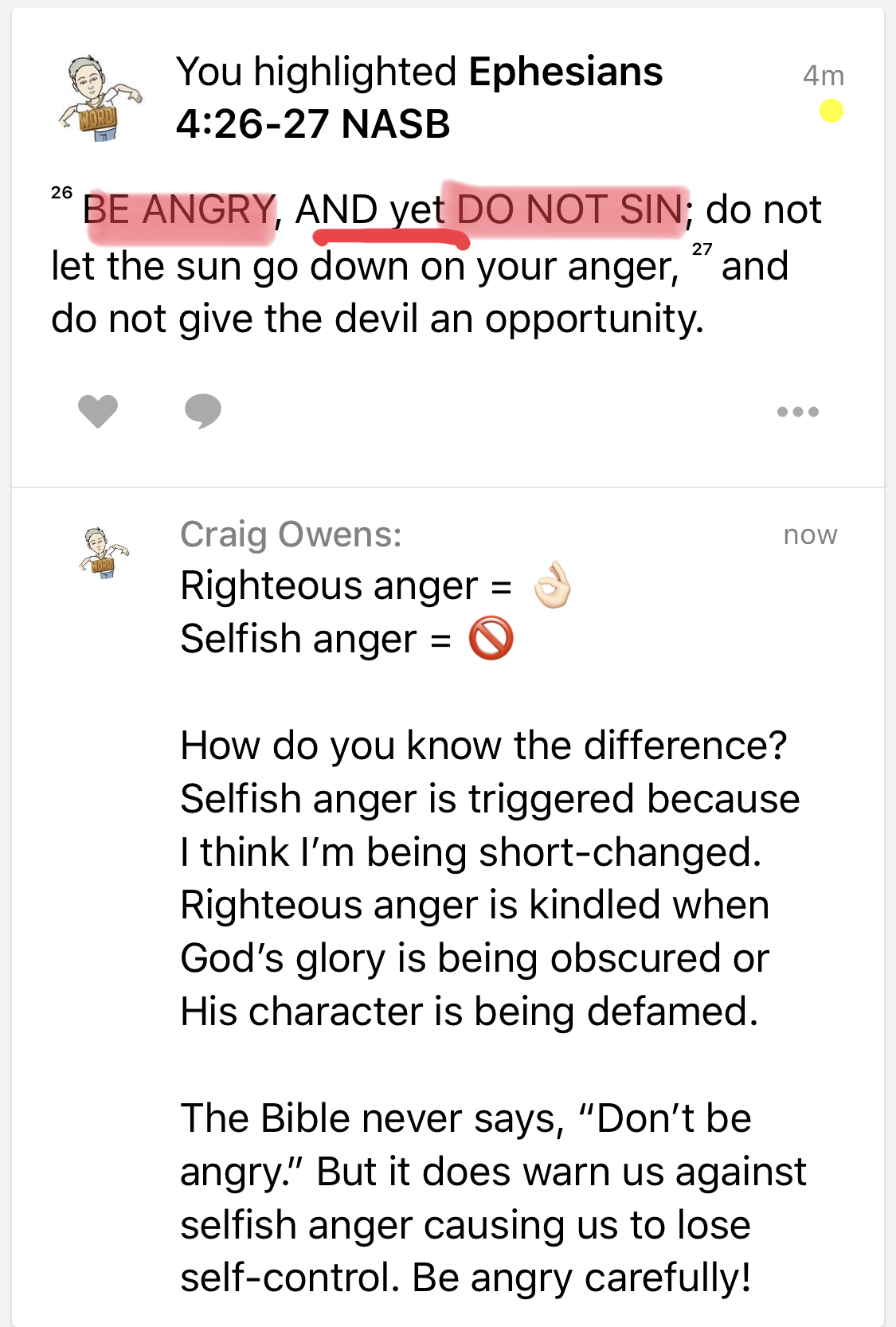
Being angry is not the issue. David said it (and Paul quoted it in Ephesians 4:26): “Be angry; just don’t sin.” God gets angry, but He does not sin. Jesus, in His public ministry, got angry, but He did not sin. We need to search our hearts to make sure our anger has not crossed the line to sin. We have to be angry in a godly way.

I see at least four ways to become angry without crossing the line into sin:

1.  Selfless Anger = anger at sin, but not angry at the sinner.

Love is not rude, it is not self-seeking, it is not easily angered, it keeps no record of wrongs. Love does not delight in evil but rejoices with the truth. (1 Corinthians 13:5, 6)

2.  Slow Anger = lengthen your fuse a bit.

Do not be quickly provoked in your spirit, for anger resides in the lap of fools. (Ecclesiastes 7:9)

My dear brothers, take note of this: Everyone should be quick to listen, slow to speak and slow to become angry, for man’s anger does not bring about the righteous life that God desires. (James 1:19, 20)

Good advice from Thomas Jefferson: “When angry, count to ten before you speak; if very angry, a hundred.”

3.  Protective Anger = when sinners entice others to join them in their sin. God is sad when people leave Him; He is angry at them when they take others with them.

But they put God to the test and rebelled against the Most High; they did not keep His statutes. Like their fathers they were disloyal and faithless, as unreliable as a faulty bow. They angered Him with their high places; they aroused His jealousy with their idols. When God heard them, He was very angry; He rejected Israel completely. (Psalm 78:56-59)

4.  Righteous Anger = against those who are keeping others from coming closer to God.

For I endure scorn for Your sake, and shame covers my face. I am a stranger to my brothers, an alien to my own mother’s sons; for zeal for Your house consumes me, and the insults of those who insult You fall on me. (Psalm 69:7-9)

This verse was recalled by Jesus’ disciples when they saw Him get angry and clear out the Temple in Jerusalem. Jesus was angry because of the religious clutter that was keeping God’s house from being a house of prayer for all nations.

I think everyone is familiar with the acrostic WWJD = What Would Jesus Do?

I’d like to propose something similar: WGGA = Would God Get Angry?

This is a great question to ask to make sure our anger does not cross that line into sin. Get angry—in a godly way—and do not sin.

Appropriate Language

Just wondering:

If the Bible says this…

Let no foul or polluting language, nor evil word nor unwholesome or worthless talk ever come out of your mouth, but only such speech as is good and beneficial to the spiritual progress of others, as is fitting to the need and the occasion, that it may be a blessing and give grace (God’s favor) to those who hear it. (Ephesians 4:29 AMP)

…does my texting, blogging, Facebooking, and Tweeting line up?

Does yours?

Wow!

Devilish Scheming

If you’ve ever locked horns with the devil in spiritual warfare, you know that he’s a schemer. Paul wrote to the church at Corinth to remind them that we shouldn’t be unaware of his scheming. And Peter said that the devil is always on the prowl, like a scheming lion looking for a place to attack.

So it should come as no surprise that since my message was about unity in the Body of Christ that the devil’s scheming would be to bring about disunity. There was just a weird mood happening yesterday. In fact, in our pre-service prayer time, I felt prompted to pray out loud that God would knock down any distractions to what the Holy Spirit wanted to do.

I saw it coming … I prayed hard against it … and my prayers knocked down the enemy before he could fully implement his devilish scheme.

Well, not exactly.

Yes, I did feel prompted to pray against distractions, but I should have been praying against disunity too. As a result, I could feel the fight all morning. It would be more accurate to say that I could feel something all morning. It wasn’t until I got home and commented to Betsy about what I had been feeling that I got clued in. She said, “What did you expect? You were talking about unity today, so obviously the devil is going to attack that very thing.”

Duh! Why didn’t I see that? I’m so grateful for a godly wife who catches these things for me.

But I learned something yesterday. I learned that my prayers need to be more specifically-targeted prayers. Sort of like the “smart bombs” our military uses that are laser-guided right on target. Like Paul said, I’m not going to be unaware of the devilish scheming.

Spiritual warfare is always hard work, which is why in Paul’s teaching on spiritual warfare he told us to keep on praying for each other.

God’s Math

I’m preparing for a wedding this weekend, and I love God’s math that shows up in the marriage relationship. Very simply it looks like this:

1 + 1 = 1

One man + One woman = One marriage.

God said, “Let the husband and wife be joined together. And the two will become one flesh.”

A husband can have his oneness—his uniqueness—enhanced by his wife. So too can a wife have her oneness—her uniqueness—beautified by her husband.

This is why God is for healthy marriages: It gives us a better picture of the oneness that we can have with Jesus Christ. He brings out the oneness—the uniqueness—in all of His followers.

I love it!

Yeah, But…

You know the story, or maybe you’ve even seen it portrayed on the big screen, where God appears to Moses in the burning bush. God handpicks Moses to lead His people to freedom. He assures Moses, “I AM the One who is sending you with My authority.” God shows Moses these miracles that He is going to do through him.

And how does Moses respond? “Yeah, but….” Sadly, this is how I usually respond too.

“Yeah, but who am I that You would handpick me?”

  • I don’t have the right credentials.
  • My family is dysfunctional.
  • I’m not comfortable with risk.
  • I’ve never done anything like this before.

“Yeah, but how do I really know this is You, God?”

  • I need a sign.
  • I’ve made mistakes before when I thought I was following You.
  • Have I mentioned I’ve never done anything like this before?

“Yeah, but what if this doesn’t work out?”

  • I need assurance.
  • I want to know where this is going to end up before I get started.
  • What happens next?

“Yeah, but how will I know what to say or do?”

  • I don’t want to look like a fool.
  • I don’t want to be embarrassed.
  • I want to be in control.

It’s interesting to see that God patiently answered all of Moses’ “Yeah, but” questions. It was only when Moses reached the conclusion “You’ve got the wrong guy” that God became angry.

Moses’ first response was his best response: Here I am.

This is what usually happens to me. God calls me to do something or say something for Him, and I immediately say, “Here I am.” Then I begin to think about what I just committed to. It’s then that I come up with all my “Yeah, but” reasons why I can’t be the guy God thinks I am. In other words, I think my way out of God’s plan for me.

Here’s what I need to remember: If God calls me, it’s only because He has already equipped me.

For we are God’s workmanship, created in Christ Jesus to do good works, which God prepared in advance for us to do. (Ephesians 2:10)

No more “Yeah, but” second-guessing, I’m just sticking with “Here I am.”

He Gave His Own Blood

I just read an amazing story about a West Michigan doctor working in Haiti. You can read the full article here, but let me highlight one section:

At a small health clinic east of capital city Port-Au-Prince, a teenage boy with a broken pelvis was dying from loss of blood.

West Michigan orthopedic surgeon Gregory Golladay sized up the options, then acted.

“He was the same blood type as me. He had a hemoglobin level of 5. You don’t have that and live long. His heart rate was 150. His blood pressure was 80 and going south. He was going to die.”

“I gave as much as I could into an IV bag and he lived,” recalled Golladay, 39, who is among a rotating group of physicians from Orthopedic Associates of Michigan offering critically needed medical care in Haiti.

“It is indescribable really. To see him survive was a very emotional experience. We said we were brothers and I believe it.”

Sounds just like Jesus, doesn’t it?

We were dying. Crushed by sin. There wasn’t much time left. Then Jesus came to earth to die on a Cross for you and me. He gave us His blood so that we could live:

For God so loved the world that He gave His one and only Son. That whoever would believe on Him should not die but have everlasting life. (John 3:16)

And now, when we accept what Jesus did for us, we are His brothers and sisters:

God decided in advance to adopt us into His own family by bringing us to Himself through Jesus Christ. This is what He wanted to do, and it gave Him great pleasure. (Ephesians 1:5)