Avoiding Foolish Controversies

Listen to the podcast of this post by clicking on the player below, and you can also subscribe on AppleSpotify, or Audible. 

Jude calls Christians to contend for the faith without contention and without compromise. Instead, we are to loving serve Jesus by engaging with others mercifully, peacefully, and lovingly. This means we have to contend without quarreling. 

But that’s easier said than done because people love to pick fights, and we hate to lose an argument. 

Look at the ministry of Jesus. His adversaries couldn’t get around the perfect logic that He used based on Scripture, so they came up with all sorts of controversies in the hope of tripping Him up and silencing Him. They posed seemingly unanswerable dilemmas like: In heaven, which one of the seven brothers will be married to the woman they all married on earth? Should we pay taxes to Caesar? Should we pay the temple tax? What’s the greatest commandment of all? They tried to get Him to take the bait about religious traditions, laws concerning the Sabbath, and the punishment for a woman caught in adultery. 

Jesus never got fluster or frustrated—He never took the bait to quarrel with them, but He simply stood unwaveringly and lovingly on God’s Word. But once again, that’s easier said than done! 

King Solomon pointed out the difficulty of this in Proverbs 26:4-5. Do we answer a fool or not? Yes, but we answer wisely not foolishly. 

(Check out all of the Scriptures in this post by clicking here.)

I believe Jude would agree with Solomon, Jesus, Paul, and Peter, but then he uses three examples that could spark a controversy:  

  • the fate of fallen angels (Jude 6) 
  • Michael and the devil arguing over the body of Moses (v. 9) 
  • Enoch prophesying (v. 14) 

But notice that how Jude uses these examples by not addressing any more than what we already know from Scripture. In this way, Jude keeps this from becoming a foolish, quarrelsome controversy (v. 10). 

Notice the consistent instruction of the Bible on how to handle critics: 

  • Michael the archangel: The Lord rebuke you! (also 2 Peter 2:11) 
  • Jesus: Away from Me! (Matthew 4:10) and Get behind Me! (Mark 8:33) 
  • James: Submit to God and then resist the devil (James 4:7) 
  • Peter: speak gently, respectfully, and with a clear conscience (1 Peter 3:15-16) 
  • Paul: warn people without becoming quarrelsome (2 Timothy 2:14, 16, 23-25) 

In Luke 13:1-5, Jesus addresses two events that could have become quite controversial, but Jesus defused the controversy by simply saying, “No matter what, everyone needs to have their sins forgiven by God.” Paul continued this singleminded focus on Jesus. I love how the Amplified Bible captures his words in 1 Corinthians 2:2. And then Paul encourages his friend Timothy to operate the same way (1 Timothy 1:15-17). 

Don’t let foolish controversies sidetrack you from the faith entrusted to us, but take everything back to Jesus as He is revealed in the Scripture. 

If you’ve missed any of the other messages in our series called Earnestly Contending, you can find them all here. 

►► Would you please prayerfully consider supporting this ministry? My Patreon supporters get behind-the-scenes access to exclusive materials. ◀︎◀︎

Continuing To Walk With God

Listen to the podcast of this post by clicking on the player below, and you can also subscribe on AppleSpotify, or Audible.

My leadership podcast partner Greg Heeres and I were discussing a leader’s epitaph. Greg asked me an unusual question: What did I want to be said on my own epitaph?

Take a listen to this snippet from The Craig and Greg Show—

The story I told about Enoch can be found in Genesis 5:3-24 and Hebrews 11:5-6. 

I’ve also blogged a couple of times about Enoch: “And then he died…” and “Walking intimately.” 

You can watch the full Craig and Greg Show episode that this clip from by clicking here.

►► Would you please prayerfully consider supporting this ministry? My Patreon supporters get behind-the-scenes access to exclusive materials. ◀︎◀︎
Walking Intimately

Listen to the podcast of this post by clicking on the player below, and you can also subscribe on AppleSpotify, or Audible. 

There’s an interesting verb used with both Enoch and Noah that denotes intimate fellowship—the word is “walked.”

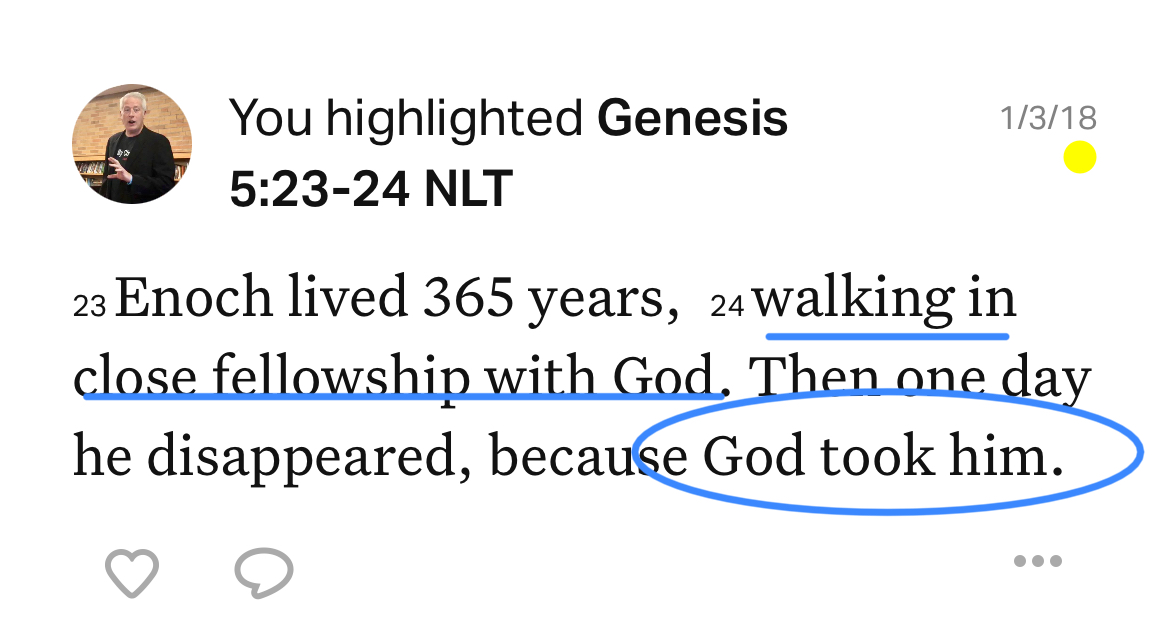
Enoch walked with God; and he was not, for God took him. (Genesis 5:24) 

These are the records of the generations of Noah. Noah was a righteous man, blameless in his generation. Noah walked with God. (Genesis 6:9)

David uses this same verb when he prays, “Vindicate me, Lord, for I have walked in my integrity, and I have trusted in the Lord without wavering. Examine me, Lord, and put me to the test; refine my mind and my heart. For Your goodness is before my eyes, and I have walked in Your truth” (Psalm 26:1-3). 

And Solomon uses the same verb to say that anyone who walks in righteous integrity leaves a legacy of righteousness for his family: “A righteous person who walks in his integrity—how blessed are his sons after him” (Proverbs 20:7). 

There is something important that is implied in this walking. God tells us what it is in this question: How can two walk together unless they agree to do so? (Amos 3:3). 

But make no mistake, God doesn’t agree with whatever path I choose to walk, but I must agree to walk God’s path. 

I must agree that God’s path is best, despite what everyone else is doing—“Then the Lord saw that the wickedness of mankind was great on the earth, and that every intent of the thoughts of their hearts was only evil continually” (Genesis 6:5). Yet Noah didn’t walk with the wicked, but he was commended because he walked with God. 

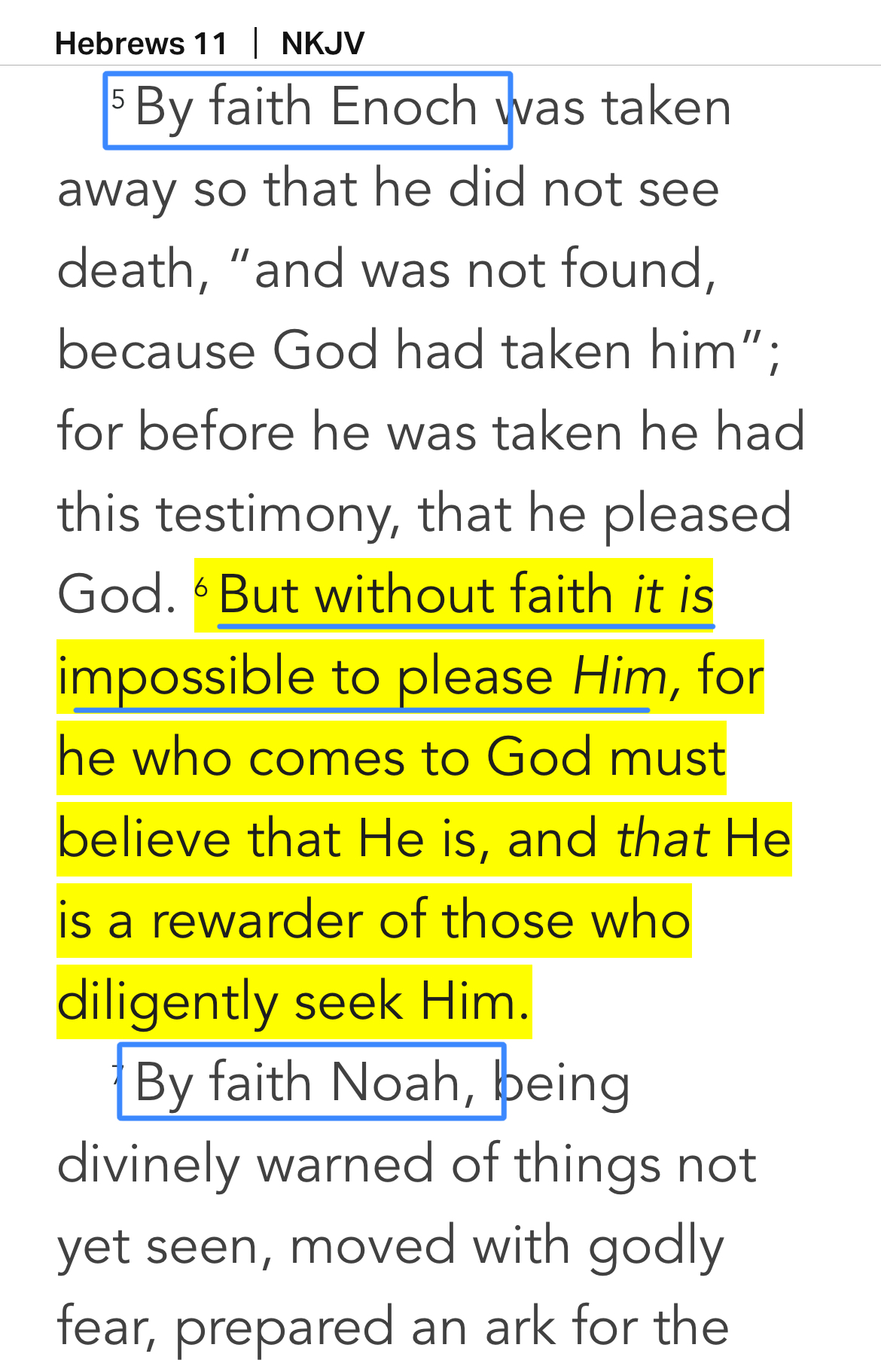
In the New Testament, Enoch and Noah are listed as back-to-back examples of faith (Hebrews 11:5, 7). The verse that connects these two men speaks of the faith-filled integrity that kept them walking with God—

And without faith it is impossible to please Him, for the one who comes to God must believe that He exists, and that He proves to be One who rewards those who seek Him. (Hebrews 11:6) 

That word “seek” means to diligently crave. Enoch and Noah and David show us examples of men who diligently craved walking with God above all else. Their faithful, diligent walking made them stand out from all those around them. 

What about us? Hebrews 11:6 says we can follow their example. We can choose to walk with God by faith. We can diligently crave Him above all else. When we walk righteously with God, He “rewards those” who do—for ever and ever! 

►► Would you please prayerfully consider supporting this ministry? My Patreon supporters get behind-the-scenes access to exclusive materials. Like this exceptional Bible study tool to help with Creation apologetics. ◀︎◀︎

Come To God And Keep Walking With Him

Listen to the podcast of this post by clicking on the player below, and you can also subscribe on AppleSpotify, or Audible. 

I have been so grateful for the insights of Dr. Gary Chapman in his book The Five Love Languages. I have found this book to be of immense value in helping couple prepares for marriage, and in helping married couples get beyond a place where intimacy has become stuck. 

In short, the five love languages are words of affirmation, quality time, gifts, acts of service, and physical touch. The goal of learning the other person’s love language—and learning to speak it consistently and fluently—is an increased level of intimacy. In the book of Amos, God asks, “Can two people walk together without agreeing on the direction?” (Amos 3:3 NLT), and speaking the right love language definitely helps people agree! 

The whole reason we come to God in prayer as a Father, as a Brother, and as a Counselor is so that we can hear Him speaking our love language and we can continue to walk in deeper intimacy with Him. 

When my then-girlfriend Betsy and I first met, we spent hours and hours getting to know each other. We would ask questions, share stories, and tell things we did and didn’t enjoy. This is the epitome of intimate conversation: getting to know the other person’s heart as you open up your heart to them as well.

I’ve shared this analogy before, but intimacy grows stale and can eventually disappear altogether if those in a relationship are no longer walking together. It doesn’t work if I say, “Betsy, I’m looking forward to spending an hour with you each week,” or even if I say, “I’ll give you 15 minutes each morning.” Instead, our relationship needs to be one of continual walking. 

It’s the same thing for us as Christians: we cannot only give God an hour at a church service on Sunday mornings, nor is intimacy going to increase if I only walk and talk with my Savior for a few minutes in my morning devotions. 

Walking closely with Him is what God has desired right from the beginning. He walked with Adam and Eve each evening. This phrase “walking with God” is used consistently throughout the Bible of those who had an intimate relationship with their Father, Brother, and Counselor—Noah, Abraham, Isaac, the people of Israel (Genesis 3:8, 6:9, 17:1, 48:15; Leviticus 26:12). And even as the New Testament era dawns, we read, “And they [Zechariah and Elizabeth] were both righteous before God, walking in all the commandments and ordinances of the Lord blameless” (Luke 1:6 NKJV). 

But I’m especially intrigued by the story of Enoch in Genesis 5:21-24. Twice in four short verses, we read “Enoch walked with God.” Remember that verse in Amos—“Can two people walk together without agreeing on the direction?”—so Enoch and God had to be in agreement. In fact, that’s exactly what we read about Enoch in the Book of Hebrews: 

By faith Enoch was taken from this life, so that he did not experience death: “He could not be found, because God had taken him away.” For before he was taken, he was commended as one who pleased God. And without faith it is impossible to please God, because anyone who comes to Him must believe that He exists and that He rewards those who earnestly seek Him. (Hebrews 11:5-6)

If you’ve taken Dr. Chapman’s love language assessment, you probably found that you were pretty lopsided: maybe you scored very highly in one love language and then barely registered in another. We may be lopsided in our love language skill, but God speaks every language perfectly! 

  • Words of affirmation—Hosea 2:14; Isaiah 40:2 
  • Quality time—Deuteronomy 31:6; Psalm 23:3-4
  • Gifts—James 1:17; 2 Peter 1:3
  • Acts of service—Philippians 2:13; Romans 8:28
  • Physical touch—Psalm 139:13-15; Luke 24:39 

(Click here to check out all of those verses.) 

Dr. Chapman noted that when our love language is being spoken to us sincerely and consistently, our love tank is filled, and all of the love languages begin to become more meaningful. 

Just as God walked with Enoch until the day He brought him Home, so He wants to walk with us. 

  • Walk in obedience to all that the Lord your God has commanded you, so that you may live and prosper. (Deuteronomy 5:33) 
  • The Lord will establish you as His holy people, as He promised you on oath, if you keep the commands of the Lord your God and walk in obedience to Him. (Deuteronomy 28:9) 
  • May He turn our hearts to Him, to walk in obedience to Him and keep the commands. (1 Kings 8:58) 
  • Blessed are all who fear the Lord, who walk in obedience to Him. (Psalm 128:1) 
  • And this is love: that we walk in obedience to His commands. As you have heard from the beginning, His command is that you walk in love. (2 John 6) 

When we walk in loving intimacy with Him, our intimacy grows deeper and more mature. Sometimes they will say of couples who have been married for a long time and walk in increasingly deeper intimacy with each other, “They seem to know each other’s thoughts.” That’s because they know each other’s hearts—and that’s what God wants to do with us. He did it with Enoch, and He will do that with us too (Jude 14; Jeremiah 33:3; Habakkuk 3:19). 

Enoch walked intimately with God for 365 years. Let us walk intimately with God for 365 days a year, for as many years as He gives us until God takes us away with Him forever! 

If you’ve missed any of the messages in our prayer series called Intimate Conversation, you can find all of the messages by clicking here. 

►► Would you please prayerfully consider supporting this ministry? My Patreon supporters get behind-the-scenes access to exclusive materials. ◀︎◀︎

Questioning God

Listen to the podcast of this post by clicking on the player below, and you can also subscribe on AppleSpotify, or Audible. 

In the first six chapters of the book of Zechariah, question marks appear 18 times. 

Question marks invite a conversation; whereas, periods or exclamation points tend to end the conversation. Clearly, God enjoys dialogue.

God sometimes asks questions to get Zechariah to evaluate his surroundings or the prevailing culture. Sometimes God asks Zechariah a question to get him to clarify what he is seeing or thinking. 

But without a doubt, most of the questions are posed by Zechariah to either God or to the angelic messenger who sometimes serves as Zechariah’s guide. Not once does God nor the angel tell Zechariah to hold his tongue. Zechariah’s questions are never belittled nor treated as though they were a bother. Nor are his questions ignored. 

Rather, every single question is answered.

God enjoyed talking with Adam and Eve in the garden of Eden, He walked and talked with Enoch, He listened to the questions asked by Job and the psalmists, and here He engages Zechariah in conversation too. 

Prayer is never designed to be a monologue—with us just speaking to God—nor is Bible reading designed to be a monologue—with just God speaking to us. Both prayer and Bible reading are used by the Holy Spirit to keep a dialogue active and engaging. You and I should never be afraid to approach God with our questions, nor should we be afraid to listen to the questions God asks us. 

The dialogue between us and God builds an intimacy that cannot be developed in any other way. So keep asking those questions!

►► Would you please prayerfully consider supporting this ministry? My Patreon supporters get behind-the-scenes access to exclusive materials. ◀︎◀︎

Links & Quotes

link quote

“‘And Enoch walked with God’ [Genesis 5:24]. If so much as this can be truly said of you and me after our decease, we shall not have any reason to complain that we have lived in vain.” —George Whitefield

“A neglect of secret prayer has been frequently an inlet to many spiritual diseases, and has been attended with fatal consequences.” —George Whitefield

“You have heard many men’s dying words, and these are mine: A life spent in communion with God is the pleasantest life in the world.” —Matthew Henry, to a friend when near his death

Sgt. Jason Kelley is a wonderful asset to my hometown, and our surrounding area. So I couldn’t be happier that he has been named Kent County Deputy of the Year!

We are losing a pastor who has been so involved in our city. Pastor Tom Holloway is moving to South Carolina, and I am going to miss him.

A U.S. Army chaplain has found an innovative way to water baptize soldiers. Love it!

Eric Metaxas asks, “How can anyone defend Planned Parenthood after the sickening video came to light this week?” Check out his insightful answer.

[VIDEO] Here is the video from another Periscope broadcast I did about handling fear—

Insert Your Name Here

I don’t think anyone would mind having his or her name inserted in any of the following compliments:

  • ___________ is a righteous person.
  • ___________ is blameless before God.
  • God looks favorably on ___________.
  • ___________ walks with God.

Pretty nice pedigree, huh?

This is the description of Noah in the Bible. I especially love the phrase “walks with God.” It’s only used of two people in the Bible: Noah and Enoch. But it’s even more encouraging to me when I read it about Noah’s life.

Noah is the first in Adam’s family line to be born after Adam died. That’s significant because all of his ancestors (including Enoch) would have been able to get a first-hand account from Adam himself about what it was like to be in the Garden of Eden. All of Noah’s ancestors could have heard right from Adam’s mouth what it was like to visit with God personally each evening, to talk to Him face-to-face. And they could have heard firsthand how devastatingly painful it was to lose that intimate fellowship because of sin.

Since Noah was the first person in this family tree to hear about this secondhand, he’s the first person to walk with God by faith. Which is the exact same way we walk with God today:

Faith is being sure of what we hope for and certain of what we do not see (Hebrews 11:1).

You too can insert your name in this blank: “___________ walks with God.”

How do you do this? Pray this:

“God, I want to walk with You. I know it’s impossible to please You except by faith. I want to get closer to You. So I believe that You exist and that You care enough to respond to me when I seek You and love You with all of my heart, soul, mind, and strength.”

Let’s enourage one another to walk in this way every single day.

“And Then He Died…”

Listen to the podcast of this post by clicking on the player below, and you can also subscribe on AppleSpotify, or Audible.

That’s the end of his life. All those years living and that’s all his obituary says: “and then he died.”

Genesis 5 is the lineage of Adam. A mind-numbing list of names and years scroll by:

  • Adam lived 930 years, and then he died.
  • His son Seth lived 912 years, and then he died.
  • His son Enosh lived 905 years, and then he died.
  • His son Kenan lived 910 years, and then he died.
  • His son Mahalalel lived 895 years, and then he died.
  • His son Jared lived 962 years, and then he died.
  • And on and on and on….

For each man we hear the name of one of his sons and how long he lived, but nothing more. Like a modern-day tombstone:

Birth DateDeath Date

The dash between the dates covers childhood, schooling, marriage, inventions, parenthood, and so many other things. But years later, more and more of the details are forgotten and only the dash remains to represent the sum total of the deceased’s life.

And then comes Enoch.

All of the same details are there. Well, except for the “and then he died” epitaph. But actually, there’s so much more. Instead of a death, there’s a phrase that appears only for him: “Enoch walked with God.” The phrase literally means “to be continually conversant.”

Because Enoch lived this way, he didn’t really die. Instead, “He was no more.” He wasn’t here any longer because he is still walking with God. What an incredible blessing to his future generations! He was a blessing while he was alive, and he continues to be a blessing after he is no more.

Enoch’s tombstone reads differently from everyone else. The birth date is there, the dash is there, but instead of “and then he died” we read “he was no more.”

It’s the way I would want my tombstone to read:

Craig T. Owens

1966He walked with God─He was no more (because he is still walking with God)

In The Seven Habits Of Highly Effective People, Stephen Covey suggests living my life today consistent with what I would like said at my own funeral. It starts with a decision: “Today I will be continually conversant with God.” Then at my funeral, they can say of me, like the Bible says of Enoch: “He didn’t die. He’s just not here any longer. He is walking with God in heaven, just like he walked with Him here on earth.”

What do you want said about your dash?

Do you want your life to simply end with “and then he died”? Do you want something more?

Make your dash a continual conversation, a daily walk with God, and all of your future generations won’t see just a dash, they’ll remember “He is no more. He walked with God, and he is still walking with God!

Start walking today!

►► Would you please prayerfully consider supporting this ministry? My Patreon supporters get behind-the-scenes access to exclusive materials. ◀︎◀︎