Light In The Darkest Of Times

Listen to the podcast of this post by clicking on the player below, and you can also subscribe on AppleSpotify, or Audible. 

One of the reasons I appreciate the Bible—in fact, one of the main reasons that continually convinces me of the truthfulness of the Bible—is the way it portrays life as it really is. It doesn’t avoid the difficult subjects, nor does it sugarcoat the bitterness of life. The Bible tells it as it is. 

The songs that have us singing praises to God “when the sun’s shining down on me and the world’s all as it should be” are great, but when we can also find hope when we’re “found in the desert place” is the real test. 

Dark times come to all of us. 

David is anointed king of Israel and given a promise by God for a lasting legacy (2 Samuel 7:8-9, 16, 27-29; Psalm 110:1). And yet David cried out one of the most painful phrases ever uttered in Psalm 22:1-2, “My God, my God, why have You forsaken me?”  

(Check out all of the Scriptures in this post by clicking here.) 

Despite the promises that God gave David, when any of us are in a dark place, there is a natural human tendency to focus on the darkness around us and second-guess what is happening to us. You know the questions:

  • How did I get here? 
  • How will I get out of here? 
  • When will I get out of here? 
  • Have I offended God and perhaps missed out on His promise? 
  • Has He forgotten me? 

The Bible does tell us, “If You, Lord, kept a record of sins, Lord, who could stand?” and we also know it’s true that “all have sinned and fall short of the glory of God” (Psalm 130:3; Romans 3:23). 

That’s for us, not for Jesus. He is the sinless One. He obediently became human to rescue us, knowing full well that He was the fulfillment of the promise God made to David (Matthew 1:1; 22:41-44). Yet He ended up uttering the same painful words David did (Matthew 27:41-46). 

Remember I said that King David was a visible picture to help us see the coming King of kings. David was inspired by the Holy Spirit with this knowledge (Acts 2:29-30, 25-28). 

The old hymn says, “When darkness veils His lovely face, I rest on His unchanging grace” and “When all around my soul gives way, He then is all my hope and stay.” Look at David’s preaching to himself:

  • I am feeling forsaken (Psalm 22:1-2) … YET You are on Your throne (vv. 3-5) 
  • I am scorned by others (vv. 6-8) … YET You are closer than my scorners (vv. 9-11) 
  • I am completely cut off (vv. 12-18) … BUT You are my rescue (vv. 19-24) 

What did Jesus know:

  • He would sit on the throne of Heaven—Matthew 26:62-64 
  • His Father was completing everything—John 19:30; Psalm 22:25-31 
  • He would conquer every enemy—Revelation 1:8, 18 

Jeremiah cries out about his dark time, and then like David he says, “YET this I call to mind and have hope.” Jeremiah then talks about the never-ending love and mercy of God, and concludes by preaching to himself, “I say to myself, ‘The Lord is my portion; therefore I will wait for Him’” (Lamentations 3:19-24). 

The Lord is my portion” means the Lord is my King who declares promises and fulfills promises. 

The help in suffering is not found in focusing on the present darkness—and all the questions—but to focus on God’s promises. Like David’s “yet” and “but” we need to preach to ourselves about God’s past deliverance and then be assured of our future hope. 

Just assuredly as our King of kings said, “I will be resurrected from the dead to sit on the throne of Heaven,” He also said, “I will come to take you where I am”! 

Take your eyes off the present, temporary darkness and put them on the eternal King! 

If you have missed any of the messages in this series on the Royal Psalms, you can find them all here. 

►► Would you please prayerfully consider supporting this ministry? My Patreon supporters get behind-the-scenes access to exclusive materials. ◀︎◀︎

Eyewitnesses And Embarrassment

Listen to the podcast of this post by clicking on the player below, and you can also subscribe on AppleSpotify, or Audible. 

In his Gospel, John gives eyewitness testimony to the physical death of Jesus. “Instead, one of the soldiers pierced Jesus’ side with a spear, bringing a sudden flow of blood and water. The man who saw it has given testimony, and his testimony is true. He knows that he tells the truth, and he testifies so that you also may believe” (John 19:34-35). 

John was at Calvary to report this event as an eyewitness, and so were the women who had been so involved with the public ministry of Jesus. 

Matthew, however, was not there. He ran away when Jesus was arrested. So in his historical account, he shares the eyewitness testimony of those who were there—

When the centurion and those with him who were guarding Jesus saw the earthquake and all that had happened, they were terrified, and exclaimed, ‘Surely He was the Son of God!’ Many women were there, watching from a distance. They had followed Jesus from Galilee to care for His needs. Among them were Mary Magdalene, Mary the mother of James and Joseph, and the mother of Zebedee’s sons. (Matthew 27:54-56)

These details in both Matthew and John’s Gospels are what lends credibility to this whole event. I’m sure it was embarrassing to Matthew for him to admit, “I ran away and hid in fear.” I’m sure it pained him again and again when he heard John, the women, and the Roman centurion recounting their eyewitness testimony. 

But this is what makes the reporting of this account real. 

If Matthew and John were attempting to perpetuate a hoax on the world—if they were concocting a conspiracy to fool people about the resurrection of Jesus—they certainly would have told their stories the same way. Matthew could have inserted himself as personally there on Calvary. John and Mark could have listed the names of the other disciples as eyewitnesses. The disciples could have given falsified information to Luke for his Gospel. And all of them could have left out the part about the female testimony, since in their day women were deemed unreliable witnesses in the courtroom. 

The fact that all four of the Gospels relate their accounts as they do—with the embarrassing details intermingled with the eyewitness accounts—is precisely what gives legitimacy to this historical event. 

Details like these are just another factor in a long, long list of evidences that attest to the historicity of all that is recorded in the Bible. 

Earlier in his Gospel, Matthew tells about the doubts of John the Baptizer (Matthew 11:2-6). John was imprisoned and sent his friends to ask Jesus, “Are You really the One?” Jesus sends John’s friends back with eyewitness testimony, and with these words: “Blessed is anyone who does not stumble on account of Me” (v. 6). 

The testimonies of both eyewitnesses and those who were embarrassed that they couldn’t give eyewitness testimony should bolster your faith in all that the Bible says. If you don’t stumble away from these testimonies, you can know the blessing of your faith in Jesus. 

►► Would you please prayerfully consider supporting this ministry? My Patreon supporters get behind-the-scenes access to exclusive materials. ◀︎◀︎
So Good!

Listen to the podcast of this post by clicking on the player below, and you can also subscribe on AppleSpotify, or Audible. 

You may have heard it this last weekend. Someone says, “Jesus is risen,” and their friend responds, “He is risen indeed!” Jesus Christ’s resurrection from the dead is the greatest event ever! And yet some people just can’t seem to grasp how good this truly is.

We’ve been trained to believe if something sounds too good to be true, then it probably is. So we are careful to be skeptical of any too-good-to-be-true claims that we may hear. Our heart might get excited at the possibilities, but then our logical mind begins to shout, “Wait!” 

Here’s what a logical argument looks like: P1 + P2 + P3 = C. 

The Ps are premises, and if we put true premises all together, then the C (conclusion) is true as well. All I have to do is invalidate one of the Ps and the whole argument falls apart. Then my logical mind can say, “See! I told you it was too good to be true!” 

People heard the teachings of Jesus, they saw His miracles, thousands of them had even tasted the bread and fish He miraculously multiplied. They had hoped He was the One they had been longing for—the Messiah that would deliver them. But then He was crucified and their excitement was extinguished. 

On the Sunday morning after His crucifixion, rumors began to swirl that Jesus had been resurrected back to life. Others said they had actually seen Him and talked with Him. Hearts began to swell with excitement again. But for many of them, their logical minds began to shout, “Wait! Don’t fall for another too-good-to-be-true story!” 

We meet a couple of men who felt like this in Luke 24:13-24. They so wanted it to be true that Jesus was the Messiah they had longed for, but I notice that they use the word “but” three times. That’s their logical mind trying to invalidate any one of the premises. 

Jesus was indeed resurrected from the dead. There is so much evidence that I don’t have time to go through today, but let me just share one item with you: Paul listed all of the people who had seen Jesus alive (1 Corinthians 15:3-8). Facing persecution and even martyrdom, none of these eyewitnesses recanted their faith. 

Chuck Colson, who was at the center of the Watergate scandal and who was not a Christian at that time, said,  

“I know the resurrection is a fact, and Watergate proved it to me. How? Because twelve men testified they had seen Jesus raised from the dead, then they proclaimed that truth for 40 years, never once denying it. Every one was beaten, tortured, stoned and put in prison. They would not have endured that if it weren’t true. Watergate embroiled twelve of the most powerful men in the world and they couldn’t keep a lie for three weeks. You’re telling me twelve apostles could keep a lie for 40 years? Absolutely impossible.”  

Remember our logical statement: P1 + P2 + P3 = C. 

Jesus gave one of His own in Luke 18:31-33. It would go something like this: 

  • ✔️ P1 (He was turned over to the Romans) 
  • ✔️ P2 (He mocked, flogged, killed) 
  • ✔️ P3 (He was raised from the dead)
  • ✔️ C (Jesus fulfills every promise of God) 

The disciples on their way to Emmaus used the word “but” three times, but Jesus counteracted that by using the word “all” three times (Luke 24:25-27), when He said all of the Scriptures point to Him and are fulfilled in Him! 

The Bible is packed with promises! Promises of courage, assurance, wisdom, healing, direction, provision. And they are all valid promised because of the resurrection of Jesus—

For no matter how many promises God has made, they are “Yes” in Christ. And so through Him the “Amen” is spoken by us to the glory of God. … What, then, shall we say in response to these things? If God is for us, who can be against us? He who did not spare His own Son, but gave Him up for us all—how will He not also, along with Him, graciously give us all things? (2 Corinthians 1:20; Romans 8:31-32)

It may seem like these promises are too-good-to-be-true, but Jesus is so good that He makes all of the promises true! 

If you missed any of the messages in our series looking at how Jesus fulfilled the smallest of details of prophecy, check them out here. 

►► Would you please prayerfully consider supporting this ministry? My Patreon supporters get behind-the-scenes access to exclusive materials. ◀︎◀︎

Jots And Tittles

As we get closer to the death and resurrection of Jesus, there are an increasing number of prophecies that are fulfilled in these events. Jesus appears to have been very attentive to making sure that each and every one of these prophecies were fulfilled to the smallest detail. 

Near the beginning of His public ministry, Jesus noted that not one iota—or “one jot or tittle” in the Old English vocabulary—of any of God’s promises would be left unfulfilled (Matthew 5:18). It’s amazing that Jesus so carefully attended to all of these, but it’s also important to ask ourselves what these fulfilled prophecies mean to us today. 

This is what we are going to be unpacking in our series Jots and Tittles. I hope you can join us, but if you have missed any of the messages in this series, you will be able to find them all right here—

Helping Skeptics See The King

Listen to the podcast of this post by clicking on the player below, and you can also subscribe on AppleSpotify, or Audible. 

I once worked with a guy that was the epitome of “all talk and no action.” After a while people just stopped listening to him or believing anything he said. But something worse is someone who says he will do something but doesn’t have the power to finish what he started. In that case, you may have believed him and not taken any steps of your own, so when he finally admits defeat, you are totally unprepared to step in to help finish the task. 

I think that comes close to the two attitudes people had prior to the First Advent of Jesus in Bethlehem. Some people thought all of God’s promises had just become “all talk and no action.” 

But after Jesus began His public ministry, His skeptics may have originally thought He was also “all talk and no action,” but when they saw how the people responded to Him, they realized He at least had the power to sway a crowd. But they certainty didn’t think He could finish what He started. 

The religious elite—the Sanhedrin—had their own plans in the works, and it appeared to them that Jesus was just going to get in the way. So they hatched a plan to have Pontius Pilate, the Roman governor, have Jesus crucified. As Jesus is hanging on the Cross, you can hear the skepticism and derision in the voices of these religious elite—

In the same way the chief priests, the teachers of the law and the elders mocked Him. “He saved others,” they said, “but He can’t save Himself! He’s the King of Israel! Let Him come down now from the Cross, and we will believe in Him. He trusts in God. Let God rescue Him now if He wants Him, for He said, ‘I am the Son of God.’” (Matthew 27:41-43)

After all, they had experienced “messiahs” before (Acts 5:35-37) so they thought this Jesus from Nazareth was just the next in a long line of pretenders. “King of Israel, indeed! Ha!” 

But when someone tells you what they are going to do, and then they actually do it, skeptics are turned into believers. We see this happen in people like Nathaniel, a whole village of Samaritans, and one of the thieves that was crucified alongside Jesus (John 1:43-51; John 4:9-42; Luke 23:39-42)

Even though Jesus told His disciples exactly what was going to happen to Him in Jerusalem—and then it did!—they were still skeptical of the claims of His resurrection until they saw it for themselves (Matthew 20:18-19; John 20:3-8). 

Just like the prophets told us how Jesus would come from a virgin and be born in Bethlehem—and then it happened!—so Jesus foretold His death and resurrection. 

There is a common theme here that turned all these skeptics into believers:

  • Philip said to Nathaniel, Come and see Jesus” 
  • The Samaritan woman said to her fellow townsfolk, “Come and see Jesus”  
  • The criminal saw and heard Jesus’ loving words when He forgave His crucifers 
  • And the doubting disciples ran to the tomb and “saw and believed” 

(See John 1:46; John 4:29; Luke 23:34; John 20:8) 

Skeptics need to see and hear for themselves that Jesus has the power to do what He says He will do. We are the ones that preach this Good News to them by the way we live. 

We have to live as good citizens of the King of kings so that people will “come and see” what a good and loving King He is. For those who are skeptical of the claims of Jesus the King, we have to live in a way that makes it real. We have to help them see the King of kings! 

Advent isn’t just a long-ago event that we fondly remember. The First Advent is proof that God has the power to keep His word. And just as we have seen the First Advent, so we will see the Second Advent. 

If you’ve missed any of the messages in this Advent series, you can check them all out here. 

►► Would you please prayerfully consider supporting this ministry? My Patreon supporters get behind-the-scenes access to exclusive materials. Like this video where I explain what the Bible means when we “examine” our lives. ◀︎◀︎

Links & Quotes

We can look back to learn or we can look back to relive. Looking back to learn is healthy, but looking back in regret to try to relive our past is unhealthy and unproductive. Learning vs. reliving makes all the difference. See my full message on this mental health thought hereI have lots of new content every week, which you can check out on my YouTube channel.

“I’ve learned one thing: You only really get to know a person after a fight. Only then can you judge their true character.” —Anne Frank

Lenny Esposito is an outstanding Christian apologist. Check out this podcast where Lenny discusses the historical facts about the crucifixion and resurrection of Jesus Christ.

“Life with God is not immunity from difficulties, but peace in difficulties.” —C.S. Lewis

“I believe it will only be known on the Last Day how much has been accomplished in missionary work by the prayers of earnest believers at home.” —James Fraser

John Piper expounds on why God would make mankind in His image, and why He would create such a vast and beautiful universe in which to place mankind.

Speaking of our amazing Creator. I’ve always been fascinated by honeybees! Professor Andrew Barron, in describing the results of an amazing study on bees’ decision-making process, said, “A honeybee has a brain smaller than a sesame seed. And yet she can make decisions faster and more accurately than we can. A robot programmed to do a bee’s job would need the back up of a supercomputer.”

This is a good reminder from Axis for parents with students returning to school. The heading of this section of Axis’ weekly Cultural Teanslator is “Back to Backpacking.” 

“What it is: As a new school year begins, teens might have mixed feelings of excitement, anxiety, and feeling overwhelmed.

How to approach this season: As Hannah King writes in Christianity Today, all seasons of transition bring with them an element of loss. Starting a new school year might mean making new friends, meeting new teachers, or starting a new curriculum. It can also mean the loss of free time, increased stress levels, and more difficulty creating intentional moments as a family. For parents, the beginning of a new school year might also feel like a reminder that time with their teens living at home is dwindling down, a feeling which can bring its own set of griefs, pressures, and regret. King recommends allowing space for teens and adults to name the things they’re disappointed about or not looking forward to, noting that repressed sadness can keep us from ‘entering freely into [the] joy’ of a new thing.

“Start the conversation: What will you miss the most about this summer?”

“Either you deal with what is the reality, or you can be sure that the reality is going to deal with you.” —Alex Haley

Reason To Hope And To Proclaim

Listen to the podcast of this post by clicking on the player below, and you can also subscribe on AppleSpotify, or Audible. 

On Resurrection Sunday, Christians celebrate an event that is the foundational truth for all of the Bible and for the Christian faith which springs from the Scriptures: The resurrection of Jesus. 

If Jesus wasn’t resurrected, this is a terrible, cruel lie we are perpetuating. If Jesus was resurrected, we have been given the key to eternal life. No one has ever made the bold claims that Jesus made about His own death and resurrection and then backed them up! 

On the Sunday morning after Jesus was crucified, some women arrived at His tomb to finish preparing His body for burial, but Luke records something fascinating: “They did not find the body of the Lord Jesus” (Luke 24:1-8). 

Think about this in a modern-day setting. If you were at the bedside of your loved one when they took their last breath, if you heard the doctor pronounce them dead, if you were at the funeral and saw their body in a casket, and if you saw that casket closed, sealed, and lowered into the ground, you would have every reason to find a body if that casket were re-opened. 

These women were on Golgotha when Jesus died, they saw the Roman soldiers verify His death, they witnessed Joseph and Nicodemus wrap His body in linen strips, and they saw His body placed in a sealed tomb. 

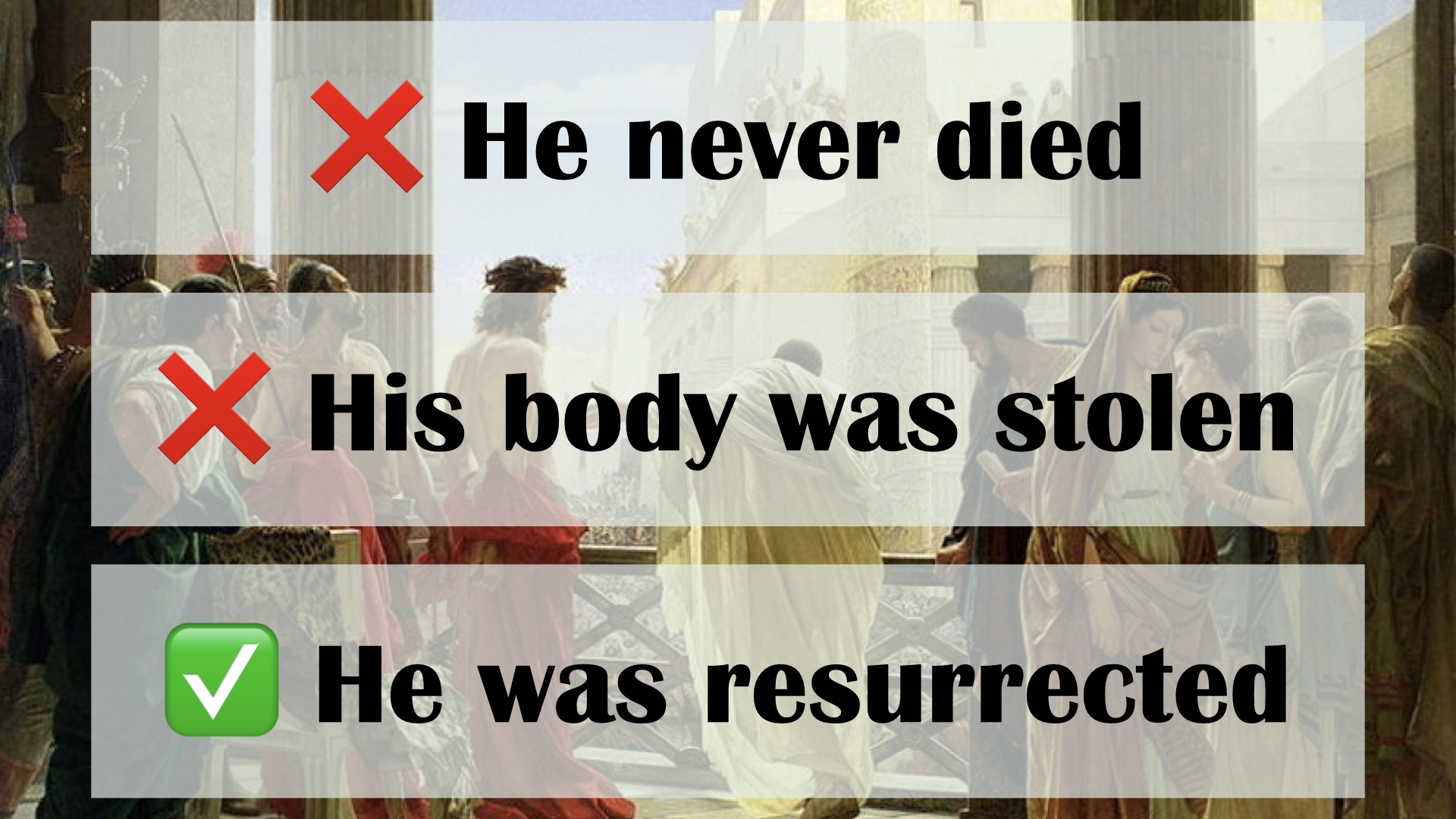
Then when there is no body where the dead body of Jesus is expected, there are only three possibilities: 

(1) He never died

Medical experts have concluded that the horrific torture that Jesus endured prior to even being crucified resulted in significant blood loss, and would have put His body in shock. Then the strain on His weakened body during crucifixion would have resulted in His body experiencing either pleural effusion or cardiac effusion, which is attested to by the flow of “blood and water” from Jesus’ dead body when His side was pierced by a Roman spear (John 19:34). 

The dead body of Jesus was thoroughly examined by both the Romans who conducted the crucifixion and His friends who prepared His body for burial (Mark 15:43-45; John 19:38-40). And two contemporary historians—Tacitus and Josephus—who were unfriendly to the cause of Christianity both attested to Christ’s death by crucifixion. 

(2) His body was stolen

The Sanhedrin was so insistent on Jesus being crucified, they wouldn’t have left the “conspiracy” option open. So they convinced Governor Pontius Pilate to allow them to both seal the tomb and place a group of soldiers outside the tomb to guard it (Matthew 27:62-66). It is highly unlikely that the disciples who fled before the temple guard and who were now locked in a room because they were quaking with fear would somehow gain the courage to undertake a mission to steal Jesus’ body. Nor is it likely that they could have escaped the notice of the highly-trained Roman soldiers guarding the tomb. 

(3) He was resurrected 

The angels at the empty tomb reminded the women that Jesus had foretold both the manner of His death and the assurance of His resurrection. Jesus described His death in detail multiple times, including such key details as His death would be in Jerusalem, the religious leaders would pronounce a death sentence but the Romans would crucify Him, and that He would be resurrected three days later (Matthew 20:18-19; Luke 18:31-33). In addition, Paul tells us that there were hundreds of eyewitnesses to the resurrected Jesus (1 Corinthians 15:3-8). 

Jesus said, “The reason my Father loves Me is that I lay down My life—only to take it up again. No one takes it from Me, but I lay it down of My own accord. I have authority to lay it down and authority to take it up again. This command I received from My Father” (John 10:17-18). 

If Jesus foretold this and fulfilled this, we can also trust His other promises. Assurances such as:

  • He is preparing an eternal home for us and He will come back to take His followers there 
  • That He alone holds the keys to Death and Hades
  • And that only those who have been cleansed from their sins will be able to enter Heaven

(see John 14:1-3; Revelation 1:18, 22:12-14)

The bold claim that Jesus would be resurrected back to life is adequately backed up by the events on Resurrection Sunday! So now we can say that believing the bold claim of Christ’s resurrection gives us hope for the future and reason to tell others about Him! 

If you’ve missed any of the other bold claims that we have discussed, you can find them all by clicking here. 

►► Would you please prayerfully consider supporting this ministry? My Patreon supporters get behind-the-scenes access to exclusive materials. ◀︎◀︎

An Unlikely Convert

There is a man that we meet in just a couple of verses of Scripture. We know that he is a Roman centurion. I gave him an appropriate Roman name of Vitellius. I created a fictional backstory for this centurion, but all of the events are well documented in both biblical history and contemporary history books of the time. I have listed below all of the scripture references that you may want to consult, along with some quotes from notable historians. 

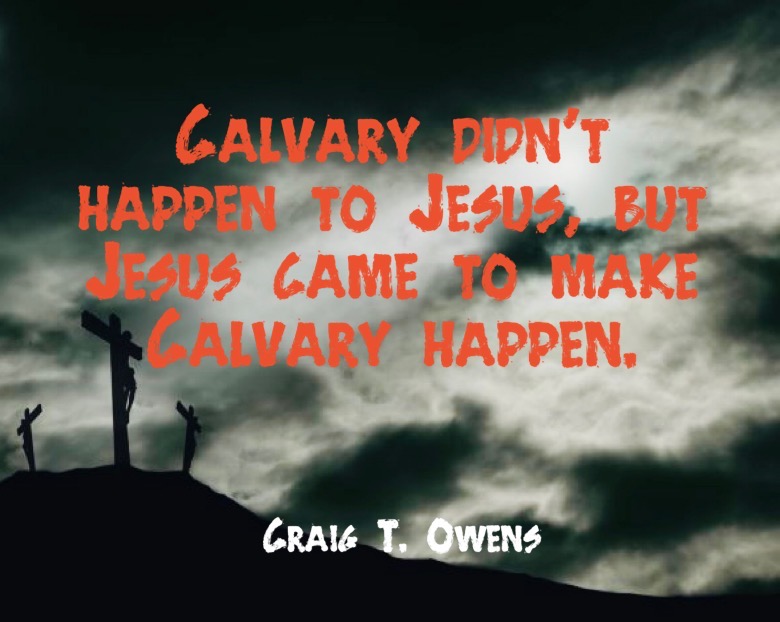
What isn’t fictional is the fact that the Cross didn’t happen to Jesus, but He came to make Calvary happen. 

Jesus said this about His crucifixion, “And I, when I am lifted up from the earth, will draw all people to Myself” (John 12:32). That’s what happened to the thief, and to the centurion Vitellius, and to me, and to all who have acknowledged that Jesus is the Savior. 

Vitellius’ bold claim on the day Jesus was crucified still rings true 2000 years later: “Certainly this was a righteous Man!” 

Looking at Jesus who was lifted up on that Cross, we can appreciate the beauty of the 700-year-old prophecy about Him:

He had no beauty or majesty to attract us to Him, nothing in His appearance that we should desire Him. He was despised and rejected by mankind, a man of suffering, and familiar with pain. Like one from whom people hide their faces He was despised, and we held Him in low esteem. Surely He took up our pain and bore our suffering, yet we considered Him punished by God, stricken by Him, and afflicted. But He was pierced for our transgressions, He was crushed for our iniquities; the punishment that brought us peace was on Him, and by His wounds we are healed. (Isaiah 53:2-5)

Which is what we celebrate in Communion still to this day. “And [Jesus] took bread, gave thanks and broke it, and gave it to them, saying, ‘This is My body given for you; do this in remembrance of Me.’ In the same way, after the supper He took the cup, saying, ‘This cup is the new covenant in My blood, which is poured out for you’” (Luke 22:19-20). 

The way Christians live today can still lift Jesus up for all to see. Jesus told His followers, “Whoever wants to be My disciple must deny themselves and take up their cross and follow Me. For whoever wants to save their life will lose it, but whoever loses their life for Me will find it” (Matthew 16:24-25). 

When we live this way, our lives become the aroma of life to even sin-hardened thieves and war-hardened soldiers.  

Check out this video of Vitellius’ personal experience—

Here are some further resources for you to check out:

  • The Bible verses that form the background for this centurion’s story—Luke 23:1-47; Matthew 27:11-54; Mark 15:1-39; John 18:28-19:34
  • Historian William Barclay wrote this about the centurions, “The centurions were the backbone of the Roman army. In a Roman legion there were 6,000 men; the legion was divided into sixty centuries, each containing 100 men, and in command of each century there was a centurion. These centurions were the long-service, regular soldiers of the Roman army. They were responsible for the discipline of the regiment, and they were the cement which held the army together. … A centurion was the equivalent of a regimental sergeant-major; and the centurions were the backbone of the Roman army.”
  • The horrific torture of crucifixion

If you have missed any of the other messages in our series of Bold Claims, you can find them all my clicking here.

Bold Claims

“That’s a pretty bold claim. Are you prepared to back that up?” 

I’ll bet you have heard something like that said to you, and maybe you have even said that yourself to someone else who made a big, audacious statement. 

After Jesus is arrested by the religious leaders—an arrest that will ultimately lead to Jesus being crucified on the Cross—there are some incredibly bold claims spoken by key people in this part of the Story. For the most part, these are claims that we don’t read earlier in any of the Gospels, but as this story is heading toward its most crucial moment, we have these audacious statements pronounced. 

But here’s the most important part: These bold claims weren’t just made, but they were backed up with proof as well. 

As we head toward the remembrance of Christ’s death on the Cross and His resurrection three days later, please join us for this look at these eye-opening bold claims. I would love to have you join us in person, but if you are unable to do that, we will make all of the messages available on Facebook and YouTube. If you’ve missed any of the messages, or simply want to review what we’ve already learned, you can find all of these messages here:

Links & Quotes

How would you respond to someone who asked, “Why would God punish Jesus for what I did?” Here’s a thoughtful reply from cold-case detective J. Warner Wallace.

“It were a good strife amongst Christians, one to labor to give no offense, and the other to labor to take none. The best men are severe to themselves, tender over others.” —Richard Sibbes

What can archeology tell us about the place where Pilate sentenced Jesus to death by crucifixion?

Doug Clay shares some thoughts on what the resurrection of Jesus means for us today.

Wow, check out this photo from the Hubble Space Telescope. It is the most distant star yet photographed.

Celebrating my Dad’s 90th birthday!

Fight The New Drug shares the benefits of quitting porn from people who actually quit using pornography.