Links & Quotes

link quote

“Historically speaking, God’s glory has often shone the brightest when the church was at its weakest. In fact, Christians should see times of cultural/political weakness as a time of the greatest opportunity to exhibit Christ.” So true! Check out the post God’s Glory And The Church’s Weakness.

For anyone who interacts with teenagers, Mark Merrill has a helpful post: 7 Cs For Communication With Teens.

Seth Godin says, “Do overs are possible, but they take guts.” Read more in his post The Do Over.

Yep, it’s true…

Death of a social media outlet

Links & Quotes

link quote

“What takes away the compulsion of revenge is our deep confidence that this world is not our home, and that God is our utterly sure and all-satisfying reward.” —John Piper

“Though it is clear as noonday in Scripture and in experience that stability is not to be found beneath the moon, yet men are for ever building upon earth’s quicksand as if it were substantial rock, and heaping up its dust, as though it would not all be blown away.” —Charles Spurgeon

[PHOTOS] 50 photos of Moms loving their kids in very trying times.

This post from a Live Dead team member—The Risk Of Security—reminds me to (1) pray for our front-line missionaries, and (2) pray that God will move on people’s hearts to raise up more missionaries!

How to poison your marriage in 3 easy steps: blame, compare, withdraw. Married couple should definitely read this post.

I love the leadership insights from Tim Elmore. He’s got a thoughtful post today on 2 temptations leaders face in turbulent times.

[VIDEO] Frank Turek and Boby Conway discuss the question: Can Science Disprove God?

12 Quotes From “From This Day Forward”

From This Day ForwardCraig & Amy Groeschel wrote a great book for anyone who wants to have a great marriage. Whether you’re single, in a struggling marriage, or in a great marriage, there are some great principles to learn in From This Day Forward. You can read my book review by clicking here. Below are a few quotes I especially liked.

“Healthy couples fight for resolution. Unhealthy couples fight for personal victory.”

“Even when you don’t agree with the other person, you can still validate their feelings.”

“One of the best ways you and your spouse can become slow to anger is by communicating regularly and honestly when you’re not facing conflict.”

“You have only one enemy, and it’s not your spouse. Get focused on that. Your enemy is a thief who’s trying to steal your joy, kill your love, and destroy your marriage. The good news is you don’t have to fight fair with that guy. No, with him, you’re actually going to fight to win. You’re going to fight for your marriage, and you’re going to fight for victory. One of the very best ways you can do that is to learn to fight fair with your spouse—for resolution, for restoration.”

“Don’t fight to win. You both should fight to lose the conflict and gain a closer relationship. Don’t fight each other; fight together to see the relationship restored. Redefine winning to mean that at the end of every fight, you’re closer to each other then you were when you started. That’s winning! And that’s what it really means to fight fair.” —Amy Groeschel

“When you’re married, fun is not a luxury; it’s a requirement. … Without romance, without adventure, without physical intimacy—without fun—marriage is reduced to a simple business arrangement. You’re like partners in a company, two roommates who split expenses like rent and food, yet living entirely different lives.”

“Guys, be intentional about pursuing happiness together with her because she’s God’s ‘reward’ in your life [Ecclesiastes 9:9].”

“Generally speaking, I don’t think anyone would argue that most men tend to desire physical intimacy more frequently than women do. So ladies, you need to understand that when you turn off that faucet and things start to go dry, for your husband, that’s a crisis. It’s the equivalent of the distress you feel when there’s silence, when there’s no emotional intimacy between you. It’s a crisis. One of the most important ways you can demonstrate love to each other is by renewing your spiritual commitment to one another through acts of physical love. Sex is spiritual. It’s two people becoming one in an alliance of intimacy. It’s a blessing from God, a way that you can genuinely serve one another. … One of the greatest things you can do for each other is to engage in frequent, creative, spiritual lovemaking. It is a gift from God that honors Him by renewing your spiritual covenant to one another.”

“Revelation 2:5 says, ‘Consider how far you have fallen! Repent and do the things you did at first.’ If you want what you once had, start doing what you once did. You got married because you had fun. Start having fun again.”

“Physical intimacy is directly related to your process of growing together, and it can be a good indicator of how healthy your relationship is—or isn’t. In fact, if physical intimacy has been a problem lately in your marriage, I’d be willing to bet that you’ve neglected being emotionally connected in other ways.” —Amy Groeschel

“By the time they reach the sin of adultery, they will have already crossed dozens of other sin lines. Sin doesn’t begin on the outside. It begins in the heart. You see something (or someone) attractive, and you allow them to capture your attention. ‘Mmm, they look good.’ That’s lust. And lust is a sin. Maybe you even take some action—just not full-blown adultery. ‘A body as hot as yours want to come with a warning label!’ Implying to someone else that you’re available when you’re not is called flirting. And it’s a sin. Maybe you don’t take any action. You just see something you want, and you let your thoughts wander after it. ‘Yowza! I’d like to take that home.’ That’s not taking every thought captive to make it obedient to Christ (2 Corinthians 10:5). That’s fantasizing, and it’s a sin. These things are problematic because they draw the line in the wrong place.”

“You probably learned that while it may be true that, at least while you’re dating, opposites attract—once you get married, opposites attack! … One way you can return to opposites attracting instead of attacking is by accepting your spouse for who they are, not who you want them to be. … Being opposites isn’t a bad thing. In fact, the truth is, if you’re married to someone who’s just like you, one of you is unnecessary. God knew exactly what He was doing when He brought you two opposites together. The only way iron can sharpen iron is if your differences are constantly rubbing against each other (Proverbs 27:17). … The challenge is that we settle into a mindset and become convinced that our differences are always going to cause conflict. But that doesn’t have to be true. Just because your spouse does things differently than you doesn’t mean that it has to be a problem. It’s just… well, different. If you refused to except your differences as the positives they are, you may find yourself sometimes trying to keep things from your spouse.”

Links & Quotes

link quote

Some good reading (and watching) I found today.

“Humility is strong—not bold; quiet—not speechless; sure—not arrogant.” —Estelle Smith

[VIDEO] Ken Davis always cracks me up! When the doctor says, “Don’t drive” … don’t drive!

Feeling beat-up? Max Lucado reminds us to rest in Christ’s finished work.

[VIDEO] Greg Koukl answers the question: What Is Marriage Anyway?

Tim Elmore discusses communicating with youth using pictures, stories and steps.

Links & Quotes

link quote

These are links to articles and quotes I found interesting today.

“It is not hard for the Lord to turn night into day. He that sends the clouds can as easily clear the skies. Let us be of good cheer. It is better on before. Let us sing hallelujah by anticipation.” —Charles Spurgeon

“A holy life is not an aesthetic, or gloomy, or solitary life, but a life regulated by divine truth and faithful in Christian duty.” —Tyron Edwards

“The greatest miracle that God can do today is to take an unholy man out of an unholy world, and make that man holy and put him back into that unholy world and keep him holy in it.” —Leonard Ravenhill

“If you see church as being just your local fellowship, then you still have not found the true Church. The God-blessed, righteous Church starts where you live.” —David Wilkerson

“As long as Christians split hairs, Christians will split churches.” —Max Lucado

Uh oh! Minimum Wage Hike Would Eliminate 500,000 Jobs

From Tim Elmore: Four Timeless Ideas To Make Your Point

“The Christian church is the body of Christ, Jesus Himself being the Headship of that body. Every true Christian, no matter where he or she lives, is a part of that body, and the Holy Spirit is to the church what our own souls are to our physical bodies.” —A.W. Tozer

8 Quotes From “Promotion”

PromotionPromotion by Rick Renner is a book to help both ministry and for-profit business organizations make better personnel decisions. You can read my full book review by clicking here. The following are a few quotes I highlighted.

“When choosing people for promotion, it’s important to understand that nothing is more important to God in the life of a leader then his heart. The heart takes first place over gifts, talents, education, and everything else.” 

“A person who is satisfied with little will never achieve much. On the other hand, a person who has a desire for excellence will never be satisfied with a low level performance in his or her life.”

“Any person who does just the required minimum should never be considered for leadership. … So be very careful not to over-spiritualize the selection process when choosing leaders. Don’t ignore telltale signs in a candidates natural life that alert you to a lack of desire.” 

“It’s normal for people to occasionally misunderstand. But when staff members misunderstand their leader’s instructions 99% of the time, something is wrong with the way that leader is communicating with those under his authority. His followers cannot be wrong all the time.”

“You should not look for a candidate free of problems, but for one who knows how to turn to God and manage life’s challenges according to Scripture.”

“Never forget that when you’re a leader, the most important pulpit you’ll ever possess is the testimony of your own personal life.”

“You’re never going to find a perfect person. … So never forget to let mercy triumphs over judgment. But if your peace is disturbed because of things you see occurring in a potential leader’s life, don’t ignore what is bothering you. Pay attention to what your spirit is telling you. Perhaps he or she is the right leader, but it isn’t the right time yet. It’s better to be slow and sure then to move forward without the inner conviction that you’re on the right track.”

“You may have a more visible position than others do during this earthly life, but your value to God for eternity is no different than anyone else in His Body.”

More Effective Communication

Do You Speak “Teen-ese”?

I highly respect the work that Dr. Tim Elmore does with teenagers. Since I have two teenagers in my home, one of his latest blog posts about communicating with teens caught my attention. He asked 16- to 24-year-olds their preferred method of communication. Their response:

1. Text messaging

2. Internet (i.e. Facebook.com)

3. iPods and Podcasts

4. Instant messaging

5. Cell phone

6. DVD / CD

7. Books

8. Email

Email is last? Yep! Not only last, but described by one teen as the method for communicating with “old people.”

Ouch!

But as a parent, if I truly want to communicate with my teenagers, I have to learn to speak Teen-ese. It’s selfish of me to try to ask my teenager to communicate the way I’m most comfortable (that would be email, if you hadn’t guessed). If I’m going to get their attention, I need to speak the way they speak.

Paul wrote to the church in Corinth that he did the same thing. He said, “I try to find common ground with everyone.” Paul’s native language—his most comfortable language—would have been speaking to Jews in the synagogue about Christ fulfilling Old Testament law.

But he stretched himself. He learned to speak to non-Jews … to those who knew nothing about the Hebrew Old Testament … to those who worshipped idols … to those who were humanistic philosophers … to soldiers … to slaves … to government officials … to everyone.

Parents, don’t try to make your teenagers talk to you in your comfortable language.

Learn Teen-ese. Make it a goal to understand them, instead of trying to make them understand you. By this, you will show your love and earn their ear.

(Watch for a review on Dr. Elmore’s latest book—Generation iY—coming later this week.)

Lingo

On Sunday nights I am teaching a series called Huh? It’s a practical set of talks geared to help us all increase our level of effective communication.

One huge hurdle to effective communication is the lingo into which we so easily slide. The dictionary defines lingo: a characteristic language of a particular group that is unfamiliar to those outside that group.

Last night—even as I am teaching on effective communication—I discovered how guilty I am of using Church Lingo. After our service was over, my daughter Samantha handed me an offering envelope on which she had written a Church Lingo lexicon.

Street Word           Church Lingo
Yes                          Amen
Mr. & Mrs.                Brother & Sister
Goodbye                  God bless
Ticked off                 Grieved
Sing                         Worship together

Ouch! A good reminder that I can so easily slip into Church Lingo and leave people all around me saying, “Huh?” I’m trying to get better.

What Church Lingo have you heard (or adopted yourself) that needs to be changed?

Understanding Misunderstanding

huh

Miscommunication is nothing new. From the dawn of history, people have always struggled to understand exactly what the other person was saying to them. That’s because we all have our own “accents”—our own way of getting our message across.

This is hard enough when trying to discuss something like politics, relationship likes/dislikes, or even movie preferences. But what about when you’re trying to communicate something intangible? Like your personal faith.

Most Christ-followers communicate their faith with the same “style” that they communicate their menu preferences, political persuasions, or music choices. But there is an added element of misunderstanding built in to the spiritual dimension. Even Jesus’ own disciples said “Huh?” many times to Him.

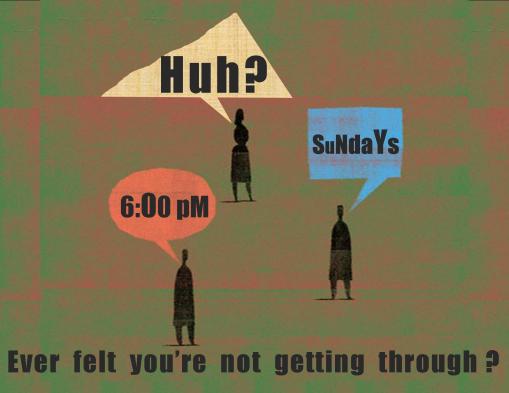
This Sunday, we begin a brand new series in our 6:00 PM service simply entitled Huh? We will be learning some very practical ways to communicate our faith to others by learning their unique communication style. If you have ever felt that you’re just not getting through, feel free to join us.