Thursdays With Spurgeon—Christ Is Glorified In Your Uniqueness

This is a weekly series with things I’m reading and pondering from Charles Spurgeon. You can read the original seed thought here, or type “Thursdays With Spurgeon” in the search box to read more entries.

Christ Is Glorified In Your Uniqueness

     To my mind it is a very beautiful thing that the Lord Jesus Christ, when He comes into the soul, does not annihilate any part of the personality, but shines in each separate being, for He is not only all, but He is in all His people [Colossians 3:11]! Very well, the grace of God does not turn the Gentile into a Jew. He remains a Gentile, but Christ is in him, and therefore he is made into a new creature [Colossians 3:9-10]. … Then comes the Jew. When he is saved, Christ is in him. … The Lord Jesus Christ, dwelling in the Jew, leaves him still a member of the house of Abraham, but through the presence of the Lord Jesus within him, how wondrously his whole character is exalted! …

     Yes, let a man be a brown man, or a yellow man, or a red man, or whatever color God made him! The more he keeps to his own nationality and reflects the glory of Christ from that angle, the more will Christ’s gospel triumph and the more will Christ Himself be honored! … 

     Christ is all, and Christ is in all His people, each one remaining the same in his individuality, but Christ shining in each one! … So note again that because Christ dwells in him, every believer becomes a copy of Christ.  

     What is more, Christ in each one of these believers creates them all into one body [Colossians 3:14-15]. … Christ in you all makes you into one body in a mysterious and unique manner.

From All And All In All

God isn’t in the cloning business. He made all of us unique. Think of that: in all of human history there has never been another YOU. In all the 7.5 billion people on planet Earth right now YOU aren’t duplicated. And for however long history goes on there will never be another YOU! 

When Jesus is your Lord and Savior, He doesn’t want to turn YOU into a copycat. He wants YOU to be YOU, with all your glorious, inimitable uniqueness. His Holy Spirit in YOU, helps YOU to be more YOU because the One who created YOU is now living in YOU. 

How amazing is that?! 

YOU be YOU. That is how God is most glorified through YOU! 
Thursdays With Spurgeon—Jesus Is All We Need

This is a weekly series with things I’m reading and pondering from Charles Spurgeon. You can read the original seed thought here, or type “Thursdays With Spurgeon” in the search box to read more entries.

Jesus Is All We Need

     So is it with every other ordinance, whether ordained of God or of man. It must never be placed in the front as if it were the means of salvation! I say to you who may have been sprinkled, or to you who may have been immersed; to you who may bow at your altars, or to you who may come to the communion table, I do not place these rites on a level, certainly, for some are of God and some are not. But I do place them all on a par in this respect: that they enter not into the essence of our salvation! And I say to all of you, “These things cannot save you, for ‘Christ is all’” [Colossians 3:11]. Be you who you may, and do you what you may, you will not be saved because of your natural birth or because of any supposed holy acts that you may perform! Neither will you be saved by any transactions that may be the work of a human priest! You must have Christ as your Savior and you must rest in Him alone, or you cannot be saved! He is the one foundation, “For no other foundation can anyone lay than that which is laid, which is Jesus Christ” (1 Corinthians 3:11), for “Christ is all.” The Lord Jesus Christ sums up everything that ordinances can possibly mean and all that pedigree and descent can possibly bring, and He is infinitely more than all of them! …  

     You must not add anything to Christ as your ground of confidence, but just lean the weight of your sin, your sorrow, your needs, and your desires wholly and entirely upon Him who lives to stand for you before God. Christ, then, is all our trust!

From All And All In All

It’s not our family lineage, it’s not our church attendance, it’s not our religious activities. It’s all Jesus. 

Jesus alone paid for our salvation, and it’s by faith in Him alone that we have the forgiveness of our sins. Don’t let anyone try to convince you that it’s “Jesus plus something else.” Nothing else needs to be added—Jesus is completely sufficient in and of Himself!

The Day Of The Lord

All we know about the prophet Joel is that he is the son of Pethuel, and his name means Jehovah is God. He appears to be addressing the southern part of Israel (Judah/Jerusalem). 

What is interesting to note about Joel’s writing is a recurring theme that goes something like this: 

Foreshadowing (or prophetic foretelling) → Calling for a godly response → God’s blessing on a right response or God’s punishment on a wrong response → An outcome which foreshadows or foretells another more dire event → repeat…

For instance, in Joel’s prophesy the massive invasion of locusts was intended to get the Israelites to pay attention to their sins. Joel calls for fasting and repentance and warns (foreshadows/foretells) that an invading army at a later date would do even greater damage (1:2-14). 

Likewise, the invading army—which would do more damage than the invading locusts—should also call the Israelites to repentance and imploring God for His help. 

Jesus, just like Joel, taught that whether it was an evil man, an accident, or even a natural disaster, painful things should cause us to consider the state of our eternal soul (see Luke 13:1-5). And Jesus and Joel both foretell of the Day of the Lord when there will be no more opportunities for repentance. 

To prepare God-fearing people for this dreadful day of the Lord, Joel foretells if the outpouring of the Holy Spirit. This is the same empowering Spirit that Jesus said would equip His followers to take the message of salvation to all four points of the compass (Acts 1:4-8). And just as Joel foretold 800 years earlier, on the first Pentecost Sunday after Christ’s ascension back into heaven, the Christians were baptized in the Holy Spirit, prompting Peter to quote an extension passage from Joel (compare Joel 2:28-32 with Acts 2:14-21).

Joel’s final chapter talks about Judgment Day, and about the multitudes, multitudes in the valley of decision. Peter confronted his audience as well about the decision they should make to turn to Jesus as their Savior and Lord. 

The Day of the Lord could come at any moment and millions around the world are still in the valley of decision. I find these words quite sobering—

“Someone asked, ‘Will the heathen who have never heard the Gospel be saved?’ It is more a question with me whether we—who have the Gospel and fail to give it to those who have not—can be saved.” —Charles Spurgeon 

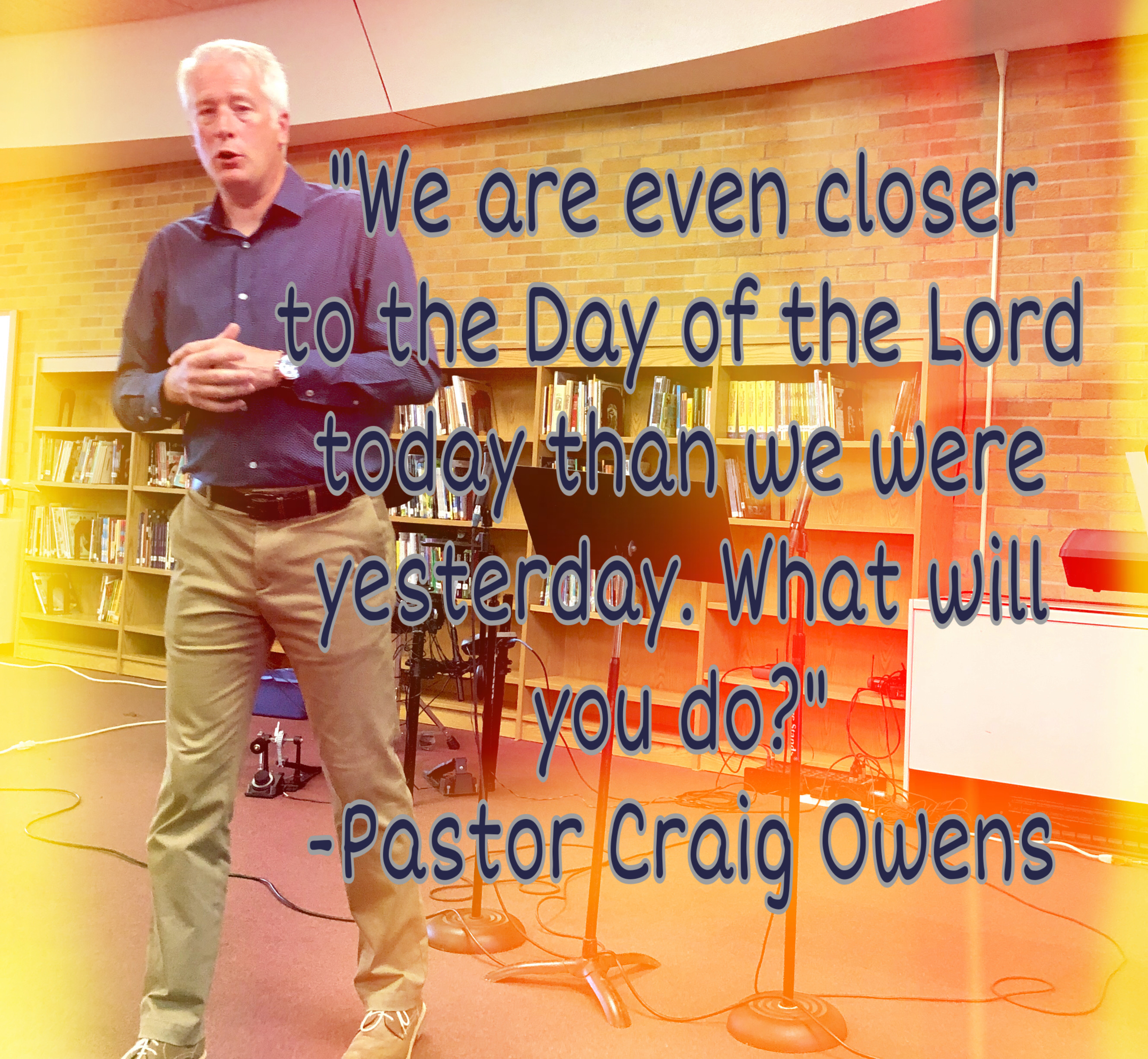
We are even closer to the Day of the Lord today than we were yesterday. What will you do?

Please join me this Sunday as we continue our series learning the major lessons from the minor prophets.

Thursdays With Spurgeon—The Patience Of God

This is a weekly series with things I’m reading and pondering from Charles Spurgeon. You can read the original seed thought here, or type “Thursdays With Spurgeon” in the search box to read more entries.

The Patience Of God

     But why are His chariots so long in coming? Why does He delay? The world grows gray, not only with age, but also with iniquity, and yet the Deliverer comes not. We have waited for His footfall at the dead of night and looked out for Him through the gates of the morning. We have expected Him in the heat of the day and reckoned that He might come before yet another sun went down. But He is not here! He waits. He waits very, very long. Will He not come?

     Long-suffering is that which keeps Him from coming. He is bearing with men. Not yet the thunderbolt! Not yet the riven heavens and the reeling earth! Not yet the great white throne and the Day of Judgment, for He is full of pity and bears long with men! Even to the cries of His own elect, who cry day and night to Him, He is not in haste to answer, for He is very patient, slow to anger, and plenteous in mercy. …

From the sermon God’s Long-Suffering

As a young child, I frequently heard my parents and grandparents say, “Jesus could return at any moment. His Second Coming is closer today than ever before.” My grandparents have all died and are with Jesus in Heaven, but I’m still here. 

Yet, I still believe it’s true: Jesus could return at any moment. His Second Coming is closer today than ever before.

Why does God delay Christ’s return? I believe the apostle Peter says it best—The Lord is not slow in keeping His promise, as some understand slowness. Instead He is patient with you, not wanting anyone to perish, but everyone to come to repentance (see 2 Peter 3:3-15). 

That’s why Spurgeon concludes this sermon with this impassioned call to Christians: 

“God calls upon us, until the world is utterly destroyed with fire, to go on saving men with all our might and main. Every year that passes is meant to be a year of salvation. We rightly call each year the year of our Lord. Let us make it so by more earnest efforts for the bringing of sinners to the Cross of Christ.” 

Let’s continue to look for Christ’s soon return, but let’s be busy telling everyone about a God who loves them, who is patient with them, and who wants them to come to repentance and spend eternity with Him! 

Thursdays With Spurgeon—Holding Two Extreme Truths

This is a weekly series with things I’m reading and pondering from Charles Spurgeon. You can read the original seed thought here, or type “Thursdays With Spurgeon” in the search box to read more entries.

Holding Two Extreme Truths

     This is a deep, unsearchable mystery. Man walks without a leash yet treads in the very steps that God ordained him to tread in as certainly as though manacles had bound him to the spot! Man chooses his own seat, selects his own position; guided by his will, he chooses sin, or guided by divine grace, he chooses right. And yet in His choice God sits as sovereign on the throne, not disturbing but still overruling and proving Himself to be as able to deal with free creatures as with creatures without freedom. As able to effect His purpose when He has endowed men with thought and reason and judgment, as when He had only to deal with the solid rocks and with the imbedded sea.

     O Christians! You will never be able to fathom this, but you may wonder at it. I know there is an easy way of getting out of this great deep either by denying predestination altogether or by denying free agency altogether. But you can hold the two: You can say, “Yes, my consciousness teaches me that man does as he wills, but my faith teaches me that God does as He wills, and these two are not contrary the one to the other. And yet I cannot tell how it is. I cannot tell how God effects His end. I can only wonder, and say, ‘Oh, the depth of the riches both of the wisdom and knowledge of God! How unsearchable are His judgments and His ways past finding out!’” (Romans 11:33). Every creature is free and doing as it wills, yet God is freer still and doing as He wills not only in heaven, but also among the inhabitants of this lower earth. 

From The Infallibility Of God’s Purpose

The debate has raged for years: predestination vs. freewill. 

People will sometimes ask me, “Are you a Calvinist (predestination) or an Arminian (freewill)?” And I always give the same answer, “Yes, I am a solid Cal-minian!” As with most things that are difficult for our finite, human minds to grasp about God’s nature, the answer is not either-or but it’s both-and.

C.S. Lewis captured the same sentiments as Spurgeon. Lewis always said the best course between two immovable ideas was right between them. He added, “Heaven will solve our problems, but not, I think, by showing us subtle reconciliations between all our apparently contradictory notions. The notions will all be knocked from under our feet. We shall see that there never was any problem” (emphasis mine).

Spurgeon would agree—there never was any problem, at least not with God. Any problems of understanding are in ourselves, not in Him. So far better than choosing one over the other, choose the both-and, and then stand in awe and wonder and worship that our infinite God is sovereign over all. Even over our puny, limited theologies and doctrines. 

Thursdays With Spurgeon—Rejoicing In God’s Unchangeableness

This is a weekly series with things I’m reading and pondering from Charles Spurgeon. You can read the original seed thought here, or type “Thursdays With Spurg

e search box to read more entries.

Rejoicing In God’s Unchangeableness

But He is unchangeable, and who can turn Him? And what He wants to do, that He does” (Job 23:13 AMP).

     Some shallow thinkers dream that the great plan and design of God was thrown out of order by the fall of man. The fall they consider all accidental circumstances, not intended in the divine plan, and thus God, being placed in a delicate predicament of requiring to sacrifice His justice or His mercy, used the plan of the atonement of Christ as a divine expedient. … I am persuaded that the very fall of man was a part of the divine purpose: that even the sin of Adam, though he did it freely, was nevertheless contemplated in the divine scheme and was by no means such a thing as to involve a digression from His primary plan. …  

     And when later the gospel was sent to the Jews, and they resisted it and Paul and Peter turned to the Gentiles, do not suppose that God had to take down His book and make an eraser or an amendment. No, the whole was written there from the beginning. He knew everything of it. He has never altered a single sentence nor changed a single line of the divine purpose. … 

     It is a sweet consolation to the mind of one who muses much upon these deep matters that God never has changed in any degree from His purpose.

From The Infallibility Of God’s Purpose 

God has a plan for all of His creation. ALL of His creation—that includes you! 

You were made on purpose and for a purpose. God’s original plan of sending Jesus for your salvation still stands. God’s original plan for your particular life—with all of your talents, gifts, personality, and uniqueness—is unaltered by any circumstance. 

YOU have immeasurable value and worth because God created YOU. 

Thursdays With Spurgeon—God’s Purpose Prevails

This is a weekly series with things I’m reading and pondering from Charles Spurgeon. You can read the original seed thought here, or type “Thursdays With Spurgeon” in the search box to read more entries.

God’s Purpose Prevails

But He is in one mind, and who can turn Him? and what His soul desireth, even that He doeth (Job 23:13 KJV). But He is unchangeable, and who can turn Him? And what He wants to do, that He does (AMP). 

     Now the fact taught here is that in all the acts of God in providence, He has a fixed and a settled purpose. ‘He is in one mind.’ It is eminently consolatory to us, who are God’s creatures, to know that He did not make us without a purpose and that now, in all His dealings with us, He has the same wise and gracious end to be served. … 

     O believer, ever look, then, on all your sufferings as being parts of the divine plan and say, as wave upon wave rolls over you, ‘He is in one mind!’ He is carrying out still His one great purpose. None of these comes by chance; none of these happens to me out of order; but everything comes to me according to the purpose of His own will and answers the purpose of His own great mind. … 

     We sweat, we toil, and we fail. How often do we come back weeping because we have toiled, as we think, without success! Yet, Christian man, you have not been without success, for ‘He is still in one mind.’ All this was necessary to the fulfillment of His one purpose. You are not lost; your labor has not rotted under the clod. All, though you see it not, has been working together toward the desired end. … 

     From every evil, good has come. And the more the evil has accumulated, the more has God glorified Himself in bringing out at last His grand, His everlasting design. This, I take it, is the first general lesson of the text—in every event of providence, God has a purpose. ‘He is in one mind.’ 

     Mark, not only a purpose, but only one purpose—for all history is but one. There are many scenes, but it is one drama. There are many pages, but it is one book. There are many leaves, but it is one tree. There are many provinces, yes, and there are many lords and rulers, yet there is but one empire and God the one Potentate.

From The Infallibility Of God’s Purpose

All of history is His storyand your life is a part of that Grand Story as well. God doesn’t miss a thing. He is working all things out to accomplish His purpose (see Romans 8:28). Even when it seems nothing is happening, turn your thoughts back to God Whose plans never fail, Whose purposes are never frustrated, Who is always working out His grand plan.

Thursdays With Spurgeon—Study The Right Things

This is a weekly series with things I’m reading and pondering from Charles Spurgeon. You can read the original seed thought here, or type “Thursdays With Spurgeon” in the search box to read more entries.

Study The Right Things

     It is very advantageous to the Christian mind frequently to consider the deep and unsearchable attributes of God. … If we study man and make him the only object of our research, there will be a strong tendency in our minds to exaggerate his importance. We will think too much of the creature and too little of the Creator, preferring the knowledge that is to be found out by observation and reason to the divine truth that revelation alone could make known to us. … 

     The fleeting things of human life and the fickle thoughts and showy deeds of men are as movable and as changeable as the waters of the treacherous deep. But when we mount up, as it were, with eagles’ wings to Him Who sits upon the circle of the earth, before Whom all its inhabitants are as grasshoppers (Isaiah 40:22), we nestle in the Rock of Ages that from its eternal socket never starts and in its fixed immovability can never be disturbed.

From The Infallibility Of God’s Purpose

I read a lot of books. But in the hands-down, it’s-not-even-close category, I read the Bible more than anything else. It is the Book of books because it reveals the eternal Wisdom behind the earth’s wisdom. 

Zig Ziglar used to say, “Every morning I read my Bible and I read the newspaper. That way, I know what both sides are up to.” That’s pretty good!

We read the Bible not just to know the Bible, but to know the One Who authored the Bible. Or, as I like to say it—

My goal in reading the Word God is to get to know the God of the Word better and better.

Charles Spurgeon would never say—nor do I—that you shouldn’t study a variety of topics. Just make sure that your priority is God’s Word. This will give you the greatest insight into other topics and will protect you from humanistic error. 

Thursdays With Spurgeon—The Best Study To Expand Your Mind

This is a weekly series with things I’m reading and pondering from Charles Spurgeon. You can read the original seed thought here, or type “Thursdays With Spurgeon” in the search box to read more entries.

The Best Study To Expand Your Mind

     The highest science, the loftiest speculation, the mightiest philosophy that can ever engage the attention of a child of God is the name, the nature, the person, the work, the doings, and the existence of the great God whom he calls his Father. … It is a subject so vast that all our thoughts are lost in its immensity, so deep that our pride is drowned in its infinity. …

     But while the subject humbles the mind, it also expands it. He who often thinks of God will have a larger mind than the man who simply plods around this narrow globe. …

     Nothing will so enlarge the intellect, nothing so magnify the whole soul of man as a devout, earnest, continued investigation of the great subject of the Deity. …  

     There is one name on which mutability can never be written. One heart never can alter. That heart is God’s; that name Love. 

From The Immutability Of God

The vastness—the infiniteness—of God is something which should much consume us! The psalmists frequently write of the time they spent meditating on God and His awesomeness. 

That word “meditate” means to mull something over and over in your mind; literally, it means “to hum.” Perhaps that’s why the psalms were written as songs, so that it would be easier for people to hum their pondering on how majestic our All-Powerful, All-Loving God is. 

It’s not about the quantity of your Bible reading, but it’s about the quality of your reading. And it’s about what you do with what you have read. Soak in it. Meditate on it. Hum it over and over again throughout the day. Let the truth of God’s majesty lift your mind and spirit to new heights!

This is truly the greatest topic on which you can muse. The illumination of God will expand your mind like no other study in the world can.

Oh Lord my God when I in awesome wonder
consider all the worlds Thy hands have made.
I see the stars, I hear the rolling thunder
Thy power throughout the universe displayed.
Then sings my soul, my Savior God, to Thee,
How great Thou art! How great Thou art! (Stuart Wesley Keene Hine)

Thursdays With Spurgeon—Following The Prompting

This is a weekly series with things I’m reading and pondering from Charles Spurgeon. You can read the original seed thought here, or type “Thursdays With Spurgeon” in the search box to read more entries.

Following The Prompting

     I once while preaching at New Park Street Chapel. I had passed happily through all the early parts of divine service on the Sabbath evening and was giving out the hymn before the sermon. I opened the Bible to find the text, which I had carefully studied as the topic of discourse, when, on the opposite page, another passage of Scripture sprang upon me like a lion from a thicket with vastly more power then I had felt when considering the text that I had chosen. The people were singing and I was sighing. I was in a strait between two, and my mind hung as in the balances. I was naturally desirous to run in the track that I had carefully planned, but the other text would take no refusal and seemed to tug at my skirts, crying, “No, no, you must preach from me! God would have you follow me.” I deliberated within myself as to my duty, for I would neither be fanatical nor unbelieving, and at last I thought within myself, Well, I should like to preach the sermon that I have prepared, and it is a great risk to run to strike out a new line of thought, but as this text constrains me, it may be of the Lord, and therefore I will venture upon it, come what may.

     I had brought myself into great difficulty by obeying what I thought to be a divine impulse, and I felt comparatively easy about it, believing that God would help me and knowing that I could at least close the service should there be nothing more to be said. I had no need to deliberate, for in one moment we were in total darkness. The gas had gone out…. Having no manuscript, I could speak just as well in the dark as in the light…. When the lamps were lit again, I saw before me an audience as rapt and subdued as ever a man beheld in his life. … Thus, providence befriended me. I cast myself upon God, and His arrangements quenched the light at the proper time for me. Some may ridicule, but I adore; others may even censure, but I rejoice.

From The Autobiography of Charles Spurgeon

God can speak to pastors as clearly in his or her sermon preparation time as He can in the very moments before the sermon begins. The key is our obedience to follow the prompting of the Holy Spirit. 

Spurgeon would never advocate that preachers “wing it” every time they step into the pulpit. His own life showed a man of diligent study of the Scripture. But neither would Spurgeon say that preachers have to stick to their prepared remarks no matter what. What I think he would say is: Trust God when you’re studying for a sermon, and trust God when you’re delivering a sermon. Allow the Spirit to change your course at any moment. 

Is this a bit nerve-wracking? Spurgeon would say, “Yes, only when deliberating whether to strike out on the new course.” But notice how once he obeyed that prompting, he felt completely at ease.

Spurgeon also reminds us, “I do not see why a man cannot speak extemporaneously upon a subject that he fully understands. Any tradesman, well versed in his line of business, could explain it without needing to retire for meditation, and surely I ought to be equally familiar with the first principles of our holy faith. I ought not to feel at a loss when called upon to speak upon topics that constitute the daily bread of my soul.”