Thursdays With Spurgeon—The Wonderful Works Of God

This is a weekly series with things I’m reading and pondering from Charles Spurgeon. You can read the original seed thought here, or type “Thursdays With Spurgeon” in the search box to read more entries.

The Wonderful Works Of God

Now there were staying in Jerusalem God-fearing Jews from every nation under heaven. … Utterly amazed, they asked “Are not all these men who are speaking Galileans…declaring the wonders of God in our own tongues!” (Acts 2:5-11) 

     The Holy Spirit being thus at work, what was the most prominent subject that these full men begin to preach about with words of fire? Suppose that the Holy Spirit should work mightily in the church. What would our ministers preach about? We should have a revival, should we not, of the old discussions about predestination and free agency? I do not think so! These are happily ended, for they tend toward bitterness, and, for the most part, the disputants are not equal to the task. We should hear a great deal about the premillennial and the postmillennial advent, should we not? I do not think so! I never saw much of the Spirit of God in discussions or dreams upon times and seasons that are not clearly revealed. Should we not hear learned essays about advanced theology? No, sir. When the devil inspires the church, we have modern theology—but when the Spirit of God is among us, that rubbish is shot out with loathing! 

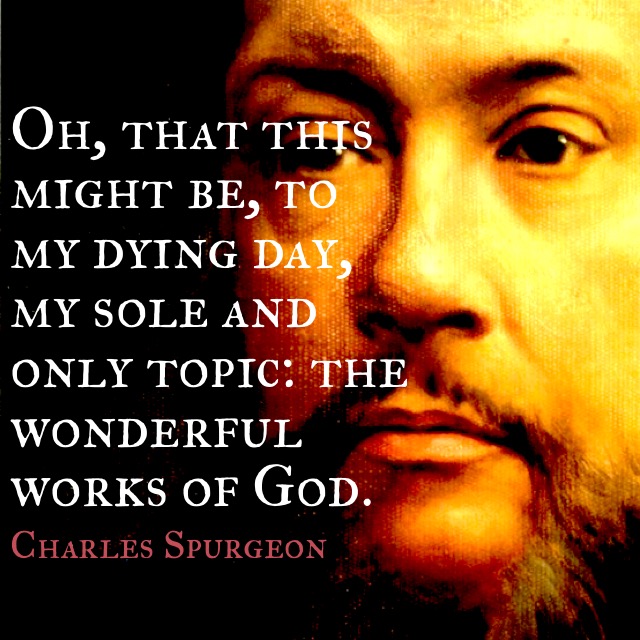
     What did these men preach about? Their hearers said, ‘We hear them speaking in our own tongues the wonderful works of God’ (Acts 2:11). The subject was the wonderful works of God! Oh, that this might be, to my dying day, my sole and only topic: ‘the wonderful works of God.’

From Pentecostal Wind And Fire

Whether we are pastors or parishioners, may our heart cry echo that of Charles Spurgeon: May all that comes from my lips be words that tell of the wonderful works of God! 

After the Church was born on that Pentecost Sunday, their message wasn’t one of doctrinal differences or the ills of society. No! These Spirit-baptized Christians went everywhere proclaiming how wonderful it was to be in a personal relationship with our Heavenly Father through the way opened to us by the death and resurrection of Jesus. 

May we emulate their example today: Empowered by the Holy Spirit to go everywhere and tell everyone how wonderful our God is!


Thursdays With Spurgeon—Church On Fire

This is a weekly series with things I’m reading and pondering from Charles Spurgeon. You can read the original seed thought here, or type “Thursdays With Spurgeon” in the search box to read more entries.

Church On Fire

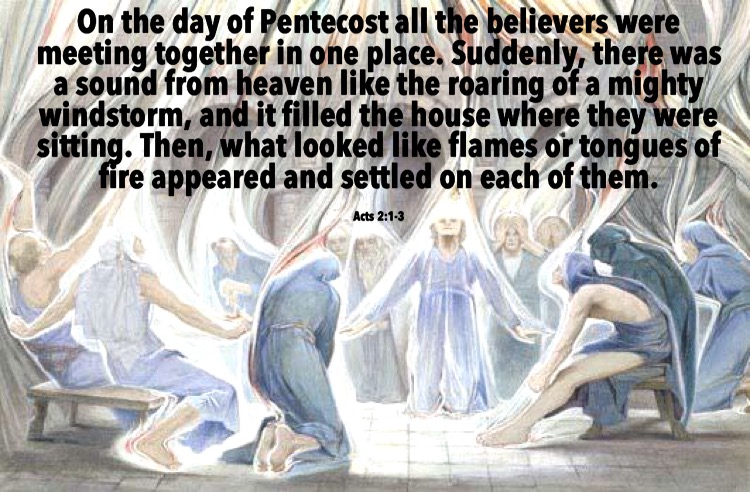
On the day of Pentecost all the believers were meeting together in one place. Suddenly, there was a sound from heaven like the roaring of a mighty windstorm, and it filled the house where they were sitting. Then, what looked like flames or tongues of fire appeared and settled on each of them. (Acts 2:1-3) 

     We are poor, empty things by nature, and useless while we remain so. We need to be filled with the Holy Spirit. Some people seem to believe in the Spirit of God giving utterance only, and they look upon instruction in divine things as of secondary importance. Dear, dear me! What trouble comes when we act upon that theory! How the empty vessels clatter, rattle, and sound! … Where the Spirit of God is truly at work, He first fills and then gives utterance—that is His way. …  

     Full! Then they were not cold, dead, and empty of life as we sometimes are. Full. Then there was no room for anything else in any one of them! They were too completely occupied by the heavenly power to have room for the desires of the flesh! Fear was banished; every minor motive was expelled! The Spirit of God, as it flooded their very beings, drove out of them everything that was extraneous. They had many faults and many infirmities before, but that day, when they were filled with the Spirit of God, faults and infirmities were no more perceptible! They became different men from what they had ever been before. Men full of God are the reverse of men full of self! …  

     The next Pentecostal symbol was utterance. … When the Spirit of God really comes upon a man, he does not wait till he has gathered an audience of the size that he desires, but he seizes the next opportunity! He speaks to one person. He speaks to two. He speaks to three—to anybody. …  

     When the Spirit of God fills a man, he speaks so as to be understood. … The crowd not only understood, they felt. There were lancets in this Pentecostal preaching, and the hearers ‘were pricked in their heart’ (Acts 2:37). … Those are the two effects of the Holy Spirit—a fullness of the Spirit in the ministry and the church, and next, a fire ministry and a church on fire, speaking so as to be felt and understood by those around!

From Pentecostal Wind And Fire

Oh, how I want this today! 

Let’s seek the fullness and the utterance that can only come through the baptism in the Holy Spirit! Let’s be set on fire so that we can impact the world around us! 

Thursdays With Spurgeon—The Purpose Of The Baptism In The Holy Spirit

This is a weekly series with things I’m reading and pondering from Charles Spurgeon. You can read the original seed thought here, or type “Thursdays With Spurgeon” in the search box to read more entries.

The Purpose Of The Baptism In The Holy Spirit

On the day of Pentecost all the believers were meeting together in one place. Suddenly, there was a sound from heaven like the roaring of a mighty windstorm, and it filled the house where they were sitting. Then, what looked like flames or tongues of fire appeared and settled on each of them. (Acts 2:1-3) 

     Ordinary winds blow from this or that quarter of the skies, but this descended from heaven itself. It was distinctly like a downdraft from above. This sets forth the fact that the true Spirit, the Spirit of God, comes from neither this place nor that, neither can His power be controlled or directed by human authority. His working is always from above, from God Himself! The work of the Holy Spirit is, so to speak, the breath of God, and His power is always, in a special sense, the immediate power of God. …  

     Tongues of flame sitting on each man’s head symbolized a personal visitation to the mind and heart of each one of the chosen company. The fires came not to consume them, for the flaming tongue injured no one. To men whom the Lord has prepared for His approach, there is no danger in His visitations. They see God and their lives are preserved. They feel His fires and are not consumed. This is the privilege of only those who have been prepared and purified for such fellowship with God. The intention of the symbol was to show them that the Holy Spirit would illuminate them as fire gives light. ‘He will guide you into all truth’ (John 16:13). … 

     But the fire does more than give light; it inflames, and the flames that sat upon each show them that they were to be ablaze with love, intense with zeal, burning with self-sacrifice, and that they were to go forth among men to speak not with the chill tone of deliberate logic, but with burning tongues of passionate pleading, persuading, and entreating men to come to Christ that they might live! The fire signified inspiration. God was about to make them speak under a divine influence, to speak as the Spirit of God should give them utterance. …  

     O You who are our God, answer us by fire, we pray! Answer us both by wind and fire and then we will see You to be God indeed. The kingdom comes not and the work is flagging. Oh, that You would send the wind and fire! You will do this when we are all of one accord: all believing, are expecting, and all prepared by prayer. Lord, bring us to this waiting state!

From Pentecostal Wind And Fire

As I said earlier, Pentecost is not the culmination of God’s power, it is the initiation of His power that is necessary to empower us to be witnesses for Jesus. 

If Jesus said that we needed this power to live and testify for Him, why would we ever want anything but the full outpouring of this Holy Spirit power?! Jesus Himself relied on the power of the Holy Spirit during His earthly ministry, so how much more so do we need this baptism into the fire and wind of the Spirit!

Thursdays With Spurgeon—The Initiation Of Power

This is a weekly series with things I’m reading and pondering from Charles Spurgeon. You can read the original seed thought here, or type “Thursdays With Spurgeon” in the search box to read more entries.

The Initiation Of Power 

     Whatever the Holy Spirit was at the first, He is that now, for as God, He remains forever the same. … We would greatly grieve the Holy Spirit if we supposed that His might was less today than in the beginning. …  

     If at the commencement of the gospel we behold the Holy Spirit working great signs and wonders, may we not expect a continuance of and, if anything, increased displays of His power as the ages roll on? … 

     It ought not to be forgotten that Pentecost was the feast of firstfruits. It was the time when the first ears of ripe corn were offered to God. If, then, at the commencement of the gospel harvest we see so plainly the power of the Holy Spirit, may we not most properly expect infinitely more as the harvest advances and, most of all, when the most numerous sheaves will be gathered? May we not conclude that if the Pentecost was thus marvelous, the actual harvest will be still more wonderful?

From Pentecostal Wind And Fire

When Jesus was approaching the Cross, He gathered His disciples together to tell them what was coming. One of the assurances He gave His followers was this: “I assure you, most solemnly I tell you, if anyone steadfastly believes in Me, he will himself be able to do the things that I do; and he will do even greater things than these, because I go to the Father” (John 14:12). 

The empowering force for these “greater things” would be the Holy Spirit indwelling the Christian (Matthew 3:11; Luke 24:49; Acts 1:8, 2:1-4). 

Pentecost wasn’t the culmination, it was the initiation. 

Pentecost was the launching point for followers of Jesus to be filled with dunamis power that would enable them to go into all the world and preach the gospel, and to have signs and wonders follow to confirm the preaching of the Word. 

As Spurgeon said, we greatly grieve the Holy Spirit when we attempt to put Him in a box as to what He can or can’t do today, or if we try to limit Him to one era of long-past history. The Holy Spirit is as vital for a Christian today as He was on that Pentecost Sunday described in Acts 2! 

Thursdays With Spurgeon—An Exhortation To Preachers

This is a weekly series with things I’m reading and pondering from Charles Spurgeon. You can read the original seed thought here, or type “Thursdays With Spurgeon” in the search box to read more entries.

An Exhortation To Preachers 

He will glorify Me, for He will take of what is Mine and declare it to you. All things that the Father has are Mine. Therefore I said that He will take of Mine and declare it to you. (John 16:14-15) 

     Ah, brothers, the Holy Spirit never comes to glorify us, or to glorify a denomination, or, I think, even to glorify a systematic arrangement of doctrines! He comes to glorify Christ! If we want to be in accord with Him, we must preach in order to glorify Christ. May we never have this thought: ‘I will put that bit in. It will sound well….’  No, no! 

     I would say, ‘Brother, though it is a very delightful piece, strike that out, because if you have had a thought of that kind about it, you had better not put yourself in the way of temptation by using it.’ … 

     Well then, it may be very admirable, and further, it might be a very right thing to give them that precious piece; but if you have that thought about it, strike it out! Strike it out ruthlessly! Say, ‘No, no, no! If it is not distinctly my aim to glorify Christ, I am not in accord with the aim of the Holy Spirit and I cannot expect His help!’ … 

     How then does the Holy Spirit glorify Christ? It is very beautiful to think that He glorifies Christ by showing Christ’s things. If you wanted to do a honor to a man, you would, perhaps, take him a present to decorate his house. But here, if you want to glorify Christ, you must go and take the things out of Christ’s house ‘the things of Christ.’ … 

     Again, I think that the blessed Spirit glorifies Christ by showing us the things of Christ as Christ’s. Oh, to be pardoned! Yes, it is a great thing, but to find that pardon in His wounds, that is a greater thing! Oh, to get peace! Yes, but to find that peace in the blood of His Cross! … That it came from Christ is the best thing about the best thing that ever came from Christ! …  

     ‘He will glorify Me, for He will take of what is Mine and declare it to you.’ Yes, it does glorify Christ for the Holy Spirit to show Christ to us. … Since it is for the honor of Christ for His things to be shown to men, He will show them to us, that we may go and show them to other people.

From Honey In My Mouth

My fellow pastor, I cannot add anything to these wise words except this simple exhortation: Read these words again and ask the Holy Spirit to show you how you can more accurately live this out in your sermon preparation and preaching. 

God bless you, my friend!

Thursdays With Spurgeon—The Unity Of Scripture

This is a weekly series with things I’m reading and pondering from Charles Spurgeon. You can read the original seed thought here, or type “Thursdays With Spurgeon” in the search box to read more entries.

The Unity Of Scripture

He will glorify Me, for He will take of what is Mine and declare it to you. All things that the Father has are Mine. Therefore I said that He will take of Mine and declare it to you. (John 16:14-15) 

     Let us never allow anybody to divide between the word of the apostles and the word of Christ! Our Savior has joined them together. ‘I do not pray for these alone, but also for those who will believe in Me through their word’ (John 17:20). And if any begin rejecting the apostolic word, it will be outside the number for whom Christ prays. …  

     Such a doctrine that we are sometimes taunted about as being not revealed by Christ but by His apostles were all revealed by Christ, every one of them! They can all be found in His teaching, but they are very much in parabolic form. It is after He has gone up into glory and has prepared a people, by His Spirit, to understand the truths of God more fully that He sends His apostles and says, ‘Go forth, and open up to those whom I have chosen out of the world the meaning of all I said.’ The meaning is all there, just as all the New Testament is in the Old! … [Jesus Christ] is the Old Testament to which the Epistles come in as a kind of New Testament, but they are all one and indivisible. They cannot be separated. …  

     Remember that the quickest way into a text is praying in the Holy Spirit. Pray the chapter over! I do not hesitate to say that if a chapter is read upon one’s knees, looking up at every word to Him who gave it, the meaning will come to you with infinitely more weight than by any other method of studying it. ‘He will glorify Me, for He will take of what is Mine and declare it to you.’ He will redeliver the Master’s message to you in the fullness of its meaning!

From Honey In My Mouth

Augustine wrote, “Scripture is the unus sermo Dei—the one sermon of God.” 

There is one consistent message in the Bible from Genesis 1:1 through Revelation 22:21, and the Holy Spirit wants to reveal that message to us. He is our Helper that will illuminate to our lives what has already been inspired in the Scripture. 

Jesus is Jehovah God from beginning to end. He is the “one sermon of God” that we can read and understand. Think about this: the same Spirit who inspired the pens of the biblical writers is the same Spirit in you who can help you understand and apply those words to your life. More than that, the Holy Spirit wants to make the Word of God clear to you. 

God is glorified and you are edified when Scripture comes alive in your heart and mind. 

Peter wrote this about Paul, “His letters contain some things that are hard to understand….” But if we don’t take the time to wrestle with that passage, Peter says this is what happens next: “…which ignorant and unstable people distort, as they do the other Scriptures, to their own destruction” (2 Peter 3:16). So, as Spurgeon suggests, begin your Bible reading time in prayer. Then if you come to a difficult text, don’t rush past it and don’t turn too quickly to what another human has written in a commentary, but ask the Holy Spirit to help. (I shared a 5-step process I use for these challenging passages here.) 

Pray, read, pray, apply, pray. The Holy Spirit WILL help you! “Remember that the quickest way into a text is praying in the Holy Spirit.”


Thursdays With Spurgeon—Not Carried Away

This is a weekly series with things I’m reading and pondering from Charles Spurgeon. You can read the original seed thought here, or type “Thursdays With Spurgeon” in the search box to read more entries.

Not Carried Away

He will glorify Me, for He will take of what is Mine and declare it to you. All things that the Father has are Mine. Therefore I said that He will take of Mine and declare it to you. (John 16:14-15) 

     [The Holy Spirit] does not aim at any originality. … The Spirit takes of the things of Christ and of nothing else. Do not let us strain at anything new. The Holy Spirit could deal with anything in heaven above or in the earth beneath—the story of the ages past, the story of the ages to come, the inward secrets of the earth, the evolution of all things, if there is an evolution. He could do it all! Like the Master, He could handle any topic He chose, but He confines Himself to the things of Christ and therein finds unutterable liberty and boundless freedom. …  

     When, therefore, anybody whispers in my ear that there has been revealed to him this or that, which I do not find in the teaching of Christ and His apostles, I tell him that we must be taught by the Holy Spirit. … If we do not remember this, we may be carried away by quirks, as many have been.

From Honey In My Mouth

How many arguments have devastated people, how many friendships have been lost, how many churches have split because of a clinging to doctrines which aren’t found in the Bible?! How this must break our Father’s heart! 

Quite simply put: we argue and take sides over things on which the Word of God makes no distinction. Oh, foolish pride! 

The Holy Spirit never reveals a unique or private or exclusive word to anyone. He only makes clear what has already been revealed in the Word of God. Does that mean we cannot have an opinion on something? Of course not!

But love for Christ and for His Bride means that my opinions must never become my doctrines. 

Holy Spirit, help me to listen to Your voice alone as You illuminate what has already been inspired. Jesus, may Your love for the Church be my love for the Church. Root out this accursed pride in my heart that makes me fight for my opinions. Father, may You be glorified in Your Church as we are unified around Your revealed truth.

Thursdays With Spurgeon—Honey In My Mouth

This is a weekly series with things I’m reading and pondering from Charles Spurgeon. You can read the original seed thought here, or type “Thursdays With Spurgeon” in the search box to read more entries.

Honey In My Mouth

He will glorify Me, for He will take of what is Mine and declare it to you. All things that the Father has are Mine. Therefore I said that He will take of Mine and declare it to you. (John 16:14-15) 

     So we actually receive, through Jesus Christ, by the Spirit, what is in the Father!  

     Ralph Erskine, in the preface to a sermon upon the fifteenth verse, has a notable piece. He speaks of grace as honey for the cheering of the saints, for the sweetening of their mouths and hearts. But he says that in the Father, ‘The honey is in the flower….’ In the Son, ‘the honey is in the comb…. But then we have honey in the mouth. That is the Spirit taking all things and making application of them, by showing them to us and making us to eat and drink with Christ and share of these things….’

From Honey In My Mouth

My grandfather had honeybees on his farm and I was fascinated by them. So much so that in my ecology class in college, I wrote my final research paper on the fascinating inner workings of the honeybee hive. My grandfather would often plant various crops so that the nectar from those flowers would give a distinct flavor to the honey. 

The nectar of a flower has everything in it to make honey except for one thing: a honeybee’s care. The nectar has to be transported back to the hive where it then undergoes the process of being transformed into honey—precise temperatures, storage, and evaporation processes are perfectly overseen by the bees until edible honey emerges. 

Ralph Erskine’s analogy of this nectar-to-honey process is very apropos to the things of God. Our Heavenly Father said that His thoughts are higher than our thoughts: they are inaccessible by our finite human minds (Isaiah 55:8-9). Jesus came as the revelation of all of the things of the Father, declaring to us all that God has for us. Jesus added, “I still have many things to say to you, but you cannot bear them now” (John 16:12), which is why the Holy Spirit illuminates the inspired Word of God.

Do you see the whole Trinity active in this process? The Father creates, the Son reveals, and the Spirit makes accessible (or, if you will, the Spirit makes edible). 

The Holy Spirit not only makes the things of God edible to us, but He gives us new tastebuds. No longer will the things of the world satisfy our tastes, no longer will we find any satisfaction in them, no longer will those earthly things nourish us. What the Father has created, and the Son has revealed, the Spirit will make real—and delicious!—to us.


Thursdays With Spurgeon—Poetic Groans

This is a weekly series with things I’m reading and pondering from Charles Spurgeon. You can read the original seed thought here, or type “Thursdays With Spurgeon” in the search box to read more entries.

Our Prayer Helper 

Likewise the Spirit also helps in our weaknesses. For we do not know what we should pray for as we ought, but the Spirit Himself makes intercession for us with groanings which cannot be uttered. (Romans 8:26) 

     A man’s heart is moved when he groans. A groan is a matter about which there is no hypocrisy. A groan comes not from the lips, but from the heart. A groan, then, is a part of prayer that we owe to the Holy Spirit, and the same is true of all the prayer that wells up from the deep fountains of our inner life. [see also Jeremiah 4:19; Isaiah 38:14; Psalm 77:4, 38:8-9] … 

     That which is thrown up from the depths of the soul, when it is stirred with a terrible tempest, is more precious than pearl or coral, for it is the intercession of the Holy Spirit! … 

     Beloved, what a different view of prayer God has from that which men think to be the correct one! You may have seen very beautiful prayers in print and you may have heard very charming compositions from the pulpit, but I trust you have not fallen in love with them. Judge these things rightly. I pray you never think well of fine prayers, for before the thrice-holy God it ill becomes a sinful supplicant to play the orator! … The tail feathers of pride should be pulled out of our prayers, for they need only the wing feathers of faith. The peacock feathers of poetical expression are out of place before the throne of God. … God looks at the heart. To Him fine language is as sounding brass or a tinkling cymbal, while a groan has music in it! 

From The Holy Spirit’s Intercession

God is not looking for well-polished prayers; He’s looking for real prayers. Let’s be honest: Not even the most educated person in the world has a vocabulary sufficient enough to accurately communicate with The Almighty God! 

Our Heavenly Father wants us to come to Him in simple, childlike anticipation. Notice I didn’t say childish anticipation—there is a huge difference. What Paul is telling us in Romans 8 is that the Holy Spirit can make the most eloquent, childlike, sincere prayer out of our deepest longings in our hearts. 

Jesus reminded us, “Your Father knows the things you have need of before you ask Him” (Matthew 6:8). Our Father wants to answer our prayers, and He has given us His Holy Spirit to help us pray in a way that He can answer. 

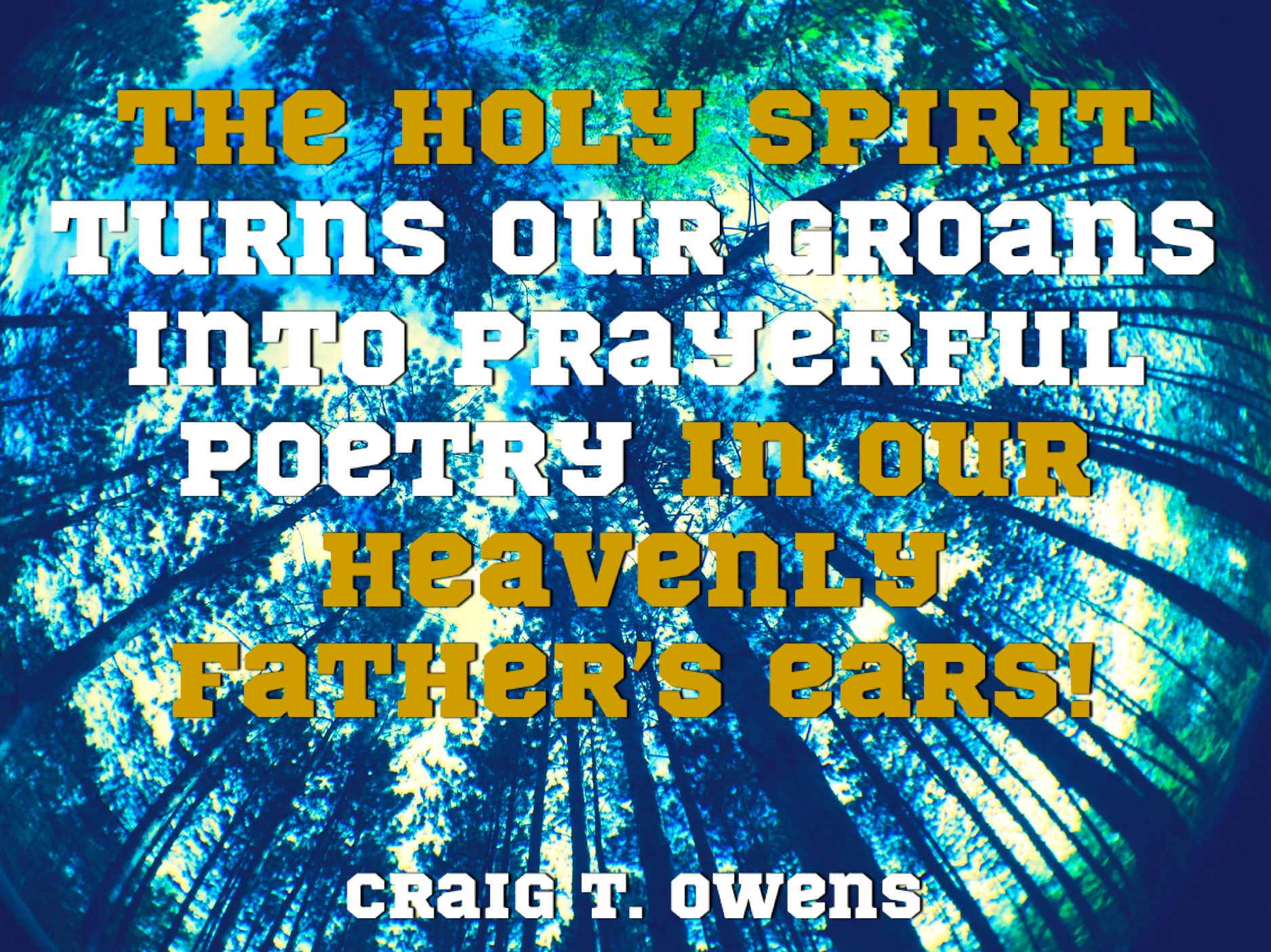
Don’t try to spruce up your vocabulary before you come to God in prayer. Just come to God in prayer, trusting that the Holy Spirit will make a beautiful prayer even out of your childlike groanings! The Holy Spirit turns our groans into prayerful poetry in our Heavenly Father’s ears!

Thursdays With Spurgeon—Our Prayer Helper

This is a weekly series with things I’m reading and pondering from Charles Spurgeon. You can read the original seed thought here, or type “Thursdays With Spurgeon” in the search box to read more entries.

Our Prayer Helper 

Likewise the Spirit also helps in our weaknesses. For we do not know what we should pray for as we ought, but the Spirit Himself makes intercession for us with groanings which cannot be uttered. Now He who searches the heart knows what the mind of the Spirit is, because He makes intercession for the saints according to the will of God. (Romans 8:26-27) 

     God helps our infirmity, and with a Helper so divinely strong, we need not fear the result! … We take our burden to our heavenly Father and tell Him in the accents of childlike confidence, and we come away quite content to better whatever His holy will may lay upon us. … 

     We bathe our wounds in the lotion of prayer and the pain is lulled; the fever is removed. But the worst of it is that in certain conditions of heart we cannot pray. We may be brought into such perturbation of mind and perplexity of heart that we do not know how to pray. … We fall into such heaviness of spirit and entanglement of thought that the one remedy of prayer, which we have always found to be unfailing, appears to be taken from us. Here, then, in the nick of time, as a very present help in time of trouble, comes in the Holy Spirit! He draws near to teach us how to pray, and in this way He helps our infirmity, relieves our suffering, and enables us to bear the heavy burden without fainting under the load. … 

     He will guide you both negatively and positively. Negatively, He will forbid you to pray for such and such a thing, even as Paul essayed to go into Bithynia, but the Spirit would not allow him. And, on the other hand, He will cause you to hear a cry within your soul that will guide your petitions, even as He made Paul hear the cry from Macedonia, saying, ‘Come over to Macedonia and help us’ (Acts 16:6-10). …  

     If I am a true believer, there dwells the Holy Spirit, and when I desire to pray, I may ask Him what I should pray for as I ought and He will help me! He will write the prayers that I ought to offer upon the tablets of my heart, and I will see them there and so I will be taught how to plead! It will be the Spirit’s own Self pleading in me and by me and through me before the throne of grace!

From The Holy Spirit’s Intercession

Oh, how many times I’ve been in desperate need but cannot find the right words to pray. The Holy Spirit understands even groans that come from my anguished heart and can help me turn those groans into perfect prayers. 

Jesus said the Holy Spirit would remind us of His words and would guide us into truth. I’ve experienced this for myself: I’m at an utter loss of what or how to pray, and then a passage of Scripture comes to my mind. I start there with that phrase. Often I will begin to read the surrounding passage from the Bible out loud and feel the gentle affirmation from the Holy Spirit as I begin to personalize that portion of Scripture into my own prayer. As Spurgeon put it, this is “the Spirit’s own Self pleading in me and by me and through me before the throne of grace!” 

What a Helper we have in the Holy Spirit!