A.L.I.V.E.—The “L” Is For Lives Changed

A man named Paul was visiting Athens. While he was in the marketplace, he began to talk with people about Jesus Christ, specifically how Jesus had been crucified and then raised back to life.

His comments caught the attention of two groups of philosophers: the Epicureans who thought all religions were made up and were simply a crutch for the weak-minded and superstitious, and the Stoics who said that a divine power was in everything but wasn’t a Person that could be personally known. These groups said to Paul, “You are presenting some new teachings and strange ideas that we have never heard before! Would you come and address our next meeting?”

In 2004, renowned atheist Anthony Flew announced something that was a “strange idea” to the ears of his followers. Flew presented one of his first papers on atheism at the Socratic Club at Magdalen College, where the Christian literary giant C.S. Lewis served as the chairman. Over the years Flew had sharpened his rhetoric to become one of the best known and most outspoken atheists on the worldwide stage.

Yet in 2004, an 81-year-old Anthony Flew remarked, “I simply had to go where the evidence led,” as Flew announced to the world: there IS a God.

“My discovery of the Divine has been a pilgrimage of reason and not of faith,” wrote Flew in his book There Is A God, which is why last week I shared the first way we can know Jesus is alive in “A” is for apologetics. Today I submit to you the second way one can know that Jesus is A.L.I.V.E.: Lives changed.

Paul, who was asked to speak to the philosophers in Athens about his “strange ideas,” had been given the name Saul by his parents. When it came to religion, Saul took a backseat to no one! He was a purebred Israelite from the tribe of Benjamin (which gave Israel its very first king, who was also named Saul). Saul called himself a “Hebrew of Hebrews” because he kept the Law of Moses and the strict rules of the Pharisees absolutely faultlessly.

When he heard about Jesus (who claimed to be God), and about the followers of Jesus who claimed He had been resurrected from the dead, Saul persecuted these Christians so vehemently that he not only had many of them thrown into prison, but he had many of them killed as well.

That all came to a complete stop when Saul met Jesus for himself! You can read how Saul retold this story in Acts 22:1-16. After this encounter, Saul’s life was 180-degrees different! He even changed his name to Paul to signify his new outlook. Now he was just as adamant to tell people about Jesus as he was previously to harass and persecute Christians.

Paul’s conversion came at a steep price. The Jews with whom he used to associate now turned violently against him. Numerous times they attempted to kill him. In addition, Paul’s newfound faith in Jesus caused him to be persecuted by the Romans as well. The Roman Emperors wanted people to say, “Caesar is lord” but Paul and the other Christians were declaring, “Jesus is Lord.” Paul ended up being executed under Emperor Nero.

Paul had numerous opportunities to recant, but he never came close to doing so. His life was one that was under constant duress and distress and danger precisely because he refused to back down from his claim that Jesus was alive!

Paul isn’t alone. Millions of people around the globe have come to know Jesus as their personal Savior. Many, like Paul, have been harassed for their faith and some even violently persecuted and martyred, and yet they so firmly believed that Jesus is alive that they were willing to go to their early grave with “Jesus is my Lord” still on their lips!

What about you? Have you met Jesus for yourself?

Check out this video where my friend Scott tells his personal story of how an encounter with Jesus has completely changed the trajectory of his life.

Join me next Sunday as we continue with our 5-part series I can know Jesus is A.L.I.V.E. because of… where we will be looking at the letter “I.” You can join me either in person or on Facebook Live. If you missed the previous lesson, check out “A” is for apologetics by clicking here.


A.L.I.V.E.—The “A” Is For Apologetics

This is part 1 of a 5-part series with a simple premise: “I can know Jesus is A.L.I.V.E. because of…” and then I am presenting evidence for each of the five letters. This is a look at the letter A” for Apologetics for the resurrection of Jesus.

For some of my evidence, I am going to use historical texts from the Bible. When I say “historical” I mean that in the scholarly definition: this Book is attested to by historians and literary critics to be an accurate record of actual historical facts. You can read more of the apologetics for the Bible’s authenticity in a post I previously published here.

I would ask you to weigh the evidence for three possibilities concerning the claims of Christians regarding the death and resurrection of Jesus.

(1) Jesus didn’t actually die.

The Romans didn’t invent crucifixion, but they perfected it to be one of the most gruesome forms of torturous death that history has ever known. This leads one to wonder how could anyone go through the torture Jesus did and survive?

A team of medical examiners, after examining the historical account of Jesus’ death concluded: “The difficulty surrounding exhalation leads to a slow form of suffocation. Carbon dioxide builds up in the blood, resulting in a high level of carbonic acid in the blood. The body responds instinctively, triggering the desire to breathe. At the same time, the heart beats faster to circulate available oxygen. The decreased oxygen (due to the difficulty in exhaling) causes damage to the tissues and the capillaries begin leaking watery fluid from the blood into the tissues. This results in a build-up of fluid around the heart (pericardial effusion) and lungs (pleural effusion). The collapsing lungs, failing heart, dehydration, and the inability to get sufficient oxygen to the tissues essentially suffocate the victim. The decreased oxygen also damages the heart itself (myocardial infarction) which leads to cardiac arrest. In severe cases of cardiac stress, the heart can even burst, a process known as cardiac rupture. Jesus most likely died of a heart attack.”

Besides that, the dead body of Jesus was also thoroughly examined by both the Romans who conducted the crucifixion (see Mark 15:43-45) and His friends who prepared His body for burial (John 19:38-40).  In addition, two contemporary historians who aren’t friendly to the cause of Christianity (Tacitus and Josephus) both attested to Christ’s death by crucifixion.

(2) Jesus didn’t actually rise from the dead.

Some say the disciples were delusional from their intense grief. But Jesus was seen on more than one occasion, sometimes by one person, sometimes by twos, and several times by large groups (see 1 Corinthians 15:3-8). Some of Jesus’ closest friends weren’t convinced by second-hand testimony but had to see Jesus for themselves (John 20:19-20, 24-28). All four biblical accounts record women seeing the resurrected Jesus. This is significant because women were not allowed to serve as “legal witnesses,” so this wouldn’t have helped the “delusional” disciples at all.

Some say the disciples stole the body of Jesus. But this is problematic because of the armed guards at the tomb of Jesus (Matthew 27:62-66; 28:11-15). 

(3) Jesus was crucified and resurrected.

Sir Arthur Conan Doyle’s Sherlock Holmes said, “When you have eliminated the impossible, whatever remains, however improbable, must be the truth.” So after looking at the shortcomings and difficulties of the first two options, let’s consider this third possibility: that it happened just as the historical records in the Bible indicate.

Cold-case detective J. Warner Wallace said of this third possibility, “The last explanation (although it is a miraculous, supernatural explanation) suffers from the least number of liabilities and deficiencies. If we simply enter into the investigation without a pre-existing bias against anything supernatural, the final explanation accounts for all of the evidence without any difficulty. The final explanation accounts for the evidence most simply and most exhaustively, and it is logically consistent…. The final explanation is also superior to all other accounts (given that it does not suffer from all the problems we see with the other explanations).”

Check out the video where I discuss all of these points in more detail, and join me either in person or on Facebook Live for the next four Sundays as we continue looking at the evidence supporting the resurrection of Jesus.

Resurrected From The Dead?! Really?

It is the foundational claim of Christianity: Christ died on a Cross and was raised back to life. It is also the claim many skeptics of Christianity find so difficult to process.

I am going to present a 5-part series of messages on this topic—“I can know Jesus is A.L.I.V.E. because of…” and then I’m going to give evidence for each of the five letters of “ALIVE.”

These messages are specifically designed for those skeptical of the claims of Christianity. The evidence won’t be a bunch of “churchy” platitudes, but court-room-level evidence that will attempt to make the case for what Christians believe about the death and resurrection of Jesus.

If you fall into that skeptical group, I would be honored to have you join me either in person at our church or on Facebook Live at 10:30am for the next five Sundays (March 18-April 15). I’m excited to present this evidence and I am looking forward to interacting with you!

If you missed any of the messages in this series, please check them out here. I can know that Jesus is alive because of…

How Should Christians Handle Objections?

It’s no secret that when a Christian says, “This is what I believe,” or “This is what the Bible says,” or even something as simple as, “I believe in God,” that there will be people who disagree. Sometimes their disagreement may even become an outright attack.

How are Christians to respond?

Here are five ways I’ve found to be effective and Christ-honoring—

1. Don’t argue. Arguments tend to create an “I don’t want to lose” feeling in the other person, which makes them unable to truly hear what you’re saying. Solomon wrote, “Do not answer a fool according to his folly, or you will be like him yourself” (Proverbs 26:4).

2. Ask questions. Jesus was a master at this. Look through the Gospels and you will see Jesus asking questions to clarify others’ positions. Questions stimulate further conversation, while statements tend to shut down the conversation. Questions develop a relationship, while definitive statements make you seem superior to the other person.

3. Don’t argue. Yes, this is good enough to repeat! Paul’s advice to Timothy was, “Do not waste time arguing over godless ideas and old wives’ tales” (1 Timothy 4:7).

4. Pray for mercy. Remember that if you are really speaking truths from the Bible, the person arguing against those truths is arguing with God, not with you.

5. Pray for light. Paul said that the “god of this age” has blinded people (see 2 Corinthians 4:2-4), so we should pray that the Holy Spirit would grant them light to see the truth.

“Oh, the unmitigated curse of controversy! Oh, the detestable passions that corrections and contradictions kindle up to fury in the proud heart of man! Eschew controversy, my brethren, as you would eschew the entrance to hell itself. Let them have it their way; let them talk; let them write; let them correct to you; let them traduce you; let them judge and condemn you; let them slay you. Rather let the truth of God suffer itself, than that love suffer. You have not enough of the divine nature in you to be a controversialist.” —Dr. Alexander Whyte

Let’s be passionate for people, not passionate to win an argument!

I go into more detail in this video…

What’s The Best That Could Happen?

I’ve had a good friend recommend a musical artist to me and I haven’t enjoyed the music.

I’ve had a good friend take me to a restaurant I haven’t liked.

I’ve had a good friend tell me how wonderful a certain movie was, and I thought it was a dud.

And I’m sure some of my good friends could say the same thing about my recommendations.

But you know what? All of these folks are still my friends.

I’ve never had one person say to me, “Your restaurant suggestion was awful. I’m unfriending you on Facebook and blocking your number from my phone. I never want to see or hear from you again!”

Yet sometimes I think church-going Christians feel like this might happen if they invite a friend to come to their church.

Seriously?!

Let’s consider the odds—

  • How likely is it that if you invite a friend to church and they say “no” that they are also going to say, “Get out of my life forever”?
  • If they do accept your invitation, but find that your church wasn’t a good fit for them, how likely is it that they’re going to say, “We can never hang out again”?

I think you would agree with me that both of these responses are highly unlikely!

But consider the other side—what if you invite them to your church and they say “yes”? What if after attending your church they like it? And what if by attending your church they enter into a personal relationship with Jesus?

If that happens, you’ve changed the course of their eternal destiny! 

Instead of focusing on the worst-case scenarios (which seem highly unlikely), we should be focusing on the best-case scenario!

If you’re still uneasy about inviting someone to your church, or even trying to have a conversation with them about your personal faith, here is a simple phrase to consider: Come and see.

Invite them to come and see your lifestyle that seeks to glorify Jesus (see Matthew 5:16). Let them see that you live your life like Jesus: doing good (Acts 10:38).

Invite them to come and see the Creator behind the creation (see Psalm 66:5). Whenever there is a discussion about the weather, or nature, or a medical science breakthrough, ask them, “Have you ever thought that if there is such a beautiful design there must also be an intelligent Designer?”

Christian, you have the best news ever! Don’t keep it to yourself. Invite those around you to come and see what a personal relationship with Jesus Christ is all about. Who knows? You may be a part of changing someone’s eternal destiny.

Come And See

Survey after survey, and personal interview after personal interview all report the same indisputable truth—the #1 reason unchurched people don’t come to church is no one has invited them!

Wow! Christians have the life-changing truth of what a personal relationship with Jesus Christ can do, and they are for the most part keeping it to themselves.

The Easter season is upon us, so we have a golden opportunity to reverse this stat. There is something about Easter and Christmas where even those that don’t normally attend a church service feel like this season might be a good time to do so.

I want to present a very simple way to invite people to hear about our Risen Savior, and it’s just three simple words:

Come and See

No pressure. No promises. No gimmicks. Just this: “Come and see for yourself what a relationship with Jesus is all about.”

Over the next two Sundays we’ll be looking at some obstacles we church people may have to overcome, and some excuses many unchurched people use. But all of this will help us to simply and clearly say to our friends, “Come and see!”

Please join me in person or watch on Facebook Live.

The Wonder Of God’s Forgiveness

King David was intimately confident that God would hear his prayers. No matter what—even if David had sinned.

The prophet Nathan confronted David after David had committed adultery with another man’s wife, gotten her pregnant, and then had her husband killed to try to cover up their affair. David assumed he had gotten away with it, but God sent Nathan to tell David that He knew all about it.

David immediately went to prayer.

His prayer is instructive for us when we sin too. David’s appeal to God for forgiveness is based solely on God’s ability and willingness to forgive, not on any merits David brings.

In this prayer, David presents a tally sheet. On his side of the ledger, he lists my transgressions, my iniquity, my sin, my bloodguilt. He sums it up with, “Against You, You only, have I sinned and done what is evil in Your sight.

David also tallies up God’s side of the ledger: You are right, You are just, You are righteous.

We might be tricked into thinking that a Perfect Being like this wants nothing to do with a sinful creature like you and me. But this is completely wrong! David appeals to God’s unfailing love, and Your great compassion. He lists God’s desire to cleanse, wash, blot out sins, restore, and release from blood-guiltiness.

David said, “I have sinned against the Lord.” And immediately Nathan responded, “The Lord has taken away your sin.”

Sin is all on me! Restoration is all on God!

With this in mind, we learn that the mark of a maturing Christian is not one who never sins, but one who…

  1. …feels a broken heart because of their sin (see Psalm 51:10)
  2. …confesses my sin
  3. …confidently asks for His forgiveness
  4. …helps others who have sinned (v. 13)
  5. …continues to abide in Jesus (vv. 10-12)

God is quick to forgive. Are we equally as quick to ask for His forgiveness?

You can study more of the lessons from the prayers of David:

How Confident Are Your Prayers?

David hasn’t done anything wrong. He’s never tried to lead a rebellion against King Saul. In fact, he’s never even talked poorly about Saul. And yet Saul is out to kill David!

David tries to get as far away as he can, choosing to live in the desert so that he might get some relief from Saul. Still Saul comes after him with a force of 3000 men! Every time David moves, Saul’s men are hot on his trail. David described his situation like this

My mortal enemies surround me. Their hearts are cold and calloused toward me, and they speak terrible things about me. They track me down and surround me. They are like hungry lions, crouching, waiting to pounce on me!

If you were in David’s sandals, how confident would you be that God could get you out of the situation? Remarkably, David’s confidence was as high as it could be!

David not only was confident that God would hear him, but that He would listen to him. More than that, David knew God would pay attention to him. And then David boldly said, “I call on You, O God, for you WILL answer me.”

How could David pray such a confident prayer? The answer is in this principle…

There is a direct correlation between intimacy and confidence.

David made two very intimate claims about his relationship with God:

  1. You will keep me as the apple of Your eye
  2. You hide me in the shadow of Your wings

The apple of the eye is the pupil. Our eyes are amazingly designed to not only take in information but to protect themselves. If something is getting too close to our eye, the eyelids blink in protection faster than we can consciously tell them to. So David was claiming that God would protect him by reflex!

The shadow of Your wings was a reference to the top of the Ark of the Covenant; a place called the mercy seat. Here is where the priest sprinkled the blood of a sacrificial lamb to atone for the people’s sin and to appeal to God’s mercy. The mercy seat was over-shadowed by two angels’ wings.

David was saying that God kept him in this intimate place—covered by God’s mercy and protection!

Jesus also told us about intimate confidence when He said, “If you remain in Me, and My words remain in you, ask whatever you wish, and it will be given you” (John 15:7).

  • Intimacy: remain IN Jesus, and let His words remain IN you
  • Confidence: ask whatever you wish, and it will be given you

Are your prayers this confident? If not, don’t work on raising your confidence, but work on increasing your intimacy. Check your intimacy level with questions like:

  • Am I abiding in Jesus?
  • Are His words abiding in me?
  • Do I have any unconfessed sin?
  • Is my prayer a “Your kingdom come, Your will be done” prayer?

Focus on intimacy, and then watch your confidence soar! 

If you are interested in learning more about the prayers of David, I have also discussed his prayer for help, his prayer of crying out loud, and his prayer of praise.

We Usually Believe The Opposite

The Lord is gracious and compassionate, slow to anger and rich in love. (Psalm 145:8)

Let those words sink in because most of us live like the exact opposite is true. Check out this 2-minute explanation …

A “Hallelujah!” Lifestyle

David shows us a picture of a man who made prayer the cornerstone of all he did. He’s quick to cry, “Help!” when he’s in trouble, and he doesn’t hold back when he’s crying out to God.

But he also shows us that prayer isn’t just for times of trouble. Prayer should be an ongoing conversation with God so that we can get to know His heart. God knows what’s going to happen (Isaiah 46:10), and He wants us to ask Him to make things clear to us (Jeremiah 33:3).

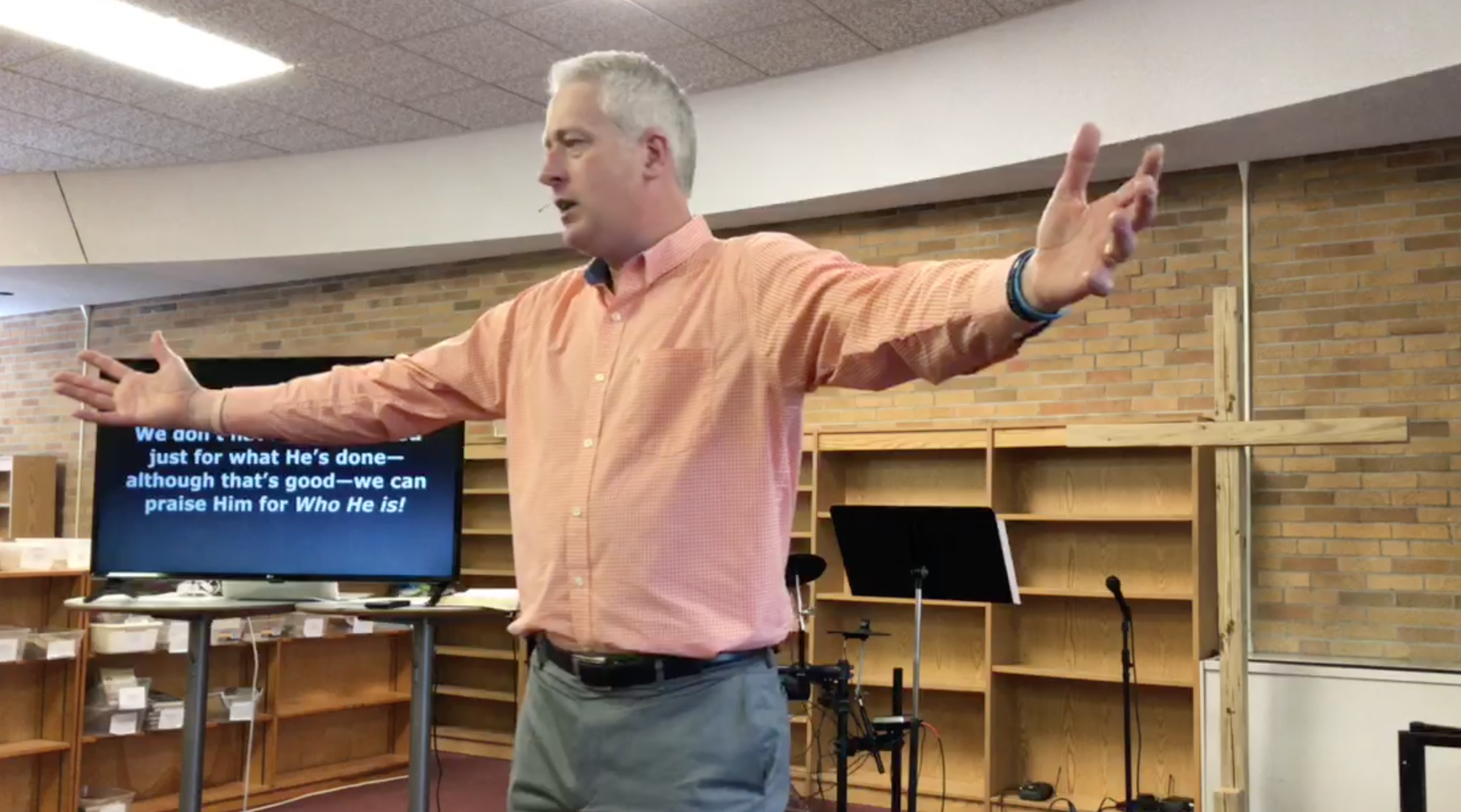
In Psalm 145, David challenges us to lift up our praise to God, as well as our prayers. This psalm of praise teaches us that we don’t have to only praise God for what He’s done—although that’s a great thing to do—but we can also praise God simply for Who He is!

In this psalm, David says God is…

…worthy of praise (v. 3a) 
…great beyond comprehension (v. 3b) 
…majestic (v. 5)
…awesome (v. 6)
…abundantly good (v. 7)
…gracious, compassionate, slow to anger, rich in love (v. 8)
…good to all (v. 9)
…mighty (v. 11)
…everlasting (v. 13)
…strong (v. 14)
…righteous and loving (v. 17) 
…near to us (v. 18)
…fulfilling (v. 19)
…watchful (v. 20)

Let’s not be known just for our petitions, but for our praise.

Let’s not be known just for our “Help!” but for our “Hallelujah!

Please join me in our continuing look at the Prayers Of David.