Saturday In The Proverbs—Do You *Really* Want To Hear This? (Proverbs 8)

[Each chapter in the Book of Proverbs contains thoughts that fit into a theme; they are not just random thoughts gathered together. In this “Saturday In The Proverbs” series, I will share a theme that I see in each chapter. But the cool thing about God’s Word is that you may see an entirely different theme. That’s great! If you do, I would love for you to share it in the comments below.]

Does not wisdom cry out…? (Proverbs 8:1).

Wisdom is accessible to all. Wisdom is not hiding; she is in plain sight and calls out to everyone (vv. 2-4). The question is: Do I want to find Wisdom? Do I really want to hear what she has to say? 

The Apostle Paul tells us to take all our thoughts captive and filter out the thoughts that aren’t obedient to Christ (2 Corinthians 10:5). In other words, I need to eliminate the thoughts that are impure, false, vile, discouraging, unloving, proud, or un-praiseworthy (Philippians 4:8). 

Wisdom herself says her words are: 

  • excellent
  • right
  • truthful
  • righteous
  • pure
  • easy to understand
  • sound
  • strengthening

The rewards for really listening to Wisdom’s words are pretty great too: 

  • treasures 
  • righteousness
  • justice
  • God’s blessings
  • eternal life
  • God’s favor

So with all that in mind, how would you answer the question now: Do you really want to hear what Wisdom has to say to you?


Thursdays With Oswald—Jeremiah 2-3

Oswald ChambersThis is a weekly series with things I’m reading and pondering from Oswald Chambers. You can read the original seed thought here, or type “Thursdays With Oswald” in the search box to read more entries.

Jeremiah 2-3

[These are notes from Oswald Chambers’ lecture on Jeremiah 2-3.]

     God is the “adornment” of His people; but God says, “My people have forgotten Me days without number”; the dead set of their life has been away from God (Jeremiah 2:32). Forgetting as an infirmity of mere consciousness is one thing; but forgetting by steadfastly refusing to recognize is another thing. These people had deliberately turned out of God’s way. They were wantoning after some other god than the God Who was holy (2:33). …  

     The thing that shocks us most is not the thing that shocked Jesus most. Social immorality shocks us till we don’t know where we are; but what struck the heart of Jesus Christ with horror was immorality against God, pride against Himself (see Luke 16:15). …  

     The innocence arising from evil is always like this—“I’ve done nothing.” It is the innocence we are all born with; sooner or later it takes its stand with evil and only knows good by contrast; whereas the innocence arising from the presence of the Spirit of God takes its stand with good and knows evil only by contrast. If we hand our hearts over to God we need never know in experience what Jesus Christ says of the human heart is true (see Mark 7:20-23). 

From Notes On Jeremiah

This is a tough concept that takes some quiet introspection in the presence of the Holy Spirit. Christians should ask themselves: Do I know the difference between good and evil because I’m doing evil and the opposite of what I’m doing is good, or because I’m doing good and the opposite of what I’m doing is evil? 

Originally, Eve knew evil only as the opposite of how she was living. But when satan tempted her to take the forbidden fruit, Eve now knew evil as something she was doing. Jesus said evil is what would naturally come out of our heart, unless “we hand our hearts over to God” and allow His Spirit to supernaturally bring out of us the Christlike fruit He produces. Is this happening in your life? 

Saturday In The Proverbs—Two Pursuits, Two Outcomes (Proverbs 7)

[Each chapter in the Book of Proverbs contains thoughts that fit into a theme; they are not just random thoughts gathered together. In this “Saturday In The Proverbs” series, I will share a theme that I see in each chapter. But the cool thing about God’s Word is that you may see an entirely different theme. That’s great! If you do, I would love for you to share it in the comments below.]

…call understanding your nearest kin… [or be] devoid of understanding… (Proverbs 7:4, 7).

Two pursuits lead to two totally different outcomes. 

Pursuit #1—I can keep God’s Word in my sight, treasure His laws and commands, and pursue His understanding. Outcome: I am kept safe from the flattery of anything that would try to seduce me (vv. 1-5).

—OR—

Pursuit #2—I can ignore God’s ways and rely on myself. I become devoid of understanding and I pursue what I want to pursue. Outcome: Seduced by flattery and led to the slaughter (vv. 6-27).

And your choice is….???

How NOT To Make A Decision

Adonijah thought he was the obvious heir to the throne so he stated what he believed, “I will be king” (1 Kings 1:5). 

On what evidence did Adonijah base his claim? 

  1. All of his friends said he would make a great king
  2. His father (the king) had always given him everything he wanted
  3. He was handsome and popular
  4. A couple members of the king’s court supported him
  5. No one had ever told him “no” 

While all of this sounded good, Adonijah overlooked some vital points. Like…

  1. …more men backed his brother Solomon to be king than backed him
  2. …his father had the decisive and definitive say in who would be king, and he chose Solomon
  3. …God had chosen Solomon to be king

It’s tempting for us to read the popular sentiment of the moment, or to listen to the cheering voices around us, or even to think that our plans are wise and well thought-out. But this is NOT the right way to make a decision.

Instead, we need to humbly consider three things that are external:

  1. The unbiased, wise counsel of others
  2. The buy-in of key stakeholders
  3. God’s clear “yes”

If these three things are in alignment, you cannot go wrong!

Thursdays With Oswald—Jeremiah 1

Oswald ChambersThis is a weekly series with things I’m reading and pondering from Oswald Chambers. You can read the original seed thought here, or type “Thursdays With Oswald” in the search box to read more entries.

Jeremiah 1 

[These are notes from Oswald Chambers’ lecture on Jeremiah 1.]

     The servant of God is never self-elected, there is always this impelling call of God, and it is always the most unlikely man, the most unlikely woman, God calls. …  

     Jeremiah’s courage was superb. It was not the courage of foolhardiness But the courage of a hyper-sensitive man being held by God; he sees the terror of the evil and wrong and knows his own sensitiveness, and yet hears God saying, “Be not afraid.” There are people who are fearless and we say they are courageous, but there is no moral virtue in their courage, it is born either of physical or moral obtuseness. Spiritual courage is the high heart that sees the difficulty and faces it. That is the courage that is valuable to God. …  

     How am I to know what God has ordained me for? By His eternal Word. We have to stir up our minds and find out what God’s purpose is by obeying His Word and relying on His Spirit. … Will the Word of God come to me? Of course it will! Will the Spirit of God see that I fulfill that Word? Of course He will! If we will keep in the light with God, our destination is as sure and as established as God, as certain as His throne.

     When once you realize the divine purpose behind your life you will never again say, “I am so weak”; you will know you are, but you will be strong in His strength. The only strength we have is the strength of God, which comes to us from the vision of God and of His power. The time of stress in which there is no vision, no insight, no sensing of the purpose of God, is the time to stand firm in faith in God and God will do all the rest. Keep true to God and your development in God’s plan is certain. …  

     The reason men and women are exhausted in life is because they have not realized God’s purpose for them; when once they are awakened by the Spirit of God, regenerated by Him, and fitted on to His purpose for them, they will end where God wants them to end. 

From Notes On Jeremiah 

God had a purpose for Jeremiah’s life. He has a purpose for your life too! 

Get into His Word. Listen to the voice of His Spirit nudging you forward, awakening compassion, prompting you to go or to speak or to serve. God is glorified when you do what He designed you to do, and the rest of us are blessed and benefitted when you do what God designed you to do!  

5 Lessons From 2 Mothers

If you’ve been reading my series of posts on God’s favor, I hope you are becoming more aware of how strongly I want you to know this: God is for you! He’s not looking for opportunities to blast you, but to bless you. (If you want to read some of these previous posts, check out the link at the bottom of this post.) 

In writing his account of the birth of Jesus, Luke is captured with the idea of God’s favor. Luke uses the word favor more than any of the other gospel writers, and he uses the word quite frequently as he relates the events leading up to the birth of Jesus. During his narrative we meet two women—Elizabeth and Mary. Here are five lessons we can learn from these two mothers. 

(1) “Favor” is not the same thing as “favorite.” To say, “I am the one on whom God’s favor rests” is not the same as saying, “I am God’s favorite.” Elizabeth recognized God’s favor on both herself and on Mary (Luke 1:25 & 43), and Mary also recognized God’s favor on herself (Luke 1:28, 30, 48-49). But nowhere did these women think they were God’s favorites. God has no favorites, but instead He showers His abundant, never-ending favor on everyone! 

(2) “Favor” probably didn’t look like what they would have planned for themselves. Elizabeth didn’t get pregnant until the age when she should have been a grandmother, and Mary got pregnant before she was even married. I’m sure neither of them thought their lives would go this way! But God knew what He was doing all along (see Isaiah 45:7-9; Psalm 139:16). 

(3) They needed humility, obedience, and perseverance to remain in the place where they could recognize God’s favor. No one can stop God’s favor, but the devil would love to keep you from recognizing God’s favor. One way satan does this is by trying to get us to appeal to our pride (“I think I can do this better”) because then obedience to God and perseverance through the trying times is very difficult to maintain. 

(4) God’s favor is for God’s glory (not necessarily for our comfort). God is accomplishing HIS plan through us. His favor toward us places us where He needs us, when He needs us there, and with the talents we need to respond correctly when we get to that moment. Mary spoke the words that I’m sure were also in Elizabeth’s heart: “I am the Lord’s servant. May it be to me just as you have said.” 

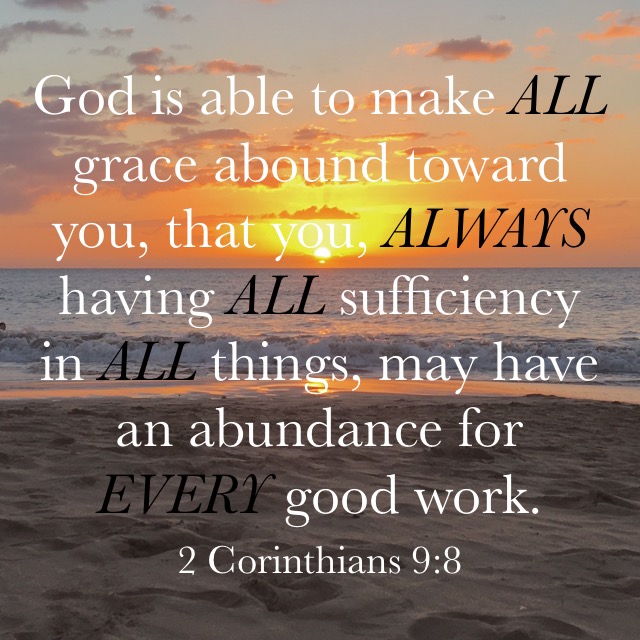
(5) God’s favor doesn’t necessarily answer all our questions. Even though God’s favor places us in the right place, at the right time, with the right skills, we will still undoubtedly have questions about why God is doing what He’s doing. If you feel that way, you’re not alone—Hebrews 11 is full of people who felt the same way. But hang in there and keep trusting God: He knows what He’s doing! In the meantime remember this: God is able to make ALL grace abound toward you, that you, ALWAYS having ALL sufficiency in ALL things, may have an abundance for EVERY good work (2 Corinthians 9:8). 

Check out this video of the full message I shared on these lessons from the life of Elizabeth and Mary. 

Join me this Sunday as we continue looking at God’s favor. You can join me either in person or on Facebook Live. 

If you’ve missed any of my previous posts on God’s favor, check out: 

Saturday In The Proverbs—5 Important Self-Examination Questions (Proverbs 6)

[Each chapter in the Book of Proverbs contains thoughts that fit into a theme; they are not just random thoughts gathered together. In this “Saturday In The Proverbs” series, I will share a theme that I see in each chapter. But the cool thing about God’s Word is that you may see an entirely different theme. That’s great! If you do, I would love for you to share it in the comments below.]

If… (Proverbs 6:1).

This collection of proverbs prompts quite a bit of self-examination. 

  1. Have I made commitments that are going to entrap me (vv. 1-2)? If so, I should plead for mercy to get out of them (vv. 3-5). 
  2. Am I less-than-diligent in my work—what Solomon calls a sluggard? Consider the diligence and initiative of the ant (vv. 6-8), and then consider the outcome if I don’t make better decisions with my time and my work ethic (vv. 9-11). 
  3. Am I a person of integrity, or am I a fast-talking, double-dealer (vv. 12-14)? I better consider the “therefore” (v. 15)! 
  4. Is my heart pure? Consider that an evil heart is at the heart of what God hates—shedding innocent blood, doing evil, lying, pride (vv. 16-19). Do I want God’s anger directed at me?
  5. Do my eyes stray toward women who aren’t my wife (v. 25)? God’s wisdom can keep me pure (vv. 20-24), but I also need to consider the devastating consequences of continuing in this immorality (vv. 26-35). 

Are you willing to honestly ask yourself these questions in the presence of God’s Holy Spirit?

You should—because your life may be at stake! 

A Leader’s Priority

But now your kingdom must end…because you have not kept the Lord’s command (1 Samuel 13:14). 

How tragic! 

Saul, as the first king ever of Israel, could have set the standard. He could have raised the bar high. He could have been the measuring stick by which every other king in Israel’s history was judged. But he missed out on all that.

It was not only tragic but short-sighted too. The prophet Samuel told Saul, “How foolish! You have not kept the command the Lord your God gave you. Had you kept it, the Lord would have established your kingdom over Israel forever. 

Saul’s priority was about appearances. Saul’s priority was about betting on a sure winner. Saul’s priority was about working his agenda.

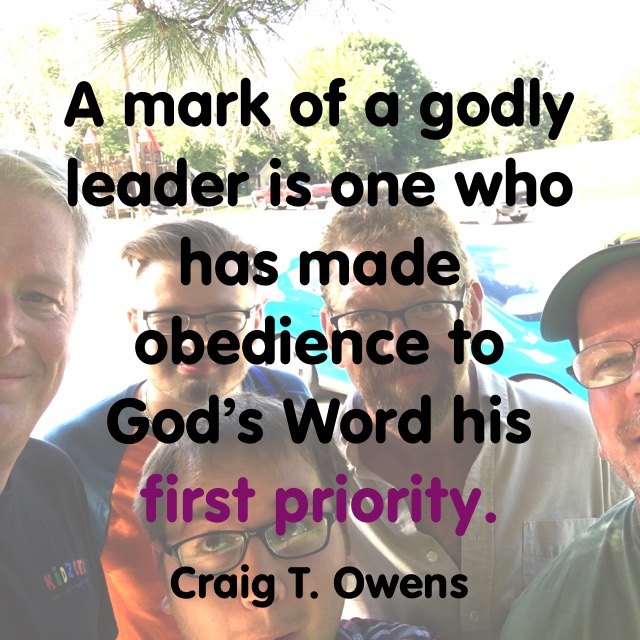
A mark of a godly leader is one who has made obedience to God’s Word his first priority. 

The psalmist tells us some of the benefits—

  • God’s Word keeps us pure
  • God’s Word keeps us from sin
  • God’s Word is the key to God’s blessings
  • God’s Word strengthens us
  • God’s Word preserves us
  • God’s Word does us good
  • God’s Word keeps us from going astray
  • God’s Word lights our path

Make God’s Word your first—and highest—priority! 

This is part 22 in my series on godly leadership. You can check out all of my posts on this topic by clicking here.

Thursdays With Oswald—Isaiah 45 and 53

Oswald ChambersThis is a weekly series with things I’m reading and pondering from Oswald Chambers. You can read the original seed thought here, or type “Thursdays With Oswald” in the search box to read more entries.

Isaiah 45 and 53

[These are notes on Oswald Chambers’ lectures on Isaiah 45 and 53.]

     Ever remember that “eternal life” is to know God, therefore you cannot expect to know Him in five minutes or forty years. … There are whole tracks of God’s character unrevealed to us as yet, and we have to bow in patience until God is able to reveal the things which look so dark. … 

     God never reveals anything ahead of moral and spiritual progress. The Christian worker who has never walked in the darkness of God’s hand with no light, has never walked with God at all. The principle of walking with God is that it is a walk by faith, not by sight; a walk in the light of Christ, not in the light of dogmatic conviction. Jesus as our example was under the shadow of the hand of God. “If it be possible, let this cup pass from Me.” He knew He could have called twelve legions of angels to His rescue, but He did not call one; not one fire of His own did He kindle, not one self-generated effort did He ever make. … Our Lord taught over and over again that things will never be explained in this life. We have to get rid of the idea that we are going to be vindicated down here; Jesus was not. The millennium age will be the vindication of the saints; this is the age of their humiliation. The triumphant thing for a saint is to stand true to God in spite of all the odds the world, the flesh and the devil can bring. … 

     Jesus Christ’s suffering was unique: He knew why He suffered. … There was nothing of the morbid fanatic about Our Lord: He looked beyond the travail to the joy set before Him, consequently He “endured the Cross, despising the shame.” … 

     Suffering unjustly will either produce sympathy with satan or similarity to Christ. Sympathy with satan arises from self-pity—“Why should I have to go through this?” 

From Notes On Isaiah 

There’s no doubt about it: suffering is hard. It’s confusing, too, for even many ‘seasoned saints.’ 

Jesus was not exempt from suffering, and neither will His followers be. In fact, Jesus even told us ahead of time that we should expect to suffer for His name’s sake. 

Our suffering never takes God by surprise. Neither is He indifferent to it. Remember that Jesus suffered in all the same ways we will without ever sinning. Now He intercedes before the Father on our behalf when we go through times of suffering. 

God’s suffering IS producing something great. Don’t bail out. Don’t give in to self-pity. Know that God is with you in your suffering, and He is accomplishing something far greater than you can ever imagine in this life. Hang in there—triumphant vindication IS coming! 

12 Quotes From “Notes On Isaiah”

Oswald Chambers always has more insights than I can possibly share with others: he is a true treasure-trove of biblical illumination! Check out my review of his Notes On Isaiah by clicking here. Below are a few shorter quotes from this book. If you would like to read some longer passages, check out my weekly series called Thursdays With Oswald. 

“What we are apt to call interruptions are God’s way of introducing us to a new knowledge of Himself.” 

“The supernatural power of satan never reasons, it appeals to man’s superstition, not to his conscience.”

“I have no right to have anything less than the hope and the belief of Jesus Christ with regard to the worst and most hopeless of men.” 

“We have to keep the call of God alive, and continually recall to our minds what we are here for. … There is no danger of spiritual retrogression if we will keep in mind the times, one or more, when the Spirit of God has touched us.” 

“God’s dates are not man’s. God seems to pay no attention to our calendars; He has a calendar of His own in which He suddenly surprises a man in the midst of his days. Leave room for God. We expect God only on special days, in particular meetings; that is not God’s way. He comes suddenly, at midnight or at noonday.” 

“We are to be in the world while not of it, and to denounce by lip and life the things that are wrong.” 

“The mark of the beast is already here, and it will grow clearer before the man of sin is revealed (see 2 Thessalonians). It is slighting no one to say that prosperity in this order of things along with godliness is impossible, and growingly more impossible.” 

“Undisciplined imagination is the greatest disturber not only of growth in grace, but of spiritual sanity [Isaiah 26:3].” 

“Conscience does not shout in thunderclaps, you can easily drown its record, but it goes on, and if you do not heed it for a while because of sensational sinning, as soon as the sensation exhausts itself, back comes the monotonous tick, tick, that nearly drives a man mad. God will never make us listen to Him; we have to will to listen.” 

“Belief in God will always manifest itself in right principles, but if you put principles first you will end in disbelief in God.” 

“The only place of confidence is personal trust in God and patient waiting for Him. … To trust in the goodness of God is not enough, it is not eternal and abiding; we have to trust God Who is infinitely more than goodness.” 

“If in the face of all the appeals of common sense you remain true to God, that is the ‘proof of your faith’ which will be found to the glory of God.”