Scared Half To Death

Mega fearHave you ever had a really good scare that turned your life around? For some people, they need to be scared half to death in order for them to make changes in their lives.

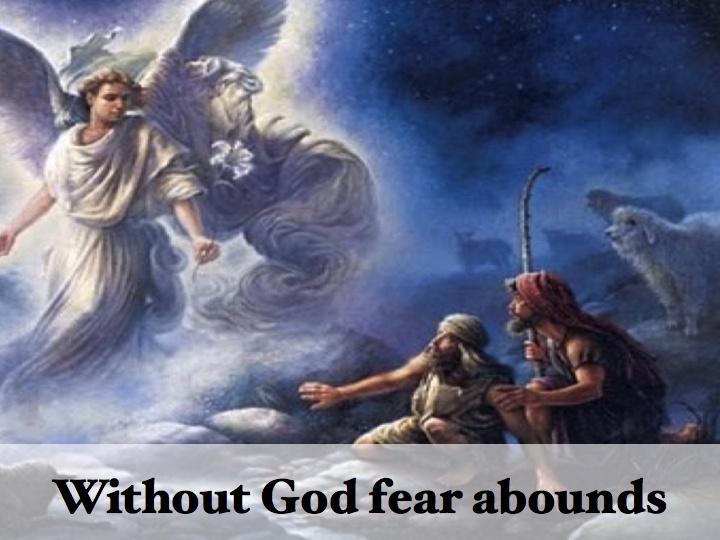
I think this is what happened to the shepherds outside Bethlehem the night Jesus was born (Luke 2:8-20). The Bible says that when the glory of the Lord shone around them they were terrified (the King James Version is very picturesque when it says they were sore afraid). The Greek word for fear is phobeo, but the phrase Luke uses here for “terrified” is megas phobeo phobos. Get the picture? They were scared half to death!!

But now, what to do what that fear? The angel gave them the first step—Go find Jesus. He didn’t tell them to get themselves cleaned up, or start going to church, or even to stop acting a certain way. Simply go find Jesus.

The shepherds obeyed and went to meet Jesus, and then something amazing happens.

  • Their fear is turned to praise—the shepherds returned, glorifying and praising God.
  • Their silence is turned to testimony—they spread the word concerning what had been told them.

Jesus was born as a Man to experience all our fears and sorrows and pains. But He took these upon Himself as He became the perfect, once-for-all sacrifice. Now there are no fears that can keep us from God’s presence. Jesus conquered all that kept us from God! 

There was nothing beautiful or majestic about His appearance, nothing to attract us to Him.He was despised and rejected—a Man of sorrows, acquainted with deepest grief. We turned our backs on Him and looked the other way. He was despised, and we did not care. Yet it was our weaknesses He carried; it was our sorrows that weighed Him down. And we thought His troubles were a punishment from God, a punishment for His own sins! But He was pierced for our rebellion, crushed for our sins. He was beaten so we could be whole. He was whipped so we could be healed.

All praise to God, the Father of our Lord Jesus Christ, who has blessed us with every spiritual blessing in the heavenly realms because we are united with Christ. Even before He made the world, God loved us and chose us in Christ to be holy and without fault in His eyes. (Isaiah 53:2-5; Ephesians 1:3-4)

This Christmas I pray you will…

Find Jesus for yourself!

Let your praises to Him ring out!

Tell others what Jesus has done for you!

If you have missed any of the messages in our Fear Not! series, you can find them all by clicking here.

Thursdays With Oswald—Not A Happy Life, But A New Life

This is a weekly series with things I’m reading and pondering from Oswald Chambers. You can read the original seed thought here, or type “Thursdays With Oswald” in the search box to read more entries.

Not A Happy Life, But A New Life 

     This attitude is spreading amongst us today amazingly, people are enchanted with the truth, sympathetic with the truth of God, but remaining in sin. “Repentance” is not in their vocabulary, only regret; there is no confession of sin, only admitting. Religion is turned into education, and the Christian life is made to mean a happy life instead of a new life. 

     Has God been convicting us of spiritual pose before Him? Have we taken the great passion of the Atonement and made it simply mean that we must have a right attitude to God? We have to have much more than a right attitude; we have to get into an active, living relation to God, the inspiration of which is a great deep true penitence. Have we forgotten all about penitence these days? Has penitence ever rung down to our very soul, or have we only known regret? Have we ever known what it is to confess our sin, to unfold our life before God until there is nothing folded up, and God’s penetrating truth has its way? If not, we shall find as [Ezekiel 33:31] reveals, that it is perilously easy to have amazing sympathy with God’s truth and still remain in sin. 

From God’s Workmanship

Sometimes my new life in Christ won’t be a happy life in Christ. Why? Because if I’m truly letting God’s Word penetrate my heart, I’m going to be unhappy with the sin His penetrating look reveals.

What will I do then? Will I just feel sorry for my sin? Or will I confess it, be penitent because of it, turn from it, and leave that sin behind?

That’s the new life God is calling me to.

A new life will become a happy life. But a happy life won’t become a new life.

Sola Fide

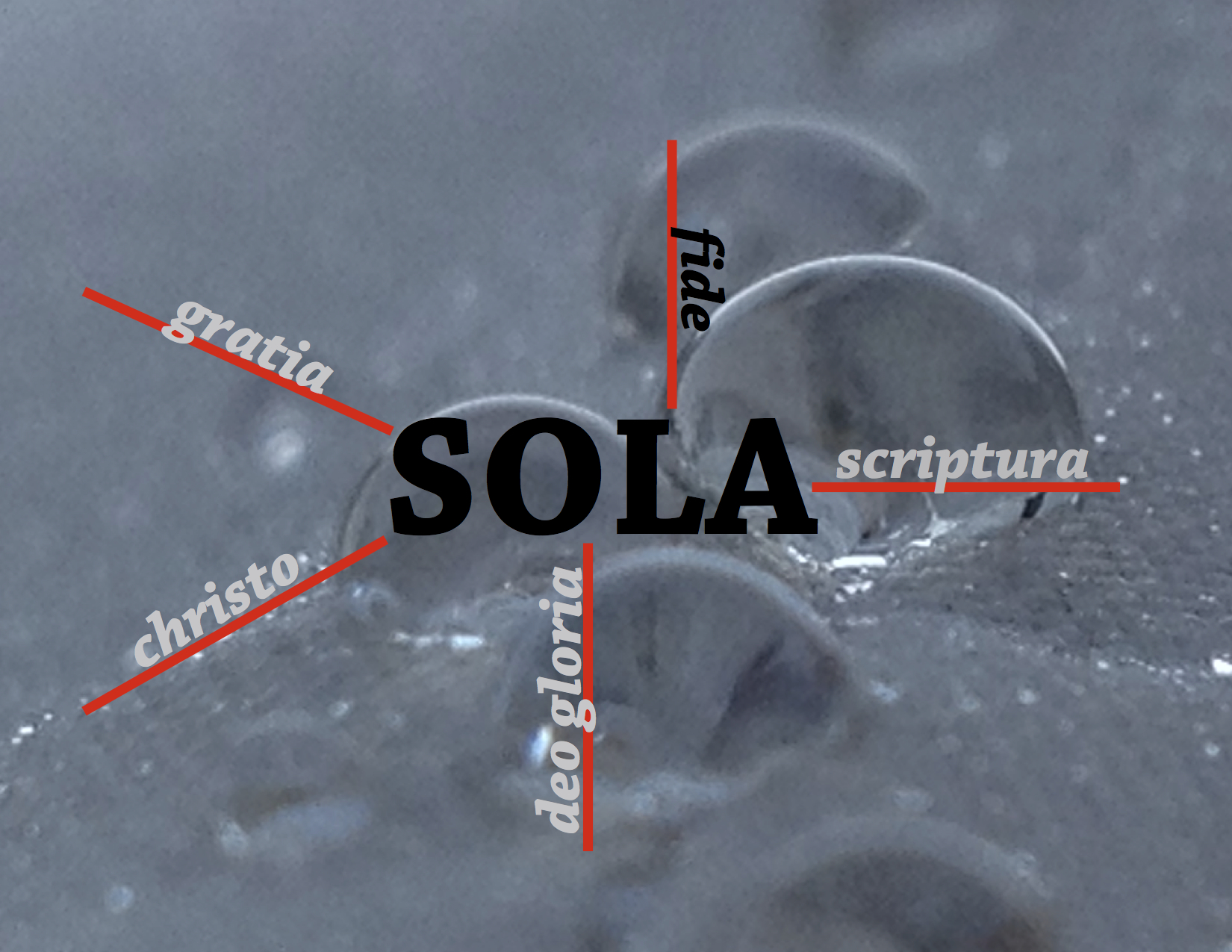
Out of the Reformation came five sola statements—five statements that tried to bring people back to the purity of the gospel message. This week as I studied to prepare my message on sola fide (justification with God by faith alone), I was struck by how in need of another reformation we are today!

That shouldn’t be surprising, because satan is always trying to so sneakily get us off track. So he gets people believing that they don’t need faith in God, that God is a myth, or if He does exist, He’s really not that involved in our individual lives. For these people, satan tries to get them to buy into this lie:

Works > Faith

In other words, what you can do for yourself is more important than the faith you can place in anyone (or in The One).

Some people might accept that the approach to God is through faith, but then they feel they have to add something to their faith in order to stay in God’s good graces. These people have bought into the lie:

Faith + Works 

And then there are some that go to the far extreme of thought that faith means utter inactivity on their part. They have received forgiveness from God, so now they can just sit back and enjoy the ride to Heaven. They’ve bought into satan’s lie:

Works ⊈ Faith

In other words, now that I have faith, I don’t have to work anymore. Or even, the more faith I have the less work I have to do. (The mathematical symbol ⊈means faith is not a part of work, nor is work a part of faith.)

The Scripture is clear that you cannot buy your justification by working for it, nor can you keep it by adding works to your faith; however, faith does indeed require work for it to grow and mature. 

The Westminster Confession says it this way:

Faith, thus receiving and resting on Christ and His righteousness, is the alone instrument of justification: yet is it not alone in the person justified, but is ever accompanied with all other saving graces, and is no dead faith, but worketh by love.

The bottom line:

Sola Fide = Faith Works

Faith works in justification. Faith works in the atonement. Faith works in sanctification. Faith works in love.

If you have missed any of the messages in this series, you can find them all here.

Know Your Theological Terms

I shared these helpful memory devices this morning, and perhaps they will be helpful to you as well. Some of the terms theologians use can be somewhat confusing, perhaps just because the words look so big! But the nice thing about the big words, they come from much smaller root words.

In these instances, these are just a different way of stating the big words, to help you remember the importance of their definitions.

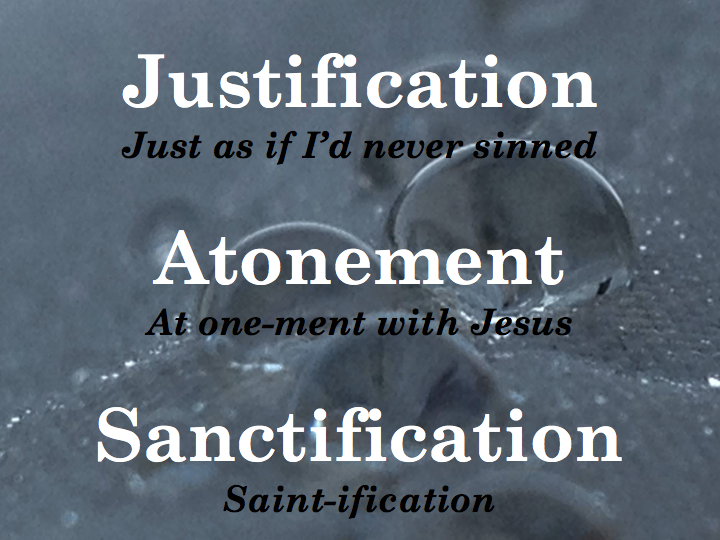
Justification = just-as-if I had never sinned. When your sins have been forgiven, you appear to God just as if you had never sinned, so you have been justified by your faith (see Romans 3:22-24).

Atonement = at one-ment with Jesus. Christ said that He was the way, the truth, and the life, and that no one could come into the Father’s presence except through Jesus. So atonement makes at one-ment with Jesus, which allows us to enter into God’s presence (see Romans 3:25).

Sanctification = saint-ification. The Holy Spirit begins a process in our lives where He is forming us into saints. Whereas justification and atonement are one-time events, sanctification is an ongoing process that is conforming us more and more into the image of Jesus (see 2 Thessalonians 2:13).

I hope this helps you understand and apply these terms.

Thursdays With Oswald—Jesus Can Satisfy

This is a weekly series with things I’m reading and pondering from Oswald Chambers. You can read the original seed thought here, or type “Thursdays With Oswald” in the search box to read more entries.

Jesus Can Satisfy 

     [There] are indications from innumerable passages in God’s Book which prove that this complex soul which we have been examining can be satisfied and placed in perfect harmony with itself and with God in its present existence. The thought that a human soul can fulfill the predestined purpose of God is a great one. The human soul, however, can also be stagnated by ignorance. In the beginning, we do not know the capabilities of our souls and are content to be ignorant; but when we come under the conviction of sin, we begin to understand the awful, unfathomable depths of our nature and the claim of Jesus Christ that He can satisfy this abyss. Every man who knows what his soul is capable of, knows its possibilities and terrors, but knows also the salvation of God, will bear equal testimony with the written Word of God that Jesus Christ can satisfy the living soul. 

From Biblical Psychology

I think Chambers explains why some people don’t read the Bible regularly. Because when we read the Word, the Holy Spirit does show us the abyss between where we are and where God wants our souls to be. Then we are convicted and restless. And, as Augustine said, “Our souls are restless until they find their rest in You.”

But with that realization of the separation—the abyss—also comes the recognition that Jesus paid the price for our atonement (our at one-ment). Our souls can find their full satisfaction here and now if we will just turn from the thoughts and practices that are separating us from God.

Don’t wait for the “sweet by and by” to find satisfaction with God:

  1. Read the Word
  2. Let the Holy Spirit convict you of the abyss in your soul
  3. Obey the Spirit’s prompting so you can repent
  4. Experience the at one-ment with God that Jesus paid for!

Thursdays With Oswald—In Christ I Can

This is a weekly series with things I’m reading and pondering from Oswald Chambers. You can read the original seed thought here, or type “Thursdays With Oswald” in the search box to read more entries.

In Christ I Can

     We are made sons and daughters of God through the Atonement and we have a tremendous dignity to maintain; we have no business to bow our necks to any yoke saving the yoke of the Lord Jesus Christ [Matthew 11:28-30]. …

     Every detail of our physical life is to be absolutely under the control of the new disposition which God planted in us by means of identification with Jesus Christ, and we shall no longer be allowed to murmur ‘can’t.’ There is no such word as ‘can’t’ in a Christian’s vocabulary if he is rightly related to God; there is only one word and that is ‘can.’

From Biblical Psychology

Sometimes Christians are known more for what we’re against than what we’re for. I think Oswald Chambers would say that is because we don’t really understand the full power of the Atonement.

We can better understand that word by saying it “at one-ment.” We have been made one with Christ. You hear this in Jesus’ prayer for us in John 17, I in them and You in Me, in order that they may become one and perfectly united, that the world may know and definitely recognize that You sent Me and that You have loved them even as You have loved Me.”

When we are in this sort of relationship, we don’t even say can’t to sin. Instead, we say I can live a holy life because of Christ in me!

As Paul said, we can say:

I CAN do everything through Christ Who gives me strength. (Philippians 4:13)

Thursdays With Oswald—A Moral Lavatory

This is a weekly series with things I’m reading and pondering from Oswald Chambers. You can read the original seed thought here, or type “Thursdays With Oswald” in the search box to read more entries.

A Moral Lavatory

     The Bible does not deal with sin as a disease; it does not deal with the outcome of sin, it deals with the disposition of sin itself. … We have cheapened the doctrine of sin and made the Atonement a sort of moral ‘lavatory’ in which men can come and wash themselves from sin, and then go and sin again and come back for another washing. …

     All Heaven is interested in the Cross of Christ, all Hell terribly afraid of it, while men are the only beings who more or less ignore its meaning.

From Biblical Ethics

This hits me in two areas.

First, as a sinner saved by grace. I am so grateful for the gift of grace. I want to treat this gift with all of the gratitude I can. It was purchased for me with such a high price: The blood of the sinless King of kings. May my sin break my heart as much as it breaks my Heavenly Father’s heart. I’m grateful grace is there when I blow it, but I don’t want to blow it ever again.

Dietrich Bonhoeffer described cheap grace like this:

“Cheap grace is the preaching of forgiveness without requiring repentance, baptism without church discipline, Communion without confession, absolution without personal confession. Cheap grace is grace without discipleship, grace without the Cross, grace without Jesus Christ, living and incarnate. … Cheap grace is the grace we bestow on ourselves.”

Second, as a pastor who teaches about the atonement and grace. I know that I will have to give account before God if the people who hear me teach about these gifts are ones who “ignore its meaning.” I want to do everything I can to make sure everyone who listens to me understands the inestimable value of the Cross of Jesus Christ.

In his book Costly Grace, Jon Walker writes:

“Costly grace justifies the sinner: Go and sin no more. Cheap grace justifies the sin: Everything is forgiven, so you can stay as you are.”

Grace is powerful stuff. May we always treat it that way.

Torn Veil

Our Where’s God? Easter drama reached its climax when the veil in the temple was torn by Christ’s death on the Cross. All three of the synoptic gospels record this—

At that moment the curtain in the sanctuary of the Temple was torn in two, from top to bottom. (Matthew 27:51; also see Mark 15:38 and Luke 23:45)

This was so significant in answering the question “Where’s God?” The veil prevented anyone from going into God’s presence (except the high priest on the Day of Atonement). This made God’s presence something of a mystery: Does God see me? Does He care about me? How do I get to God? Can I even approach Him? Would He receive me or would He reject me?

The best way to remember the definition for atonement is like this: at-onement.

In one moment, when Jesus said, “It is finished,” all that separated us from God was removed! And we can now live forgiven! We can now be at onement with God!

The veil not only literally and physically hung in the temple, but it figuratively and spiritually hangs in our hearts. This is what the Apostle Paul writes—

But their minds were made dull, for to this day the same veil remains when the old covenant is read. It has not been removed, because only in Christ is it taken away. Even to this day when Moses is read, a veil covers their hearts. But whenever anyone turns to the Lord, the veil is taken away. Now the Lord is the Spirit, and where the Spirit of the Lord is, there is freedom. And we, who with unveiled faces all reflect the Lord’s glory, are being transformed into His likeness with ever-increasing glory, which comes from the Lord, Who is the Spirit. (2 Corinthians 3:14-18)

Jesus Christ’s death on the Cross allowed the Heavenly Father to tear apart the physical veil in the temple. Have you allowed the Holy Spirit to tear apart the spiritual veil in the temple of your heart? Here’s how you can know that the veil has been torn apart—you can notice that you are being transformed more and more into Christ’s likeness.

That’s the significance of the torn veil! That’s the power of Christ’s atonement!

If you missed any of the message in our Where’s God? series, you can find them all here.

Thursdays With Oswald—Not Self-Conscious, But God-Conscious

This is a weekly series with things I’m reading and pondering from Oswald Chambers. You can read the original seed thought here, or type “Thursdays With Oswald” in the search box to read more entries.

Not Self-Conscious, But God-Conscious

     When I am lifted by the Atonement into oneness with God I do not lose my personal identity, my identity becomes that of conscious union with God. Man’s relationship with God in the beginning was such that the consciousness of union with Him was a delight: as soon as sin entered that went and man became self-conscious: he realized he was no longer in union with God and tried to hide himself from His presence.

From Biblical Ethics

For to me, to live is Christ… I have been crucified with Christ and I no longer live, but Christ lives in me. The life I live in the body, I live by faith in the Son of God, Who loved me and gave Himself for me. (Philippians 1:21; Galatians 2:20)

A great way to remember the meaning of the word Atonement is like this: At one-ment. Jesus paid the price for me to be at one-ment with the Father. He did not die so I could become more aware of myself, but so I could become more aware of God.

Christ’s Atonement makes me dead to me, and alive to Him; dead to trying to figure out myself, and alive to learn more of Him; dead to self-consciousness, and alive to God-consciousness.

And I would much rather be more aware of Him than I am of me!

Thursdays With Oswald—My God Came Down The Stairs

This is a weekly series with things I’m reading and pondering from Oswald Chambers. You can read the original seed thought here, or type “Thursdays With Oswald” in the search box to read more entries.

My God Came Down The Stairs

     It is not our earnestness that brings us into touch with God, nor our devotedness, nor our times of prayer, but our Lord Jesus Christ’s vitalizing death; and our times of prayer are evidences of reaction on the reality of Redemption, so we have confidence and boldness of access into the holiest. What an unspeakable joy it is to know that we each have the right of approach to God in confidence, that the place of the Ark is our place, “Having therefore, brethren, boldness.” What an awe and what a wonder of privilege, “to enter into the holiest,” in the perfectness of the Atonement, “by the blood of Jesus.”

Oh, long and dark the stairs I trod,
With stumbling feet to find my God:
Gaining a foothold bit by bit,
Then slipping back and losing it:
Never progressing, striving still,
With weakening gasp and fainting will,
Bleeding to climb a God: while He
Serenely smiled, unnoting me.
Then came a certain time when I
Loosened my hold and tell thereby.
Down to the lowest step my fall,
As if I had not climbed at all.
And while I lay despairing thereby.
I heard a footfall on the stair,
In the same path where I, dismayed,
Faltered and fell and lay afraid.
And lo! when hope had ceased to be,
My God came down the stairs to me.

From Christian Disciplines

I am so grateful my God came down the stairs to me!

I am so awed that I now can come into His presence with confidence!

I am so humbled that God would save a sinner such as me!