Are You An Encourager?

Check out these words of the Apostle Paul—

When we arrived in Macedonia, there was no rest for us. We faced conflict from every direction, with battles on the outside and fear on the inside. But God, who encourages those who are discouraged, encouraged us by the arrival of Titus. (2 Corinthians 7:5-6)

Paul wasn’t doing so well! No rest … conflicts every direction he turned … battles … fear … discouragement …

But did you see how God encouraged Paul?

By the arrival of Titus

God encouraged Paul through Titus. Not through an angel, or a sign in the heavens, or anything dramatic. But through a friend showing up.

God wants to encourage you through others…

are you allowing those encouraging friends into your life?

God wants to encourage others through you…

are you allowing Him to use you to do that?

People are almost always the means of God’s ministry to the world. May you and I always be ready, available, and obedient.

Open Door

Listen to the podcast of this post by clicking on the player below, and you can also subscribe on Apple or Spotify.

The phrase open door shows up several times in the New Testament, and it shows up quite a bit in the present-day vocabulary of many Christians too. But I’m not sure we mean the same thing.

I hear Christians saying things like, “I’m praying for God to open a door for a new job,” or “I’m waiting to see what door God will open for my schooling,” or something to that effect. In other words, the open door seems to be for our personal benefit.

The apostle Paul said this:

A great door for effective work has opened to me, and there are many who oppose me (1 Corinthians 16:9).

Let’s get one thing clear: God opens doors (we don’t), and our job is to obediently walk through those open doors (God won’t shove us through them).

Paul knew that the open door was not for his benefit, but for the benefit of those who were presently outside of the Kingdom of God. God opens doors for His people so that those outside His Kingdom can come inside (see Acts 14:27; 2 Corinthians 2:12; Colossians 4:3).

It might look like God opened a door by providing a job, but that job is His means to help you invite others into His Kingdom. The open door (the job, in this case) isn’t primarily for you; it’s for you to invite others in.

That’s why when God opens doors there will be many who oppose you. They are not really opposing you, but they are opposing the opportunity for the kingdom of darkness to be robbed and the Kingdom of God to be enriched.

So when you pray for open doors, remember:

  • When God opens a door, it’s mainly for the benefit of those outside the Kingdom of Heaven
  • You will be opposed by the kingdom of darkness

If you’re ready for both of those, then by all means pray for open doors!

►► Would you please prayerfully consider supporting this ministry? ◀︎◀︎

Be A Foolish Preacher

Pastor, do you realize how clever we try to be?

  • We come up with a catchy sermon series and add some stylish graphics.
  • Then we labor over sermon titles that sound so compelling.
  • As we write our sermons we try to dream up memorable patterns, like all three of our main points start with “S,” or we spell out the word “P.E.A.C.E.”

When the truth of the matter is, what we’re saying is foolishness.

Where is the wise man? Where is the scholar? Where is the philosopher of this age? Has not God made foolish the wisdom of the world? For since in the wisdom of God the world through its wisdom did not know Him, God was pleased through the foolishness of what was preached to save those who believe. Jews demand miraculous signs and Greeks look for wisdom, but we preach Christ crucified: a stumbling block to Jews and foolishness to Gentiles, but to those whom God has called, both Jews and Greeks, Christ the power of God and the wisdom of God. For the foolishness of God is wiser than man’s wisdom, and the weakness of God is stronger than man’s strength. (1 Corinthians 1:20-25)

You don’t have to try to make God’s Word clever. It is already profound!

You don’t have to try to make it memorable. The Holy Spirit makes it memorable (John 14:26)!

You don’t have to make the Bible relevant. It is the most relevant, applicable wisdom that humanity has ever known! 

D.L. Moody said it this way:

“If God has given you a message, go and give it to the people as God has given it to you. It is a stupid thing for a man to try to be eloquent. Make your message, and not yourself, the most prominent thing. Don’t be self-conscious. Set your heart on what God has given you to do, and don’t be so foolish as to let your own difficulties or your own abilities stand in the way.”

Don’t try to be clever. Just be Spirit-led and you will utter the most profound, compelling, and memorable words ever spoken by a preacher!

What Is Successful Church Ministry?

I like to keep asking myself and my leadership team this question: How do we know if our church is successful? 

The apostle Paul uses two words to help answer these questions: Quality and Faithfulness.

But each one’s work will be shown for what it is; the Day will disclose it, because it will be revealed by fire—the fire will test the quality of each one’s work. (1 Corinthians 3:13)

Now it is required that those who have been given a trust must prove faithful. (1 Corinthians 4:2)

So here are two important questions we need to ask ourselves:

  • Am I doing quality work?
  • Am I faithfully doing my work?

To help answer those questions, I like this thought from Leonard Sweet’s book I Am A Follower:

“The most important metrics we must rely on, the crucial ‘deliverables’ we can present, must focus on the newly formed lives of the disciples we are making, the followers who are following Christ into a place of serving Him by serving others. The most important measure of our faithfulness to Christ must be the extent of transformation into the living image of Christ Himself. …

The quantifiable fruit of our church is not found in the number of people we can gather on a weekly basis. What counts is what is happening in the lives of those who have gathered. …It is quite possible to have a ‘successful’ life—and a ‘successful’ church—without God. But it is absolutely impossible to have a truly fruitful one.”

Again, Paul’s advice here is invaluable:

My conscience is clear, but that does not make me innocent. It is the Lord who judges me. Therefore judge nothing before the appointed time; wait till the Lord comes…. (1 Corinthians 4:4, 5)

Pastor, you need to think about these questions about “success.” But they should be questions framed around your quality and faithfulness of work as revealed to you by the Holy Spirit, not by some “expert” or anyone else.

(By the way, if you’re interested in exploring this further, I framed this question a different way in this post.)

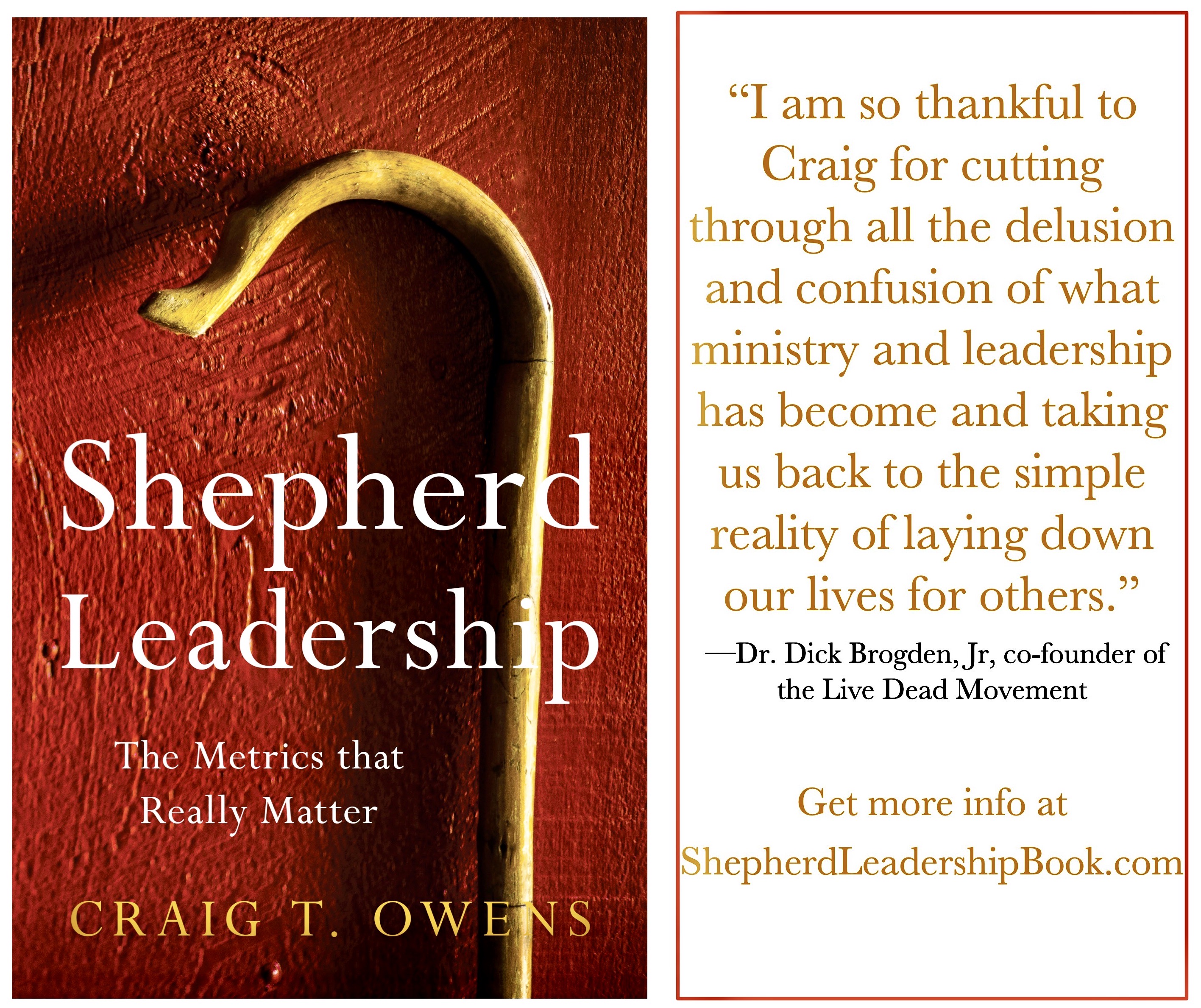
UPDATE: This post was one of the seed thoughts that went into fashioning my book Shepherd Leadership: The Metrics That Really Matter.

Co-Workers

Obvious statement #1: Church ministry is not lone ranger work.

I needed to state that not only as a reminder to myself, but to my other pastor friends too. It seems like we can often lose sight of this fact. We can become so focused on the next sermon, the next appointment, the next Board meeting, the next outreach that we are actually worshiping the ministry instead of worshiping God through our ministry.

Oswald Chambers gave this warning:

“Beware of any work for God that causes or allows you to avoid concentrating on Him. A great number of Christian workers worship their work. The only concern of Christian workers should be their concentration on God. … A worker who lacks this serious controlling emphasis of concentration on God is apt to become overly burdened by his work. … Consequently, he becomes burned out and defeated. There is no freedom and no delight in life at all. His nerves, mind, and heart are so overwhelmed that God’s blessing cannot rest on him.”

When we are more focused on the work than on God, we can easily begin to feel over-worked and under-appreciated. And this usually leads to us either bearing down to work harder or to simply throwing in the towel.

There is a healthy alternative: link arms with The Co-Worker—

Walk with me and work with Me—watch how I do it. Learn the unforced rhythms of grace. I won’t lay anything heavy or ill-fitting on you. Keep company with Me and you’ll learn to live freely and lightly.” (Matthew 11:29, The Message)

Link with The Co-Worker, and then you will do ministry out of the overflow of your personal worship. Remember, you are a co-worker, not a solo-worker.

Obvious statement #2: Church ministry is not just for the pastor.

Church member, you too are a co-worker with Christ. And with your pastor.

The apostle Paul reminded the church at Corinth that “we are God’s fellow workers” (1 Corinthians 3:9). In other words, we’re all in this together. You need your pastor, and your pastor needs you.

Allow me to paraphrase a quote from President Dwight Eisenhower:

“Never let yourself be persuaded that one [pastor] is necessary to the salvation of America. When [the Church] consists of one leader and [a bunch of] followers, it will no longer be [the Church].”

The Church is a beautiful thing! It functions best when:

  • Pastor and church member are both linked with Christ
  • The pastor is not a lone ranger
  • The church members are not spectators

Ready? Go BE the Church of Jesus Christ!

What’s Your Point?

As I am preparing my message for each Sunday, I have one point that I want everyone to have clear in their hearts and minds when they leave. It’s sort of my “finish line.” I say, “If they get only one thing from this message, what should it be?” This is the part where I spend quite a bit of time.

Then I read this from the Apostle Paul:

When I came to you, brothers, I did not come with eloquence or superior wisdom as I proclaimed to you the testimony about God. For I resolved to know nothing while I was with you except Jesus Christ and Him crucified. (1 Corinthians 2:1-2)

So what’s my point?

Something clever and witty?

Something that shows how eloquent I am?

Perhaps another rule to follow?

Or another application to make?

Oswald Chambers says, “To say that we are called to preach holiness or sanctification is to miss the main point. We are called to proclaim Jesus Christ….” (emphasis mine)

My point should be only this:

To help people see Jesus more clearly.

Anything less than this is to miss the point.

Anything more than this is attempting to make myself sound eloquent.

Always Be The Majority

In Acts 27, Paul is on his way to Rome to stand trial before Caesar. The weather has hindered them, so they are currently behind schedule. As they are docked at a town called Lasea, Paul advises the ship’s crew that they should stay right where they are.

But then comes this key phrase: “The majority decided that we should sail on” (Acts 27:12).

The majority in this case includes the sailing experts: the sailors, the ship captain, and even the ship’s owner. Julius, the centurion in charge of Paul, even sided with the majority.

But the majority was wrong.

As the ship is being ripped apart and driven way off course by a fierce storm, this majority even begins to give up on living through this nightmare.

But one man—Paul—with a word from God and “faith in God that it will happen just as He told me” (v. 25), became the most influential voice. From this point on, everyone listened to Paul: the sailors, the captain, the centurion.

One man + Faith in God’s Word = A Majority

Are you in a storm?

Is the majority telling you what you should do?

What has God said to you? Have you heard His Word?

Once you hear from God, cling to that Word in faith, and you will be the influential majority.

Thursdays With Oswald—Serving Like Christ

This is a weekly series with things I’m reading and pondering from Oswald Chambers. You can read the original seed thought here, or type “Thursdays With Oswald” in the search box to read more entries.

Am I Serving Like Christ?

The Son of Man did not come to be served, but to serve… (Matthew 20:28)

     Jesus also said, ‘Yet I am among you as the One who serves’ (Luke 22:27). Paul’s idea of service was the same as our Lord’s—‘…ourselves your bondservants for Jesus’ sake’ (2 Corinthians 4:5). We somehow have the idea that a person called to the ministry is called to be different and above other people. But according to Jesus Christ, he is called to be a ‘doormat’ for others—called to be their spiritual leader, but never their superior. Paul said, ‘I know how to be abased…’ (Philippians 4:12). Paul’s idea of service was to pour his life out to the last drop for others. And whether he received praise or blame made no difference. As long as there was one human being who did not know Jesus, Paul felt a debt of service to that person until he did come to know Him. But the chief motivation behind Paul’s service was not love for others but love for his Lord.

     …The institutional church’s idea of a servant of God is not at all like Jesus Christ’s idea. His idea is that we serve Him by being the servants of others. Jesus Christ actually ‘out-socialized’ the socialists. He said that in His kingdom the greatest one would be the servant of all (see Matthew 23:11). The real test of a saint is not one’s willingness to preach the gospel, but one’s willingness to do something like washing the disciples’ feet—that is, being willing to do those things that seem unimportant in human estimation but count as everything to God.

From My Utmost For His Highest

I cannot add anything to this brilliant observation. But I can tell you the parts that the Holy Spirit is really working in my heart:

  • “…called to be a ‘doormat’ for others—called to be their spiritual leader, but never their superior.” God, help me to keep my pride in check.
  • “The real test of a saint is not one’s willingness to preach the gospel, but one’s willingness to do something like washing the disciples’ feet.” May I never shrink back from willingly serving at the lowest level of society.

UPDATE: This idea of servant-leaders plays prominently in my book Shepherd Leadership: The Metrics That Really Matter.

Not Playing It Safe

Listen to the podcast of this post by clicking on the player below, and you can also subscribe on AppleSpotify, or Audible.

Sometimes I like to think about counterfactual history. That means thinking about the “What ifs” of historical events. What if George Washington had been killed in battle? What if a congressman had voted a different way? And so on.

Here’s one I was thinking about as I read the Book of Acts: What if Paul had prayed, “God, keep me safe”?

Over the last few chapters of Acts, Paul has the opportunity to share the gospel with…

  • the Jewish Sanhedrin
  • Claudius Lysias, a Roman garrison commander
  • two Roman governors (Felix and Festus)
  • Ananias, the high priest in Israel
  • Tertullus, a noted attorney
  • King Agrippa and his wife Bernice
  • a Roman centurion named Julius
  • Publius, the chief Roman official on Malta
  • the leading Jews in Rome
  • and the Roman Caesar

That’s quite an impressive list! But here’s the deal: Paul only got to speak to these high-ranking and influential people because he was a prisoner.

Paul could have prayed for a “safe life.” He could have run away. He could have disobeyed. Instead, he was willing to let God use him anytime, anyplace, anyway.

Isn’t that really the opening line of the Lord’s Prayer? Your Kingdom come, Your will be done.

Is that what I really want?

Or do I want to play it safe?

Phillips Brooks had another thought about how we should pray:

“Do not pray for easy lives; pray to be stronger men. Do not pray for tasks equal to your powers; pray for powers equal to your tasks. Then the doing of your work shall be no miracle; but you shall be a miracle.”

I don’t want to play it safe. I want to be strong enough, obedient enough, and willing enough to let God use me anytime, anyplace, anyway. I hope you will join me in that prayer.

►► Would you please prayerfully consider supporting this ministry? My Patreon supporters get behind-the-scenes access to exclusive materials. ◀︎◀︎

I-Have-To-Have-It Attitude

In our Live Dead series, we have been talking about different areas we need to allow to die, so that we might truly live for Christ as His disciples.

One of the things that often gets in the way of our pursuit of Christ is our cravings. This word—which the dictionary defines as a longing or an eager desire—has an interesting origin. The root word in both Latin and Old English means to lay claim to or to demand by right.

In other words, a craving is when something that was originally a want has now become a need in my mind. So I lay claim to it, saying that it’s something that is owed to me.

The Apostle Paul talks about cravings that we all had before we came to know Christ as Savior when he wrote, “All of us also lived among them at one time, gratifying the cravings of our sinful nature and following its desires and thoughts” (Ephesians 2:3).

This same Greek word shows up in Christ’s parable of the sower when He talks about the seed that falls among the weeds. These people, He explains, allow the worries of this life, the deceitfulness of wealth and the desires for other things come in and choke the Word (Mark 4:19).

Gratifying my cravings = Choking out the life of Christ in me

The problem is that this craving or desire for things other than Christ is often an unconscious habit. We have allowed them to become cravings—laying our claim to them as needs—without even realizing it.

The antidote: fasting. When we give up something, the Holy Spirit can show us if that thing has created an I-Have-To-Have-It attitude in our hearts. This spiritual discipline is hard because our bodies will rebel against having to give up “a right.” But when we press through with this discipline of fasting, God describes the results:

Then your light will break forth like the dawn, and your healing will quickly appear; then your righteousness will go before you, and the glory of the LORD will be your rear guard. Then you will call, and the LORD will answer; you will cry for help, and He will say: Here am I. (Isaiah 58:8-9)

That’s how I want to live! So I must live dead to my cravings. I can only do this when I allow a time of fasting to open my heart to hear the Holy Spirit point out all my I-Have-To-Have-It attitudes.

To check out all of the messages in our Live Dead series, please click here.