Religious Liberty In School

free-to-speakAs our students are heading back to their schools, it is a great time to be reminded of the religious liberties they have while in school. With all of the talk of so-called “separation of church and state,” I think many parents and students are reluctant to say anything that sounds remotely Christian, for fear of getting in trouble with the powers-that-be.

But we don’t have to tread so carefully!

Gateways To Better Education has some great resources. I ordered a couple hundred of their “Free To Speak” pamphlets. I gave them to our school superintendent, and as many parents as as I could. This short pamphlet summarizes the US Department of Education’s guidelines on what is allowed in school. In short, the Seven Freedoms are:

  1. Students can pray, read their Bibles or other religious material, and talk about their faith at school.
  2. Students can organize prayer groups and religious clubs, and announce their meetings like any other club.
  3. Students can express their faith in their class work and homework.
  4. Teachers can organize prayer groups with other teachers.
  5. Students may be able to go off campus to have religious studies during school hours.
  6. Students can express their faith at a school event.
  7. Students can express their faith at a graduation ceremony.

Don’t be intimidated. Don’t be uninformed. Know your rights as a US citizen.

The Beauty Of Intolerance (book review)

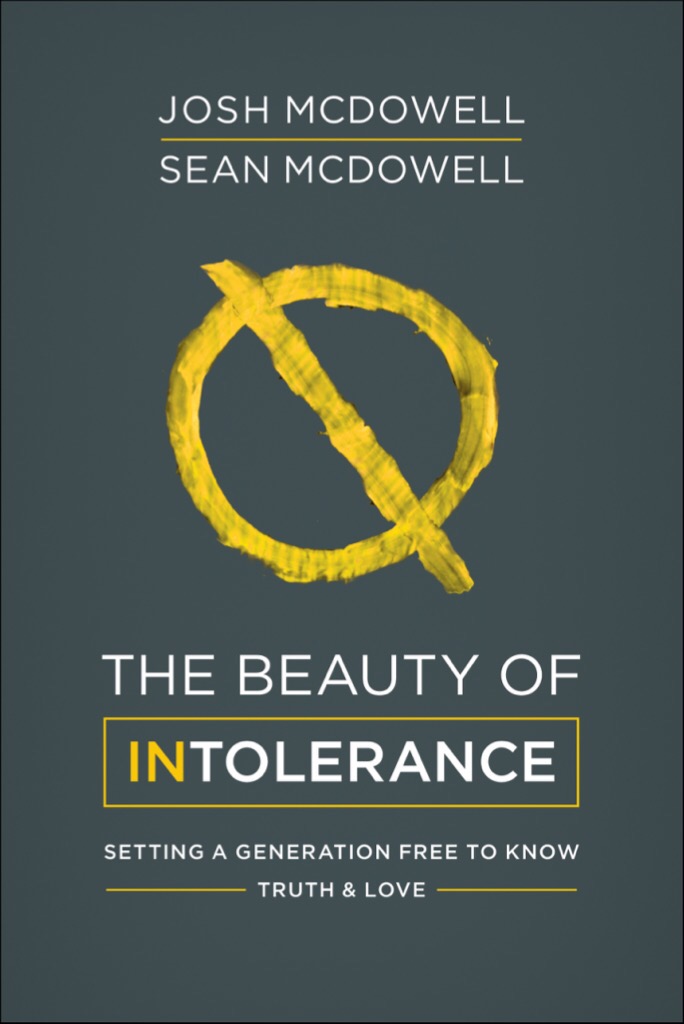
Beauty Of IntoleranceOur current culture sets tolerance as a high virtue, so those who exhibit the greatest levels of tolerance are upheld as the model for everyone else. On the other hand, intolerance is an ugly label for anyone to have. So what do you think when you hear that Josh and Sean McDowell have teamed-up to write a book called The Beauty Of Intolerance?

Many times there is a generational clash of worldviews: today’s grandparents and parents tend to hold to viewpoints which many of today’s youth find intolerant, mean, or even bigoted. Does that mean that the older generations are unenlightened, and the younger generations have seen the light? Or does it mean that the younger generations are rebelling, while the older generations are holding the line? Josh and Sean have become the “translators” between these two starkly-different worldviews.

It starts, the McDowells say, with an understanding of the word “tolerance.” It turns out that the this word has taken on a new meaning with younger generations, but that doesn’t mean that the younger generations don’t value what the older generations do. For example, consider a t-shirt that Josh McDowell designed. The front of the shirt says, “Intolerance is a beautiful idea.” But the back of the shirt clarifies this statement by reminding us:

  • Mother Teresa was intolerant of poverty.
  • Bono was intolerant of AIDS.
    Nelson Mandela was intolerant of apartheid.
  • Martin Luther King was intolerant of racism.
  • Jesus was intolerant of bigotry.

It turns out it’s not just the word “tolerance” that needs a tune-up, but also words like “respect,” “dignity,” “acceptance,” “morality” and “truth.” Fortunately for us, The Beauty Of Intolerance leads us through a modern-day understanding of all these terms.

Using true-to-life dialogue between parents and children, Josh and Sean help both generations see how intolerance really is a beautiful thing. The McDowells guide us through conversations we might encounter at home, in school, in the government, at church, and in day-to-day living. They give us the tools necessary to help everyone see that intolerance can be a beautiful thing!

For anyone who wants to speak the truth lovingly and convincingly across generational lines, The Beauty Of Intolerance is a must-read book.

I am a Shiloh Run Press book reviewer.

5 Ways To Be A Christlike Employee

Work like JesusHave you ever had a bad boss? One who was harsh, unreasonable, overly demanding, or just a plain meany? Do you think working for a “bad boss” means that you get to lower your standards?

Not if you are a Christian!

Christians are on Earth to represent Jesus. We are aliens and strangers here for a short time, but here to also point people toward Heaven. One place we have tremendous opportunity to do this is on our jobs.

Think about it: most people will work 30-40 hours per week, and probably work 40-50 years of their life. That’s a lot of hours in which to show that living for Jesus makes all the difference in the world. 

Peter addresses our work situation in his first epistle. In essence he says, “You may not be able to control your boss’s actions, but you can control your reactions. A Christian has a different attitude about workplace employers than Earthlings do.”

The two things that set Christian employees apart is their submission and their respect.

Submission means understanding the proper order. This isn’t just showing up on time, wearing the right uniform and checking off the right things on your job description. All of those things can be done with a lousy attitude, with an attitude that’s nothing like Christ’s attitude.

Submission means viewing our employers differently—

  • Obeying them like we would obey Jesus (Ephesians 6:5).
  • Being sincere when we say, “Yes, I’d be happy to do that” (Ephesians 6:5).
  • Working hard even when our employer isn’t watching us (Ephesians 6:6).

With that in mind, here are five ways to be an “alien employee.” That is, someone who honors God on-the-job…

  1. Work for God.
  2. Trust God to be your Provider, not your employer.
  3. Trust God to keep perfect records of your faithful service.
  4. Pray for God’s blessing on your employer.
  5. Pray for your employer to see Jesus in your work ethic.

Here’s a great question to ask yourself: If Jesus were filling out my employee evaluation, what would He say about my work ethic? 

If you’ve missed any messages in this series, you may find the complete list by clicking here.

Poetry Saturday—In The Center Of The Circle

FullSizeRenderIn the center of the circle
   Of the will of God I stand:
There can come no second causes,
   All must come from His dear hand.
All is well! for ‘tis my Father
   Who my life hath planned.
Shall I pass through waves of sorrow?
   Then I know it will be best;
Though I cannot tell the reason,
   I can trust, and so am blest.
God is Love, and God is faithful,
   So in perfect Peace I rest.
With the shade and with the sunshine,
   With the joy and with the pain,
Lord, I trust Thee! both are needed,
   Each Thy wayward child to train,
Earthly loss, did we but know it,
   Often means our heavenly gain. —I.G.W. (from Streams In The Desert)

Waiting For Hope

George Matheson“Waiting with hope is very difficult, but true patience is expressed when we must even wait for hope.

“When we see no hint of success yet refuse to despair, when we see nothing but the darkness of night through our window yet keep the shutters open because stars may appear in the sky, and when we have an empty place in our heart yet will not allow it to be filled with anything less than God’s best—that is the greatest kind of patience in the universe. …

“Dear Lord, You have made waiting beautiful and patience divine. You have taught us that Your will should be accepted, simply because it is Your will. You have revealed to us that a person may see nothing but sorrow in his cup yet still be willing to drink it because of a conviction that Your eyes see further than his own.” —George Matheson

Thursdays With Oswald—The Value Of Temptation

Oswald ChambersThis is a weekly series with things I’m reading and pondering from Oswald Chambers. You can read the original seed thought here, or type “Thursdays With Oswald” in the search box to read more entries.

The Value Of Temptation

     Temptation is not sin…. Temptation is something that exactly fits the nature of the one tempted, and is therefore a great revealer of the possibilities of the nature. … A good illustration of temptation is the way steel is tested. Steel can be “tired” in the process of testing, and in this way its strength is measured. … Temptation trains innocence into character or else into corruption. … 

     If the power to disobey were removed, our obedience would be of no value, for we should cease to be morally responsible. It is gloriously possible not to sin, but never impossible to sin, because we are moral agents. Morality must be militant in this order of things, but we can be “more than conquerors” every time. …

     Spiritual life is attained…by moral choices, whereby we test the thing that presents itself to us as being good. … Health is the balance between my physical life and external nature. If the fighting force on the inside begins to dwindle or is impaired, I get diseased, things outside begin to disintegrate my vital force. … The same is true spiritually; if I have enough spiritual fighting capacity, I will produce a character like Jesus Christ’s. Character must be attained, it is never given to us.

From The Philosophy Of Sin

It is interesting to think that what tempts us is a revealer of what’s really inside of us. We need to watch carefully what is enticing us toward sin, because that will help us see the areas of weakness in our lives.

God allows temptation to occur as a means of helping us submit that area of revealed weakness to His control. Lust is wanting something my way, and sin is when I give in to that lust. What I should do instead of giving in is submit that area of weakness to Christ’s Lordship.

I can develop the same character that Jesus Christ exhibited on earth, IF I will allow the Holy Spirit to develop that “vital force” in me. The Holy Spirit doesn’t give me character, but He gives me strength to overcome temptation and thus develop that Christ-like character.

Don’t confuse temptation with sin. But don’t treat temptation lightly either. See temptation for what it really is: (1) a revealer of an area of weakness in your heart, and (2) an opportunity for you to develop Christ-like character.

The Lion Chaser’s Manifesto

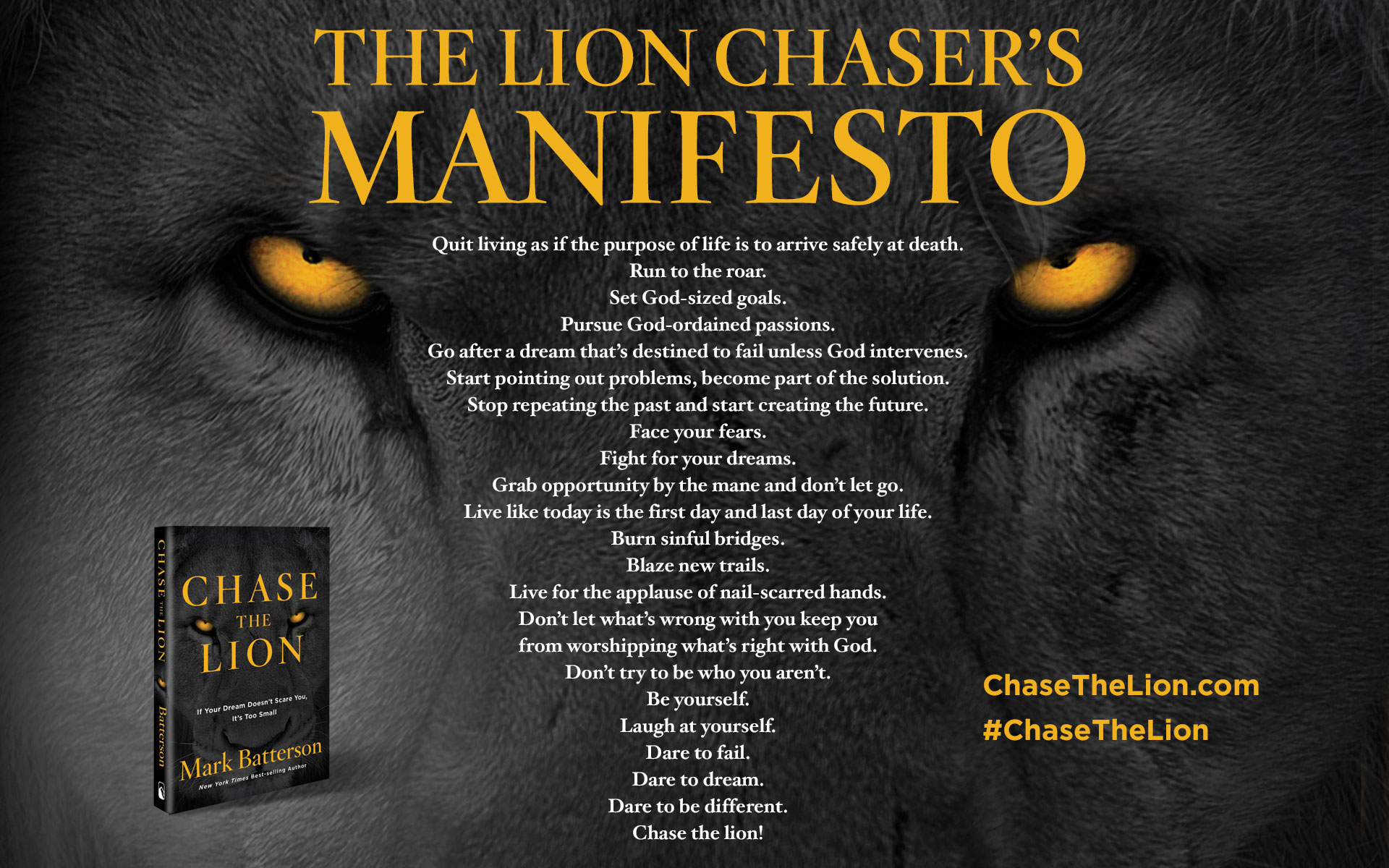
Just started reading Chase The Lion by Mark Batterson. Already hooked at this opening page!

Lion Chaser's ManifestoQuit living as if the purpose of life is to arrive safely at death.

Run to the roar.
Set God-sized goals. Pursue God-given passions.
Go after a dream that is destined to fail without divine intervention.
Stop pointing out problems and become part of the solution.
Stop repeating the past and start creating the future.
Face your fears. Fight for your dreams.
Grab opportunity by the mane and don’t let go!
Live like today is the first day and last day of your life.
Don’t let what’s wrong with you keep you from worshiping what’s right with God.
Don’t let fear dictate your decisions.
Burn sinful bridges. Blaze new trails.
Live for the applause of nail-scarred hands.
Don’t try to be who you’re not.
Be yourself. Laugh at yourself.
Dare to dream God-sized dreams. Dare to be different.
Quit holding out. Quit holding back. Quit running away.
Chase the lion.

9 More Quotes From “Today’s Moment Of Truth”

Today's Moment Of TruthToday’s Moment Of Truth by Lee Strobel and Mark Mittelberg is so chockfull of helpful truths that I couldn’t possibly have shared all of the passages I highlighted. Here are a few more quotes I wanted to share with you:

“Jesus said, ‘Do not believe Me unless I do the works of My father. But if I do them, even though you do not believe Me, believe the works, that you may know and understand that the Father is in Me, and I in the Father’ (John 10:37-38). And Jesus did the miraculous works He referred to. Even the Pharisee Nicodemus conceded, ‘Rabbi, we know that You are a teacher who has come from God. For no one could perform the signs You are doing if God were not with Him’ (John 3:2).

“We can see such confirmation repeatedly in the lives of Jesus and the biblical prophets. But it never happened in the life of Mohammad, the founder of Islam. Mohammad believed Jesus was a prophet who performed miracles, including raising the dead. Muslims also believe Moses and Elijah performed miracles.

“However, according to the Qur’an, when unbelievers challenged Mohammad to perform a miracle, he refused. He merely said they should read a chapter in the Qur’an (Surah 2:118; 3:181-184; 4:153; 6:8, nine, 37).

“So, unlike Jesus, Mohammad never did miracles. It wasn’t until approximately 150 to 200 years after Mohammad’s death that some of his followers begin to come up with stories of miracles and ascribe them to him.” —Lee Strobel & Mark Mittelberg 

“There are two major competing worldviews to Christian theism—atheism and pantheism…. The problem with atheism is that, with its denial of God’s existence, there’s a loss of any ultimate moral basis by which to declare something good or evil. So atheists are left without any objective standard by which to judge something as being right or wrong. Instead, they’re left with mere preferences. I have mine. You have yours. Rape and murder may not be my cup of tea, but they maybe somebody else’s. And who are we to say that what others choose to do is wrong? [We are] not saying an atheist cannot live a moral life; we are saying that an atheist cannot define what morality is. ….

“If everything is part of god [as in pantheism], then what we call evil is actually part of that god as well. … This is the very god, or ultimate reality, that Eastern philosophy says we’re supposed to strive to become more like and eventually to become one with. This presents a tremendous problem: we’re supposed to join with the very entity that contains evil within itself!” —Lee Strobel & Mark Mittelberg

“Revering Christ as Lord and being prepared to defend our faith are ongoing processes in the Christian life. … It’s interesting that in the original Greek, the word Peter used for answer is apologia [1 Peter 3:15], from which we get our word apologetics. It literally means we are to be ready to give a speech of defense—a well-thought-out account of why our faith in Christ makes sense. … With God’s help we can present information that will remove intellectual barriers, helping people move one step closer to faith in Christ.” —Lee Strobel & Mark Mittelberg

“In 2 Chronicles 7, God says if Israel’s sin reaches a certain level, He’ll destroy the temple, exile the people, and leave them in a state of judgment. Sure enough, this comes to pass. The prophet Daniel prays in Daniel 9 that God would have mercy. God gives him a revelation about the temple being rebuilt. Before this new temple is destroyed, Daniel is told, several things are going to take place, including the bringing of everlasting atonement—the final dealing with sin.

“The prophet Haggai says the glory of the second temple will be greater than the glory of the first temple. God will fill the second temple with His glory. Then the prophet Malachi says the Lord will come to His temple. He uses a Hebrew term that always refers to God Himself: the Lord—He will come to that temple.

“Keep in mind the second temple was destroyed in AD 70. Atonement for sin had to be made and the divine visitation had to take place before the second temple was destroyed.

“So … if it’s not Yeshua, the Jewish name for Jesus, then throw out the Bible, because nobody except Him accomplished what needed to be done prior to AD 70. What divine visitation did take place if not for Yeshua? When else did God visit the second temple in a personal way? How else was the glory of the second temple greater than the first?

“Either the Messiah came two thousand years ago, or the prophets were wrong and we can discard the Bible. But they weren’t wrong. Yeshua is the Messiah—or nobody is.” —Michael Brown, a messianic Jew

“Even nonreligious people live in the trust that their nonreligious beliefs are accurate and that they won’t someday face a thoroughly religious Maker who actually did issue a list of guidelines and requirements that they failed to pay attention to.” —Mark Mittelberg 

“There can be no doubt that archaeology has confirmed the substantial historicity of Old Testament tradition.” —William F. Albright

“The noted Roman historian Collin J. Hemer, in The Book Of Acts In The Setting Of Hellenistic History, shows how archaeology has confirmed not dozens, but hundreds and hundreds of details from the biblical account of the early church. Even small details have been corroborated, like which way the wind blows, how deep the water is a certain distance from the shore, what kind of disease a particular island had, the names of local officials, and so forth.

“Now, Acts was authored by the historian Luke. Hemer gives more than a dozen reasons why Acts had to have been written before AD 62, or about thirty years after Jesus’ crucifixion. Even earlier, Luke wrote the Gospel of Luke, which is substantially the same as the other biblical accounts of Jesus’ life.

“So here you have an impeccable historian, who has been proven right in hundreds of details and never proven wrong, and it’s written within one generation while eyewitnesses were still alive and could have disputed it if it were exaggerated or false.” —Norman Geisler 

“No Book of Mormon cities have ever been located, no Book of Mormon person, place, nation, or name has ever been found, no Book of Mormon artifacts, no Book of Mormon scriptures, no Book of Mormon inscriptions,…nothing which demonstrates the Book of Mormon is anything other than myth or invention has ever been found.” —John Ankernerg and John Weldon

“Jesus did exist, whether we like it or not.” —Bart Ehrman, an agnostic

If you would like to read the first set or quotes from this book, please click here.

You can check out my review of Today’s Moment Of Truth here.

And to read some of the other quotes I’ll be sharing from this book, be sure to follow me on Tumblr and Twitter.

The Gospels Side-By-Side (book review)

Gospels Side By SideI love reading. But hands-down, without a doubt, my favorite book to read is the Bible. So I’m always intrigued by any resource that can help me get more out of my time in the Scriptures. In The Gospels Side-By-Side by Rose Publishing, I found a goldmine.

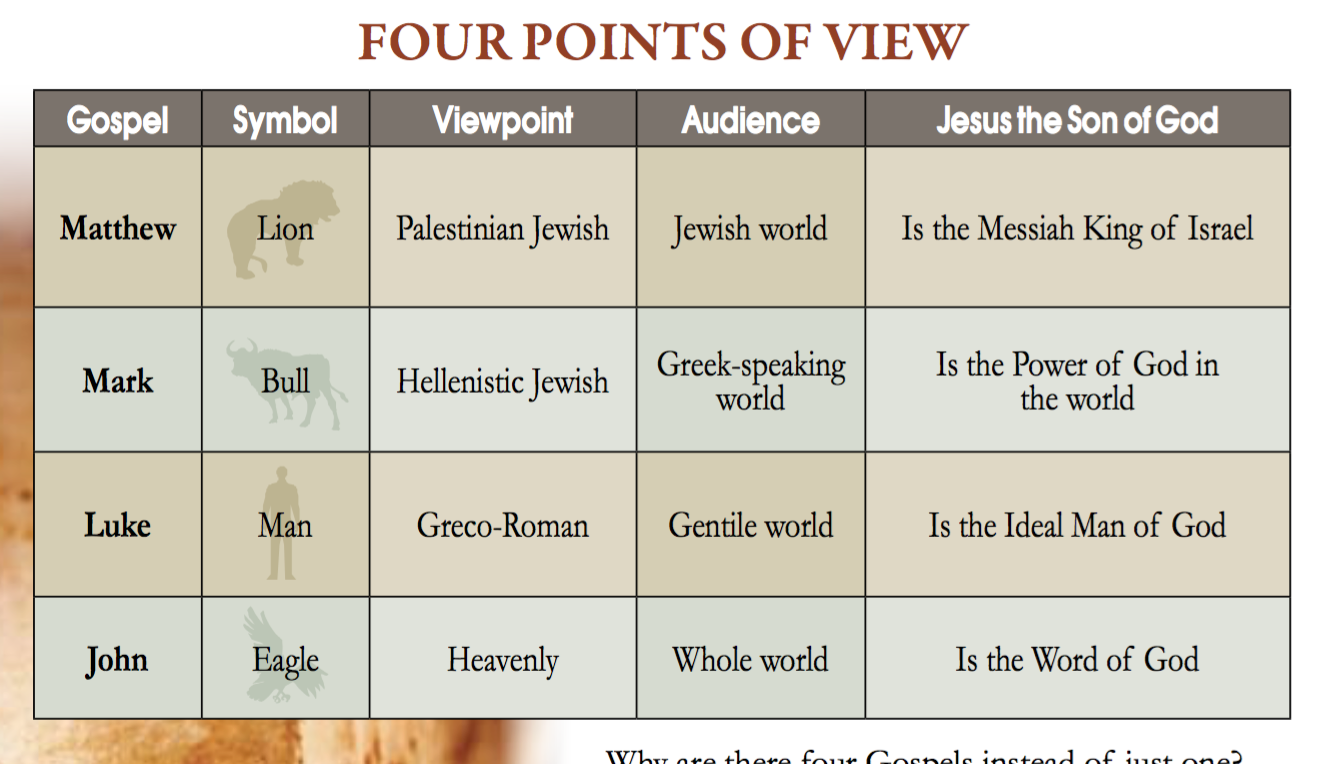
This short pamphlet is chockfull of graphics, charts, maps and historical background information  that helped me see the bigger picture of the story of Jesus that the Gospel writers were conveying to us. It begins with the unique perspective of each Gospel writer, and launches us deeper into the Bible from there.

In this book you will see things like:

  • The events of Christ’s life, and which Gospel tells particular events
  • The miracles of Jesus
  • The parables of Jesus
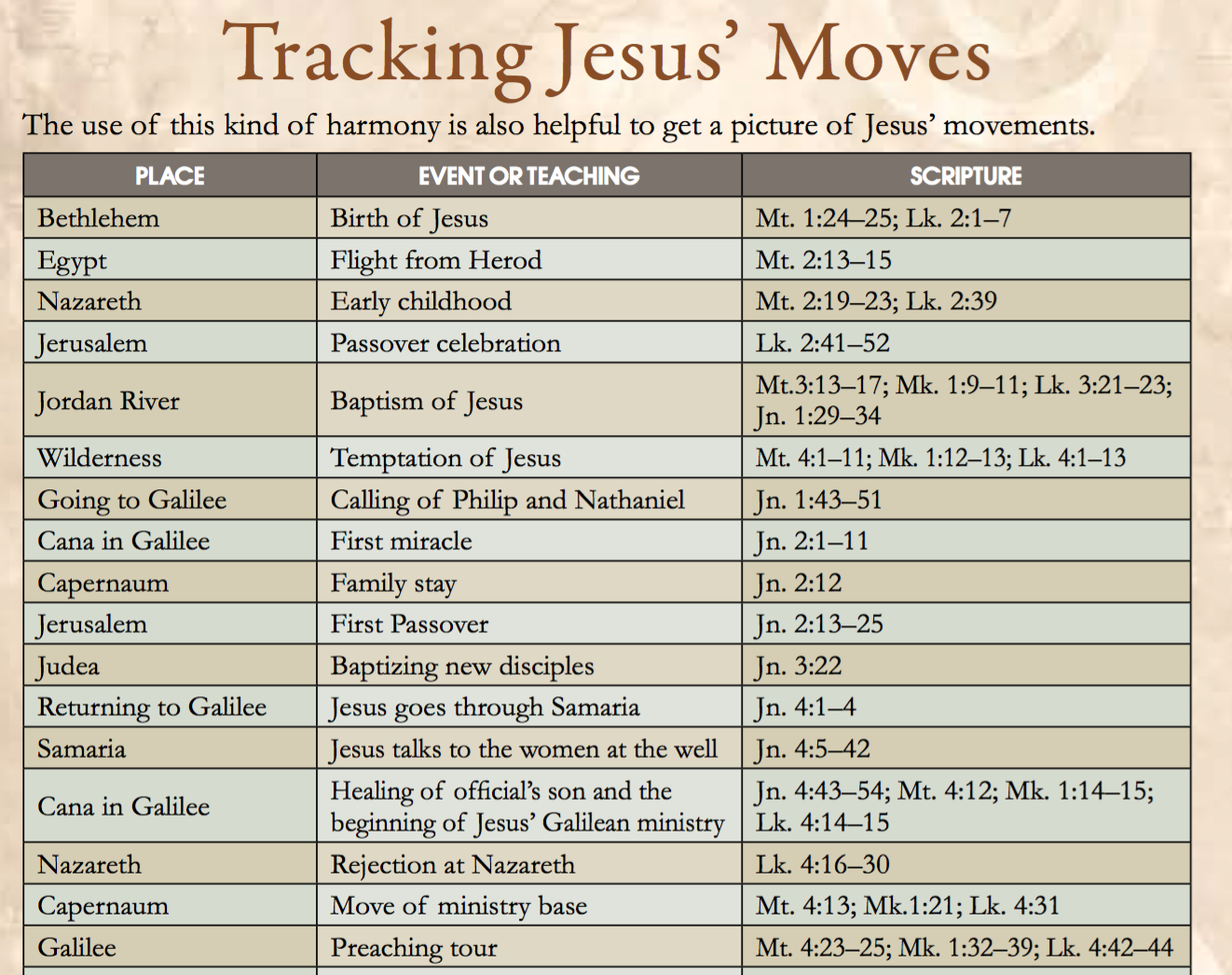
  • The chronological movements of Jesus
  • How Jesus celebrated Passovers during His public ministry
  • How these biblical biographies compare to other biographies of the era
  • Even the historical harmony of the Gospel message in the post-apostolic age

This should bring new life to any Bible student’s reading time! I highly recommend you check out not only this pamphlet, but many of the other resources available at Rose Publishing.

Here are a couple of screenshots from the book…


Screen Shot -Christ's movesScreenshot - gospel writers

4 Tips For Making Better Goals

1 Corinthians 10.31I have noticed a lot of similarities between the September back-to-school rush, and New Year’s Day. Except instead of resolutions, in the fall most people set new goals, or try to readjust their schedules to take advantage of a new season.

This is an excellent idea, and the perfect time to do it.

In a psalm written by Moses, he tells us to understand the value of our days, and be as wise as we can with what we do with each day God has given us (Psalm 90:12).

The Apostle Paul echoes these thoughts:

Be very careful, then, how do you live—not as unwise but as wise, making the most of every opportunity, because the days are evil. Therefore do not be foolish, but understand what the Lord’s will is. (Ephesians 5:15-17)

One way for us to make the most of every day is to wisely set some goals. Here are four tips that I’ve discovered to help me.

(1) The fewer the goals, the better.

Craig Groeschel said, “To do more things, do less things better.” I totally agree. I would suggest limiting yourself to just 1-2 goals at a time. Then put these one or two goals on your calendar first. In other words: Don’t prioritize your schedule, but schedule your priorities.

(2) Don’t fall into the sacred/secular trap.

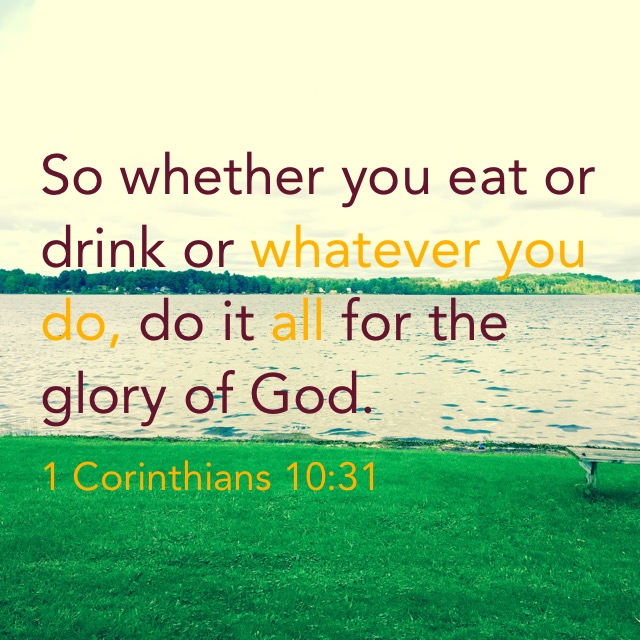
So many people—even Christians—think that there are spiritual goals and non-spiritual goals. But the Bible says, “So whether you eat or drink or whatever you do, do it all for the glory of God” (1 Corinthians 10:31). Every goal you set is a spiritual goal, because every goal should help you live your life wisely, in a way that honors and glorifies God.

(3) Make your goals S.M.A.R.T.

You may have heard these before, but I really like to use them. Make your goals:

  • Specific—not “I want to eat better” but “I want to eat two servings of fruits or vegetables each day.”
  • Measurable—have a way to track your progress toward your goal. How many pages did you read? how many calories did you eat? how many minutes did you work out?
  • Achievable—don’t set a goal to run 5 miles a day if you’ve only been a couch potato. Ramp your goals up little by little in a way that’s achievable for you.
  • Relevant—I like to ask a “so that?” question about each of my goals in make sure it’s moving me forward. “I want to exercise for 20 minute three times per week, so that my blood pressure comes down, so that I can live medicine-free, so that I can….” I think you get the idea. Keep going to make sure your goal is relevant for your life.
  • Time to review—set a date to revisit your goals and see if you need to adjust anything.

(4) Make a “stop doing” list.

You cannot do everything, so focus on the important, not the urgent. And remember not everything can stay on your calendar. For instance, if you want to read more in the evenings, you may have to eliminate some TV time; if you want to exercise in the mornings, you may have to eliminate that second cup of coffee.

Just a couple of verses after Moses challenges us to make the most of every day God has given us, he asks God for His helpMay the favor of the Lord our God rest upon us; establish the work of our hands for usyes, establish the work of our hands.

May God give you wisdom as you make new goals, and may He bless the work of your hands as you implement your new strategies.