According to Romans 12, all Christians have been given a unique gift package by God. We are to use these motivational gifts to make God’s Kingdom more visible and more desirable.
This week we discuss the gifts of teaching and exhortation. You may download the participant’s notes and the gifts assessment I use in this lesson:
This is a weekly series with things I’m reading and pondering from Charles Spurgeon. You can read the original seed thought here, or type “Thursdays With Spurgeon” in the search box to read more entries.
Listen to the podcast of this post by clicking on the player below, and you can also subscribe on Apple, Spotify, or Audible.
This Bible Is God’s Bible
Here lies my Bible—who wrote it? I open it, and I find it consists of a series of tracts. The first five tracts were written by a man called Moses. I turn on and I find others. Sometimes I see David is the penman, at other times, Solomon. Here I read Micah, then Amos, then Hosea. As I turn further on, to the more luminous pages of the New Testament, I see Matthew, Mark, Luke, and John, Paul, Peter, James and others. But when I shut up the Book, I ask myself who is the author of it?
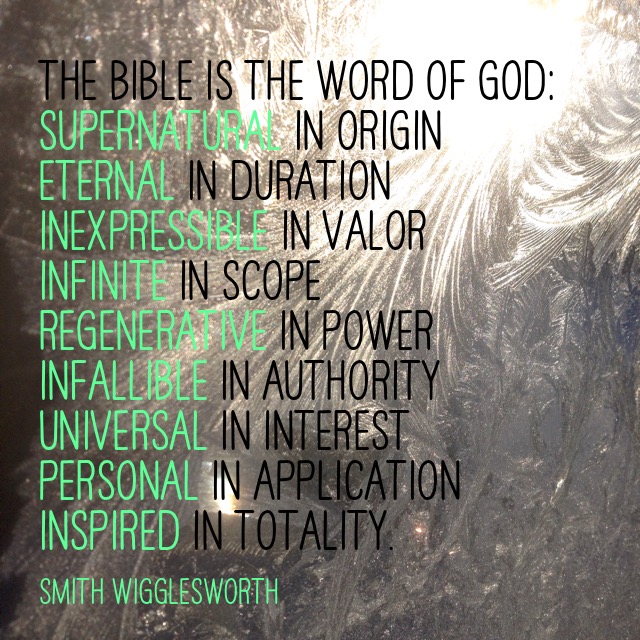
Do these men jointly claim the authorship? Are they the compositors of this massive volume? Do they between themselves divide the honor? Our holy religion answers, ‘No!’ This volume is the writing of the living God. Each letter was penned with an Almighty finger. Each word in it dropped from the everlasting lips; each sentence was dictated by the Holy Spirit. Albeit that Moses was employed to write his histories with his fiery pen, God guided that pen. It may be that David touched his harp and let sweet Psalms of melody drop from his fingers, but God moved his hands over the living strings of his golden harp. It may be that Solomon sang canticles of love, or gave forth words of consummate wisdom, but God directed his lips, and made the Preacher eloquent. If I follow the thundering Nahum when his horses plow the waters, or Habakkuk when he sees the tents of Cushan in affliction, if I read Malachi, when the earth is burning like an oven, if I turn to the smooth page of John, who tells of love, or the rugged, fiery chapters of Peter, who speaks of the fire devouring God’s enemies; if I turn to Jude, who launches forth anathemas upon the foes of God, everywhere I find God speaking. It is God’s voice, not man’s. The words are God’s words, the words of the Eternal, the Invisible, the Almighty, the Jehovah of this earth. This Bible is God’s Bible.
From The Bible
I love God’s Book! I hope you love it and love is Author more and more.
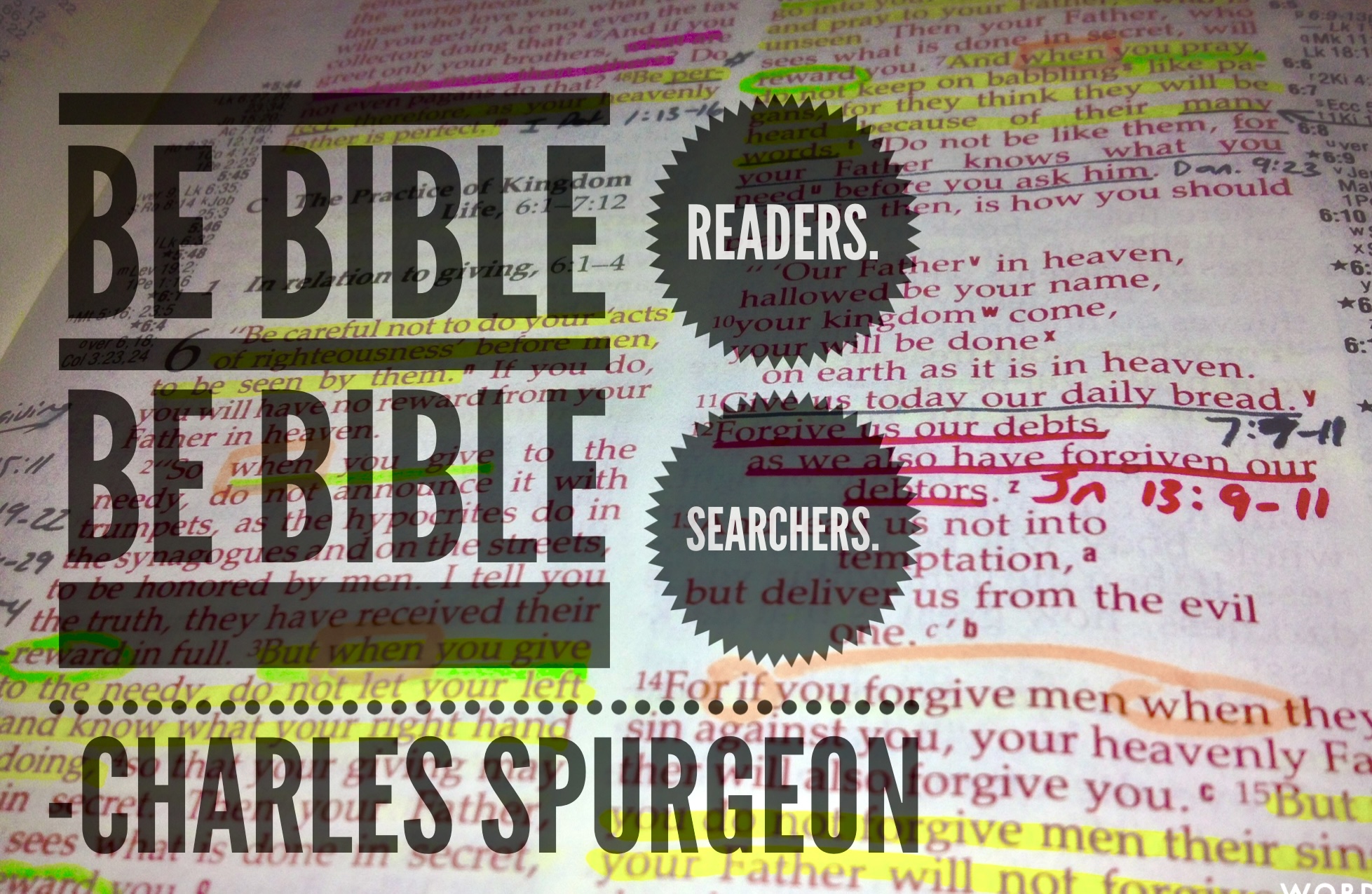
One final word from Charles Spurgeon: “Be Bible readers. Be Bible searchers.”
The problem becomes very challenging when non-biblical issues are given biblical status, and as a result, people begin to respond in a decidedly unbiblical way.
In a recent talk that I gave to some ministry interns, I unpacked this idea in more depth.
Jeff asked me what was different for our church during the pandemic shutdowns. I explained to him how our season of change had begun long before anyone was even talking about a coronavirus.
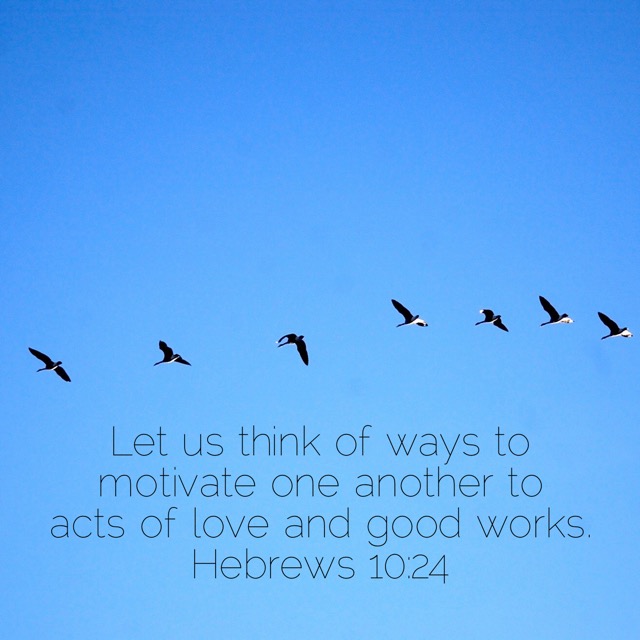
Of course one of the big things in my personal life during the last year was authoring a #1-selling book called Shepherd Leadership: The Metrics That Really Matter. As I commented to Jeff, those “let us” phrases in the Book of Hebrews so struck me that I wrote about it in my book.
Have you noticed that the word “saints” in the New Testament is always in the plural, never the singular? That’s because we need each other to bring out the saintly qualities in each other. This is why the writer of Hebrews stresses the camaraderie of “let us” so many times (Hebrews 10:22–25). I’ve found that many shepherd leaders tend to isolate. They are so involved in their own pasture of ministry that they seldom make the time to interact with other shepherds. In fact, isolation is one of the devil’s favorite tactics. I encourage you to find friends—fellow saints—who are also committed to healthy spiritual growth and avail yourself of their friendship and insight. —an excerpt from the chapter ‘Four Elements to Optimal Spiritual Health’
“Let us” be the church wherever God places us and however He chooses to use us.
I’ll be sharing more clips from this 200churches interview soon, so please stay tuned. Shepherd Leadership: The Metrics That Really Matter is available in print or ebook, and in audiobook through either Audible or Apple.
Listen to the podcast of this post by clicking on the player below, and you can also subscribe on Apple, Spotify, or Audible.
A father came home from work and noticed a note addressed to him taped to his teenage son’s door:
Dear Dad,
Jason and I borrowed Mom’s car to go to Taco Bell. I know I didn’t have permission, but I thought we’d be back before you and Mom got home. Unfortunately, I hit a pothole and blew out the front right tire.
We jacked up the car to put on a spare tire, but the jack slipped and the car rolled backward into the ditch.
Bill came with his pickup to pull us out, but the tow strap pulled off the front bumper and the car rolled further down the hill and sunk in the pond.
I bought a bus ticket to get out of town and go enlist in the Army. Give Mom a hug and I’ll see you both in about 2 years.
Love, your son
P.S. None of the above is true. Mom took her car to Aunt Jan’s house and I rode my bike to Jason’s house. However, I hope the fact that none of these bad things actually happened will help you put in perspective the D+ on my report card.
We like to manage expectations, don’t we? We frequently deliver bad news with the good news close by.
Psalms 88 and 89 are written by brothers: both of them are called Ezrahite, and both of them were worship leaders in the tabernacle. And until Solomon, these guys were considered the wisest in the land (1 Chronicles 2:6; 15:19; 1 Kings 4:29-34).
I believe these two psalms form a couplet. They make up the last two psalms of Book III in the Psalter, with Psalm 89 ending with, “Amen and Amen.” Both of them label their psalms a maskil which means “a poem of contemplation” (NKJV). And look how Psalm 88 leaves us in the dark, while Psalm 89 shines a light in the dark.
In Psalm 88, Heman soberly prepares us for his two-Selah psalm in his introductory remarks. He uses a phase mahalathleannoth which means someone who is so physically weak from emotional grief that they are now battling depression. The NLT calls it “the suffering of affliction.”
Heman is describing a reality: We will all experience pain in this life. Maybe even for our entire earthly life—from my youth I have been afflicted and close to death (v. 15). Heman’s reality is seen in his words in the first five verses of this psalm.
His first Selah is breathtaking because he wants us to pause to realize that God has allowed all of this (notice the pronoun You in vv. 6-8, 16-18). But still, Heman knows God saves because he has made a decision to continue to praise Him even in the dark times (vv. 1-2, 9, 13).
Heman’s second Selah comes in the middle of a series of five questions (vv. 10-14) that sound a lot like both questions Jesus asked in Gethsemane and from the Cross, and the reality of the temporary darkness He was facing (Psalm 22:1-2; Luke 22:53; John 19:11).
Even the way Heman closes his psalm foreshadows the darkness surrounding the death of Jesus: “My God, My God, why have You forsaken Me?”
Psalm 88 shows us the reality of temporary darkness (like Good Friday), but Psalm 89 points us to the certainty of eternal light (like Resurrection Sunday)!
So when you are battling your dark times, let me give you these assurances:
I thought this was brilliant insight from the weekly Cultural Translator newsletter from Axis—
In the Q&A portion of one of his lectures, Jordan Peterson was asked about his thoughts on abortion. At one point he said, “The discussion regarding the legality of abortion is nested inside a larger discussion about the morality of abortion, and that’s nested inside a larger discussion about the proper place of sexuality in human behavior. And to me, that’s the level at which the problem needs to be addressed.” Although he doesn’t offer specific prescriptions about how to do that, it’s a helpful way to position the conversation.
In many people’s minds, sex is appropriate whenever the parties involved consent to it. In this view, sexual activity outside of marriage becomes a foregone conclusion. Abortion is then regarded as a necessary adaptation for this new undeniable sexual ethic. In that same Q&A, Peterson says, “Let’s say you are in a position where you are inclined to seek an abortion. The question is: how did you get there?” The literal answer for 99% of pregnant women is via voluntary sexual intercourse—but when our culture frames “sexual expression” as an inevitability, it can seem hard to envision other safe paths forward apart from abortion.
For some, it’s too late to think proactively. Along those lines, one of the primary pro-choice arguments has been that having children too soon will plunge parents into permanent poverty. But when the church is at its best, it has rallied together to provide for those who could not provide for themselves. Acts 2:44-45 says about the early church, “All the believers were together and had everything in common. They sold property and possessions to give to anyone who had need.” Other ancient sources record that the early church was known for saving and protecting unwanted children, who were sometimes left outside to die.
Although some may frame “celebrating the Supreme Court’s decision” and “thinking about how to be more holistically pro-life” as somehow in tension, the early church models both a care for babies and for their mothers. May God give us grace to do the same.
The 1440 Daily Digest had an interesting article for the July 4th weekend entitled “Happy Birthday, America.”
Congratulations, America—Monday marks the 246th commemoration of the day the Declaration of Independence was adopted by the Second Continental Congress. The Congress actually voted to separate from Great Britain two days earlier, and possibly didn’t sign the document until August. Some argue the US didn’t really become a country until we began operating under the Constitution in 1789.
Still, since then, the country has grown from 13 colonies with about 2.5 million people to 50 states and 14 territories with a population of more than 330 million. The economy has swelled to roughly $24T. Advances in public health—public sanitation, the germ theory of disease, and more—have cut the child mortality rate from more than 45% to under 1%, and our citizens live 35 years longer on average.
We’ve built almost 4 million miles of paved roads and more than 5,000 public airports. More than 2.7 million miles of power lines electrify the country, with about 85% of households having access to broadband internet and 92% having at least one computer. In 1800, 95% of the population lived in rural areas, and now about 83% live in urban areas. The US has also been responsible for more than 800 human visits to space—the most of any other country with a space agency.
While there will always be challenges to face and improvements to make, we’ve come a long way since the beginning. So grab a hot dog and your drink of choice—here’s to the next 246 years.
“The measure of a country’s greatness is its ability to retain compassion in times of crisis.” —Thurgood Marshall
According to Romans 12, all Christians have been given a unique gift package by God. We are to use these motivational gifts to make God’s Kingdom more visible and more desirable.
This week we discuss the gifts of teaching and exhortation. You may download the participant’s notes and the gifts assessment I use in this lesson:
This is a weekly series with things I’m reading and pondering from Charles Spurgeon. You can read the original seed thought here, or type “Thursdays With Spurgeon” in the search box to read more entries.
Listen to the podcast of this post by clicking on the player below, and you can also subscribe on Apple, Spotify, or Audible.
God Means What He Says
…For the mouth of the Lord has spoken (Isaiah 1:20).
You talk about God as being ‘love,’ and if you mean by this that He is not severe in the punishment of sin, I ask you what you make of the destruction of Jerusalem? Remember that the Jews were His chosen nation and that the city of Jerusalem was the place where His temple had been glorified with His presence. Brethren, if you roam from Edom to Zion and from Zion to Sidon and from Sidon to Moab, you will find, amid ruined cities, the tokens that God’s words of judgment are sure. Depend on it, then, when Jesus says, ‘These will go away into everlasting punishment’ (Matthew 25:46), it will be so. When He says, ‘If you do not believe that I am He, you will die in your sins’ (John 8:24), it will be so. …
It is of no avail to sit down and draw inferences from the nature of God and to argue, ‘God is love, and therefore He will not execute the sentence upon the impenitent.’ He knows what He will do better than you can infer. He has not left us to inferences, for He has spoken pointedly and plainly. He says, ‘He that believes not shall be damned’ (Mark 16:16), and it will be so, ‘for the mouth of the Lord has spoken.’ Infer what you like from His nature. But if you draw an inference contrary to what He has spoken, you have inferred a lie and you will find it so. …
I know why you do not believe in the terrible threats. It is because you want to be easy in your sins. … Yet if you do not believe its loving warnings nor regard its just sentences, they are true all the same. If you dare its thunders, if you trample on its promises, and even if you burn it in your rage, the Holy Book still stands unaltered and unalterable. ‘The mouth of the Lord has spoken.’ Therefore, I pray you, treat the sacred Scriptures with respect and remember that ‘these are written that you may believe that Jesus is the Christ, the Son of God, and that believing you might have life through His name’ (John 20:31).
From The Infallibility Of Scripture
Spurgeon delivered this sermon on March 11, 1888. Nearly 2000 years earlier, Asaph delivered a similar message from God—
“Call upon Me in the day of trouble; I will deliver you, and you shall glorify Me.” But to the wicked God says: “What right have you to declare My statutes, or take My covenant in your mouth, seeing you hate instruction and cast My words behind you?When you saw a thief, you consentedwith him, and have been a partaker with adulterers. You give your mouth to evil, and your tongue frames deceit. You sit and speak against your brother; you slander your own mother’s son.These things you have done, and I kept silent; you thought that I was altogether like you; but I will rebuke you, and set them in order before your eyes. Now consider this, you who forget God, lest I tear you in pieces, and there be none to deliver:Whoever offers praise glorifies Me; and to him who orders his conduct aright I will show the salvation of God.” (Psalm 50:15-23)
Commenting on this passage from Psalm 50, T.M. Moore wrote, “Surely, this is the most fundamental error of thinking humans ever make: To think of God, spiritual things, worship, human life, the world, and everything else from our vantage point rather than His. … Asaph could see what was happening. And even though the nation was safe, strong, and surfeited with wealth, he knew that, spiritually, things were going awry. The people had persuaded themselves that God was just like them, that He thought like they did, and so was agreeable to their doing things their own way, indulging all their base desires, and pursuing their schemes for success—all the while continuing an outward show of faith.”
Let us take the Bible as what it truly is: Words the mouth of God has spoken. Let us not play games with them, changing the message to words we like. But if the Word of the Lord makes us uncomfortable, let us repent and return to Him. It is those who accept God’s Word as His Word, and obey it, that will see the salvation of God.
Listen to the podcast of this post by clicking on the player below, and you can also subscribe on Apple, Spotify, or Audible.
God had a rather simple message for Ezekiel, “The word of the Lord came to me: ‘Son of man, speak to your people’” (Ezekiel 33:1–2).
I find that pronoun “your“ intriguing because you would think that God would say, “My people.” They are indeed God’s people, but God had set Ezekiel apart as His watchman (vv. 7–20), so Ezekiel had to take personal responsibility for the people. They were to be treated and spoken to as though they were indeed his people.
This idea of responsibility gets a little tricky for some leaders because, with the responsibility to their people, they usually feel they are accountable to their people as well.
But in the next few verses, God makes it clear that Ezekiel must be accountable to God alone.
Responsible to his people. Accountable to his God.
When we start feeling we are accountable to people, we can get distracted, discouraged, or derailed by their unpleasant responses.
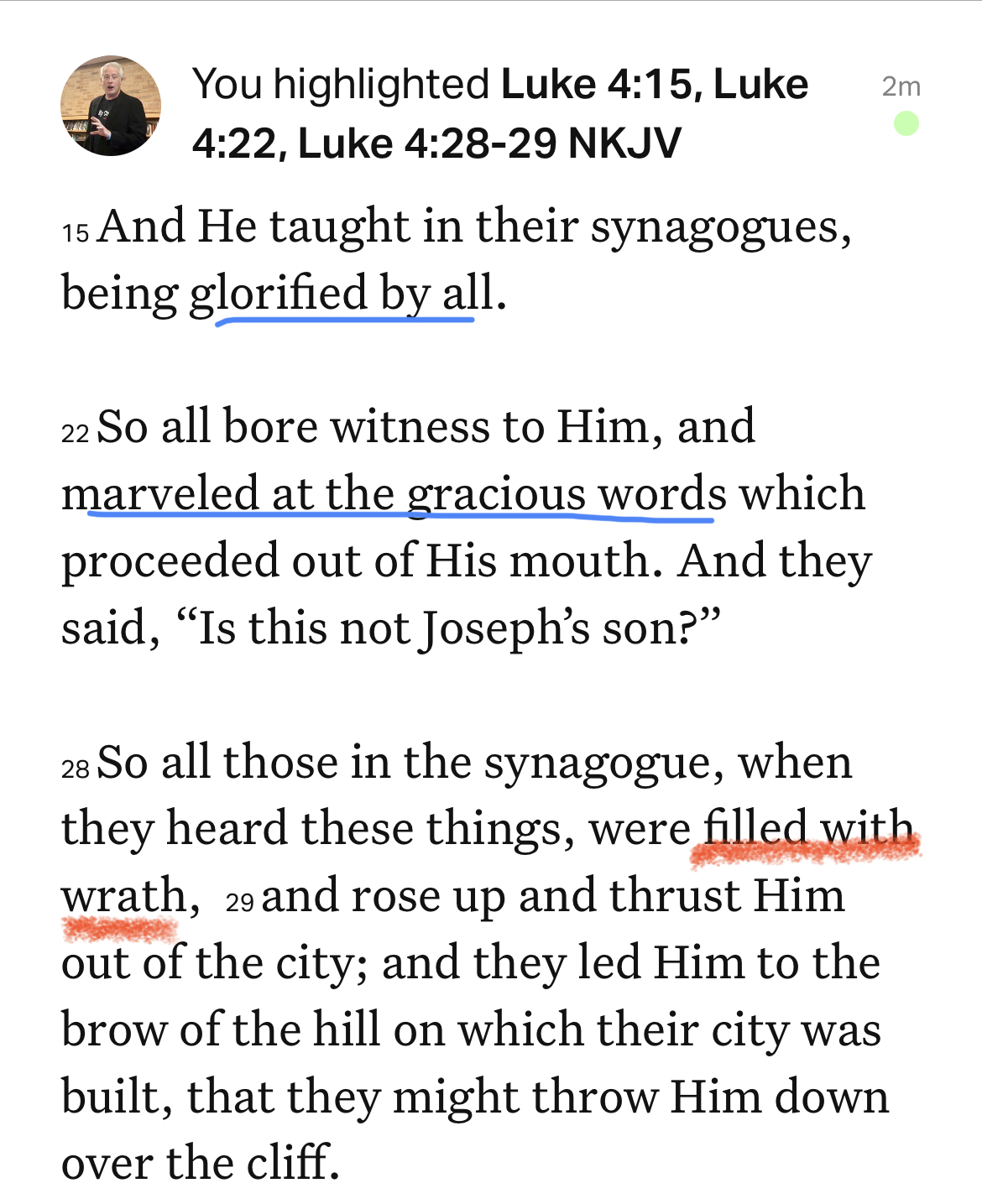
Notice that when Jesus spoke pleasing words to people, everyone spoke well of Him. But when He pointed out to them the words of God they were ignoring, they were ready to kill Him.
People are fickle—they sing praises when they hear those words they like, and they are ready to attack the messenger when the words are upsetting.
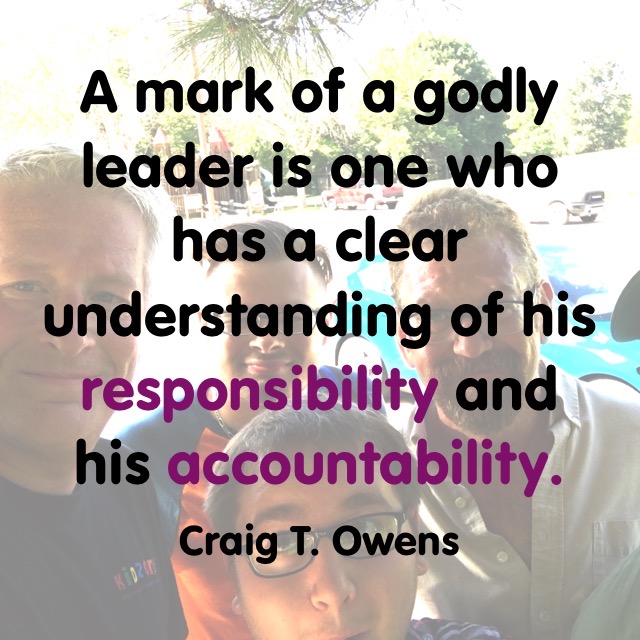
A mark of a godly leader is one who has a clear understanding of his responsibility and his accountability.
When you are God’s leader, He will entrust people to your care and He will entrust His message for those people to you. You are now responsible to deliver His message to your people. You are then accountable to God alone for delivering His message. Be responsible to people, accountable to God, and be careful not to mix the two.
This is part 66 in my series on godly leadership. You can check out all of my posts in this series by clicking here.
[3:20] Leaders look for ways to honor those around them
[3:48] Can you honor too much?
[4:29] How can we honor our parents and grandparents?
[5:13] Greg has a book releasing soon called Sage Advice
[9:44] Greg explains that application is the real compliment
[10:36] Honor starts with noticing others and then expressing what was noticed
[11:49] Honoring calls out great potential in others
[12:32] What does it mean to “trust the person with a limp”?
[14:15] Honor is for people who gave, not for people who received
[15:28] Why is hard for leaders to acknowledge the success of others?
[16:27] Leaders need to looking around for opportunities to honor others
[17:11] Hand out compliments publicly for maximum effect
[17:55] Leaders receive honor by first honoring others
[19:45] Our leadership challenge to you
Check out this episode and subscribe on YouTube so you can watch all of the upcoming episodes. You can also listen to our podcast on Spotify and Apple.



 According to Romans 12, all Christians have been given a unique gift package by God. We are to use these motivational gifts to make God’s Kingdom more visible and more desirable.





 Craig T. Owens