Listen to the podcast of this post by clicking on the player below, and you can also subscribe on Apple, Spotify, or Audible.
Heartfelt prayer is never a meaningless exercise. Without exception, something is changed with every single prayer we offer to God. Last week, we talked about how prayer changes our attitude.
Here’s an important question: What do you expect is going to happen when you pray? Or maybe we should ask the question the opposite way: What do you expect is going to happen when you don’t pray? The writer of Hebrews talks about our expectation in coming to God (Hebrews 11:6).
Recall that last week that we used the word “attitude” as a pilot understands it; that is, the direction of the nose of the plane takes the rest of the plane and all its passengers up or down. The same thing is true of our expectation in prayer: it also impacts those around us.
There was a father that comes to Jesus with a heavy burden on his heart: his demonically-afflicted son (Mark 9:14-18). The man came in a posture of prayer (Matthew 17:14-15) only after he had first gone to the followers of Jesus, but they could not heal this boy.
Why? I don’t think they expected that they could ask for God’s power to be released. How sad! Look at what they had already experienced:
the miraculous feeding of the 4000 (Mark 8)
a deaf and mute man healed (Mark 7)
Jesus walking on the water and feeding 5000 people (Mark 6)
Jairus’ daughter raised to life (Mark 5)
And probably most shocking of all, they themselves had been used by God to heal people—“They went out and preached that people should repent. They drove out many demons and anointed many sick people with oil and healed them” (Mark 6:12-13).
Jesus calls His disciples an “unbelieving generation” (9:19). Some translations use the word “faithless” (like the NKJV and NLT). The Greek word here is a- (without) + -pistos (faith) = apistos. Literally translated it means without trust in God.
Bu I think maybe Jesus was really saying, “O unexpecting generation!”
Their lack of expectation negatively impacted the praying father. He originally came in faith for healing, but now he says to Jesus, “If You can” (Mark 9:20-22).
Jesus calls on this father to banish the “if” (vv. 23-24). At the word of Jesus, the father’s expectation changes, he believes for a miracle, and the miracle happens (vv. 25-27)!
The disciples wanted to know how to banish the “if” from their hearts, and Jesus gives them an interesting answer in vv. 28-29. He tells them to pray. We are supposed to pray in faith, but that faith comes as we pray (Matthew 17:19-21). Other New Testament writers bring this out as well: James tells us the prayer offered in faith is effective (James 5:15), and Paul tells us to be faithful—or faith-filled—in our praying (Romans 12:12).
Does this sound circular? It is a beautifully circular thing!
Abdu Murray said, “Hope is a positive expectation of a desired future event. Faith is trusting in the One who promised to make that event happen.”
It was the word of Jesus that raised the expectation of the father, that gave him the spark of faith (Hebrews 11:1; Romans 10:17). Then he used that faith to raise his expectation of a miracle from God.
Go back to the biblical record or even your own personal history to see what God has already done. Let the word of Jesus ignite your expectations—let that word raise your expectations!—and then cling to His word as you pray in faith.
Faith fuels your prayer, and prayer fuels your faith. So we need to remain on the lookout for opportunities to pray for ourselves and others (Colossians 4:2).
Let me return to the opening question: What do you expect is going to happen when you pray? If your expectation is too low, start by praying, “God, forgive us of expectations of You that are too low!” Be humbly bold enough to admit, “I do believe, but help my unbelief.” Then when you hear the word of faith, expect the miracle through that faith. The longer you pray, the more you need to include a prayer for your own faith to remain expectant.
The God who gives you faith wants to reward that faith. Let prayer raise your expectations as you continually banish the “if”!
If you have missed any of the other messages in our series Prayer Changes Things, you can find them all by clicking here.
“I love to think of nature as unlimited broadcasting stations, through which God speaks to us every day, every hour and every moment of our lives, if we will only tune in and remain so.” —George Washington Carver
J. Warner Wallace writes, “Some object, saying, ‘Christians are biased.’ But there’s an obvious oversight here. Yes, Matthew ultimately became a Christian, but look closely at his background. He started out as a tax collector named Levi—not a member of John the Baptist’s group, not a friend of Peter or Andrew, not one who grew up expecting a Messiah. He encountered Jesus, witnessed miracles, listened to teaching, and after observing all these things firsthand, became a follower. Don’t hold his subsequent transformation against him as if it poisons the well. The fact that someone who wasn’t predisposed to belief chose to follow Christ after seeing what he saw lends real weight to the testimony.” Read more about how our judicial system vets courtroom witnesses.
Listen to the podcast of this post by clicking on the player below, and you can also subscribe on Apple, Spotify, or Audible.
The apostle Paul writes one of the simplest but most profound statements about Jesus the Christ in his letter to the church at Colosse. He said, “The Son is the image of the invisible God, the firstborn overall creation” (Colossians 1:15).
Actually, Paul may be quoting something even closer to the time of Christ’s resurrection from the grave. Verses 15-20 are thought by many scholars to be a Christian hymn that Paul is quoting. And what a profound song it is!
Notice that the definitive article “the” is prominent in this hymn, highlighting the unique and exclusive Person of Jesus. He is called—
the Son
the image of God
the firstborn over all creation
the head of the Body—the Church
the Beginning of all things
the Supreme One
Not only is Christ’s position exclusive and unassailable, His power is unrivaled—
He is over all creation because He created all things
He controls all things
He is before all things
He holds all things together
He has supremacy over all things
He possesses all the fullness of God
He alone can reconcile all things to Himself
Our human language runs out of words and phrases to describe this majestic King of kings, but I love when people try their best to paint a picture of this King. S.M. Lockridge did just that in a sermon entitled “That’s my King!” Check out this portion of this message—
He’s the greatest phenomenon that ever crossed the horizon of this world.
He’s God’s Son…
He’s a sinner’s Savior…
He’s the centerpiece of civilization… He stands in the solitude of Himself… He’s august and…
He’s unique…
He’s unparalleled…
He’s unprecedented…
He’s the loftiest idea in literature…
He’s the highest personality in philosophy…
He’s the supreme problem in higher criticism…
He’s the fundamental doctrine of true theology…
He’s the cardinal necessity for spiritual religion…
He’s the miracle of the age…
He’s the superlative of everything good that you choose to call Him… He’s the only one qualified to be an all-sufficient Savior…
And you may also want to check out a series of messages I shared on the Royal Psalms called All hail, King Jesus!
For in Christ lives all the fullness of God in a human body. So you also are complete through your union with Christ, who is the head over every ruler and authority. (Colossians 2:9-10 NLT)
Don’t ever stop getting to know this King more and more intimately for yourself. He wants you to see Him in all of His glory so that your life is unalterably changed.
Open your mouth for the people who cannot speak, for the rights of all the unfortunate. Open your mouth, judge righteously, and defend the rights of the poor and needy. (Proverbs 31:8-9)
✅ Open your mouth to speak up for others who don’t have a voice.
If you have been foolish in exalting yourself, or if you have plotted evil, put your hand on your mouth. (Proverbs 30:32)
🚫 Close your mouth to evil words or if you are trying to promote yourself.
Listen to the podcast of this post by clicking on the player below, and you can also subscribe on Apple, Spotify, or Audible.
In The Matrix, Neo is fascinated by a young man who appears to be bending spoons simply by looking at them. Neo sits down on the floor across from this young man and takes a spoon in his hand. Although young, this boy gives sage counsel to Neo, “Don’t try to bend the spoon, for that is impossible. Instead remember that there is no spoon. That way you will see that it is not the spoon the bends, but you are the one who bends.”
There is a nugget of truth here for anyone who has ever been face-to-face with an impossible situation. The God who does the “impossible” has offered us the means to see His omnipotence at work—He has told us that we can bring our impossibles to Him in prayer. Prayer changes things!
In God’s perfect will, sometimes the impossible is done before our very eyes, and sometimes we see that it is not the situation that bends, but it is we who bend, becoming more godly, wise, and mature because of what God has imparted to us. Heartfelt prayer is never a meaningless exercise. Without exception, something is changed with every single prayer we offer to God.
There are many of us who have experienced a miraculous answer to prayer. We prayed to God in a bitter season of our life and experienced His sweetness come to our rescue. These answered prayers are testimonies of God’s love and power.
Think about people you know who are struggling with the bitterness of life. I wonder: do they know that there is a sweetness that only God can bring? Brian Ridolfi noted, “Vinegar is not bitter to those who have not tasted honey.” Peter told us we are to crave more and more of God’s sweetness “now that you have tasted that the Lord is good” (1 Peter 2:2-3). This isn’t primarily for us, but it is to us and through us so that a watching world can recognize their bitterness as contrasted to the sweetness in our Savior.
One of the things prayer changes is my attitude about the things of God. When I say “attitude” I am referring to how an airplane pilot defines this term: The nose of the plane in relation to the horizon. If the attitude of the plane is up, the plane and all of its passengers are climbing.
There is a man we meet in the Gospels whose name means “whom God enlightens.” The answer to prayer he received was an attitude-changer for him, everyone around him, and his family. Check out his story in Luke 8:40-56.
Jairus is called “a ruler of the synagogue.” He is the final authority on what happens in his synagogue. He came and “fell at [Jesus’] feet, pleading with Him” [pleaded earnestly—Mark 5:23], which sounds like a posture of intense prayer to me!
We don’t know how long the journey was to Jairus’ home, but it was made longer by “the crowds [that] almost crushed [Jesus].” It was made even longer by an interruption of yet another healing (vv. 43-48). During this delay, there is not a word of protest from Jairus as he is clinging to his faith in Jesus.
Jairus gets the news, “Your daughter is dead.”
Jesus reignited Jairus’ faith with the words, “Don’t be afraid; just believe, and she will be healed.” Matthew 9:18 records Jairus’ renewed faith-filled prayer as he acknowledges, “My daughter has died.”
The family and friends gathered at Jairus’ house were “wailing and mourning.” The AMPC says, Jesus saw “the tumult and the people weeping and wailing loudly” (Mark 5:38). Why? Because they knew she was dead—this was now an impossible situation.
But let me ask you: Is it possible that Jesus allowed this delay so that the little girl would become beyond all human hope? I think it is. Jesus was going to do something that absolutely no one could take any credit for. Jesus said, “Stop wailing. She is not dead but asleep.” They laughed at Him!
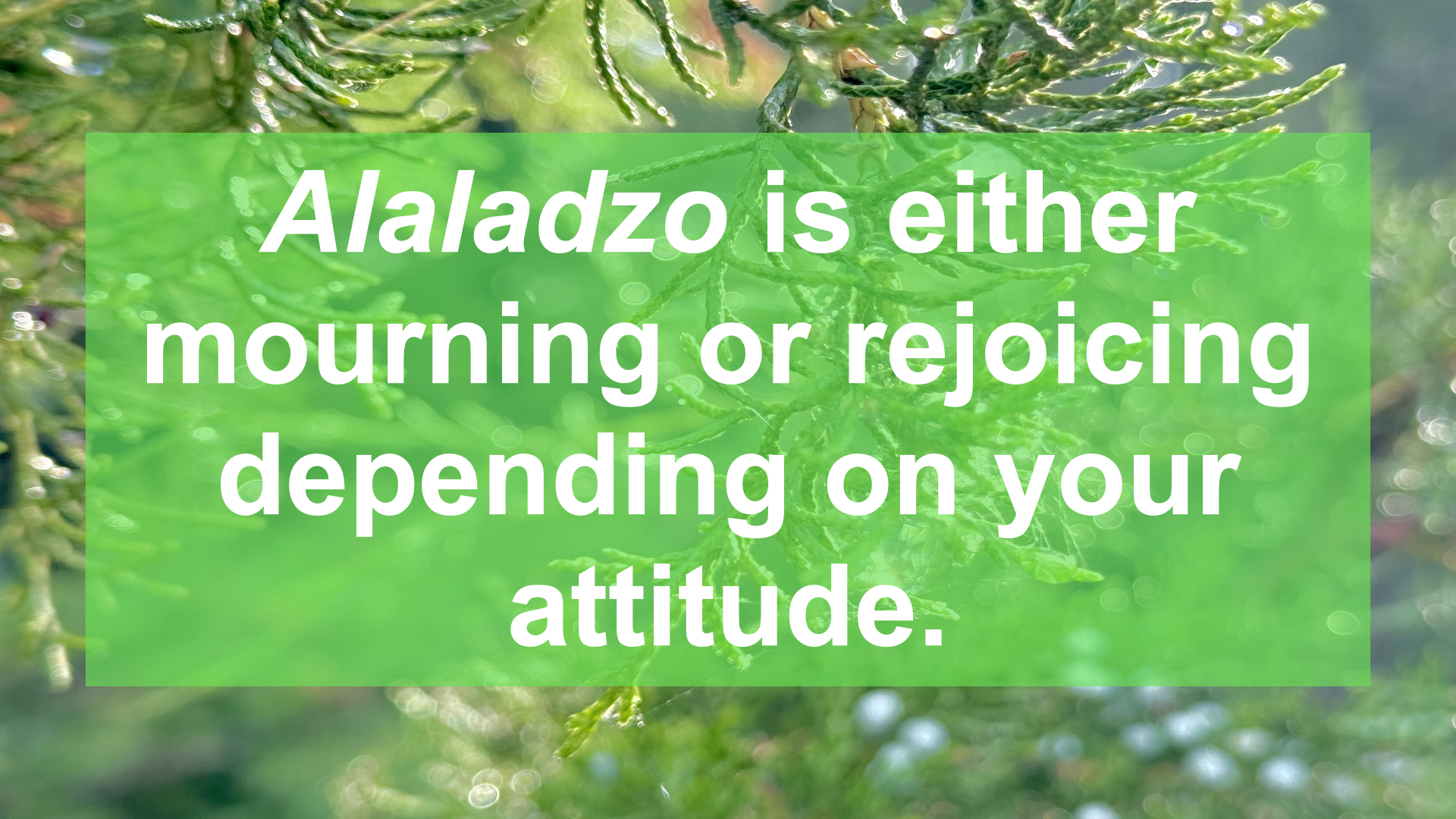
The Greek word for “wail” (alaladzo) has an interesting root word (alala) which means the cry of soldiers running to the battlefield. And then when those soldiers return victoriously, they have a total change in their attitude so alaladzo is now a joy-filled shout (Psalm 47:1; 66:1-3).
(1) Jairus had an attitude change.I believe became a Christ-follower in the truest sense of the word. Why do I think this? Because we know his name. There are four “synagogue rulers” described in the New Testament: three that become Christians we know by name (Crispus [Acts 18:8], Sosthenes [Acts 18:17], Jairus) and one who remains anonymous because he was bitter that Jesus healed someone on a Sabbath (Luke 13:14).
(2) The scorning mourners who knew the girl was dead had an attitude change. They spread the laughter everywhere (Matthew 9:26).
(3) What about us? An encounter with Jesus changes us (Romans 12:2; 2 Corinthians 3:18). In order to “taste and see” how good God is, we must be people who are consistently prayerful and expectant of His wonder-working power. Let’s change our wailing into a battlecry, our mourning into praise, so that God can chance our tears into laughter!
A world steeped in bitterness needs to see the sweetness of our God—Come and see what God has done, His awesome deeds for mankind! (Psalm 66:5).
Keep up with all of the messages in this prayer series by clicking here.
Jesus showed us how to remain faithful as a shepherd even in the face of painful attacks. If you are a pastor—or if you love your pastor—please check out my books Shepherd Leadership and When Sheep Bite.
Every year I see the same unsubstantiated claims that the Christian celebration of Christmas is a hodgepodge of pagan and cultic myths cobble together and hijacked by Christians. Here are three myths refuted by archeological evidence.
Dr. Allen Tennison points out how Luke emphasizes the work of the Holy Spirit all throughout his Gospel, and then continues that theme as he moves into the Book of Acts.
“One of the first gospel blessings is that of complete justification. A sinner, though guilty in himself, no sooner believes in Jesus than all his sins are pardoned. The righteousness of Christ becomes his righteousness, and he is accepted in the Beloved.” —Charles Spurgeon
“For the apostle Paul, as, indeed, for all the apostles and early Christians, the Church is the Body of Christ, the continuing incarnation of the reigning and conquering King of Glory. The Church, according to the apostles, is the centerpiece of Christ’s historical agenda (Matthew 16:18). Whatever Christ intends to do on earth prior to His imminent return, the focal point of that work will be in and through His Church. … We do not have the mind of Christ if we are not thinking the same way about His Body, the Church. We need the Church, and if we do not think this is so, then we do not have the mind of Christ. We need the Church. But we need it according to the purpose with the guidance and blessing of the Lord Jesus Christ.” —T.M. Moore
What an amazing story of faithfulness! The faithfulness of God is seen in the loving actions of an unnamed Sunday School teacher and in a lifelong missionary.
Cold-case detective J. Warner Wallace contrasts blind belief and unreasonable belief with what he calls forensic faith. His conclusion: “A forensic faith gives you confidence in uncertainty, strength in adversity, and the ability to engage intellectually with both believers and skeptics. It transforms faith from mere hope into informed trust, and that makes all the difference in how you live out your beliefs in a world that’s constantly questioning them.”
“Depression is one of satan’s most dynamic weapons to divert you from God’s purpose for your life. If he can scatter a little dejection here and there in your thoughts—and even in your prayers—he can convince you to remove your breastplate of righteousness because it is too cumbersome and will go against your material and temporal interest. Do not give in that easily!” —William Gurnall, The Christian In Complete Armor
Listen to the podcast of this post by clicking on the player below, and you can also subscribe on Apple, Spotify, or Audible.
One of a leader’s most important jobs is guiding the vision of their organization. Much has been said about getting others to follow that vision, and in our most recent episode Greg and I talked about being careful to stay true to the vision you have set.
You can watch this full episode of The Craig and Greg Show here.
The first book in our Business by the Book series is on a CEO’s vision casting. This will be available soon. In the meantime, check out some other leadership resources from Greg and me:
In the sci-fi movie The Matrix, a character named Neo is fascinated by a young man who appears to be bending spoons simply by looking at them. Neo sits down on the floor across from this young man and takes a spoon in his hand. Although young, this boy gives sage counsel to Neo, “Don’t try to bend the spoon, for that is impossible. Instead remember that there is no spoon. That way you will see that it is not the spoon the bends, but you are the one who bends.”
Although this is a science fiction movie, there is a nugget of truth here for anyone who has ever been face-to-face with an impossible situation. The God who does the “impossible” has offered us the means to see His omnipotence at work—He has told us that we can bring our impossibles to Him in prayer.
Prayer changes things!
In God’s perfect will, sometimes the impossible become completed before our very eyes, and sometimes we see that it is not the situation that bends, but it is we who bend, becoming more godly, wise, and mature because of what God has imparted to us.
Heartfelt prayer is never a meaningless exercise. Without exception, something is changed with every single prayer we offer to God. I invite you to join me for this series of messages looking at what prayer changes.














 Craig T. Owens