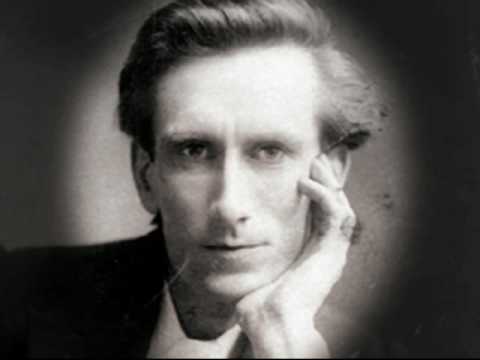
This is a weekly series with things I’m reading and pondering from Oswald Chambers. You can read the original seed thought here, or type “Thursdays With Oswald” in the search box to read more entries.
The Power Of Your “Say So”
Many of us are on the verge of a spiritual vision the realization of which never becomes ours because we will not open our mouths to “say so.” We have to “say so” before we “feel so.” … If I will not confess with my mouth what I believe in my heart, that particular phase of believing will never be mine actually. Assurance of faith is never gained by reserve but only by abandonment.
If you want to encourage your own life in spiritual things, talk about them. … If you have not received, ask; if you have not found, seek; if the door is shut, knock. When you are up against the barriers, the way out is to “say so,” then you will be emancipated, and your “say so” will not only be an emancipation for yourself, but someone else will enter into the light.
From The Place Of Help
Oswald Chambers is urging Christians to not just believe what they believe, but say what they believe. Say it out loud!
The tongue has the power of life… (Proverbs 18:21).
For the accuser of our brothers and sisters, who accuses them before our God day and night, has been hurled down. They triumphed over him by the blood of the Lamb and by the word of their testimony… (Revelation 12:10-11).
O give thanks to the Lord, for He is good; for His compassion and lovingkindness endure forever! Let the redeemed of the Lord say so… (Psalm 107:1-2).
You need to hear your “say so” in your own ears to energize your faith. The enemy needs to hear your “say so” to defeat him. Others in need around you need to hear your “say so” to encourage them.
Don’t keep quiet! “Assurance of faith is never gained by reserve but only by abandonment.” Abandon your reserve and “say so” for all to hear!
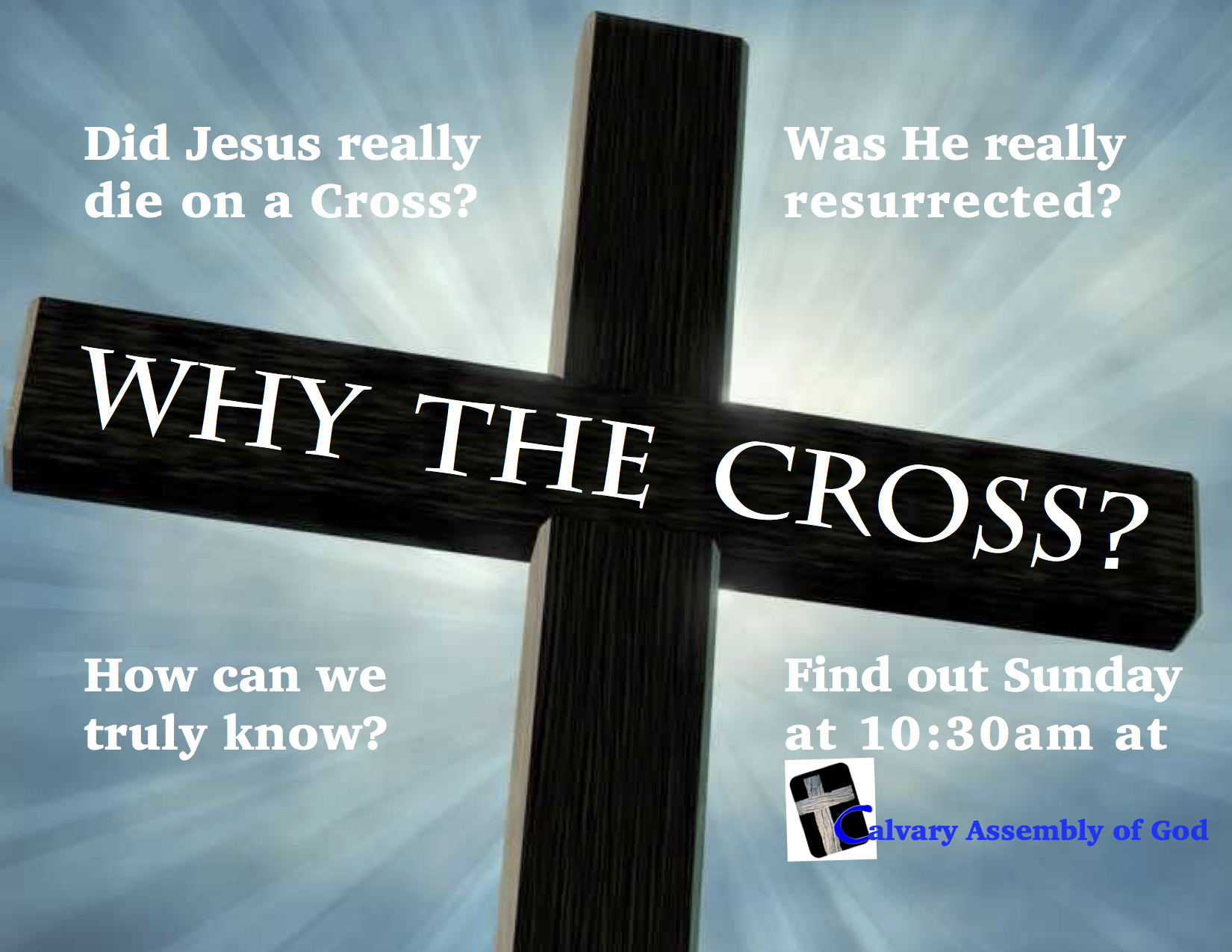
Crucifixion seems so extreme (click here to read The Horrors of Crucifixion)! Why would God allow His Son to go through this?
But perhaps we should back up a step or two. Before asking why the Cross maybe there are some other questions we should explore. Questions like…
These are questions we must all wrestle with, especially those who call themselves Christians. After all, Christian means a follower of Jesus Christ who believes that Jesus in fact died on a Cross and was raised back to life three days later.
Join me this Sunday was we explore the reliability of the evidence. Then on Easter Sunday morning we will consider the claims that Jesus died and came back to life, as well as the claims that this is all make-believe stuff.
You won’t want to miss this! Click here to find a map to our meeting place. If you cannot join us in person, we will be broadcasting live on Periscope (click here to find the account to follow to be notified when the broadcast begins).
“God paid a great price for you. So use your body to honor God [1 Corinthians 6:20]. You young men who come to London amidst its vices, shun everything that is akin to lewdness or leads on to unchasity, for your bodies were bought with your Lord’s lifeblood, and they are not yours to trifle with. Shun the strange woman, her company, her wine, her glances, her house, her songs, her resorts. Your bodies are not yours to injure by self-indulgence of any sort. Keep them pure and chaste for that heavenly Bridegroom who has bought them with His blood. And then your soul is bought too.
“I was obliged to mention the body, because it is mentioned here, and it is so needful it should be kept pure. But keep the soul pure. Christ has not bought these eyes that they should read novels calculated to lead me into vanity and vice, such as are published nowadays. Christ has not bought this brain of mine that I may revel in the perusal of works of blasphemy and filthiness. He has not given me a mind that I may drag it through the mire with the hope of washing it clean again.…
“Your whole manhood belongs to God if you are a Christian. Every faculty, every natural power, every talent, every possibility of your being, every capacity of your spirit.… It is all bought with blood. Therefore keep the whole for Jesus, for it belongs to Him.”
—Charles Spurgeon
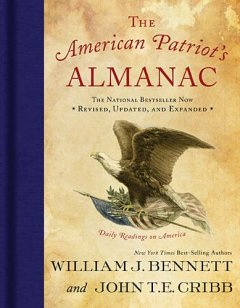
I feel so blessed to live in the United States of America! With the blessing of living in this great country comes the responsibility of knowing as much as I can about our country’s founding and guiding principles. A wonderful help on this journey of discovery is The American Patriot’s Almanac: Daily readings on America by William Bennett and John Cribb.
I am now on my second time through this book, and I’m still discovering how much there is to love about the USA. Each day Bennett and Cribb present a snapshot of a notable event in our nation’s history, that makes me so proud of our heritage all over again. There are cool stories about both the well-known and little-known folks who sacrificed and invested to make this country what it is.
At only a page a day, there’s no excuse for American patriots not to read this book through over the course of a year, and re-discover what a privilege it is to live in the land of the free and the home of the brave. We all owe it to our future generations to keep these memories alive, so that no one forgets our amazing heritage.
Last week I shared three types of Bible studies you could try to go a little deeper in your time studying Scripture. Today I’d like to share two more studies.
Remember that I’m a big proponent of reading systematically through the Scripture. I recommend that you begin reading in Matthew (the first book of the New Testament), and read all the way through the New Testament. Then return to Genesis, the first book of the Bible, and read straight through to the end of the Bible.
Here’s why? (1) Jesus said that all of Scripture pointed to Him, so in reading the NT first, you will get to know Jesus through His own life, and then through the lives of His first followers. (2) Then when you are reading anything in the OT that is confusing, you can ask yourself, “How does this point to Jesus? What do I learn about man’s fallen state? How do I see the need for a Savior?”
As you reading systematically through the New and Old Testaments, here are two Bible studies for you to try.
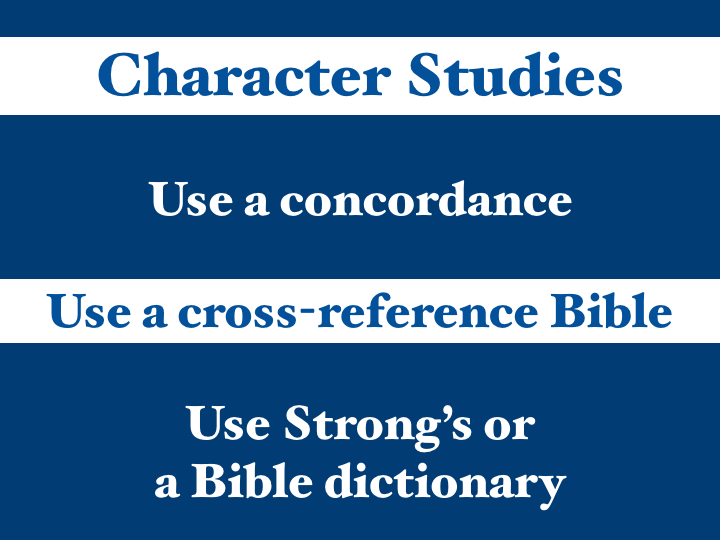
Character Studies
When you come across someone’s name in your systematic reading, use a concordance to find all the other places they may be mentioned. You may also want to look up their name in a Bible dictionary, or Strong’s Concordance to find out about their ancestors or meaning of their name.
As an example, let’s look at King David. He first shows up in Ruth 4:17 in a brief genealogy. Then beginning in 1 Samuel 16, we read page after page of his entire life.
Using a concordance, you would also spot some of the Psalms that were written by David, and you would see how David’s life and words were used in the New Testament setting. For instance, in Matthew 1:1 you would see another genealogy that traces Jesus Christ through King David’s family line.
Another example is a man named Barnabas. He first shows up in Acts 4:36. But unlike David, we don’t read consecutive pages about Barnabas. Instead, he sort of pops into the narrative of the early church as recorded in the book of Acts (Acts 9:27; 11:22-26; 12:25-13:3; 15:37-39).
In the Acts 15 passage, we see that Mark’s behavior was a point of serious disagreement between Barnabas and Paul. As a result, they went on separate missionary journeys, and we don’t read anything explicitly written about Barnabas. But continuing to use our concordance of the Bible, we find that Barnabas was still at work behind the scenes to reconcile Mark and Paul (see Colossians 4:10 and 2 Timothy 4:11).
Prophesy
The easiest way to see prophesy at work is noticing what OT passages are recorded in the NT. Here is where you might want to make use of a Bible with cross references in the margins. For example, in Matthew 1:22-23, you see the words, “All this took place to fulfill what the Lord has said through the prophet….” Looking at the verses in my reference Bible, I find mentioned Isaiah 7:14, where the prophesy of Christ’s virgin birth was foretold. Keep your eyes open for phrases like “to fulfill” or “it is written.”
When you are reading in the OT, you will come across certain passages that the Holy Spirit will use to remind you of something that sounds familiar from the NT. Here you would use your concordance or Bible software to search out NT references. Here’s a couple of exampled:
Check out this video to see how I describe these Bible studies in more detail.
You can also check out this video to watch how I described the three previous Bible studies. I hope you grow deeper in God by studying His Word more in-depth!
The Bible consistently gives us—right up front—the rewards for right living, and the consequences for wrong living. No one ever has to be surprised.
For example, take this message from Jesus in Luke 6.
God doesn’t miss a thing! He told us how to stay in the place where He can bless us, and how we can avoid life’s negative consequences.
We would all do well to hear these words and put them into practice (v. 47)!
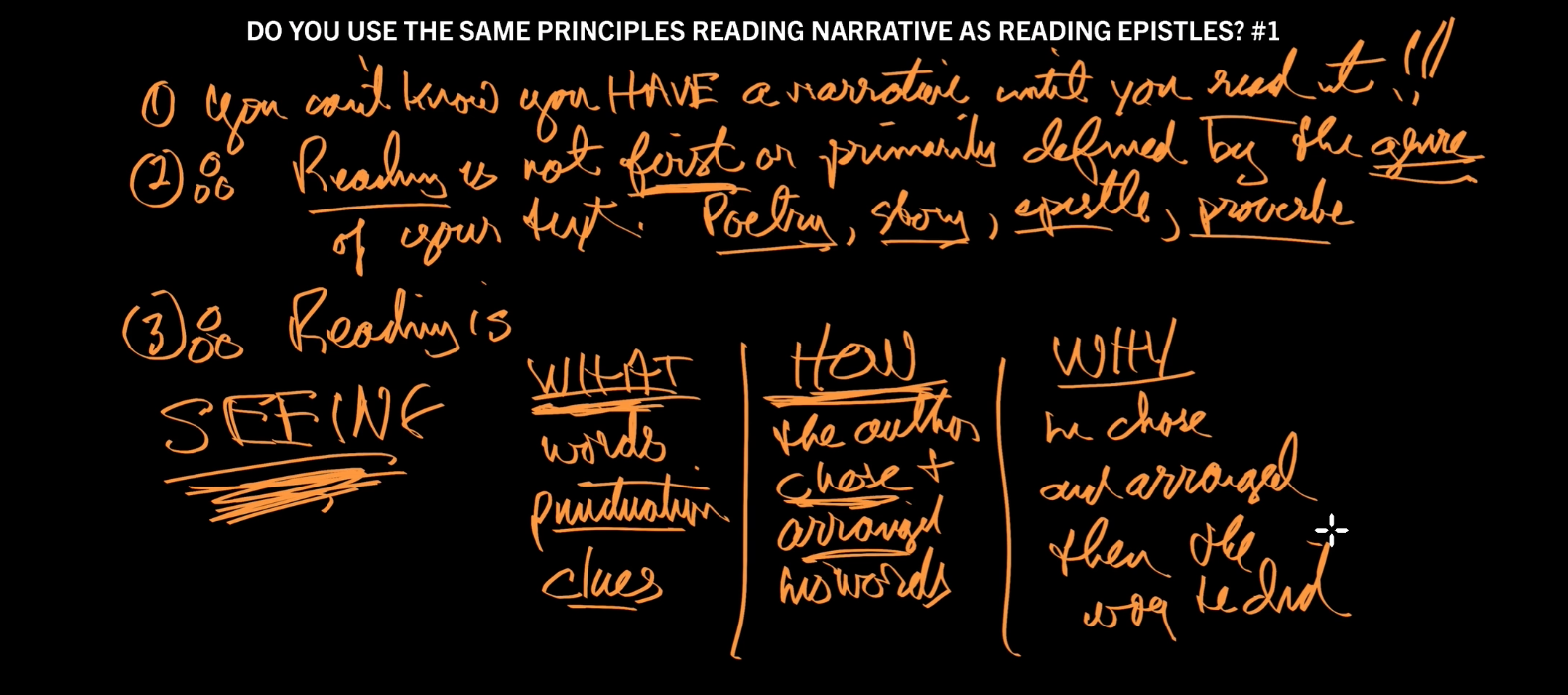
At Calvary Assembly of God, we have been going through a series on how to study our Bibles. I love this insight from John Piper on how to read Bible stories—
Pastor Bobby Conway from the One Minute Apologist has a great series of videos that give us an oversight of each book of the Bible. In this video, he talks about the different genres of Scripture (much like Piper did in the above video)—
“Are you expecting the Lord? Are you living in this expectation? Is it a deep-seated, abiding, cherished hope? Is it a hope that tells upon your character, your life, your daily actings in public or private, your opinions, your whole man? Does it quicken you? Does it purify you? Does it keep you separate from the world? Does it keep you calm in the midst of earth’s most exciting events, or most untoward changes? Does it give you a new view of history as well as prophecy? …
“Let your expectation of the Lord’s coming be a calm and healthy one; not one that excites, but one that tranquilizes; not one that unfits for duty, but one that nerves you more firmly for it; not one that paralyzes exertion, but one that invigorates you for it; not one that makes you indifferent to present duty, but one that makes you doubly in earnest about everything that your hand findeth to do; not one that stops liberality, and prayer, and work, but one that increases all these a hundred fold; not one that dwells exclusively on the future’s dark side—the judgments that are at hand—but one that realizes the glory and the joy of Messiah’s approaching victory and triumphant reign.” —Horatius Bonar