“Our human minds cannot comprehend the immensity of [Christ’s] task and His sacrifice. We simply know that it was to save us, and that Jesus’ suffering is the most blessed influence the world has ever known.” —Dr. Henry Halley, Halley’s Study Bible
The Hill, though high, I covet to ascend, The Difficulty will not me offend; For I perceive the Way to life lies here. Come, pluck up Heart, let’s neither faint nor fear;
Better, though difficult, the Right Way to go,
Than wrong, though easy, where the End is Woe. —Christian in John Bunyan’s The Pilgrim’s Progress
“Nearly half the Law of God is devoted to directing God’s people in how to worship Him. And while the specific practices of that portion of God’s Law have been replaced (Hebrews 7:11-18), the emphasis on worship and the idea that worship and life are related remains. The more faithful we are in worshiping the Lord the more we will love our neighbors with the justice His Law prescribes.” —T.M. Moore
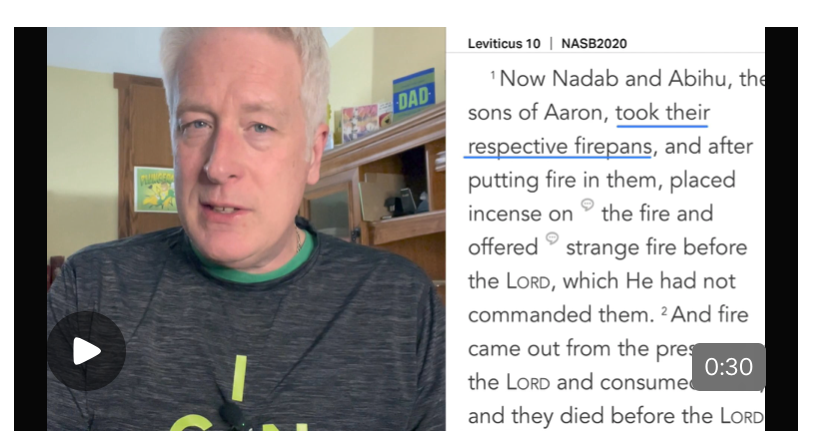
The deaths of Nadab and Abihu is a tragic story, but I think there are some important leadership insights to be gleaned from it. I shared an exclusive video with my Patreon supporters. Will you prayerfully consider joining?
Listen to the audio-only version of this podcast by clicking on the player below, or scroll down to watch the video.
Are you a person that likes to meticulously plan every detail, or are you more comfortable planning as you go? In this episode, Greg and I say leaders should strive for both! Join us as we discuss the art and science of balancing planning and spontaneity to hit the golden mean of the two.
[0:25] Most leaders haven’t thought through the balance between planning and spontaneity.
[1:46] This balance is usually more art than science.
[3:27] For some people, planning and spontaneity can be like trying to mix oil and water.
[5:43] Leaders need to work on flexibility in every situation.
[6:36] We need to know the temperament of our teammates so that we can keep everyone appropriately engaged.
[9:13] Regardless of whether you tend more toward planning or being spontaneous, you can supplement the others who are opposite of you.
[11:32] We can use the diversity on our teams to do amazing things for everyone.
[13:00] Debriefing with our teams after a spontaneous event can help prepare everyone for the next opportunity.
[13:45] Leaders need to learn how to read their teammates and the setting.
[16:08] Leaders need to earn trust with our teammates. One huge component in earning trusting is openness to input.
[18:05] Do we know what our teammates think of our leadership style? Are we willing to address this and make changes?
[22:00] Some important leadership takeaways.
Check out this episode and subscribe on YouTube so you can watch all of the upcoming episodes. You can also listen to our podcast on Spotify and Apple.
Listen to the podcast of this post by clicking on the player below, and you can also subscribe on Apple, Spotify, or Audible.
“Who gave You this authority,” the chief priests twice demanded of Jesus in Luke 20:1-8.
Worldly minded people are always looking for a résumé of accomplishments or the stamp of approval from a superior, so they can demand the unquestioned loyalty from those who report to them. In other words, they are looking for authority from their position that allows them to prove to others that they are in charge.
The “chief priests and the teachers of the law, together with the elders” (v. 1) had earned their positions, or so they thought. They are, therefore, asking Jesus to, “Prove it!” They want to know why Jesus gets to say and do the things He says and does.
Jesus had every right to flex on them! But He knew that His words and deeds spoke for themselves. He “knew that the Father had put all things under His power” (John 13:3) so there was nothing for Him to prove to anyone.
In my book When Sheep Bite, I have a chapter about sheep questioning the authority of their shepherd. In that chapter I wrote—
When our conversation with criticizing sheep hasn’t gone well, and when those unhealthy sheep begin to gossip and then slander, it’s inevitable that they will eventually began to question your authority as a shepherd. Perhaps they think you’re too young and naive, or too old and out of touch. They may question your motives, or the vision you’ve imparted for the church, or your ability to follow through on what you have already shared. Whatever the case, these biting sheep seem to be implying that they know better than you do how this pasture should be run. During times like these, it is tempting to want to “prove” that we are qualified, that we do know what we’re doing, and that we can indeed successfully pursue the vision we’ve articulated for them. Once again, it’s natural to want to say, “I’ll show you just how qualified I am!”
Before we respond, we need to recognize the source of our authority. … Far greater than positional authority is moral authority. This is authority that comes not merely from a title or position, but from who conferred that title or position on the leader. If God has called us and appointed us to this pasture, that is all the authority we need.
Jesus didn’t answer the “Prove it!” demand, but went right on teaching and serving. We need to remember that there is only One to whom we must give an answer. There is only One who can say to us either, “Depart for Me,” or “Well done, good and faithful servant!”
A mark of a godly leader is one who is quietly confident of his moral authority.
As a result, that leader no longer feels the need to prove anything.
This is part 78 in my series on godly leadership. You can check out all of my posts in this series by clicking here.
Listen to the podcast of this post by clicking on the player below, and you can also subscribe on Apple, Spotify, or Audible.
I was reading the results of a survey which said one of the top traits for exemplary leaders was: They keep their word.
But don’t we really mean, “They keep their word most of the time”? After all, we do allow those who have a track record of integrity an “out” for unusual or unexpected circumstances. And we would still say that leader had honesty and integrity.
God always keeps His word. He never needs an “out” because nothing is ever unexpected for Him! He is always the Promise Maker and the Promise Fulfiller (Isaiah 42:9, 46:10, 55:10-11; Jeremiah 1:12).
I like the way Jesus sums up these statement from His Father: For assuredly, I say to you, till heaven and earth pass away, one jot or one tittle will by no means pass from the law till all is fulfilled (Matthew 5:18 NKJV).
Ajot is the smallest Hebrew letter (yodh). In Greek the word is iota. This tells us that God is concerned about the smallest of details.
A tittle is the precise difference between Hebrew letters like cheth and he, between daleth and resh, and between beth and kaph.
All of these are fulfilled—brought to their perfect completion (Luke 1:37, 22:37)!
When we see any of God’s promises made and kept, we need to ask ourselves three questions:
What did it mean then?
What does it mean now?
What does it mean for me today?
For example, look at the promise that was made about people living in a very dark place seeing the Light of God. The prophecy is first made in Isaiah 8:19-9:7 that the people of Zebulun and Naphtali would get to see and experience the light of the Messiah.
Matthew 4:11-17 tells us that after Jesus endured the temptation of the devil for 40 days, He went to Capernaum—the region of Zebulun and Naphtali. But before He arrived there, He was first rejected by the folks in His hometown of Nazareth (see Luke 4:14-31).
Our God who knows the end from the beginning never makes a mistake; nothing is ever random or inconsequential. We should develop the habit of praying, “Now that this is happened, what would You have me do?” As Jesus was rejected by the people who should have been so excited to see His ministry flourish, He wasn’t dismayed or discouraged, but He directed His steps toward Capernaum.
In my heart, I may plan a course for my life, but I must trust God to direct my steps. My life has a purpose. Just as the Holy Spirit directed the movements of Jesus, He is directing my steps.
Even when God seems to have directed my steps into a dark place, He has sent me there as His light. I am sent on purpose. I walk a path Jesus has already walked, and a path that He is still walking with me—He guides me in paths of righteousness for His name’s sake. Even though I walk through the valley of the shadow of death, I will fear no evil, for You are with me (Psalm 23:3-4).
I don’t walk into the darkness in my own strength or as a way to fulfill my own plans but instead I trust that “the zeal of the Lord Almighty will accomplish this” (Isaiah 9:7)!
Because Jesus is fulfilling every jot and every tittle, I can live confidently in Him!
If you would like to follow along with all of the messages in this series called Jots and Tittles, you can find them all here.
God’s blessings are not primarily for me, but they are through me for His glory. This is a short clip from an exclusive video I shared with my Patreon supporters. Become a supporter today! I have lots of new content every week, which you can check out on my YouTube channel.
“What to do with a mistake: recognize it, admit it, learn from it, forget it.” —Dean Smith
Until the mid-1800s, the historicity of King Sargon II (mentioned by Isaiah) was in doubt. Not only has archeology again affirmed the historical statements made in Scripture, but “the way Isaiah spelled Sargon’s name is an indicator that the prophet lived at the time of Sargon II, and that the book was not penned hundreds of years later.” Check out this archeological biography of Sargon II.
And then there is this archeological report about the destruction of Sodom and Gomorrah. Fascinating!
How sweet and gracious even in common speech,
Is that fine sense which men call Courtesy!
Wholesome as air and genial as the light,
Welcome in every clime as breath of flowers—
It transmutes aliens into trusting friends,
And gives its owner passport round the globe. —James T. Fields
“A person always doing his or her best becomes a natural leader, just by example.” —Joe DiMaggio
Not using the spiritual gift God has given you is selfish. He gave you these gifts on purpose so that His kingdom could be made more visible and desirable.
Listen to the podcast of this post by clicking on the player below, and you can also subscribe on Apple, Spotify, or Audible.
If God has given you influence as a leader, it is never to further your agenda but to help others grow. Leadership is about servanthood. If we try to make leadership about others serving us, we will quickly get ourselves in trouble.
Check out this full conversation Greg and I had on an episode of The Craig and Greg Show called “The responsibility of power.”
Listen to the podcast of this post by clicking on the player below, and you can also subscribe on Apple, Spotify, or Audible.
A large crowd surrounded Jesus. “He welcomed them and spoke to them about the kingdom of God, and healed those who needed healing. Late in the afternoon the Twelve came to Him and said, ‘Send the crowd away so they can go to the surrounding villages and countryside and find food and lodging, because we are in a remote place here.’ He replied, ‘You give them something to eat’” (Luke 9:11-13).
Why did the crowds seek out Jesus? They came to Him because they knew He had wisdom, healing, and food for them. As disciples of Jesus, we never know when people will be around us that are in need. In fact, the closer we walk with Jesus, the more needy people will begin to gravitate toward us.
Jesus never intends that we simply give them a verbal blessing like, “Go, be filled and be warm” (James 2:16).
Jesus wants us to give them something substantial.
This means we need to both prepare and stock up ahead of time (be proactive) and we need to be sensitive to the prompting of the Holy Spirit in each encounter we have with a needy person (be reactive).
Jesus also instructed us to have available both old and new treasures to share with people around us (Matthew 13:52). The old speaks to being proactive, and the new is reactive to each thing that we are learning and experiencing.
That means I also want to leave every person better than they were before we crossed paths.
In order to do this, I have to have something substantial—something eternally significant—to give to them. When needy people show up, it is too late for me to prepare.
I want to be always ready. That means I need to be always abiding with my Savior. I need to be learning at the feet of Jesus, filled with the power of the Holy Spirit, and saturated in the love of God, so that I always have something good to give.
Jesus, when you tell me, “Give them something to eat,” I want to give them You. Help me to proactively prepare so that I am ready to react in a way that glorifies You every single time.
As we get closer to the death and resurrection of Jesus, there are an increasing number of prophecies that are fulfilled in these events. Jesus appears to have been very attentive to making sure that each and every one of these prophecies were fulfilled to the smallest detail.
Near the beginning of His public ministry, Jesus noted that not one iota—or “one jot or tittle” in the Old English vocabulary—of any of God’s promises would be left unfulfilled (Matthew 5:18). It’s amazing that Jesus so carefully attended to all of these, but it’s also important to ask ourselves what these fulfilled prophecies mean to us today.
This is what we are going to be unpacking in our series Jots and Tittles. I hope you can join us, but if you have missed any of the messages in this series, you will be able to find them all right here—
Listen to the podcast of this post by clicking on the player below, and you can also subscribe on Apple, Spotify, or Audible.
Have you ever been going through a difficult time in your life and wondered to yourself, “What in the world is going on here?” I might have a different way for you to think about that!




 The deaths of Nadab and Abihu is a tragic story, but I think there are some important leadership insights to be gleaned from it. I shared an exclusive video with my Patreon supporters. Will you prayerfully consider joining?






 Craig T. Owens